Sony FE 24-105mm f/4 G OSS Review: The One-Lens Answer for Sony Shooters

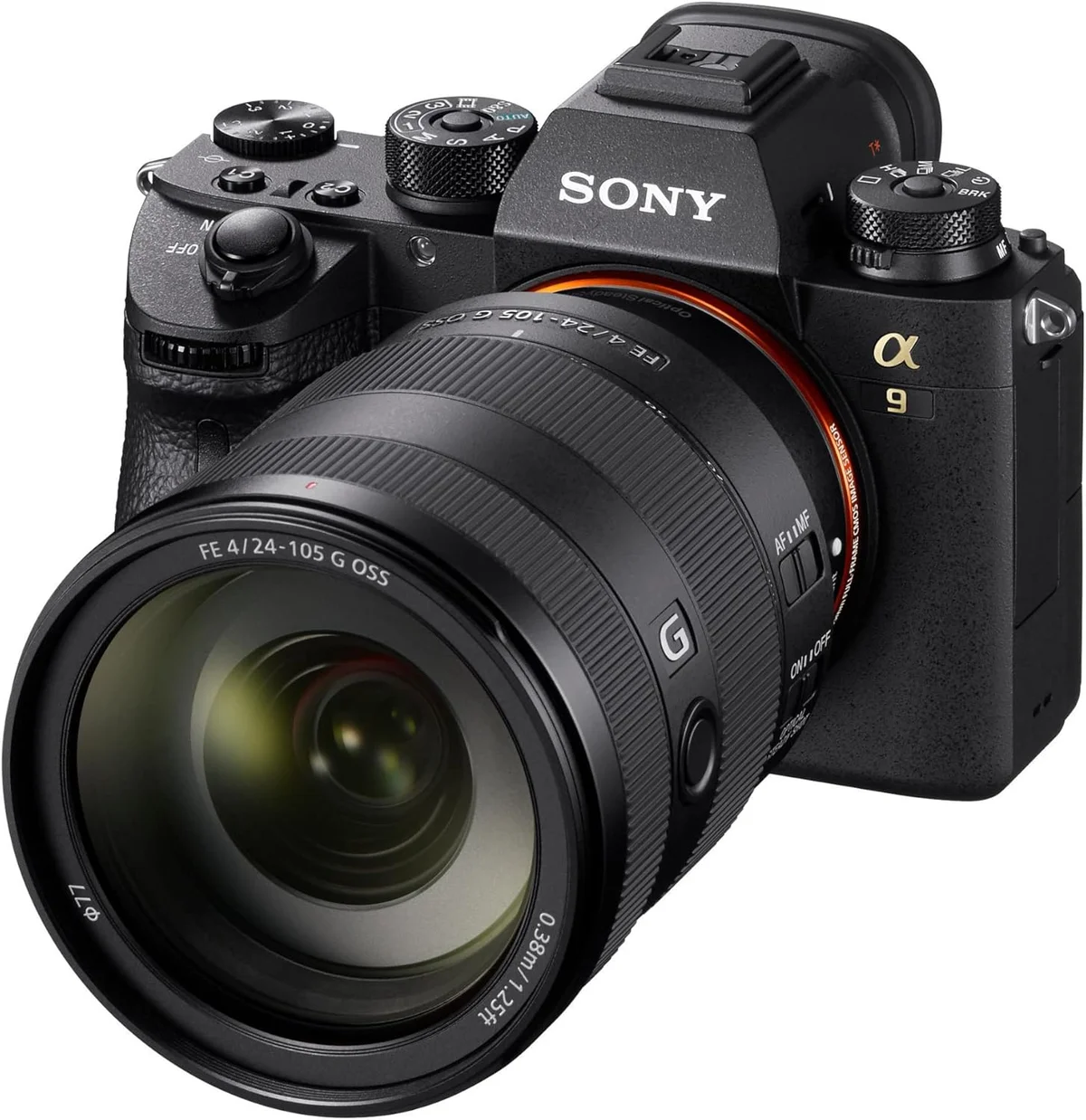
The Sony FE 24-105mm f/4 G is the one-lens solution for Sony shooters who travel or shoot events. The zoom range covers 90% of situations, and the OSS stabilization is a genuine advantage for video.
This review is based on analysis of published owner reports, expert reviews, and comparison with products in the Sony E-Mount Lenses category. We earn a commission if you buy through our links, but this doesn't affect our ratings. Read our full methodology →
One Lens, 90% of Situations
The Sony FE 24-105mm f/4 G OSS is the most practical single lens in the Sony E-mount system.
The 24-105mm range covers situations that force 24-70mm shooters to either change lenses or crop aggressively. Built-in OSS provides stabilization that the pricier GM II and Sigma Art II zooms lack entirely. The constant f/4 aperture is the honest limitation: it works in good light and with modern high-ISO sensors, but it cannot replicate the subject separation or dim-venue performance of f/2.8 glass. For travel, events in reasonable light, video with handheld stabilization, and any assignment where one lens must do everything, the 24-105mm f/4 G is the default recommendation. For the full Sony lens ecosystem, see our Sony E-mount roundup.
The Sony FE 24-105mm f/4 G is the one-lens solution for Sony shooters who travel or shoot events. The zoom range covers 90% of situations, and the OSS stabilization is a genuine advantage for video.
Best for: Travel and event photographers wanting one-lens coverage
Overview
Most photographers eventually ask the same question: can one lens cover an entire trip, an entire event, an entire day? The Sony FE 24-105mm f/4 G OSS is Sony's answer. The 24-105mm focal range handles architecture at the wide end, environmental portraits in the middle, and candid details at the telephoto end — without a single lens change. Built-in OSS stabilization adds handheld capability that the pricier Sony 24-70mm f/2.8 GM II cannot match on its own.
We read Amazon owner reviews and cross-referenced optical performance data from Dustin Abbott, Opticallimits, and Fstoppers. The consensus: the 24-105mm f/4 G delivers excellent center-frame sharpness, reliable autofocus, and a zoom range that eliminates the need for a second lens in most situations. The cost is physics — f/4 gathers half the light of f/2.8, which limits low-light performance and background separation. Reviewers who moved from the 24-70mm f/2.8 to the 24-105mm consistently note the extra reach as the deciding factor. Those who moved back cite the f/2.8 aperture's importance for indoor events and portraiture.
Sony positions this in the G-series — professional-grade optics and build quality, one tier below the G Master line. The construction uses dust and moisture resistant sealing throughout, with a rubber mount gasket and fluorine-coated front element. At 663g, it sits between the ultralight Tamron 28-75mm f/2.8 G2 (540g) and the heavier 24-70mm GM II (695g). The DDSSM (Direct Drive Super Sonic Motor) with linear motor assistance focuses quickly and quietly — two motors working in tandem for different focus group elements.


Key Specifications
OSS Stabilization: The Feature Its Competitors Lack
Neither the Sony 24-70mm f/2.8 GM II nor the Sigma 24-70mm f/2.8 Art II has built-in optical stabilization. Both rely entirely on body IBIS. The 24-105mm G's OSS works in conjunction with IBIS on compatible bodies (A7 IV, A7C II, A7R V) for a dual-IS system that provides roughly 5-6 effective stops of stabilization. At 105mm — where camera shake is most punishing — the difference between lens-only IBIS and dual IS is visible in handheld video and low-shutter-speed stills.
For video shooters, the OSS advantage compounds. Handheld walking shots at 50-105mm produce smoother footage than the same shots on an unstabilized zoom. The OSS corrects for the angular shake that IBIS handles less effectively at longer focal lengths. One videographer shooting corporate event coverage noted the 24-105mm eliminated the need for a gimbal at focal lengths below 85mm — the dual IS was smooth enough for B-roll and talking-head shots. Above 85mm, a gimbal still improves results, but the baseline handheld quality is usable for social media and web delivery.
DDSSM Autofocus: Fast Enough for Events, Quiet Enough for Ceremonies
Sony uses a dual-motor architecture in this lens — not the latest XD linear motors, but still fast and refined.
The DDSSM (Direct Drive Super Sonic Motor) paired with a linear motor drives two focus groups independently. The result is fast acquisition — not quite at the XD linear motor level of the GM II, but fast enough for event shooting at 10fps on an A7 IV. The motor is quiet. Not silent like the XD motors (a faint mechanical movement is audible in dead-silent recording environments), but quiet enough that built-in microphones on the FX3 and A7S III pick up no lens noise during normal recording.
Focus breathing is moderate. At 105mm, racking from close focus to infinity narrows the field of view — a common behavior in stills zooms that video purists notice. Sony's breathing compensation on newer bodies (A7 IV and later) reduces this, with the same resolution-cropping trade-off as on the GM II. For stills photographers, breathing is invisible. For video, enable breathing compensation for any shot where focus transition speed matters.
What Works and What Falls Short
The skeptic's case: f/4 is slow.
Indoor events without flash require ISO 3200-6400 to maintain usable shutter speeds. Background blur at f/4 is modest — clients expecting creamy bokeh portraits will be underwhelmed compared to what the Sony 85mm f/1.8 or Sigma 85mm f/1.4 Art delivers. Corner sharpness drops at 105mm f/4, which matters for architectural documentation and landscape work at the telephoto end. The lens also exhibits some focus breathing during video — less than budget zooms, more than dedicated cinema glass. And at 663g, it is not light by any absolute standard — just lighter than many f/2.8 alternatives.
The enthusiast's counter: the zoom range solves problems no f/2.8 zoom can.
A wedding ceremony at 24mm for the wide establishing shot, the ring exchange at 70mm, the couple walking up the aisle at 105mm — no lens change, no moment missed. Paired with an A7C II or A7 IV, the combined weight stays under 1.4kg with OSS smoothing every handheld shot. One reviewer described selling both a 24-70mm and 70-200mm after a month with the 24-105mm, finding the single lens covered 90% of his paid work. The G-series build quality — weather sealing, fluorine coating, solid zoom ring tension — matches lenses costing twice as much. For the working photographer who values range and reliability over maximum aperture, this lens does more than any other single optic in Sony's lineup.

Strengths & Limitations
Strengths
- Covers 24-105mm — eliminates lens changes for most situations
- Built-in OSS stabilization for handheld video
- Consistent sharpness across the zoom range
- G-series build quality with weather sealing
Limitations
- Heavier than APS-C alternatives at 663g
- f/4 limits low-light and bokeh compared to f/2.8 zooms
- Some focus breathing during video
- Not the sharpest at 105mm compared to dedicated telephotos
Performance
Optical Performance by Focal Length
At 24mm, center sharpness is outstanding from f/4 onward and corners are well-controlled — minimal softness even at the edges. Barrel distortion is present but corrected automatically by in-camera profiles and Lightroom. At 35mm and 50mm, the lens hits its optical sweet spot: corner-to-corner sharpness at f/5.6 is excellent, and f/4 performance is strong enough for professional use without stopping down. Chromatic aberration is well-controlled through the mid-range thanks to the three ED glass elements.
The 70-105mm range is where optical compromises appear. Center sharpness remains strong through 105mm, but corner resolution softens at f/4. Stopping down to f/5.6 recovers most of the corner performance, and f/8 brings the corners close to the center. For portraiture at 85-105mm, corner softness is irrelevant (subjects are centered or the background is out of focus). For landscape shots at 105mm where edge-to-edge sharpness matters, plan on f/8 for best results.
Flare Resistance and Color Rendering
Sony's coating technology on the 24-105mm G is one generation behind the Nano AR Coating II found on the GM II.
In practice, flare is well-controlled for a zoom of this range. Shooting into backlit scenes produces minor veiling flare at extreme angles, but ghosting artifacts are rare. One reviewer shooting sunset timelapse sequences noted the 24-105mm held contrast better than the Tamron 28-75mm G1 under identical conditions. Color rendering leans neutral-warm — skin tones are accurate without the oversaturation some third-party alternatives introduce. Reds and oranges separate cleanly, which matters for event photographers shooting in venues with mixed tungsten and LED lighting.
Minimum Focus Distance: Closer Than You Expect
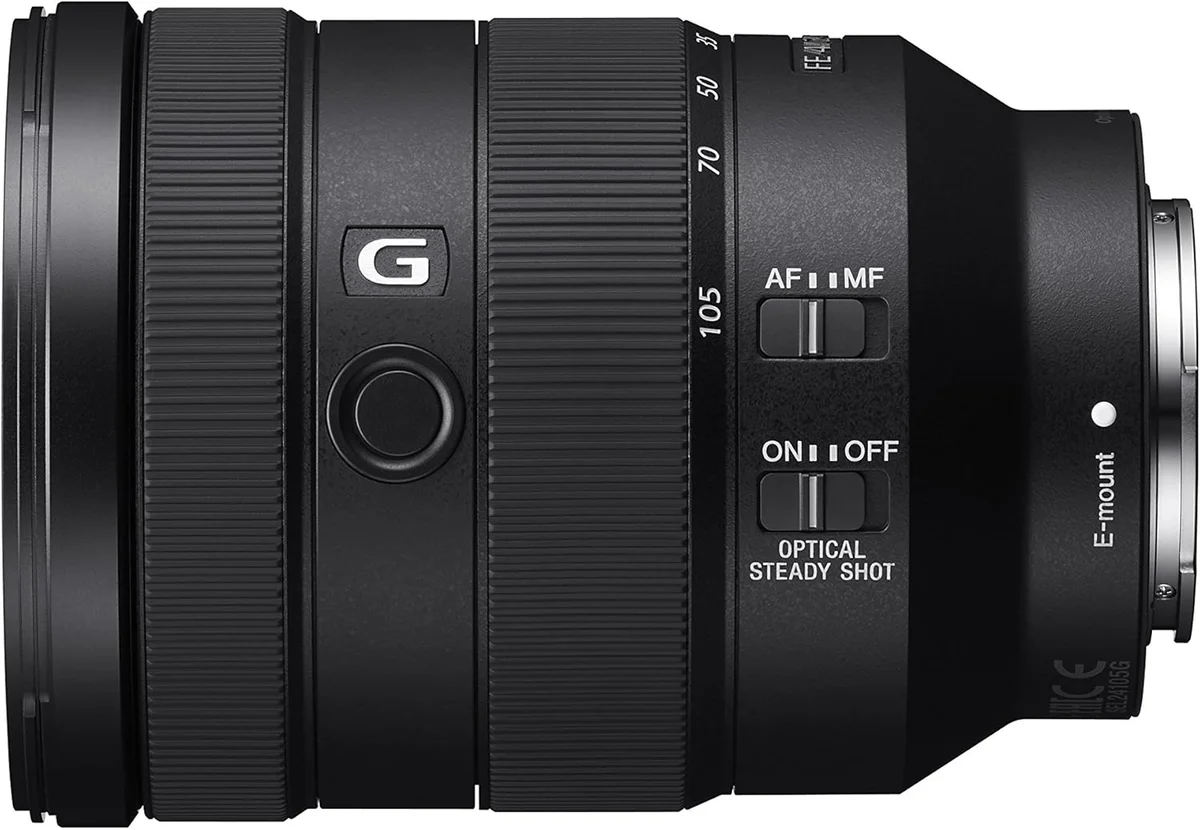
The minimum focus distance of 0.38m (roughly 15 inches) at the wide end enables close-up work that dedicated macro lenses handle better but that most zoom lenses cannot approach. At 0.38m and 24mm, magnification reaches approximately 0.31x — enough for product shots, food photography flats, and detail captures of textures and small objects. This close-focus capability converts the 24-105mm from a pure working zoom into a surprisingly capable close-up tool for commercial shooters who need quick detail shots between wider compositions.
At the telephoto end, minimum focus distance extends to roughly 0.45m with lower magnification.
The practical application is restaurant and event photography: shoot the room at 24mm, zoom to 105mm and lean in for a plate detail or table arrangement without switching to a macro lens. Multiple reviewers cite this wide-to-tele-plus-closeup range as a reason they leave the 24-105mm mounted as their default lens. Real estate photographers benefit too — wide establishing shots of rooms at 24mm, then detail crops of fixtures and finishes at 105mm, all from the same lens without breaking shooting flow. The close-focus capability is not a replacement for true macro glass, but it covers the quick-detail-shot use case that would otherwise require a lens swap or cropping in post.
Value Analysis
Where the 24-105mm Fits in Your Kit
The natural use case is as a one-lens travel and event setup. Pair it with a Sony A7C II (515g) and the total system weighs 1,178g — a complete full-frame kit under 1.2kg that covers 24-105mm with stabilization. For travel photographers who refuse to carry multiple lenses, this combination eliminates the "what if I need more reach" question that 24-70mm users constantly face.
As part of a larger kit, the 24-105mm pairs well with a fast prime for low-light backup. The Sony FE 50mm f/1.8 at 186g adds an f/1.8 option for reception dancing and dark venues. The Sony FE 35mm f/1.8 provides a wider fast option for documentary and street work in dim conditions. Either prime weighs less than the stop of light you sacrifice by choosing f/4 over f/2.8 in a zoom.
Against the Tamron 28-200mm f/2.8-5.6, the decision is range versus quality. The Tamron covers nearly double the focal range and starts at f/2.8 at the wide end. The Sony is sharper at shared focal lengths, maintains f/4 constantly (the Tamron slows to f/5.6 by 200mm), and adds OSS. For image quality-conscious shooters who need reliable performance across the zoom range, the Sony wins. For travelers who prioritize one-lens flexibility above all else, the Tamron's range is difficult to argue against. Our travel lens guide breaks down this decision in full.
What to Expect Over Time
Years of Daily Use: What Holds Up
The Sony FE 24-105mm f/4 G has been in production since 2017, giving it one of the longest track records in Sony's current E-mount lineup. Multiple reviewers report using it as their primary lens for 3-5 years without mechanical issues. The zoom ring maintains its tension without loosening. The OSS system shows no degradation in stabilization effectiveness over time. The DDSSM autofocus motor remains fast and accurate after thousands of focus cycles.
Weather sealing has proven reliable across extended outdoor use. Reviewers shooting in light rain, coastal humidity, and dusty festival environments report no internal contamination or fogging. The fluorine coating on the front element continues to repel water and fingerprints after years of cleaning cycles. For a lens that lives mounted on the camera — exposed to everything the photographer encounters — the G-series durability holds up to the branding promise.
Sony has released firmware updates maintaining compatibility with newer bodies including the A9 III and A1 II. The lens receives ongoing support in Sony's compatibility matrix. No replacement has been announced, though rumors of a GM-tier 24-105mm f/4 occasionally surface. The current G version continues to be one of Sony's best-selling E-mount lenses, which typically extends its production life. Used market prices hold at 60-70% of retail — lower retention than G Master glass but strong for a G-series zoom.
One overlooked longevity factor: the 77mm filter thread. This is one of the most common professional filter sizes, shared with a wide range of Sony, Sigma, and Tamron lenses. A single set of 77mm filters — polarizer, variable ND, graduated ND — works across multiple lenses in a kit. Photographers who invest in high-quality 77mm filters find the 24-105mm integrates into their existing filter collection without additional adapters or step-up rings.
Sony 24-105mm f/4 G — Practical Questions
Answers based on Amazon owner reviews, optical test data from Dustin Abbott and Opticallimits, and long-term field reports for the Sony FE 24-105mm f/4 G OSS (SEL24105G).
Is the Sony 24-105mm f/4 G worth it over the 24-70mm f/2.8?
It depends on what you value more: reach or aperture. The 24-105mm gives you 35mm of extra telephoto range and built-in OSS stabilization — two advantages the 24-70mm f/2.8 GM II lacks. But you lose a full stop of light (f/4 vs f/2.8), which means less background blur and worse low-light performance. For travel, events in decent light, and video where stabilization matters, the 24-105mm is the more practical choice. For indoor events, portraits with subject separation, and low-light work, the 24-70mm f/2.8 wins. Many pros own both.
Does the Sony 24-105mm f/4 G have image stabilization?
Yes. The Sony FE 24-105mm f/4 G OSS has built-in Optical SteadyShot (OSS) stabilization, rated for approximately 3.5 stops of shake reduction. Combined with in-body stabilization (IBIS) on cameras like the A7 IV or A7C II, the dual-IS system provides roughly 5-6 effective stops. This is a genuine advantage over the Sony 24-70mm f/2.8 GM II and the Sigma 24-70mm f/2.8 Art II, neither of which has optical stabilization. For handheld video and low-light stills without a tripod, the OSS makes a visible difference.
How sharp is the Sony 24-105mm f/4 G?
Center sharpness is excellent across the entire zoom range — sharp enough to resolve fine detail on 61MP sensors at f/4 through f/8. Corner performance is strong from 24mm to 70mm but softens noticeably at 105mm, particularly at f/4. Stopping down to f/5.6 or f/8 at the telephoto end brings corners into line. For most real-world shooting — events, travel, video — the sharpness is more than adequate at every focal length. Pixel-peepers shooting test charts will find the 24-70mm f/2.8 GM II resolves more detail at the edges, but the 24-105mm costs considerably less and covers more range.
Can the Sony 24-105mm f/4 G be used for portraits?
Yes, particularly at 85-105mm where the mild telephoto compression flatters faces. At f/4 on a full-frame sensor, background blur is present but moderate — enough for environmental portraits with context, not enough for the creamy bokeh isolation that an 85mm f/1.4 or 70-200mm f/2.8 delivers. The 9-blade circular aperture produces pleasant out-of-focus rendering. For headshots that need strong subject separation, pair the 24-105mm with a fast prime. For event portraits, group shots, and editorial work where some background context is desirable, the 24-105mm at f/4 and 85-105mm is a capable working lens.
Sony 24-105mm f/4 G vs Tamron 28-200mm — which is better for travel?
The Tamron 28-200mm covers almost twice the focal range (28-200mm vs 24-105mm) in a lighter package (575g vs 663g). The Sony starts 4mm wider at 24mm — useful for architecture and interiors — and maintains f/4 constantly instead of slowing to f/5.6 at 200mm. Image quality favors the Sony, especially at shared focal lengths: sharper corners, better contrast, and less distortion. The Tamron wins on range and weight. For a single-lens travel setup where focal length flexibility matters most, take the Tamron. For better image quality and stabilization in a slightly heavier package, take the Sony.