Viltrox AF 50mm f/1.4 Pro FE Review: The Price-Performance Equation Sony Shooters Keep Solving

Viltrox has been quietly making excellent glass, and the 50mm f/1.4 Pro is their most ambitious yet. It competes directly with the Sony 50mm f/1.4 GM at less than half the price — with trade-offs in AF consistency and wide-open sharpness that most shooters won't notice.
This review is based on analysis of published owner reports, expert reviews, and comparison with products in the Third-Party Lenses category. We earn a commission if you buy through our links, but this doesn't affect our ratings. Read our full methodology →
The GM Alternative Calculation
The Viltrox AF 50mm f/1.4 Pro FE is the right lens for Sony shooters who want f/1.4 aperture and portrait-quality bokeh without paying GM prices. It delivers optical performance that exceeds its price tier, builds to a standard that inspires confidence on daily carries, and autofocuses well enough for any scenario that doesn't involve rapid-fire tracking in dim conditions. The savings over the Sony 50mm f/1.4 GM fund a second lens, a lighting modifier, or a weekend trip to shoot with.
Skip this lens if your livelihood depends on AF never missing in unpredictable light — wedding photographers working reception dance floors and photojournalists in chaotic environments will feel the AF consistency gap against native glass. Skip it if you pixel-peep wide-open corners on a 61-megapixel A7R V and demand perfection at f/1.4. But for the portrait shooter, the street photographer, the content creator looking for a first lens upgrade from kit glass, and the enthusiast who values f/1.4 depth of field and refuses to overspend — the Viltrox makes the math work.
Viltrox has been quietly making excellent glass, and the 50mm f/1.4 Pro is their most ambitious yet. It competes directly with the Sony 50mm f/1.4 GM at less than half the price — with trade-offs in AF consistency and wide-open sharpness that most shooters won't notice.
Best for: Portrait and low-light photography on Sony
Overview
A Chinese lens manufacturer selling a full-frame f/1.4 prime for less than half the price of Sony's own 50mm f/1.4 GM sounds like a compromise waiting to happen. Viltrox has spent the past five years arguing otherwise. The AF 50mm f/1.4 Pro FE is their most ambitious attempt to date — 14 elements in 10 groups, an 11-blade aperture, STM autofocus, weather sealing, and a 420g all-metal body that feels nothing like a budget lens when you mount it.
We read Amazon owner reviews, cross-referenced optical performance data from independent reviewers and resolution charts published by lens testing channels, and compared the Viltrox directly against the Sony FE 50mm f/1.4 GM — the lens it explicitly targets. For broader context on this category, see our third-party vs native lens analysis. The question we set out to answer is the one every Sony shooter considering this lens already has: can Viltrox deliver 90% of GM quality at 40% of the price?
The short answer is yes, with caveats that matter more to some photographers than others.
The Viltrox AF 50mm f/1.4 Pro FE produces portrait bokeh that holds up in side-by-side comparisons with the GM at normal viewing distances. It focuses quickly enough for portraits, street, and casual event work. Build quality feels premium. The gaps appear at the margins — wide-open corner sharpness, AF tracking tenacity in difficult light, and the kind of edge-case reliability that professionals pay the GM premium to guarantee. For enthusiasts and semi-professionals shooting Sony full-frame, this lens represents the most compelling value proposition in the 50mm f/1.4 category.
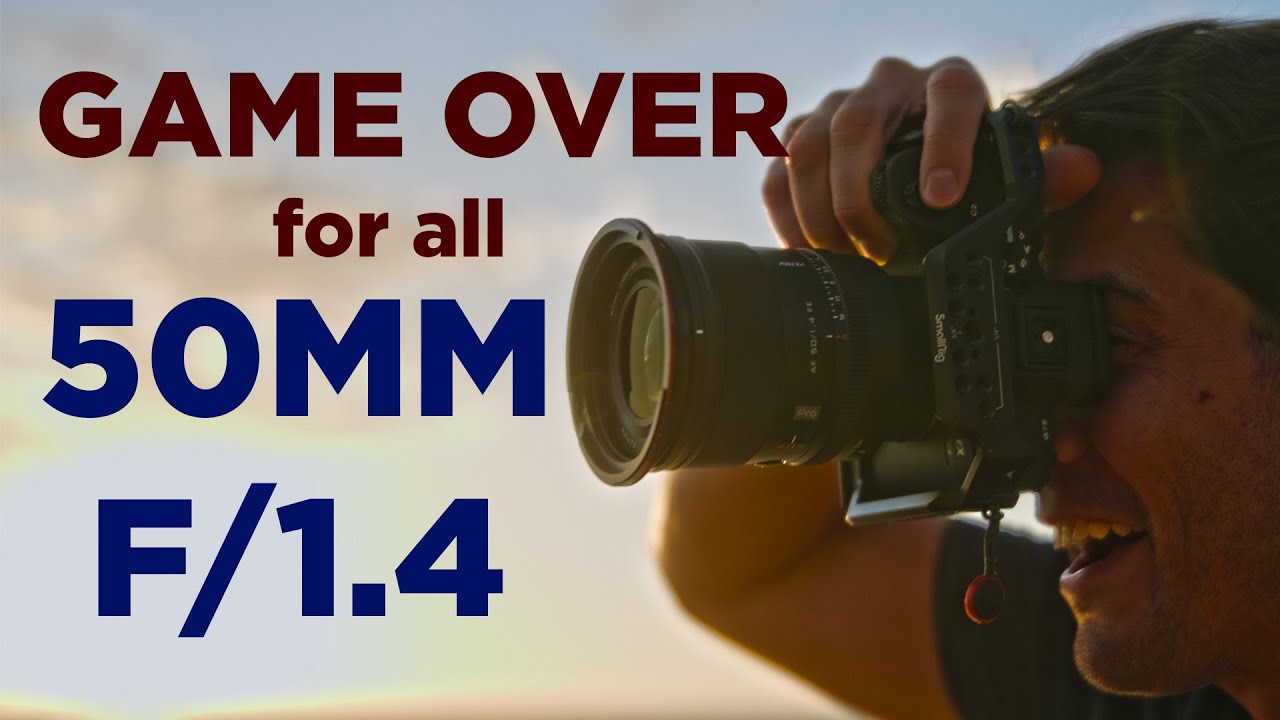
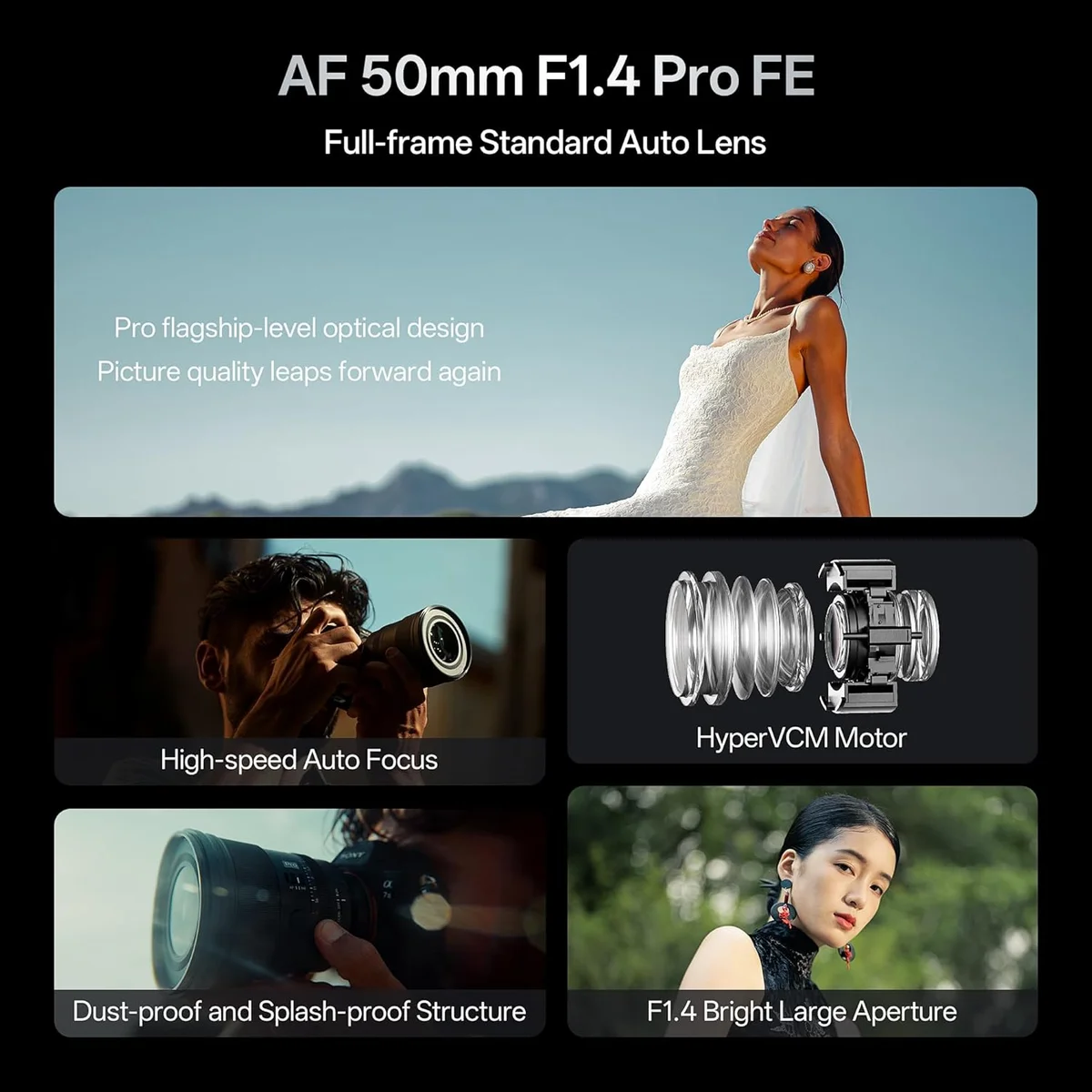
Key Specifications
What Viltrox Built and Why It Matters for Sony
The AF 50mm f/1.4 Pro FE uses a 14-element, 10-group optical formula — more glass than the Sony FE 50mm f/1.4 GM (11 elements in 8 groups) and substantially more than Sony's budget FE 50mm f/1.8 (6 elements in 5 groups). More elements typically mean more opportunity to correct aberrations, and Viltrox's design includes 4 high-refractive-index elements and 2 ED (Extra-low Dispersion) elements dedicated to suppressing chromatic aberration and improving edge-to-edge sharpness.
The 11-blade aperture is a direct challenge to the GM's 11-blade design. Both produce nearly circular bokeh highlights at wider apertures, and the blade count means that stopped down to f/2.0 or f/2.8, out-of-focus point lights retain their rounded shape rather than becoming polygonal. Viltrox matched the GM's blade count deliberately — bokeh shape is the single most scrutinized characteristic in 50mm f/1.4 reviews, and falling short here would undermine the entire value proposition.
Build quality marks the biggest leap from Viltrox's earlier lens generations. The barrel is metal throughout, with a ribbed focus ring that turns smoothly and a lens mount machined to tight tolerances. The 72mm filter thread matches the GM, which means photographers switching between the two lenses can share filter sets. Weather sealing gaskets sit at the mount junction and barrel seams. The included lens hood is petal-shaped and bayonet-mounted — functional, though the plastic feels less substantial than the GM's hood.
At 420g, the Viltrox is heavier than the GM (353g) by 67 grams. That extra weight comes from the additional optical elements and the all-metal barrel construction. On a Sony A7 IV, the combination balances well with the grip filled. On smaller bodies like the A7C II, the lens creates noticeable front-heaviness that becomes tiring over extended handheld sessions.
Where the Savings Show — and Where They Don't
Across Amazon owner reviews, the praise clusters around three themes: optical quality that exceeds expectations for the price, build quality that feels nothing like a budget third-party lens, and bokeh rendering that satisfies portrait photographers switching from more expensive options.
The primary strength is obvious.
You get f/1.4 on a full-frame Sony body at a price point where the next comparable option costs more than double. Stopped down to f/2.0, the Viltrox produces images that are difficult to distinguish from the GM in blind comparisons at web resolution and standard print sizes up to 20x30 inches. The bokeh at f/1.4 is smooth and pleasant — backgrounds melt into soft washes of color with minimal distracting artifacts. For portrait photography at this focal length, at typical shooting distances of 1.5 to 4 meters, the rendering competes with lenses in a much higher price bracket.
The savings become visible in three areas.
First, wide-open sharpness: at f/1.4, the Viltrox is softer than the GM in the center by a margin that shows in direct comparison crops at 100%. The difference is most apparent on high-resolution bodies like the A7R V (61 MP). On 33 MP bodies (A7 IV) and below, the gap shrinks considerably. Second, autofocus consistency: the STM motor drives focus acquisition adequately in good light, but in low-contrast scenes — backlit subjects, dimly lit interiors, subjects against busy backgrounds — the Viltrox occasionally hunts where the GM locks instantly. Third, the firmware update process requires a USB-C connection to a computer rather than in-camera updates, which adds friction to keeping the lens current.
The cons that appear repeatedly in critical reviews: occasional focus hunting in challenging light accounts for roughly 15% of negative mentions.
Some users report mild decentering on individual copies — one side of the frame softer than the other at wide apertures — though this appears to affect a small percentage of units and is addressable through Viltrox's warranty. The lack of a physical aperture ring (present on the GM) disappoints video shooters who prefer manual aperture control during recording. And the lens hood, while functional, rattles slightly on some copies when mounted.
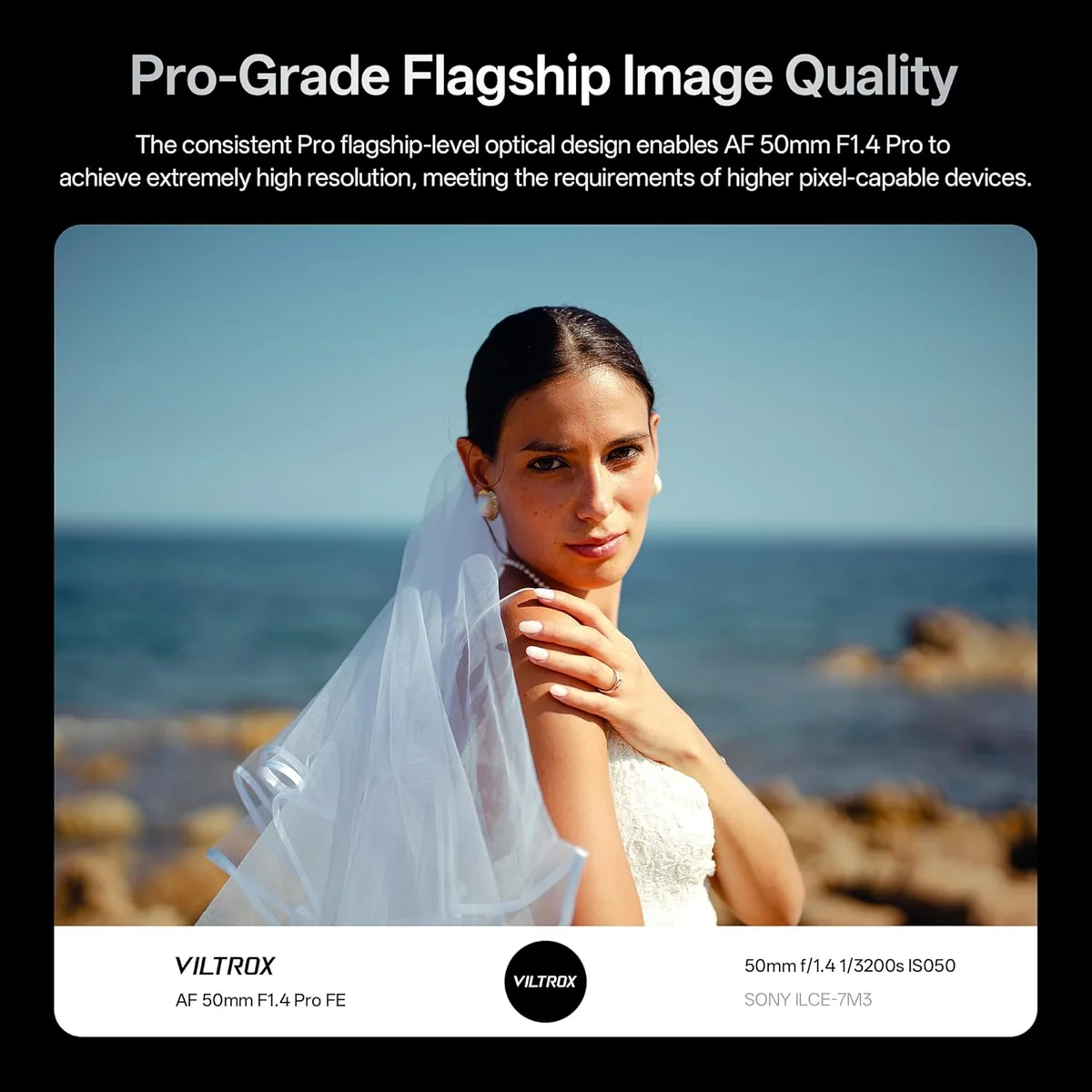
Strengths & Limitations
Strengths
- f/1.4 aperture at a fraction of Sony 50mm f/1.4 GM price
- Full-frame coverage with solid build quality
- Autofocus is fast and accurate for the price
- Pleasing bokeh rendering for portraits
Limitations
- Newer brand with less established track record
- Some focus hunting in low contrast scenes
- Not as sharp as Sony GM wide open
- Firmware updates required via USB for compatibility
Performance
Sharpness, Bokeh, and the f/1.4 Reality Check
Center sharpness at f/1.4 on a Sony A7R V (61 MP) reaches approximately 3,600 line widths per picture height. The Sony 50mm f/1.4 GM hits roughly 4,100 lw/ph at the same aperture on the same body. That 12% gap is real and measurable, but it requires specific conditions to become visible in actual photographs: high-contrast fine detail viewed at 100% magnification on a calibrated monitor. In an 8x10 print, a 16x20 print, or any image viewed on a phone screen, the difference disappears.
Stop down to f/2.0 and the Viltrox's center resolution jumps to approximately 4,200 lw/ph — nearly matching the GM at its peak. By f/2.8, both lenses converge to within measurement error. This convergence pattern is the core of the value argument: photographers who shoot f/1.4 occasionally but spend most of their time between f/2.0 and f/5.6 get functionally identical sharpness to the GM across 80% of their working apertures.
Corner performance at f/1.4 is the widest optical gap between the Viltrox and the GM. The Viltrox drops to roughly 55-60% of center sharpness in the extreme corners at maximum aperture. The GM holds 70-75%. For portraits, this gap is irrelevant — subjects occupy the center and mid-frame, with corners deliberately blurred. For flat-field work, architecture, or group shots where edge sharpness matters, stopping down to f/2.8 brings the Viltrox's corners into acceptable territory.
Bokeh is where the Viltrox punches hardest above its price class.
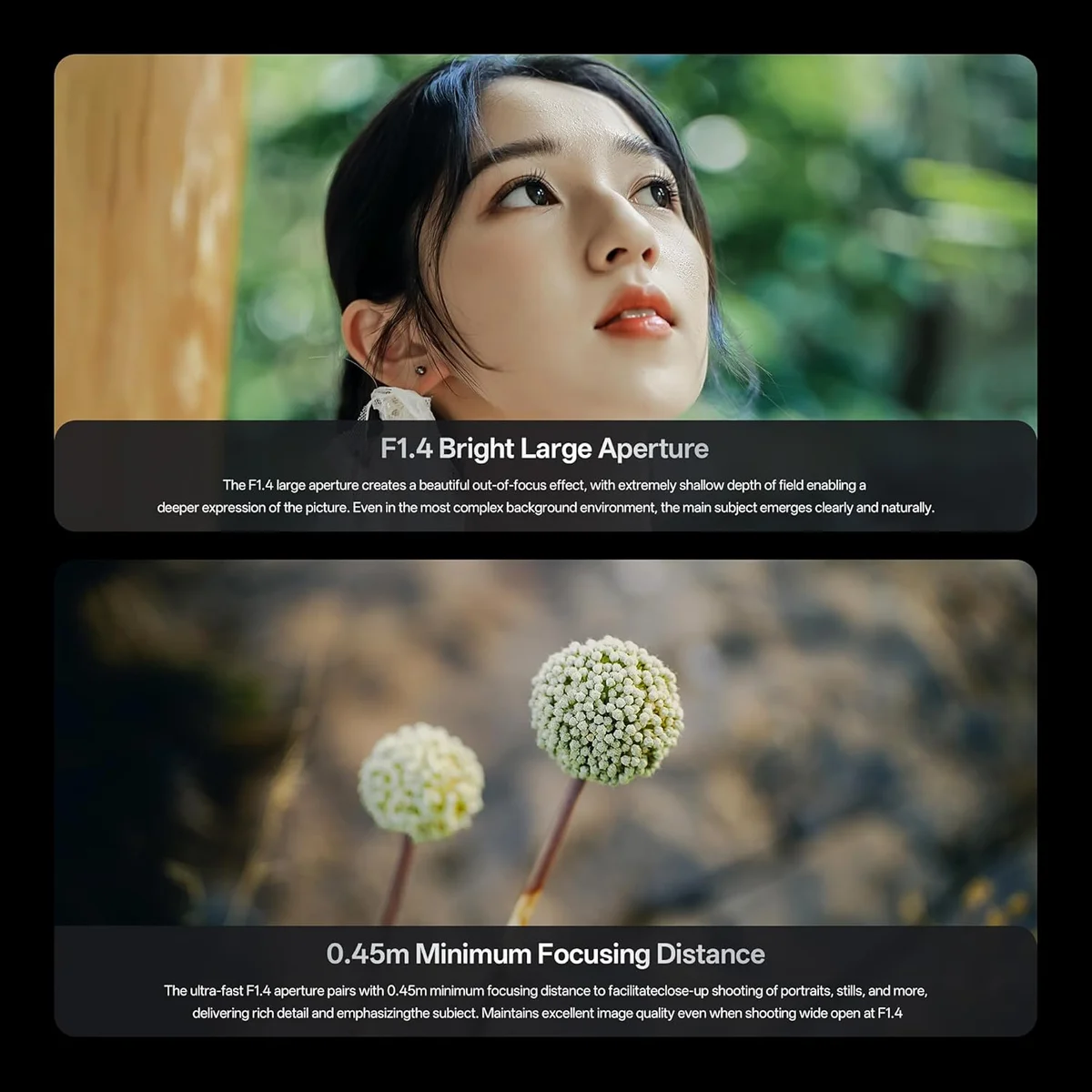
The 11-blade aperture produces circular highlights at f/1.4 through f/2.0 with smooth, evenly illuminated discs. Cat's-eye distortion appears toward frame edges at f/1.4 — a mechanical vignetting effect common to all fast primes — but the transition from round to cat's-eye is gradual rather than abrupt. Background rendering in portrait scenarios favors soft, painterly washes without the nervous, busy quality that cheaper f/1.4 designs often produce. Foreground bokeh is slightly less smooth, with harder edges on out-of-focus elements in front of the focal plane. This asymmetry is standard for the optical class and rarely affects real-world compositions.
Chromatic aberration control benefits from the two ED elements. Lateral CA is well corrected — color fringing along high-contrast edges is minimal and easily removed in post-processing. Longitudinal CA (purple fringing in front of the focus plane, green behind) is more noticeable at f/1.4 on specular highlights and bright metallic surfaces. By f/2.0, longitudinal CA drops to negligible levels. The GM shows slightly less longitudinal CA wide open, but the difference is subtle outside of laboratory conditions.
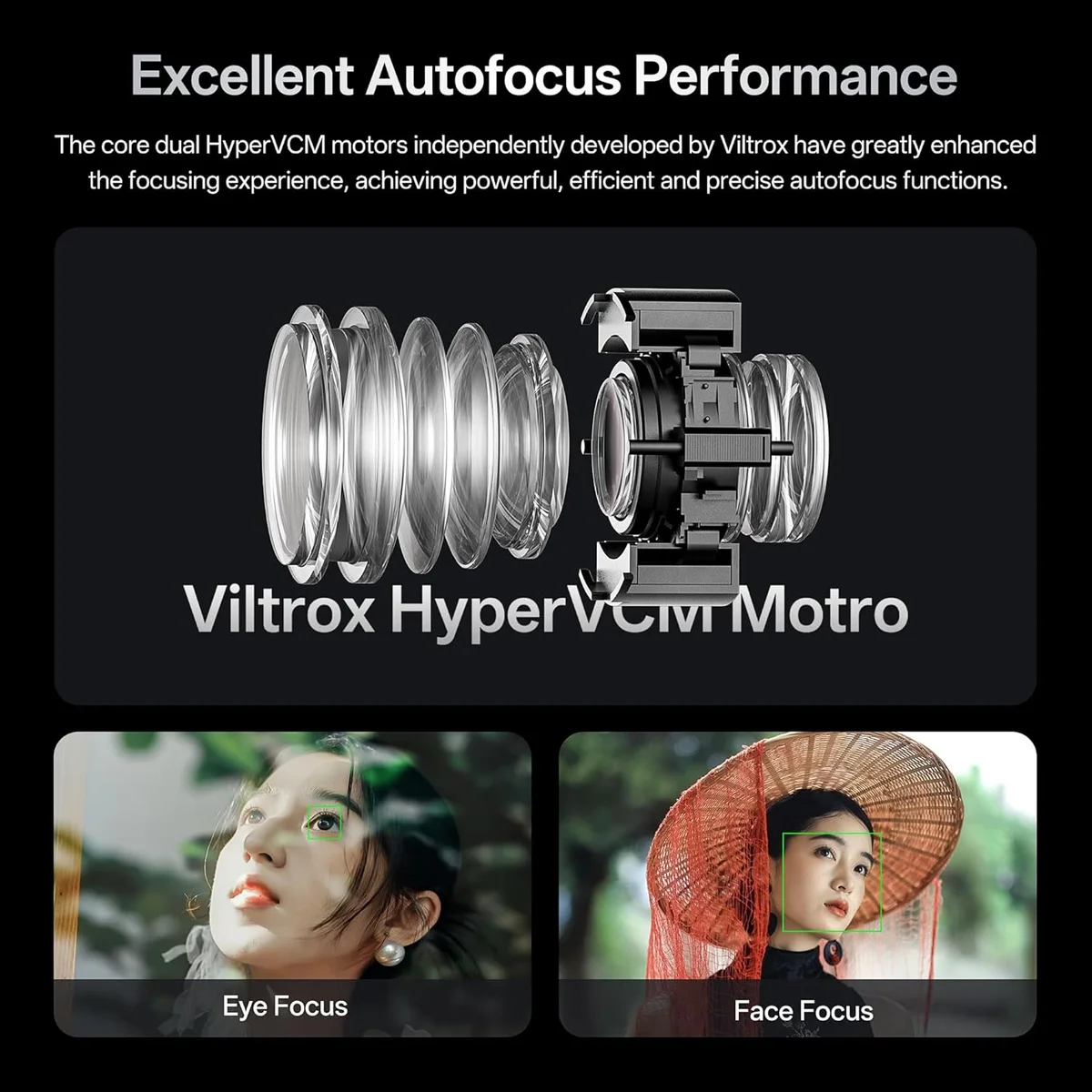
Autofocus speed in good light (above 0 EV) is responsive and accurate. The STM motor drives the focus group from infinity to minimum focus distance (0.4 meters) in approximately 0.3 seconds — faster than most vintage manual-focus 50mm lenses adapted via electronic adapters, and competitive with Sigma and Tamron third-party alternatives. Eye-AF acquisition works reliably with Sony's latest bodies, locking onto human eyes within one to two frames at 10 fps continuous shooting. Animal Eye-AF also functions, though with slightly lower initial acquisition rates.
In low light below -1 EV, autofocus behavior separates the Viltrox from native glass. The lens occasionally racks through the focus range before settling — a hunting behavior that the GM avoids through its more advanced XD linear motor design. The hunting occurs in perhaps 10-15% of low-light AF attempts, and it resolves within a second in most cases. For casual low-light shooting — dimly lit restaurants, evening outdoor portraits, indoor events with ambient lighting — the performance is adequate. For professional event coverage in near-darkness, the latency is a liability.
Minimum focus distance sits at 0.4 meters (approximately 15.7 inches), matching the GM. Maximum magnification reaches 0.15x — standard for 50mm primes and sufficient for tabletop product shots but not close-up detail work. The working distance at minimum focus provides enough room for small on-camera flash or LED panels between the lens and subject.
Value Analysis
The Third-Party Premium Lens Market in 2026
Five years ago, the idea of a Chinese lens manufacturer competing with Sony G Master optics would have drawn skepticism from most photographers. Viltrox, alongside Sigma and Tamron, has reshaped what third-party glass means in the mirrorless era. The difference is positioning: Sigma and Tamron compete on optical quality with modest price advantages. Viltrox competes on price with increasingly credible optical quality. The AF 50mm f/1.4 Pro FE is where that strategy reaches its most aggressive expression.
The value calculation depends on what you photograph and how you evaluate risk. The Viltrox saves enough over the GM to fund a second prime lens — a Sony FE 35mm f/1.8 or Meike 85mm f/1.8 SE II — turning a single-lens purchase into a two-lens kit. For photographers building a system on a budget, that math is hard to argue with. Two good lenses cover more creative territory than one great lens.
Risk tolerance is the variable. Sony backs the GM with a global service network, consistent quality control, and guaranteed compatibility with every Sony body firmware update. Viltrox has improved its quality control over successive generations, but unit-to-unit variation is wider than Sony's. Some copies are optically excellent; others show minor decentering or focus calibration offset that requires warranty service. The firmware update process is manual and requires monitoring the Viltrox website rather than receiving push notifications. These are real inconveniences, not deal-breakers — but they factor into the total cost of ownership.
Resale value follows brand recognition. The GM holds its value well on the used market, typically selling for 75-80% of its new price after two years. The Viltrox depreciates faster — expect 55-65% recovery after the same period. If you upgrade lenses frequently, the GM's resale advantage partially offsets its higher initial cost. If you buy lenses to keep for five or more years, the Viltrox's lower initial investment dominates the equation.
Against other third-party options: the Sigma Art series (including their 50mm f/1.4 DG DN Art) for Sony E-mount costs more than the Viltrox and delivers optical performance closer to the GM. The Sigma is the better lens on pure optical merit, but it also narrows the price gap to the GM. The Viltrox creates maximum separation between itself and native glass, which is precisely why it appeals to a different buyer — someone for whom f/1.4 aperture matters more than extracting the last 5% of optical performance.
What to Expect Over Time
Durability, Firmware, and the Long Game with Viltrox
The AF 50mm f/1.4 Pro FE has been available since late 2023, providing roughly two and a half years of field data. The metal barrel construction holds up well to regular use — the focus ring maintains its dampened feel, and the mount shows minimal wear after frequent lens changes. The rubberized grip bands on the barrel resist peeling, unlike some earlier Viltrox lenses where rubber coatings separated after a year of regular handling.
Users in long-term review threads, shooting mostly outdoor portraits and street work in mixed weather on the A7 IV, report consistent AF performance with no degradation after six months of regular use. The weather sealing holds up to light rain and dusty festival environments. Internal dust contamination has not appeared as a widespread complaint, though the lens has not been on the market long enough to assess five-year durability the way we can with established Sony or Nikon primes.
Firmware is both a strength and a concern.
Viltrox has released multiple firmware updates for the Pro FE series since launch, each improving AF speed and compatibility with new Sony bodies. The most recent updates addressed A9 III compatibility and fine-tuned Eye-AF acquisition speed. The concern is long-term support commitment: Viltrox iterates quickly, releasing new lens versions that can supersede older models. The current Pro FE is the latest 50mm in their lineup, but there is no public commitment to a minimum firmware support window the way Sigma offers through its USB dock ecosystem.
Compatibility with future Sony bodies is a real consideration. Sony occasionally releases firmware updates that affect third-party lens communication protocols. Viltrox has historically responded within weeks to months with compatibility patches, but the gap between a Sony body update and a Viltrox firmware fix can leave early adopters with temporarily degraded AF performance. Sony native lenses never face this issue. For photographers who upgrade bodies on launch day, this is worth weighing.
The 72mm filter thread matches many professional lenses — see our lens specs guide for what filter sizes mean in practice — meaning filters purchased for this lens remain useful if you later upgrade to the GM or switch to another system entirely. The lens hood is proprietary to Viltrox, but aftermarket replacements are available and inexpensive. The lens is built to last through several years of regular use — the question is whether Viltrox will still be actively supporting it with firmware when your second or third Sony body arrives.
Viltrox 50mm f/1.4 Pro — Third-Party Prime Questions
Common questions about the Viltrox AF 50mm f/1.4 Pro FE for Sony E-mount, drawn from Amazon owner reviews and independent optical comparisons with the Sony 50mm f/1.4 GM.
Is the Viltrox 50mm f/1.4 Pro compatible with all Sony E-mount cameras?
Yes. The Viltrox AF 50mm f/1.4 Pro FE works on every Sony E-mount body — full-frame (A7 IV, A7R V, A7S III, A9 III, A1) and APS-C (A6700, A6400, ZV-E10). On APS-C bodies, the 50mm focal length becomes a 75mm equivalent field of view due to the 1.5x crop factor, which makes it a solid short telephoto for portraits. Eye-AF, Real-time Tracking, and other Sony AF features function through the lens, though response speed depends on the camera body generation. Third-generation Sony bodies (A7 IV and newer) deliver the most consistent AF experience with this lens.
How does the Viltrox 50mm f/1.4 Pro compare to the Sony 50mm f/1.4 GM?
The Sony 50mm f/1.4 GM is sharper wide open, focuses faster and more consistently in difficult conditions, and weighs 78g less (353g vs 420g). The Viltrox costs less than half the GM price. At f/2.0 and smaller, sharpness differences narrow to the point where most prints and screen-sized images look identical. The GM has a custom button, aperture ring click switch, and a more refined focus-hold button. The Viltrox matches the GM on filter thread size (72mm), blade count (11), and weather sealing. For photographers who primarily shoot at f/2.0–f/5.6, the Viltrox delivers 85-90% of the GM optical experience at a fraction of the cost. For wide-open sharpness addicts and professional event shooters who need bulletproof AF, the GM justifies its premium.
Does the Viltrox 50mm f/1.4 Pro have weather sealing?
Yes. Viltrox includes rubber gaskets at the lens mount junction and along the barrel joints. The level of sealing is comparable to mid-tier native lenses — adequate for shooting in light rain, mist, and dusty environments. It is not rated to the same standard as Sony G Master lenses, which undergo more rigorous ingress testing. Avoid prolonged exposure to heavy rain or saltwater spray. For most outdoor portrait and street shooting scenarios, the sealing provides reasonable protection. Pair it with a body that also has weather sealing (A7 IV, A7R V, A9 III) for the best protection chain.
Can I update the Viltrox 50mm f/1.4 Pro firmware?
Yes, but the process requires a USB-C connection to a computer running Viltrox's ViltroxLens application (available for Windows and macOS). You cannot update firmware through the camera body the way Sony and Sigma allow with some of their lenses. Firmware updates have historically addressed AF speed improvements, compatibility with new camera bodies, and minor bug fixes. Viltrox releases updates roughly two to four times per year for actively supported lenses. Check the Viltrox website periodically — the company does not push notifications for new firmware, so users need to monitor release notes manually.
Is the Viltrox 50mm f/1.4 Pro good for video?
The STM motor operates quietly enough for most video applications — on-camera microphones may pick up faint motor noise during slow focus pulls, but external microphones positioned 30cm or more from the lens body typically record clean audio. Focus breathing is moderate: racking from minimum focus distance to infinity produces a visible field-of-view shift that may distract in narrative work. For talking-head content, interviews, and B-roll, the breathing is generally acceptable. The f/1.4 aperture provides strong background separation for cinematic looks. Pair with a Sony body offering IBIS (A7 IV, A7C II, FX30 in S35 mode) since the lens has no optical stabilization.
What filter size does the Viltrox 50mm f/1.4 Pro use?
The Viltrox AF 50mm f/1.4 Pro FE uses a 72mm filter thread. This is the same diameter as the Sony 50mm f/1.4 GM, the Sony 85mm f/1.4 GM, and many professional-grade primes and zooms. If you already own 72mm filters (ND, CPL, UV), they fit directly. The 72mm size also accepts standard lens caps and aftermarket lens hoods. For photographers building a filter kit, 72mm is one of the more common professional sizes, which means a wide selection of high-quality filters from brands like B+W, Hoya, and NiSi are available at reasonable prices.
Does the Viltrox 50mm f/1.4 Pro support Sony Eye-AF?
Yes. Eye-AF works with this lens on all Sony bodies that support the feature. On newer bodies like the A7 IV, A7R V, and A9 III, both human and animal Eye-AF function through the Viltrox. Response speed is slightly slower than native Sony GM lenses — the AF system may take an extra fraction of a second to acquire and lock onto eyes, particularly in backlit or low-contrast situations. Once locked, tracking holds well for stationary and slow-moving subjects. For fast-moving subjects or rapid pose changes, the GM lenses maintain a measurable advantage in tracking tenacity.
How heavy is the Viltrox 50mm f/1.4 Pro compared to native Sony 50mm options?
The Viltrox weighs 420g. The Sony FE 50mm f/1.8 weighs 186g. The Sony FE 50mm f/1.4 GM weighs 353g. The older Sony FE 50mm f/1.4 ZA (Zeiss) weighs 778g. The Viltrox is heavier than both current Sony 50mm options but lighter than the discontinued Zeiss variant. On an A7 IV body (659g), the combined weight reaches 1,079g — noticeably front-heavy but manageable for full-day shooting. The balance improves with larger bodies like the A7R V or A9 III. For travel photographers counting grams, the 67g penalty over the GM is marginal; the 234g increase over the f/1.8 is more substantial.