Sony FE 85mm f/1.8 Review: The Portrait Lens That Makes Eye AF Feel Like Cheating
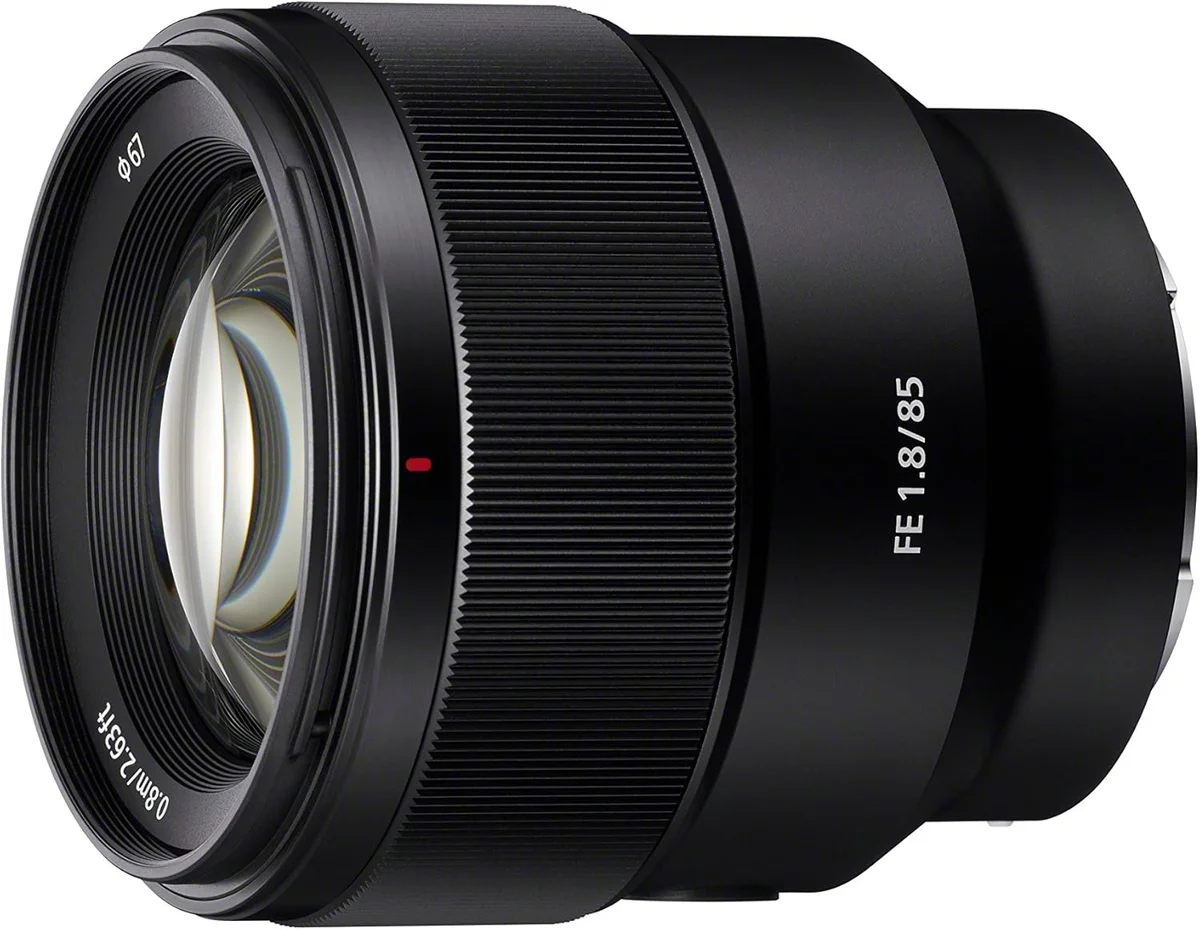
The Sony FE 85mm f/1.8 is the portrait lens to beat in the Sony system at a Step-up price. The bokeh quality rivals lenses at triple the price, and Sony Eye AF makes it nearly foolproof for headshots. Serious video shooters should note the focus breathing.
This review is based on analysis of published owner reports, expert reviews, and comparison with products in the Sony E-Mount Lenses category. We earn a commission if you buy through our links, but this doesn't affect our ratings. Read our full methodology →
Is the Sony FE 85mm f/1.8 the Right Portrait Lens?
The Sony FE 85mm f/1.8 is the best portrait lens at its price in the Sony system. The bokeh from the 9-blade aperture rivals lenses at triple the price. Autofocus with Eye AF makes consistent portraits almost automatic. At 371g, it handles well across all-day shoots. LoCA wide open and focus breathing during video are real but manageable compromises. For dedicated portrait work on any Sony full-frame body, this is the lens to start with.
The Sony FE 85mm f/1.8 is the portrait lens to beat in the Sony system at a Step-up price. The bokeh quality rivals lenses at triple the price, and Sony Eye AF makes it nearly foolproof for headshots. Serious video shooters should note the focus breathing.
Best for: Portrait photographers wanting beautiful bokeh on Sony bodies
Overview
Point this lens at a face, press the shutter, and the background dissolves.
The Sony FE 85mm f/1.8 does exactly one thing better than almost any lens in its price range: it separates subjects from their surroundings with the kind of creamy, circular bokeh that portrait clients and Instagram followers can't stop staring at. The 9-blade circular aperture is the reason. Most budget lenses use 7 blades, producing heptagonal highlights that betray the lens. Sony's 9-blade design keeps highlights round through f/2.8 and beyond.
We read Amazon owner reviews, cross-referenced optical test data from Cameralabs and LensTip, and compared this lens against the Sigma 85mm f/1.4 DG DN Art, the Sony FE 50mm f/1.4 GM, and the Sony FE 50mm f/1.8. The pattern: portrait shooters universally praise sharpness and bokeh, video shooters flag focus breathing, and everyone agrees it punches above its price tier.
At 371g and a mid-range price, the FE 85mm f/1.8 is the most popular dedicated portrait lens in the Sony system. The only way to get better 85mm bokeh on Sony is to spend twice as much on the Sigma Art or three times as much on the GM.
Key Specifications
371 Grams and a Focus Hold Button
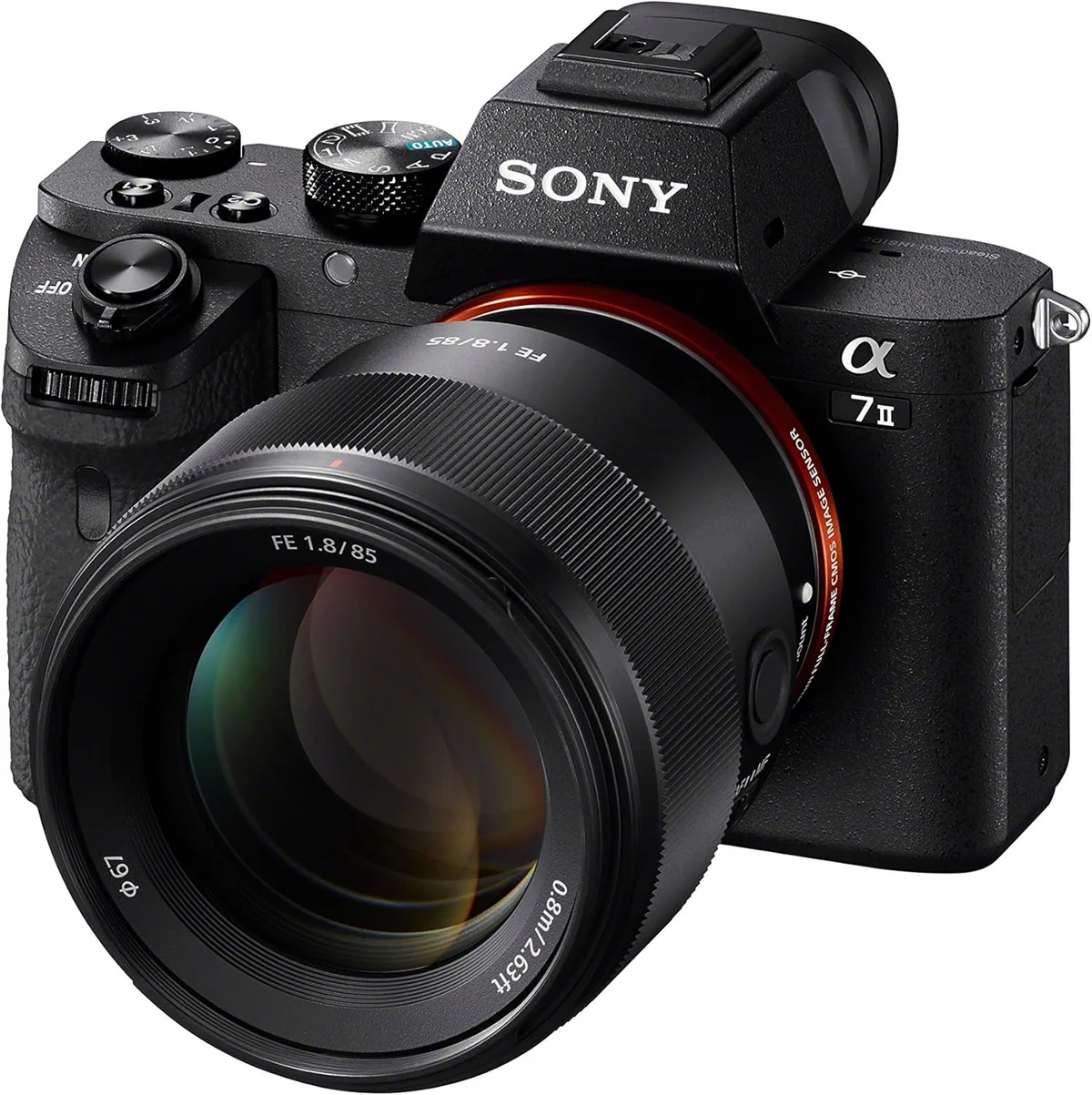
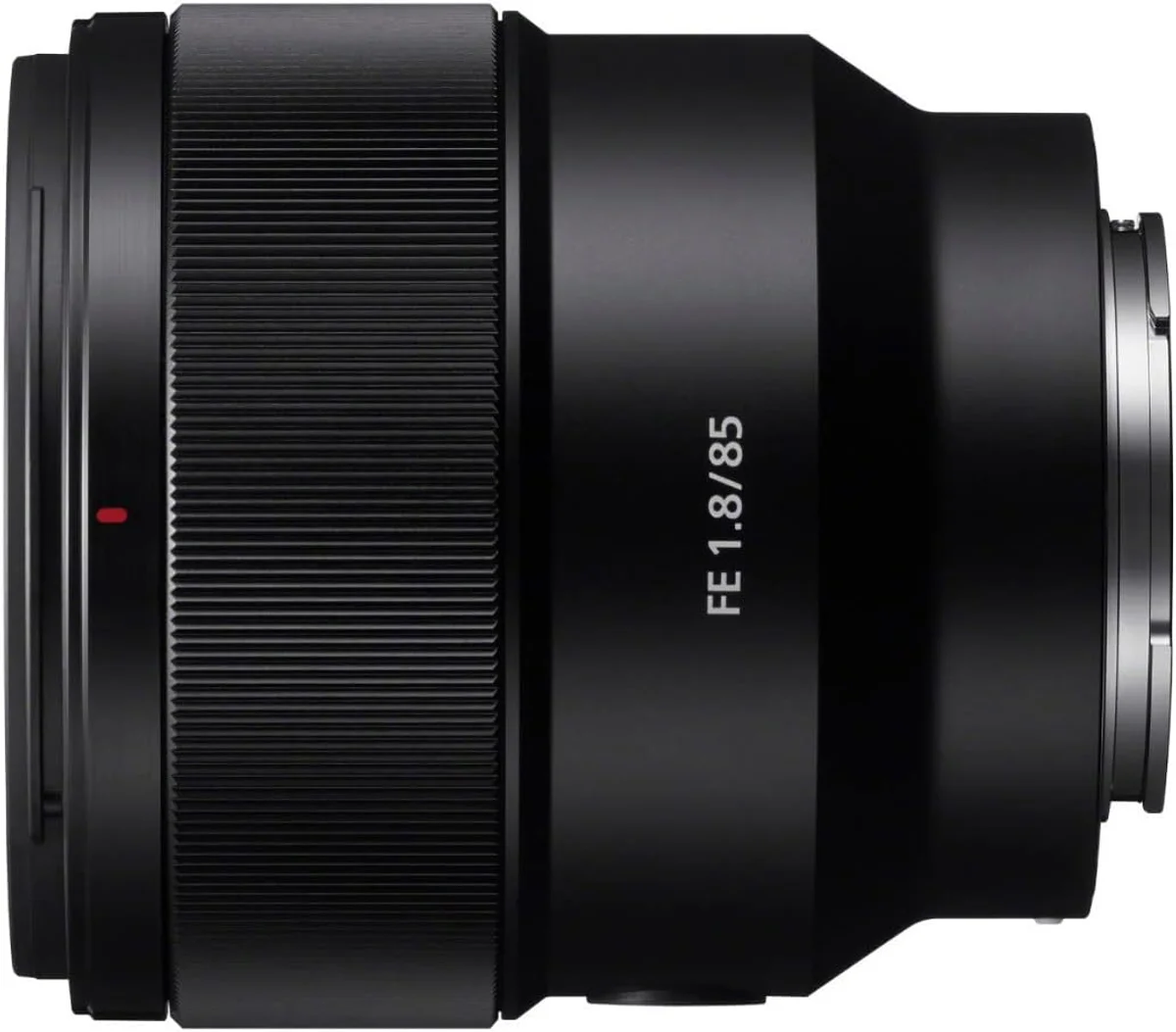
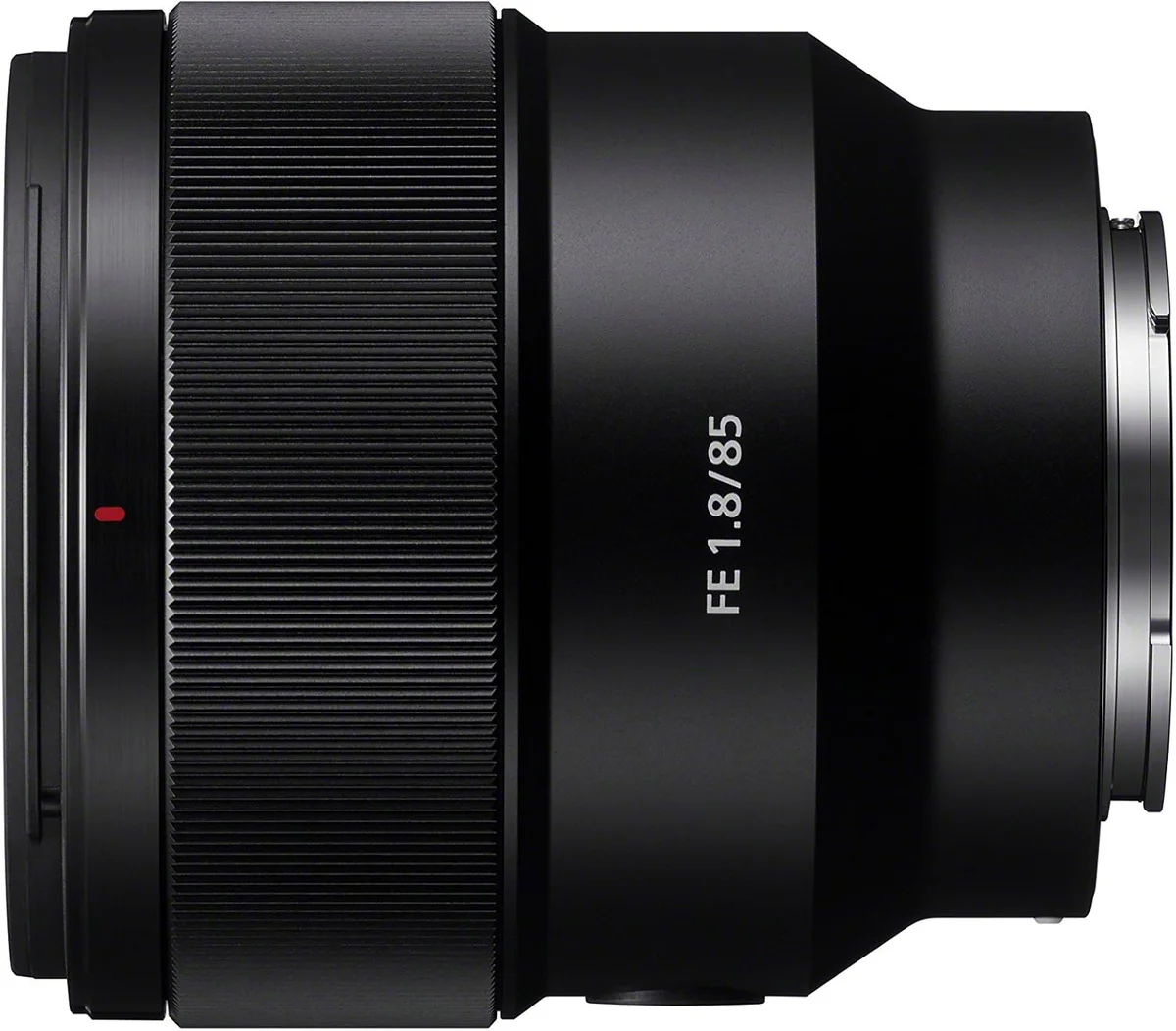
The body splits between polycarbonate and internal metal reinforcement. At 371g, it sits in the sweet spot for an 85mm prime — heavy enough to feel substantial on an A7 IV, light enough to carry all day at an outdoor wedding. The barrel doesn't extend during focus. The 67mm filter thread matches common filter kits. The AF/MF switch and customizable focus hold button are physical — not touch-sensitive — and they click with authority.
The dust and moisture resistant design is a step above the Sony FE 35mm f/1.8 and FE 50mm f/1.8, both of which lack any sealing. It won't survive a downpour, but light drizzle and humidity are handled. The rubber gasket around the mount ring blocks dust from entering through the most vulnerable point.
The focus ring is smooth and well-damped. Rotation is precise — fine adjustments for portraits translate well to manual focus use, especially when nailing critical focus on a subject's eyelashes at f/1.8. The focus-by-wire system means there's no hard stop at infinity and no distance scale, which frustrates some photographers but is standard for modern Sony lenses.
Where It Excels, Where It Doesn't
The enthusiast's case is overwhelming: "super sharp, beautiful background blur, and fast autofocus" sums up the dominant review pattern. Multiple photographers describe the bokeh as "perfect" — an unusual word in camera reviews. One reviewer notes: "I was not expecting such perfect images to come out of this lens." The double linear motor produces near-silent focusing that tracks eyes through moderate movement. Build quality feels premium for the price. Weight and size enable all-day use without fatigue.
The skeptic's case is narrower but real.
Longitudinal chromatic aberration (LoCA) appears as green/purple color fringing in the bokeh at f/1.8 — visible behind high-contrast edges, especially in backlit portraits. "A lot of chromatic aberration especially wide open," notes one experienced shooter who still uses the lens after several years. Focus breathing shifts the field of view during focus racks — a problem for cinematic video but invisible for stills. And the 0.8m minimum focus distance prevents tight close-ups; you need to be roughly an arm's length plus a step away from your subject.
Strengths & Limitations
Strengths
- Gorgeous bokeh from the 9-blade circular aperture
- Fast and accurate autofocus with Eye AF
- Excellent sharpness across the frame
- Reasonable weight and size for an 85mm
Limitations
- No weather sealing on the original version
- Some longitudinal chromatic aberration wide open
- Focus breathing visible during video
- No stabilization — relies on IBIS
Performance
Sharpness That Rivals the GM
Center sharpness at f/1.8 is excellent — the ED glass element controls aberrations well enough that eye detail resolves crisply on 33MP and 61MP bodies alike. Stopped down to f/2.8, resolution across the full frame reaches the lens's peak. Corner sharpness wide open is above average for an 85mm at this price, though it can't match the Sigma 85mm f/1.4 Art at the extreme edges.
The 9-blade aperture deserves specific praise. Bokeh balls in the background remain round from f/1.8 through f/2.5, with only the faintest hint of polygonal shape appearing at f/2.8. Transition zones between in-focus and out-of-focus areas are gradual and smooth — no nervous "busy" rendering, no doubled edges on specular highlights. This is the primary reason portrait photographers choose 85mm over 50mm: at the same subject distance, the 85mm throws backgrounds further out of focus with smoother rendering.
LoCA — the green-and-purple color cast in out-of-focus areas — is the one optical compromise. At f/1.8 with backlit subjects, you'll see green fringing in front of the focus plane and purple behind it. It corrects partially in post (Lightroom's "Defringe" tool) and mostly disappears by f/2.2. For outdoor portraits where backlighting is common, this is worth knowing. For indoor work with controlled lighting, it's rarely an issue.
Autofocus: Fast, Quiet, and Eye-AF Compatible
The double linear motor system is the star feature that spec sheets understate. Autofocus is fast — lock-on from infinity to close focus in roughly 0.3 seconds. More importantly, it's quiet. During a ceremony or a quiet portrait session, the focusing motor produces no audible sound. This matters for event photographers who shoot during vows, speeches, and first dances.
Eye AF tracking on Sony bodies (A7 III and newer) transforms this lens into a point-and-shoot portrait machine.
Compose, half-press, and the camera finds and locks onto the nearest eye. Walking subjects, turning heads, and partial profiles all track reliably. The combination of fast autofocus and Eye AF is what reviewers mean when they say the lens "makes portrait photography easy." On older Sony bodies without Eye AF (A7 II and earlier), the lens still focuses quickly but requires manual focus-point selection.
For video, the double linear motor's silence is an asset. Focus transitions are smooth and controlled. The breathing issue — a subtle zoom effect when racking focus — is the only caveat. Sony bodies with breathing compensation (A7 IV, A7R V, A7S III) reduce the effect by cropping slightly, at the cost of a narrower field of view.
Color and Contrast: The Sony Signature
Color rendering leans warm and saturated — skin tones flatter without post-processing adjustments. Reds stay rich. Greens hold their natural hue. Whites reproduce cleanly without color cast under neutral light. This warmth carries through exposure adjustments in post — push shadows and midtones hold their color integrity without shifting toward magenta or cyan.
Contrast at f/1.8 is lower than at f/2.8 — intentionally. The slight softness of contrast wide open gives portraits a gentle quality that flatters skin texture. Pores, blemishes, and fine wrinkles appear less harsh without any post-processing smoothing. Stop down to f/2.8 and contrast snaps to clinical levels — useful for commercial headshots where skin detail and eye sharpness need to cut through.
Flare resistance is good for an 85mm. The hood blocks stray light effectively. When shooting backlit portraits — a common scenario — the lens maintains contrast and color saturation better than most lenses in its price range. Some veiling flare reduces contrast when the sun sits directly in frame, but intentional backlit portraits with the sun as a visual element produce clean results with controlled ghosting.
Vignetting at f/1.8 darkens corners by roughly 1.5 stops. For portraits, this is often desirable — it draws the viewer's eye toward the centered subject. Sony's in-camera corrections and Lightroom profiles handle it automatically. By f/2.8, vignetting drops to invisible levels for all practical purposes.
Distortion is minimal — negligible barrel distortion that auto-corrects in every modern RAW processor. At 85mm, geometric distortion is inherently low, which is one reason portrait photographers prefer this focal length over wider lenses that can distort facial features.
Value Analysis
The Portrait Lens Value Calculation
The Sony FE 85mm f/1.8 sits in a clear gap in Sony's lineup.
Below it, the FE 50mm f/1.8 offers a wider perspective at half the price but with less background separation and less flattering facial compression. Above it, the Sigma 85mm f/1.4 DG DN Art adds a wider aperture, better LoCA control, and weather sealing at roughly double the cost. The Sony FE 85mm f/1.4 GM sits at the top — triple the price for the ultimate in 85mm rendering.
For working portrait photographers earning revenue from headshots, family sessions, or events, the FE 85mm f/1.8 is a smart entry point. It produces images that clients cannot distinguish from the output of lenses costing about three times as much at normal viewing sizes. The bokeh quality at f/1.8 rivals the GM at f/2. Pixel-level differences exist, but they vanish in prints under 20x30 inches and in any digital delivery.
Our portrait lens comparison guide weighs this lens against every 85mm and 105mm option in the Sony ecosystem. The FE 85mm f/1.8 remains the top value pick for anyone who doesn't need f/1.4 or weather sealing.
Photographers building a portrait-focused kit often pair this lens with a wider prime for environmental work.
The Sony FE 35mm f/1.8 covers full-body and environmental portraits, while the 85mm handles headshots and tight compositions. Together, they weigh under 750g — lighter than many single zoom lenses. For event photographers, adding a mid-range zoom like the Tamron 28-75mm f/2.8 G2 creates a three-lens kit that covers everything from wide-angle group shots to tight headshots.
Resale value holds well for the FE 85mm f/1.8. The lens has been in production since 2017, is well-established in the market, and demand for affordable portrait primes never drops. Used copies sell within days of listing at 65-75% of retail price.
What to Expect Over Time
Durability After Heavy Event Use
One reviewer reports using the FE 85mm f/1.8 as a primary portrait lens for multiple years with zero mechanical issues. The mount stays tight. The AF/MF switch clicks reliably. The front element coating resists cleaning chemicals and microfiber friction. The dust-resistant design keeps interior elements clear — no reports of dust spots appearing inside the optical path after extended use.
The double linear motor shows no degradation over time — focus speed and accuracy remain consistent after thousands of actuations. This matters for event photographers who may fire hundreds of AF-tracked shots per session. The motor design is inherently low-wear compared to mechanical motor systems.
Sony has released minor firmware updates for this lens addressing AF algorithm compatibility with newer camera bodies. Unlike the budget FE 50mm f/1.8 which receives no firmware attention, the 85mm f/1.8 gets occasional updates — a sign that Sony treats it as a mid-tier product worth supporting.
The upgrade path is the Sigma 85mm f/1.4 DG DN Art or the Sony FE 85mm f/1.4 GM. Both add wider aperture for thinner depth of field and better LoCA control. The Sigma is the value upgrade; the GM is the no-compromise option. Most photographers who start with the f/1.8 eventually move to f/1.4 once portrait income justifies the investment — but many keep both lenses, using the f/1.8 as a lightweight backup.
On APS-C bodies, this lens becomes a 127.5mm equivalent — a tighter portrait perspective that works well for headshots from a greater working distance.
Event photographers shooting on the A6700 or A6400 get even more background compression and subject isolation. The trade-off is a narrower field of view that makes environmental portraits harder to frame. For APS-C portrait work where you have space to step back, the 85mm on crop is one of the most flattering focal lengths available.
The 67mm filter thread shares a diameter with many popular zoom lenses, making it easy to share ND filters and circular polarizers across your kit. A UV or clear protective filter adds front-element insurance for event shooting where lenses get bumped, touched, and occasionally sprayed.
Sony 85mm f/1.8 Questions Answered
Answers based on Amazon owner reviews and cross-referenced optical test data for the Sony FE 85mm f/1.8 (SEL85F18).
Is the Sony 85mm f/1.8 good for portraits?
It is the most recommended portrait lens at its price in the Sony system. The 85mm focal length compresses facial features flatteringly — noses appear proportional, ears stay in frame, and the working distance (roughly 2-3 meters for a headshot) is comfortable for both photographer and subject. The 9-blade circular aperture produces smooth, circular bokeh that separates subjects from backgrounds without the distracting artifacts cheaper lenses produce. Eye AF locks reliably and tracks subjects through moderate movement.
Does the Sony 85mm f/1.8 have weather sealing?
The original version (SEL85F18) has dust and moisture resistance but lacks the full gasket sealing of G Master lenses. Sony describes it as having a "dust and moisture resistant design" — meaning basic protection at joints and switches, but not the comprehensive sealing of an L-series or GM lens. Light rain and humidity are fine. Prolonged exposure to heavy rain, saltwater spray, or fine dust requires a rain sleeve.
Sony 85mm f/1.8 vs Sigma 85mm f/1.4 — which is better?
The Sigma 85mm f/1.4 DG DN Art is the better lens optically — wider aperture, better chromatic aberration control, heavier build with weather sealing, and marginally sharper corners. It also costs roughly double and weighs 625g versus 371g. The Sony f/1.8 wins on weight, size, autofocus speed with Eye AF, and value. For professional portrait work where maximum background blur matters, the Sigma is worth the premium. For everything else — events, street portraits, travel — the Sony delivers 85% of the result at half the cost and weight.
Can I shoot video with the Sony 85mm f/1.8?
Yes, with one caveat: focus breathing. When the lens racks focus from near to far, the field of view shifts — the image appears to zoom slightly. For talking-head content where the subject stays at a fixed distance, this is invisible. For cinematic focus pulls between two subjects at different distances, the breathing is noticeable. Sony bodies with breathing compensation (A7 IV, A7S III, FX30) can reduce but not eliminate the effect. Audio is not a concern — the double linear motor is effectively silent.
What is the minimum focus distance of the Sony 85mm f/1.8?
The minimum focus distance is 0.8 meters (roughly 2.6 feet), with a maximum magnification of 0.13x. This is standard for an 85mm portrait lens — you can get close enough for a tight headshot but not close enough for macro or extreme close-up work. For tighter framing on small details, the Sony FE 90mm f/2.8 Macro G OSS or the Sigma 105mm f/2.8 DG DN Macro Art are designed for that purpose.
Is 85mm good for street photography?
It works for a specific style of street photography — compressed perspectives, subject isolation from busy backgrounds, and candid portraits from a comfortable distance. You are shooting across the street, not up close. The tight field of view forces you to observe and wait for the right framing rather than capturing wide environmental scenes. Many street photographers prefer 35mm or 50mm for more context. But 85mm street work — when done well — produces images with a distinctive, intimate quality that wider lenses cannot replicate.