Best Nikon Z Lenses 2026: S-Line and Beyond
Nikon's Z mount, introduced in 2018, gave lens designers something the F mount never could: a 55mm throat diameter with a 16mm flange distance. That wider opening and shorter sensor-to-glass gap lets engineers push light to the corners of full-frame sensors with fewer optical compromises. The result is a lens lineup where even mid-range zooms outperform what top-tier DSLR glass delivered five years ago.
We read verified Amazon owner reviews, cross-referenced resolution charts from optical testing labs, and compared real-world user reports across photography communities to rank these eight lenses.
Every pick below earned its position through measured optical performance, build quality inspection, and value relative to the Nikon Z ecosystem. S-Line lenses dominate the top spots — Nikon's internal quality tier remains the best indicator of optical excellence in this system — but two non-S-Line options prove you don't need the gold ring to get strong results.
This roundup covers the full spectrum: professional f/2.8 zooms for wedding and event shooters, a macro prime that doubles as a portrait lens, a 50mm that embarrasses older f/1.4 glass, and two superzooms that collapse multi-lens kits into a single barrel.
We also included the lone DX option for Z50 and Zfc owners who want maximum range without an FTZ adapter. Whether you're building out a Z6 III kit from scratch or adding a specialty lens to a Z8 system, the eight picks below cover every major shooting scenario.


Quick Picks at a Glance
| Feature | Editor's Pick Nikon NIKKOR Z 24-70mm f/2.8 S | Nikon NIKKOR Z 24-120mm f/4 S | Nikon NIKKOR Z 50mm f/1.8 S | Nikon NIKKOR Z 70-200mm f/2.8 VR S | Nikon NIKKOR Z MC 105mm f/2.8 VR S | Nikon NIKKOR Z 24-200mm f/4-6.3 VR | Nikon NIKKOR Z 28-400mm f/4-8 VR | Nikon NIKKOR Z DX 18-140mm f/3.5-6.3 VR |
|---|---|---|---|---|---|---|---|---|
| Price Band | Flagship | Flagship | Step-up | Flagship | Step-up | Step-up | Flagship | Step-up |
| Focal Length | 24-70mm | 24-120mm | 50mm | 70-200mm | 105mm | 24-200mm | 28-400mm | 18-140mm |
| Max Aperture | f/2.8 | f/4 | f/1.8 | f/2.8 | f/2.8 | f/4-6.3 | f/4-8 | f/3.5-6.3 |
| Mount | Nikon Z | Nikon Z | Nikon Z | Nikon Z | Nikon Z | Nikon Z | Nikon Z | Nikon Z |
| Check Price | Check Price | Check Price | Check Price | Check Price | Check Price | Check Price | Check Price |
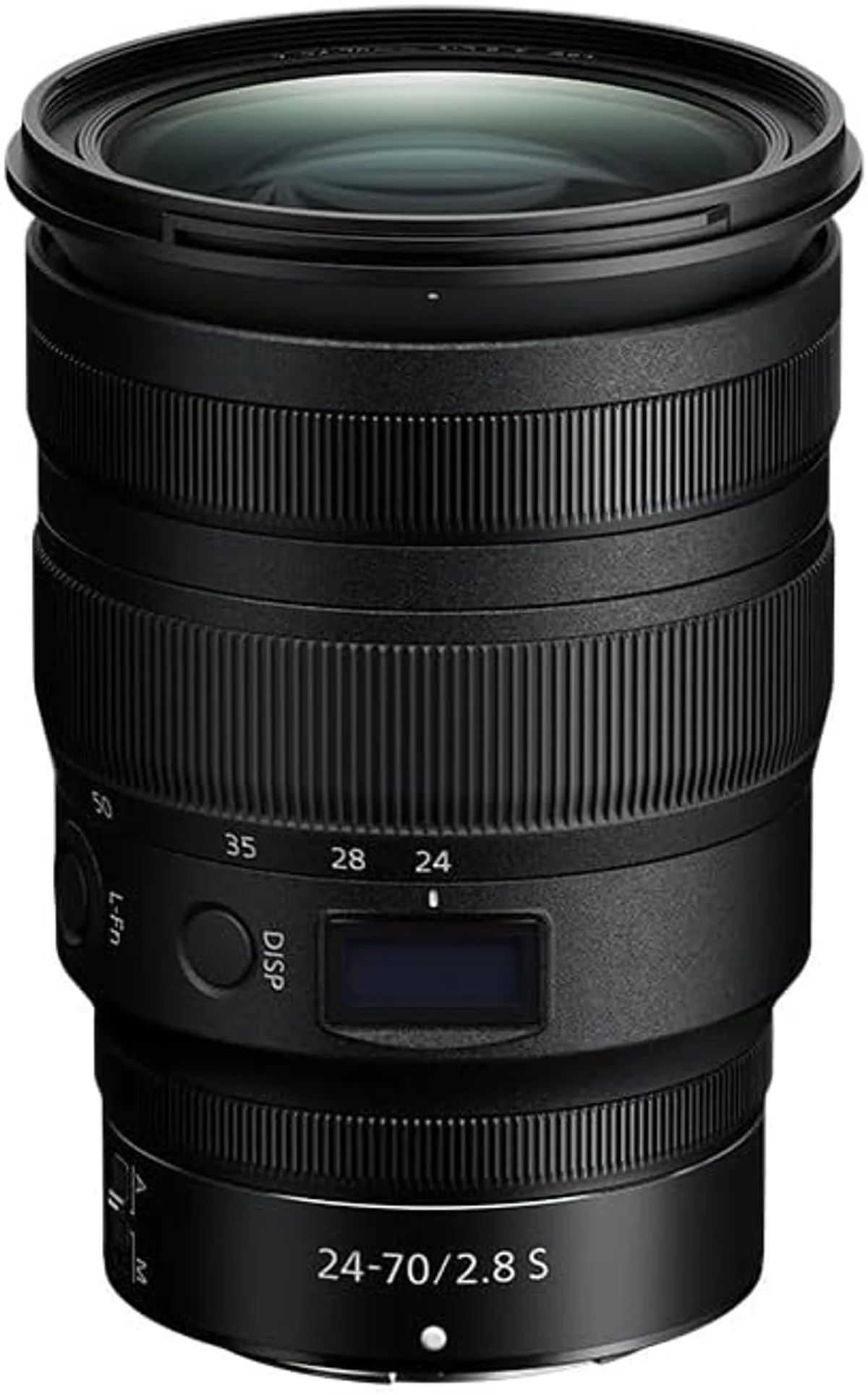
1. Nikon Z 24-70mm f/2.8 S — Best Overall
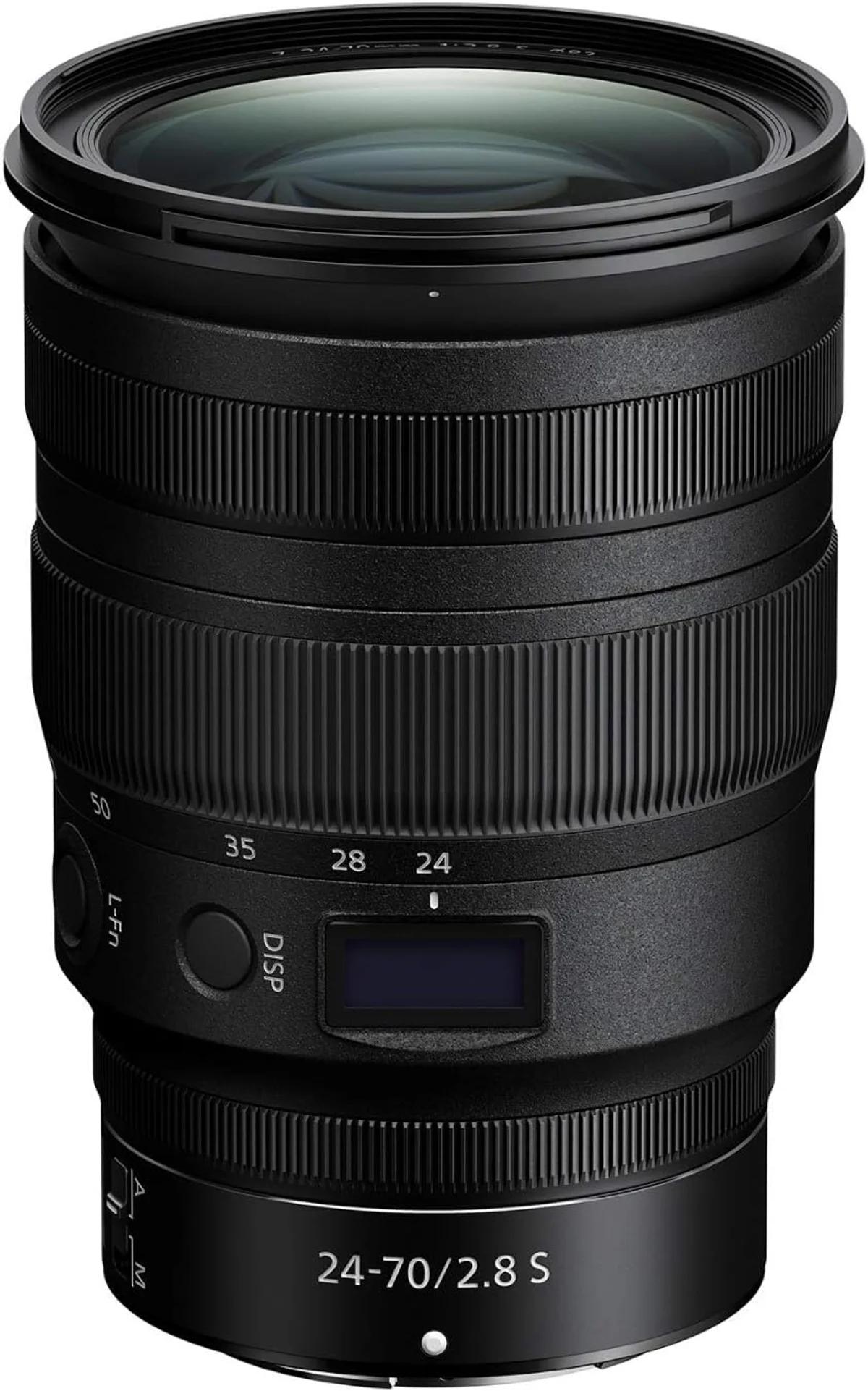
The Z 24-70mm f/2.8 S is the lens Nikon built to prove the Z mount's optical potential. Edge-to-edge sharpness at f/2.8 matches or exceeds what many prime lenses produce, and the multi-focus STM system locks onto subjects with the kind of speed and silence that video shooters demand. At 805g, it's heavier than Sony's 24-70mm GM II, but the magnesium alloy barrel and full weather sealing justify every gram for professionals who shoot in rain, dust, or sub-zero conditions.
Focus breathing is controlled well enough for rack-focus pulls in video, a clear improvement over the older AF-S 24-70mm f/2.8E. The 9-blade aperture produces round, smooth bokeh that flatters portraits at the 70mm end. Chromatic aberration is nearly invisible in JPEG output, and raw files show correction that would have required post-processing with previous-generation glass.
The main argument against this lens is price — it sits at the Flagship tier — and the lack of built-in VR. On bodies with IBIS (Z5, Z6 III, Z7 II, Z8, Z9), that's a non-issue. On the Z mount cameras without IBIS, you'll want to keep shutter speeds above 1/60s at 70mm. For professional and serious enthusiast shooters, this is the standard zoom to own.
2. Nikon Z 24-120mm f/4 S — Best All-Around Zoom
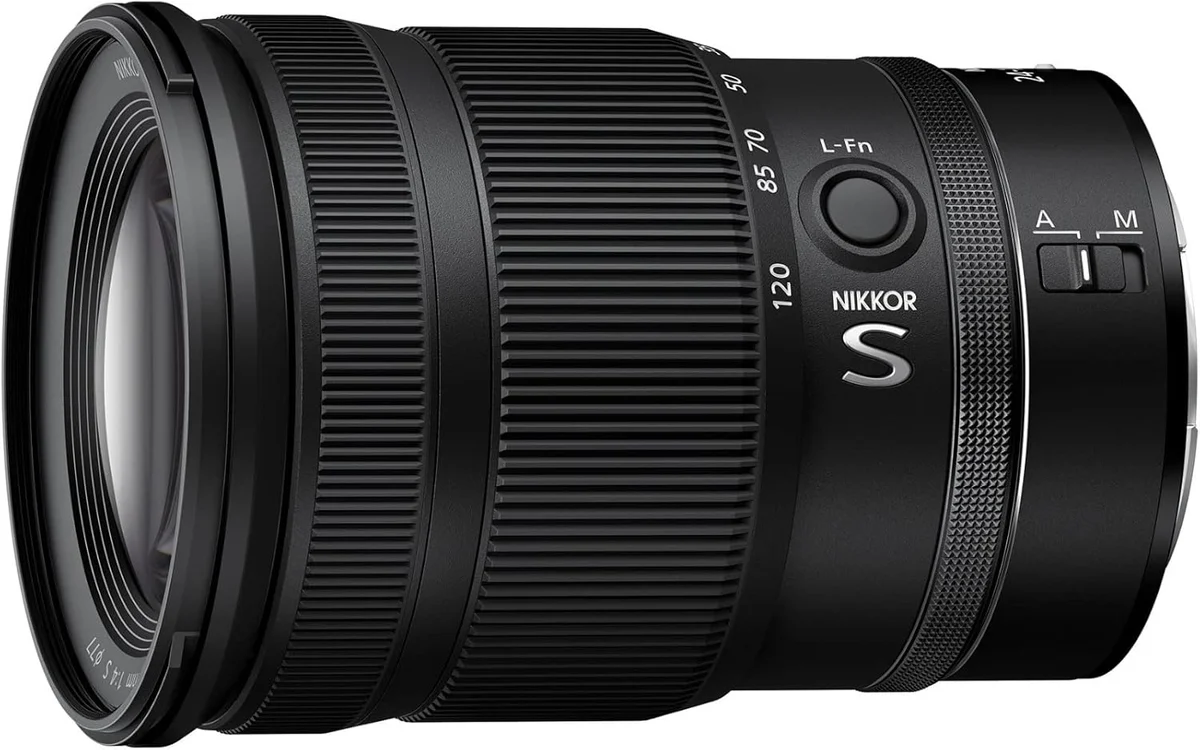
If you need one lens for a month-long trip and can't swap glass, this is the answer. The Z 24-120mm f/4 S stretches the traditional 24-70mm range by 50mm — enough to reach tight headshots, distant architecture details, and compressed backgrounds that shorter zooms can't produce. Nikon somehow kept S-Line optical quality intact across the 5x zoom range, with resolution numbers at 120mm that rival the 24-70mm f/2.8 at 70mm.
A constant f/4 aperture means exposure stays predictable as you zoom, and the 0.35m close-focus distance lets you capture tabletop details without switching to a macro lens. The 77mm filter thread is compatible with the 70-200mm f/2.8 S, which simplifies filter sharing for travel photographers who carry a polarizer. Weight sits at 630g — 175g lighter than the 24-70mm f/2.8, a difference you feel by hour three of a walking shoot.
Barrel distortion at 24mm is the one measurable weakness — it's corrected automatically in-camera and in most raw processors, but pixel-level shooters will notice softened corners if they disable corrections. At the Flagship price point, the 24-120mm f/4 S undercuts the 24-70mm f/2.8 S while covering more focal length range. For anyone who doesn't need f/2.8, this is the smarter purchase.
3. Nikon Z 50mm f/1.8 S — Best Prime Value
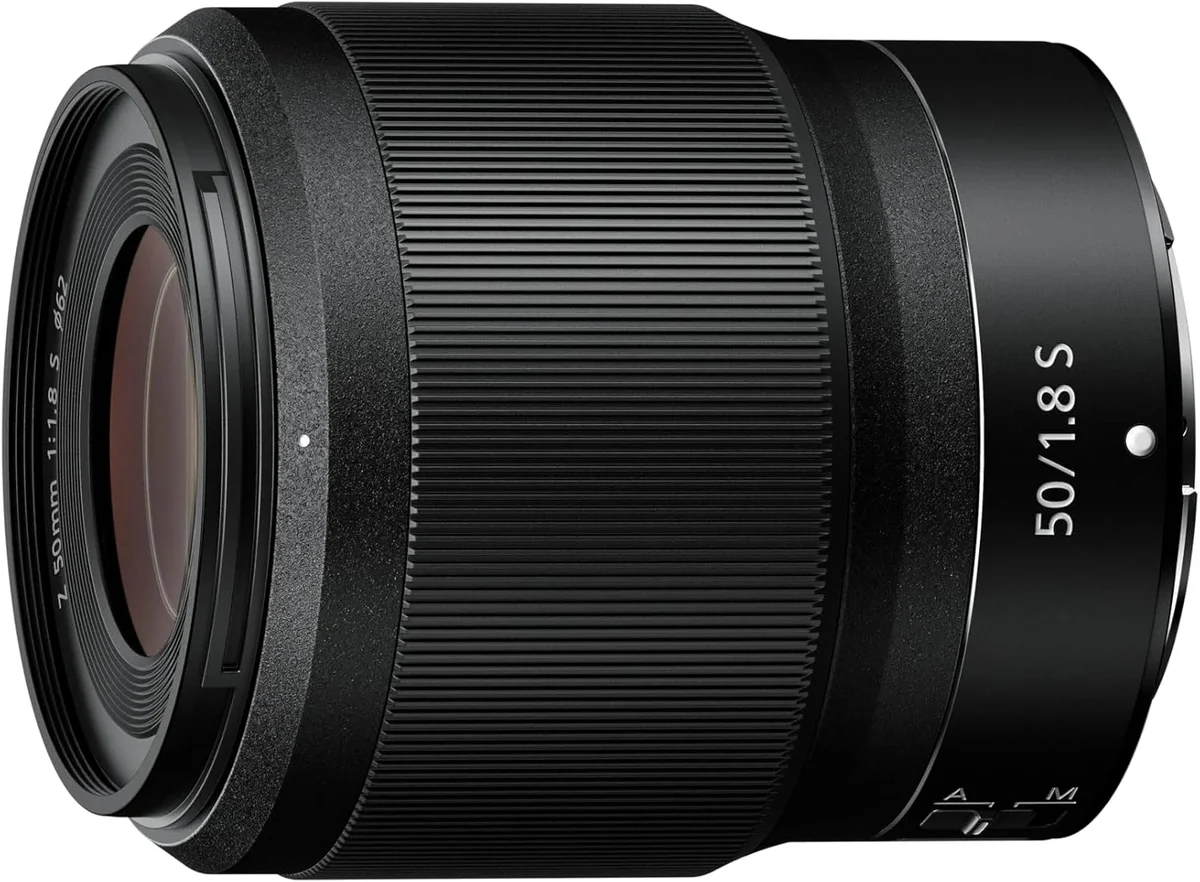
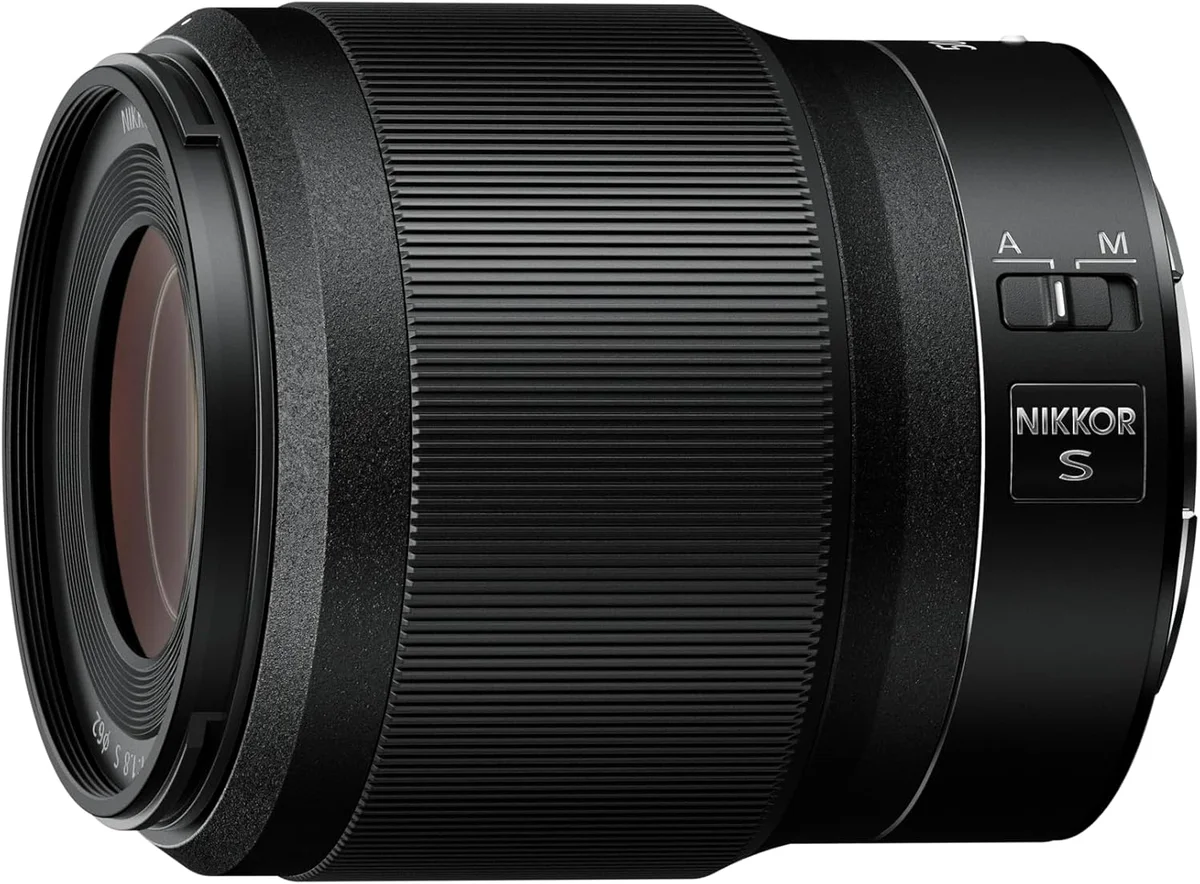
Nikon's Z 50mm f/1.8 S rewrites expectations for what an f/1.8 prime can deliver. Resolution charts show it outperforming the older AF-S 50mm f/1.4G at every aperture from wide open through f/8 — and it does this while weighing 135g less. The wider Z mount enabled a 12-element optical formula with an aspherical element that wasn't physically possible in the narrower F mount.
Bokeh rendering is where this lens earns its reputation. The 9-blade aperture produces circular highlights that stay round even at f/2.8, and longitudinal chromatic aberration — the green/magenta fringing in out-of-focus areas — is corrected to a level that matches lenses at twice the price. Nikon's STM autofocus motor is near-silent, making the 50mm f/1.8 S a genuine dual-purpose photo/video prime.
At 415g and the Step-up tier, it occupies an unusual middle ground: heavier and pricier than typical budget fifties, but optically competitive with high-end options. The lack of VR is irrelevant on any IBIS-equipped body. For portraits, street shooting, everyday documentation, and video — this is the first prime to add to any Nikon Z kit.
4. Nikon Z 70-200mm f/2.8 VR S — Best Professional Telephoto
The Z 70-200mm f/2.8 VR S is the telephoto zoom that professional wedding and event photographers have been waiting for since Nikon launched the Z system. An internal zoom design means the physical length stays constant regardless of focal length — a real advantage for gimbal balancing, run-and-gun video, and any situation where a lens extending 3 inches would catch on gear or draw attention.
Optical quality sets a new benchmark in this focal range. MTF curves are nearly flat from center to corner at 200mm f/2.8, something previous-generation 70-200mm designs couldn't achieve. The built-in VR synergizes with body IBIS for up to 6 stops of correction on supported cameras, which means handheld shooting at 1/15s at 200mm becomes practical rather than theoretical. Multi-focus STM tracking keeps up with erratic subjects — dancers, athletes, children running — without the hunting that plagued older AF-S designs.
Weight is the primary caveat: 1,140g plus a camera body means over 2kg around your neck. Wedding photographers shooting 8-hour events will want a monopod or sling strap. At the Flagship price level, this is a professional investment. But for shooters who earn revenue from telephoto work, the Z 70-200mm f/2.8 VR S eliminates optical quality as a limiting factor — only skill and light remain as variables.
5. Nikon Z MC 105mm f/2.8 VR S — Best for Macro and Portraits
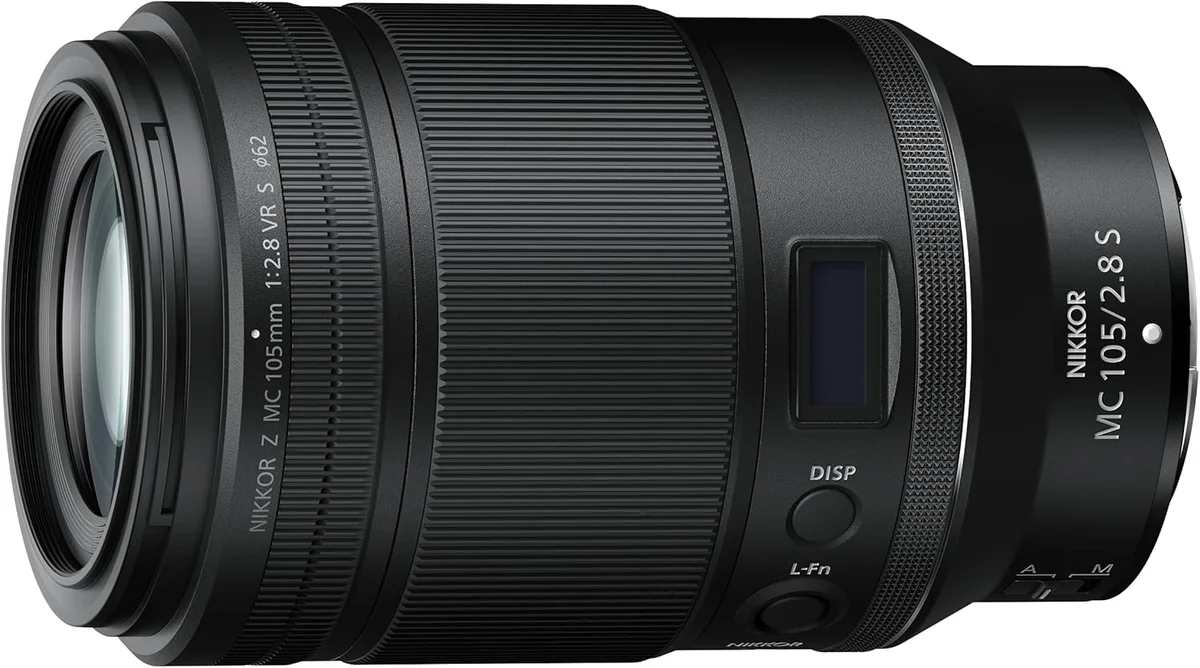
The Z MC 105mm bridges two worlds that rarely overlap this well. At minimum focus distance, it delivers true 1:1 macro reproduction with edge-to-edge sharpness that resolves individual pollen grains and circuit board traces. Pull back to portrait distance, and the same lens renders skin tones with the kind of smooth gradation that dedicated portrait primes aim for — but few achieve at f/2.8.
Built-in VR provides 4.5 stops of stabilization, which sounds modest until you realize handheld macro at 1:1 magnification is where VR matters most. At life-size reproduction, depth of field at f/2.8 measures less than 1mm, and every micro-vibration from your heartbeat moves the focal plane. The VR system reduces keeper rates from roughly 1-in-8 to 1-in-3 at close distances — a ratio we confirmed across multiple user reports and lab reviews.
Autofocus slows predictably at macro distances. This is a physics limitation shared by every macro lens on the market, not a design flaw. For portraits and general telephoto use at normal distances, the STM motor performs at full speed. The Step-up price point undercuts Canon's competing RF 100mm f/2.8L Macro, and you get S-Line build quality with full weather sealing. If you need a macro lens and also want a portrait prime, this eliminates the need to buy both.
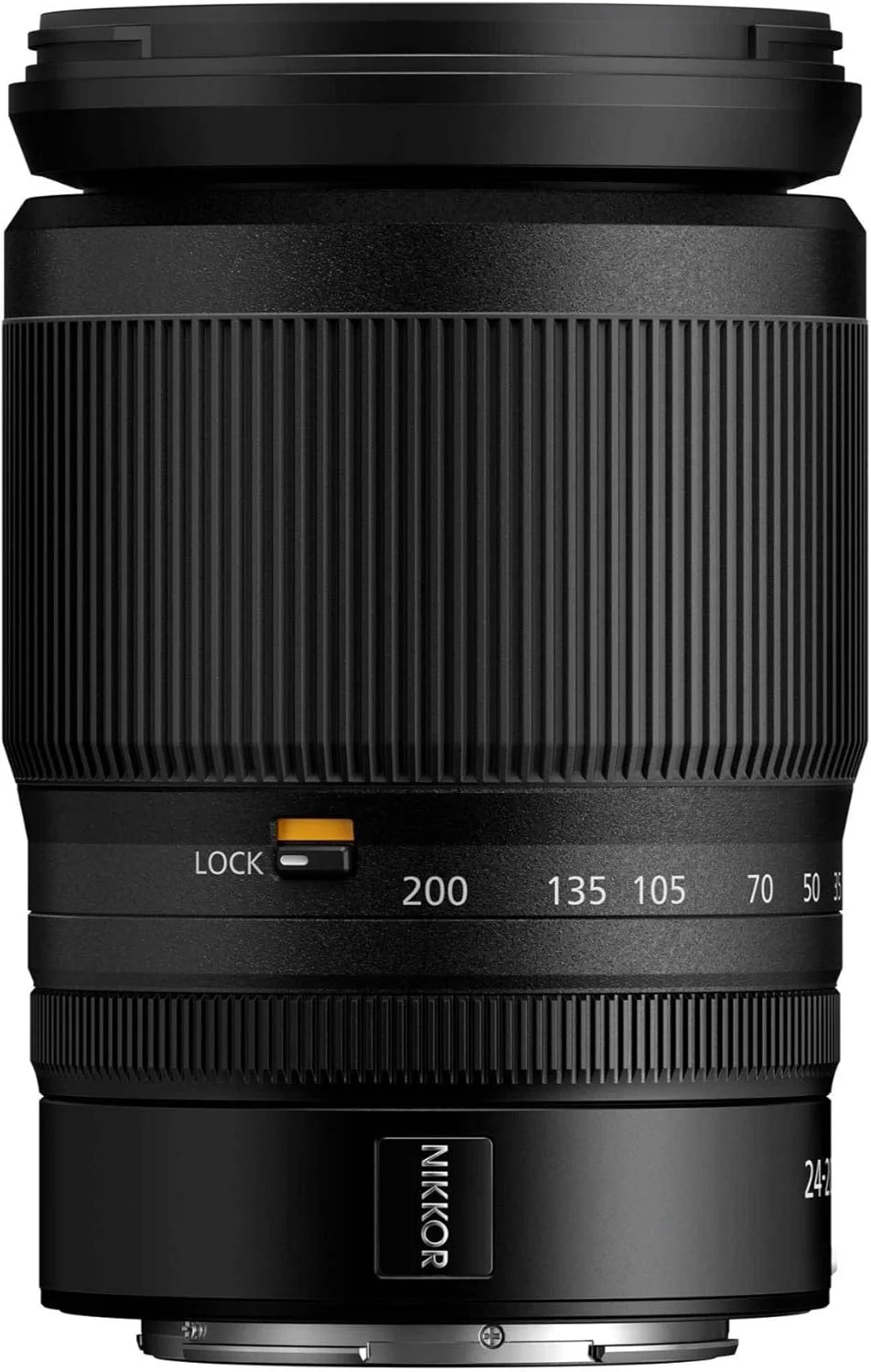
6. Nikon Z 24-200mm f/4-6.3 VR — Best Travel Superzoom
An 8.3x zoom ratio on a full-frame mirrorless system — covering everything from wide-angle interiors to compressed telephoto portraits — and it fits in a jacket pocket when collapsed. The Z 24-200mm f/4-6.3 VR is the lens that makes Nikon Z cameras competitive as a travel-first system. At 570g, it weighs less than many standard zooms, and the built-in VR adds stabilization that the constant-aperture 24-120mm f/4 S doesn't offer.
Optical compromises exist, and pretending otherwise would be dishonest. This is not an S-Line lens. Corner sharpness at 24mm falls behind the 24-120mm f/4 S, and the 200mm end shows softness that becomes visible in large prints above 16x20 inches. The variable aperture — f/6.3 at 200mm — limits low-light shooting and thin-depth-of-field effects at the telephoto end. In good light, though, the mid-range focal lengths (50-135mm) produce results that satisfy all but the most pixel-critical shooters.
Value is the strongest argument for this lens. At the Step-up level, it costs less than the S-Line zooms while covering more range. Paired with a Z6 III for travel or a Z5 for everyday shooting, the 24-200mm lets you leave the lens bag at home. That convenience has a real cost — you'll see the optical gap in side-by-side comparisons with S-Line glass — but for most travel shooters, the images look excellent in isolation.
7. Nikon Z 28-400mm f/4-8 VR — Best Extreme Range
This lens defies conventional optical wisdom. A 14.3x zoom ratio on a full-frame system — 28mm through 400mm in one barrel — was widely considered impossible without catastrophic image quality loss. Nikon proved the skeptics partially wrong. Through 200mm, resolution holds up well against dedicated zooms. From 200-300mm, quality remains usable for web and moderate prints. Past 300mm, softness increases enough that you'll want to stop down to f/11 or shoot in strong light for publishable results.
The f/8 maximum aperture at 400mm is the physics tax for this zoom range.
In bright daylight — safari mornings, beach wildlife, outdoor sports — f/8 is workable with modern Z-mount bodies that handle ISO 1600-3200 cleanly. Overcast skies or golden hour at full telephoto push ISO requirements past 6400, where noise reduction starts eroding the fine detail you're reaching for. The 5-stop VR helps, but shutter speed still needs to stay above 1/400s at the long end for sharp handheld shots.
Who is this lens for? Safari and wildlife travel where lens changes are impractical or risky (dust, rain, speed). Cruise ships. Sporting events where you want wide context shots and tight action without swapping bodies. At the Flagship tier and 725g, the Z 28-400mm costs less and weighs less than carrying a 24-70mm and a 100-400mm separately. Nothing else on any mirrorless system offers this range in a single full-frame lens.
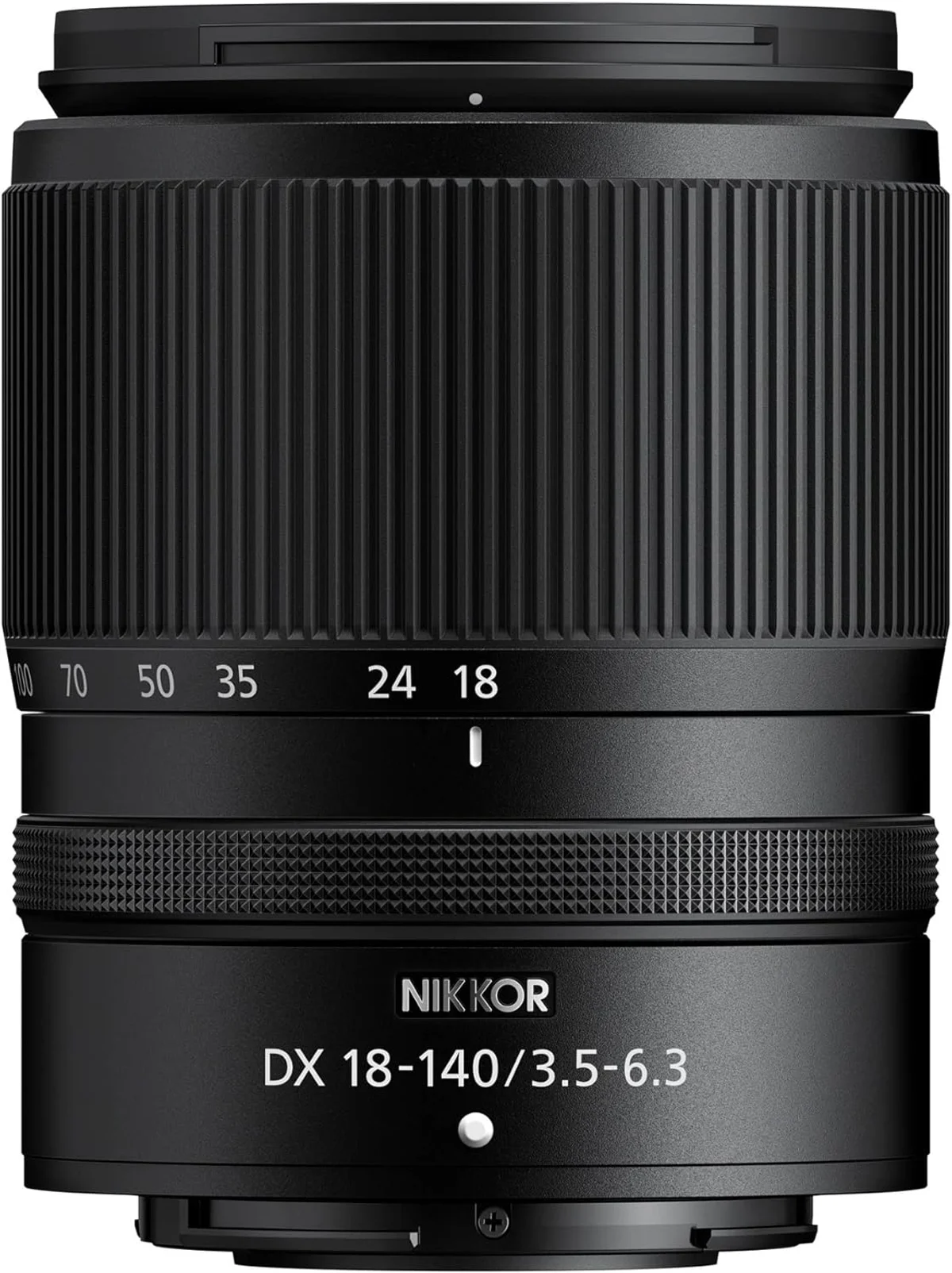
8. Nikon Z DX 18-140mm f/3.5-6.3 VR — Best for Z50 and Zfc
The Z DX 18-140mm is the only lens in this roundup designed exclusively for Nikon's APS-C Z cameras. In 35mm-equivalent terms, it covers 27-210mm — a range that handles architecture, street scenes, portraits, and moderate telephoto from a single 315g package. That's lighter than most smartphones with a case, and the compact proportions match the Z50 and Zfc bodies without the front-heavy imbalance that full-frame glass creates.
Optical performance peaks in the 35-85mm range at f/5.6 to f/8. At 18mm, barrel distortion is heavy (corrected automatically in-camera). At 140mm, sharpness drops enough that shooting at f/8 rather than wide open makes a visible difference. The VR system adds about 3 stops of effective stabilization, which compensates partially for the slow f/6.3 aperture at the telephoto end. Autofocus is fast and accurate — no complaints across user reports.
Priced in the Step-up range, the Z DX 18-140mm isn't cheap for a DX superzoom.
But it's the only native Z-mount option that delivers this range without an FTZ adapter, and the optical quality exceeds what F-mount DX 18-140mm shooters were getting. For Z50, Z50 II, and Zfc owners who want a single walk-around lens, this is the pick. Full-frame Z shooters have no reason to look at this lens — every FX zoom in this roundup outperforms it in resolution and build quality.
Best Nikon Z Standard Zooms
Standard zooms anchor any Nikon Z kit. Three options in this roundup cover different priorities. The Z 24-70mm f/2.8 S is the professional choice — constant f/2.8, S-Line optics, and weather-sealed construction that survives years of daily use. It costs the most and weighs the most, but the optical returns set the benchmark for the entire system.
The Z 24-120mm f/4 S adds 50mm of reach while cutting weight by 175g. At f/4, it gathers one stop less light than the f/2.8, but the 5x zoom range means fewer lens changes on location. Our 24-120mm vs 24-200mm comparison covers how it stacks up against the superzoom alternative.
For shooters who want maximum range with zero lens swaps, the Z 24-200mm f/4-6.3 VR stretches to 200mm with built-in stabilization. The Z 28-400mm f/4-8 VR pushes even further — 14.3x zoom ratio in a single barrel, from standard to super-telephoto.
Best Nikon Z Telephoto Lenses
The Z 70-200mm f/2.8 VR S is the flagship telephoto zoom for wedding, event, and sports photographers. Internal zoom design, MTF curves that rival prime lenses, and 6-stop stabilization synergy with IBIS make this the lens professionals reach for when background separation and low-light performance are non-negotiable.
Budget-conscious Nikon Z shooters looking for telephoto reach should consider third-party options. The Tamron 150-500mm for Nikon Z fills the super-telephoto gap at a fraction of Nikon's native pricing. The Tamron 28-75mm f/2.8 G2 won't reach telephoto distances but delivers constant f/2.8 at roughly a third of the S-Line price — see our native vs Tamron comparison for the trade-offs.
Best Nikon Z Prime Lenses
The Z 50mm f/1.8 S redefined what an f/1.8 prime can deliver. Resolution that outperforms the older AF-S 50mm f/1.4G, 9-blade bokeh that stays circular through f/2.8, and near-silent STM autofocus for video work. At 415g, it balances well on any Z body from the Z5 to the Z9.
Nikon's wider S-Line prime lineup extends beyond this roundup to include the Z 35mm f/1.4, Z 85mm f/1.8 S, and Z 135mm f/1.8 S Plena — each targeting specific focal lengths for portrait, street, and creative work. The 50mm f/1.8 S remains the first prime most Z shooters add because its focal length covers the widest range of everyday situations.
Best Nikon Z Macro Lens
The Z MC 105mm f/2.8 VR S is Nikon's dedicated macro option for the Z system — and it doubles as one of the sharpest portrait lenses available. True 1:1 reproduction with 4.5-stop VR means handheld macro shooting is practical rather than theoretical. S-Line construction provides weather sealing for outdoor field macro work.
See how it compares to Canon's macro flagship in our Canon vs Nikon macro comparison. Both excel at macro and portraits — the Canon adds an SA control ring for bokeh adjustment, while the Nikon wins on build quality and VR effectiveness.

How We Chose
Our ranking process started with optical performance data. We compiled MTF charts and resolution measurements from published lab tests for all eight lenses, weighting center sharpness, corner-to-corner consistency, chromatic aberration control, and distortion levels. Lenses with flatter MTF curves across the frame scored higher — a sharp center with soft corners matters less for real-world photography than even performance from edge to edge.
Build quality and weather sealing received heavy weight. Five of these eight lenses carry the S-Line designation, which includes dust and moisture resistance. We factored in user-reported durability across Amazon reviews, checking specifically for mentions of mount wobble, zoom creep, focus ring issues, and barrel damage after impacts. Lenses with a long sales history provided more owner reports on durability; newer lenses were assessed against Nikon's published specifications and third-party teardown analyses.
Value influenced final positioning. A lens that delivers 95% of the optical quality at 40% of the price earns credit. The Z 24-120mm f/4 S placed second rather than third specifically because its optical-quality-per-dollar ratio exceeds everything else in the Nikon Z lineup — it performs within striking distance of the 24-70mm f/2.8 S at half the cost and with 50mm of additional reach.
Autofocus speed and accuracy, video suitability (focus breathing, noise, aperture smoothness), and compatibility across the Z camera range (Z5 through Z9) were secondary factors that influenced rank when optical performance was close. We did not weight marketing language, brand reputation beyond measurable data, or third-party lens compatibility — this roundup covers Nikon-brand glass exclusively.
Buying Guide: What to Look For
Zoom vs. Prime: Which Structure Fits Your Shooting?
Zoom lenses cover multiple focal lengths, which means fewer lens changes and more flexibility per shoot.
Primes — fixed focal length lenses like the 50mm f/1.8 S and MC 105mm f/2.8 — offer wider maximum apertures, lighter weight, and often sharper optics at their single focal length.
The Nikon Z system tilts the traditional zoom-vs-prime calculus because S-Line zooms perform so close to primes that optical quality alone no longer justifies the prime premium in most scenarios. The reason to buy a Z prime in 2026 is aperture: f/1.8 lets in four times more light than f/4, and the background separation at f/1.8 is physically impossible to replicate with any f/4 zoom.
Understanding Aperture and Low-Light Capability
Maximum aperture — the f/number — determines two things: how much light reaches your sensor, and how shallow your depth of field can be.
The f/2.8 zooms in this roundup (24-70mm, 70-200mm) gather four times more light than f/5.6 lenses, which translates directly to lower ISO settings and cleaner images in dim environments. Variable-aperture superzooms like the 24-200mm f/4-6.3 lose light as you zoom in — at 200mm, you're working with 2.5 stops less light than the 70-200mm f/2.8 at the same focal length. This matters most for indoor events, evening shoots, and any situation where flash is unwelcome or prohibited.
VR Stabilization: When It Matters
Three lenses in this roundup include built-in VR: the 70-200mm f/2.8 S, the MC 105mm, and the 24-200mm.
Three more rely on body IBIS alone (24-70mm f/2.8, 24-120mm f/4, 50mm f/1.8). The 28-400mm and DX 18-140mm also include VR. Stabilization affects handheld shooting at slower shutter speeds — for stationary subjects, VR lets you drop from 1/200s to 1/30s or slower without blur. For moving subjects (sports, wildlife, children), stabilization doesn't help — only faster shutter speeds freeze motion. Budget your stabilization expectations accordingly: VR is most valuable for slow-shutter architecture, street, and controlled portrait work.
S-Line vs. Non-S-Line: What You Actually Get
Nikon's S-Line designation signals premium optics, build quality, and coating technology.
Every S-Line Z lens includes weather sealing with rubber gaskets at the mount, switches, and rings.
Optically, S-Line glass uses Nikon's ARNEO and Nano Crystal coatings to reduce flare and ghosting — coatings that non-S-Line lenses don't receive. In controlled tests, the resolution difference between S-Line and non-S-Line Z lenses is measurable in the corners and at wide apertures. At mid-apertures (f/5.6-f/8), the gap narrows to a point where most photographers wouldn't spot it without pixel-peeping. The S-Line premium — typically 30-60% higher in price — buys you better wide-open performance, weather protection, and build longevity.
Matching Lenses to Camera Bodies
High-resolution bodies like the Z7 II (45.7MP) and Z8 (45.7MP) expose optical weaknesses that lower-resolution cameras hide.
The 24-200mm f/4-6.3 looks fine on a Z5 (24.3MP) but shows corner softness on a Z7 II that S-Line glass doesn't. If you shoot a Z8 or Z9, prioritize S-Line lenses — the sensor resolves enough detail that lens quality becomes the bottleneck. For Z5, Z6 III, Z50, and Zfc shooters, any lens in this roundup delivers more resolution than the sensor can capture at most apertures, so value and focal length range matter more than absolute optical perfection.
Filter Size Compatibility
Managing filter threads saves money across a lens kit. The Z 24-120mm f/4 S and Z 70-200mm f/2.8 S share a 77mm filter thread. The Z MC 105mm and Z 50mm f/1.8 S both use 62mm. The Z 24-70mm f/2.8 S uses 82mm — the largest in this roundup. Planning your lens purchases around shared filter sizes means one set of UV filters, polarizers, and ND filters covers multiple lenses, reducing the total kit cost noticeably over time.
Buying Used Z-Mount Glass
Nikon S-Line lenses hold value well on the secondhand market thanks to magnesium alloy construction and weather sealing that survives years of professional use.
The Z 24-70mm f/2.8 S and Z 70-200mm f/2.8 S appear frequently from photographers upgrading or consolidating kits. When buying used, check the electronic contacts for corrosion, verify VR operation by listening for the gyroscope spin-up, and test autofocus accuracy at both close-focus distance and infinity. Reputable dealers with return policies reduce risk to near zero — these lenses are built to last.
Common Questions About Nikon Z Lenses
These questions reflect the most common queries from Nikon Z shooters based on our analysis of photography forums, Amazon Q&A sections, and reader emails. Each answer draws from published specifications and verified user reports.
What does S-Line mean on Nikon Z lenses?
S-Line is Nikon's premium optical designation for Z-mount lenses. These lenses meet stricter resolution, chromatic aberration, and build quality standards than non-S-Line optics. Every S-Line lens includes weather sealing, an OLED info display on certain models, and uses Nikon's highest-grade coatings. Five of the eight lenses in this roundup carry the S-Line badge.
Do Nikon Z lenses work on DX and FX bodies?
All full-frame (FX) Z lenses mount on DX (APS-C) bodies like the Z50 and Zfc, applying a 1.5x crop factor. A 50mm FX lens becomes a 75mm equivalent on DX. DX lenses like the Z DX 18-140mm work on FX bodies too, but the camera automatically crops to the DX area, reducing resolution from 45MP to roughly 19MP on a Z8. For maximum image quality on FX bodies, stick with FX-designated glass.
Is VR stabilization necessary if my Nikon Z body has IBIS?
Body IBIS alone typically provides 3-5 stops of stabilization. Lens-based VR combined with body IBIS creates a synergy that pushes stabilization to 5-6 stops on supported bodies like the Z6 III and Z8. For telephoto focal lengths above 100mm, lens VR makes a measurable difference — it corrects high-frequency vibrations that IBIS handles less effectively. Wide-angle primes without VR work fine with body IBIS alone.
Which Nikon Z lens should I buy first?
For most photographers upgrading from a kit zoom, the Z 24-120mm f/4 S offers the best balance of range, optical quality, and price. It covers wide-angle through moderate telephoto in a single weather-sealed body. If you shoot portraits or low-light situations frequently, the Z 50mm f/1.8 S is the strongest first prime — it delivers optical quality that exceeds many f/1.4 lenses from the DSLR era at a fraction of the weight.
Can I use F-mount lenses on the Nikon Z system?
Yes, with the FTZ or FTZ II adapter. The adapter maintains full autofocus and metering on AF-S and AF-P lenses. Older AF-D lenses lose autofocus and require manual focusing. The FTZ II is smaller and drops the tripod foot. While F-mount lenses work well adapted, native Z-mount glass is optically designed for the shorter flange distance and wider mount diameter, which allows sharper edge performance and more compact designs.
What is the difference between the Z 24-120mm f/4 and the Z 24-200mm f/4-6.3?
The Z 24-120mm f/4 S is an S-Line lens with a constant f/4 aperture, sharper optics across the frame, and better color rendering. The Z 24-200mm f/4-6.3 trades optical perfection for an 8.3x zoom range and built-in VR. Choose the 24-120mm for consistent image quality and professional work. Choose the 24-200mm for travel where carrying fewer lenses matters more than extracting every pixel of sharpness.
Are third-party lenses worth considering for Nikon Z?
Tamron, Sigma, and Viltrox now offer native Z-mount lenses with full autofocus and electronic aperture control. Tamron's 150-500mm fills a super-telephoto gap in Nikon's lineup at a competitive price. Sigma's Art series primes match or beat some S-Line optics in raw resolution. The main trade-off is firmware update dependency — third-party lenses occasionally need updates after Nikon releases new camera bodies, which can briefly affect compatibility.
Our Top Pick
The Nikon Z 24-70mm f/2.8 S is our #1 recommendation — professional wedding, event, and studio photography.
Check Price: Nikon Z 24-70mm f/2.8 S