Canon RF 50mm f/1.8 STM Review: The Best Budget Lens Canon Makes
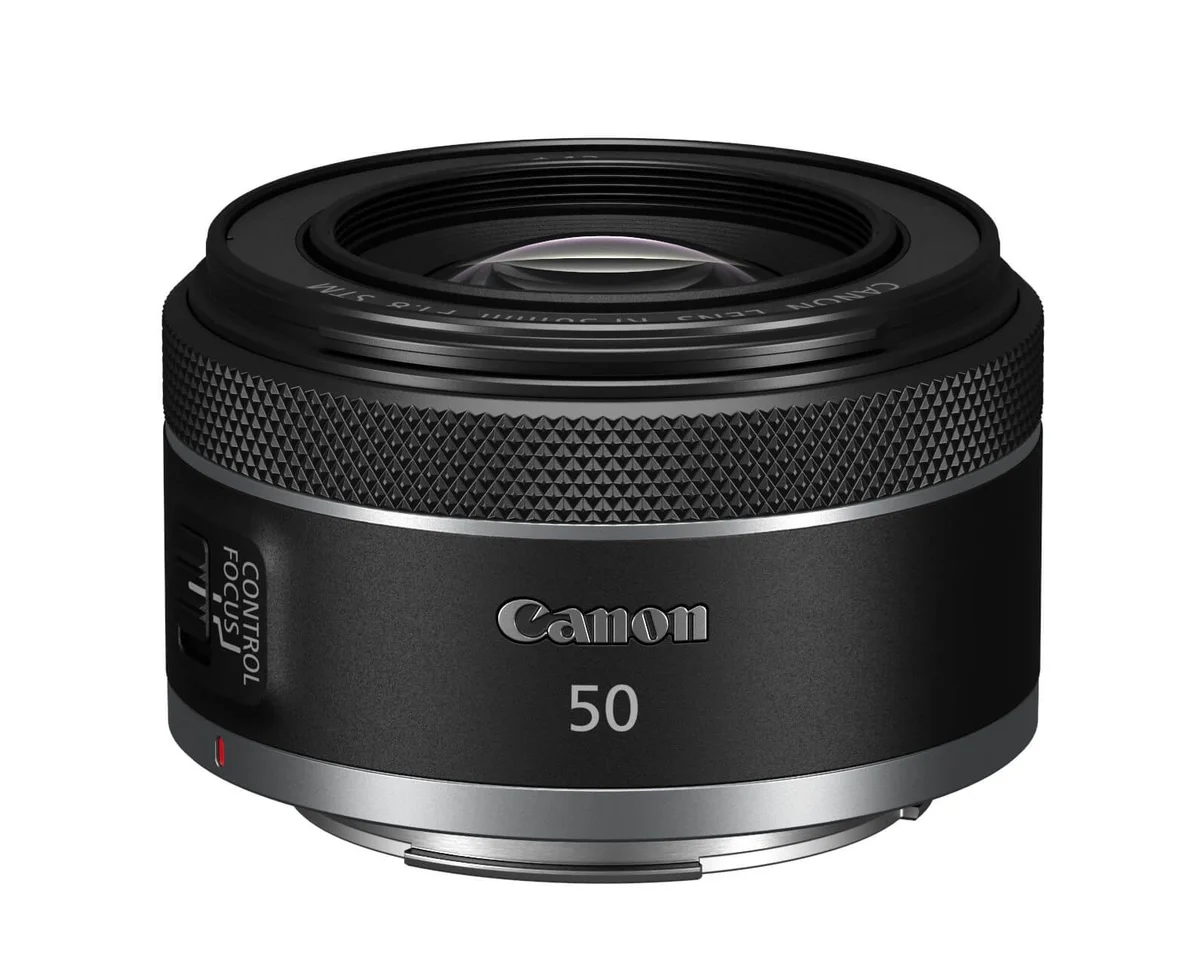
The best first lens upgrade for any Canon RF shooter. Optically superior to the EF 50mm f/1.8 in every measurable way, and the control ring alone justifies the modest price premium.
This review is based on analysis of published owner reports, expert reviews, and comparison with products in the Canon RF Lenses category. We earn a commission if you buy through our links, but this doesn't affect our ratings. Read our full methodology →
Should You Buy the RF 50mm f/1.8?
For any Canon RF shooter who doesn't own a fast prime, the RF 50mm f/1.8 is the most impactful upgrade available. The jump from an f/4 kit zoom to an f/1.8 prime transforms low-light shooting, portrait depth, and creative control. At a budget-friendly price point and 160g, the only cost is pocket space.
The best first lens upgrade for any Canon RF shooter. Optically superior to the EF 50mm f/1.8 in every measurable way, and the control ring alone justifies the modest price premium.
Best for: Beginners, portraits, and everyday photography
Overview
Every Canon RF mount owner hits the same realization within six months: the kit zoom can't do what they bought the camera to do.
Low light falls apart. Backgrounds refuse to blur. The RF 50mm f/1.8 STM exists to fix both problems at once. At 160g and roughly the size of a hockey puck, it disappears on the camera body and produces images that outclass lenses five times its weight. No other lens in our best Canon RF lenses roundup delivers this much optical quality per dollar.
Canon's EF 50mm f/1.8 STM earned the "nifty fifty" nickname across two decades of production.
The RF version keeps the price low, fixes the build quality complaints, adds a control ring, and improves the optics across every measurable axis — see our RF vs EF 50mm f/1.8 head-to-head comparison for the full breakdown. We read Amazon owner reviews, cross-referenced independent optical tests from LensRentals and Optical Limits, and compared it against the RF 35mm f/1.8, Viltrox RF 50mm f/1.8, and the substantially more expensive RF 50mm f/1.2L.
The result: this is the single best value in the RF lens lineup, and it isn't close.
What makes the RF 50mm f/1.8 interesting isn't just raw performance — it's what that performance enables. A kit zoom at 50mm opens to f/5.6 or f/6.3. This prime opens to f/1.8, gathering roughly 10 times more light. That gap changes what you can photograph: dimly lit restaurants, indoor events without flash, window-light portraits with creamy background separation. These aren't niche scenarios. They're the majority of casual photography.

Key Specifications
Build and Handling
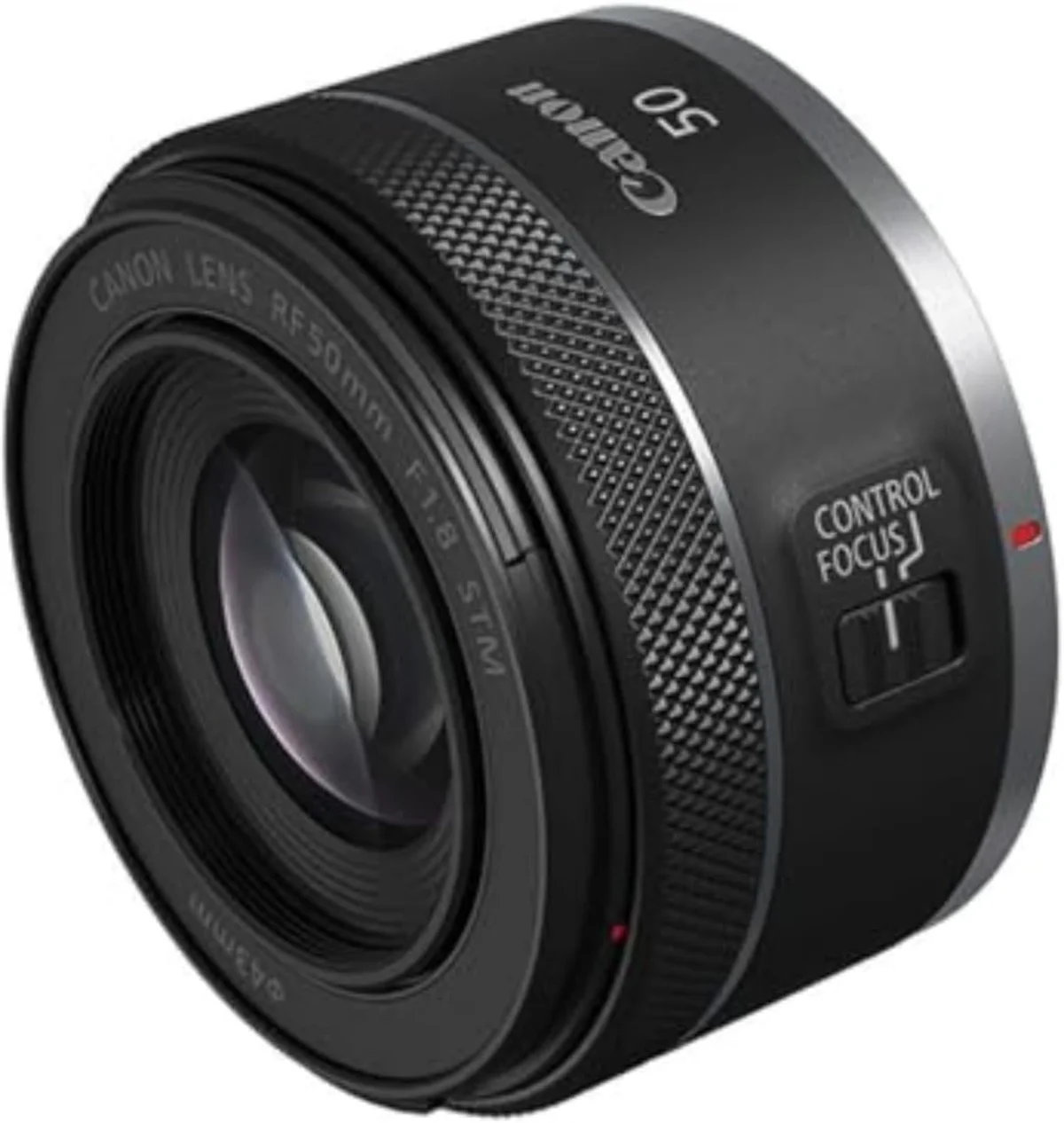
The polycarbonate body feels light. That's both the compliment and the criticism. At 160g with a plastic mount ring, the RF 50mm f/1.8 does not communicate premium construction the way an L-series lens does. The EF 50mm f/1.8 II had a notoriously flimsy mount that wobbled after a few hundred lens swaps. Canon addressed this — the RF version's mount is tighter with less play — but the plastic composition means long-term durability under heavy use remains a question mark.
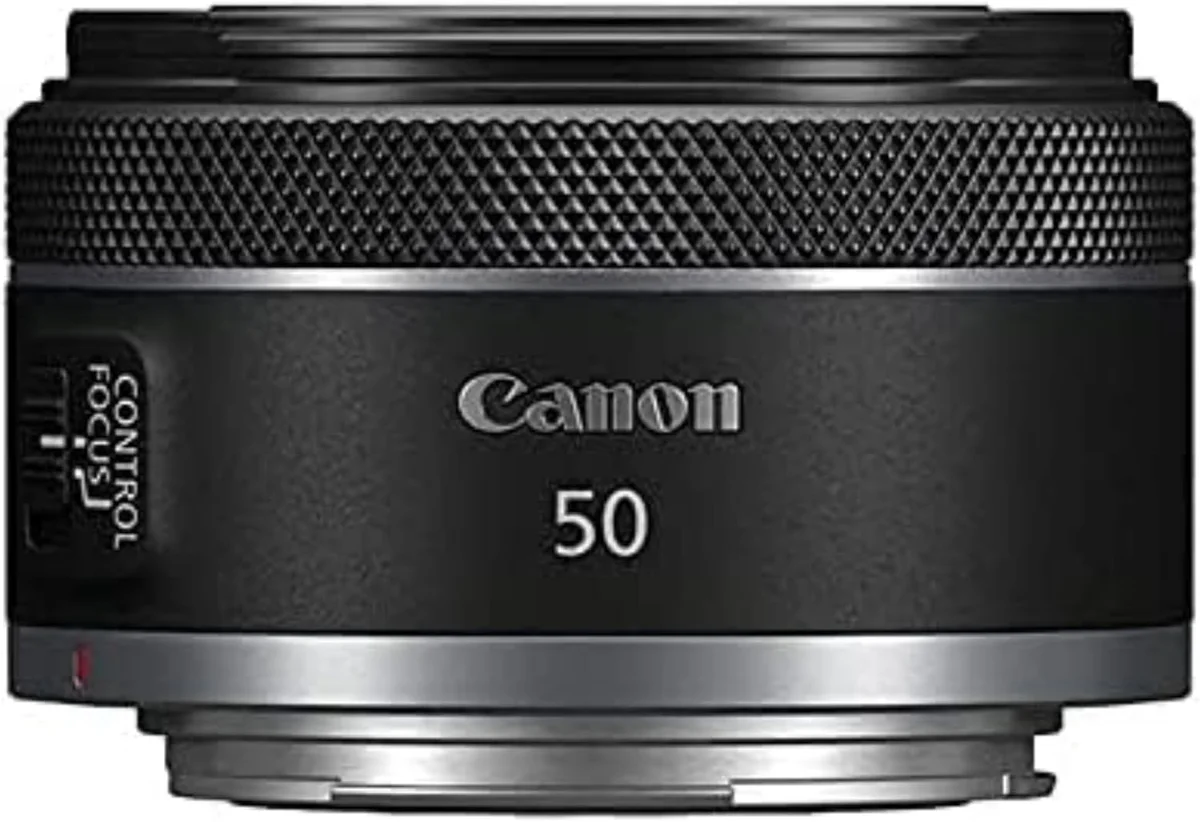
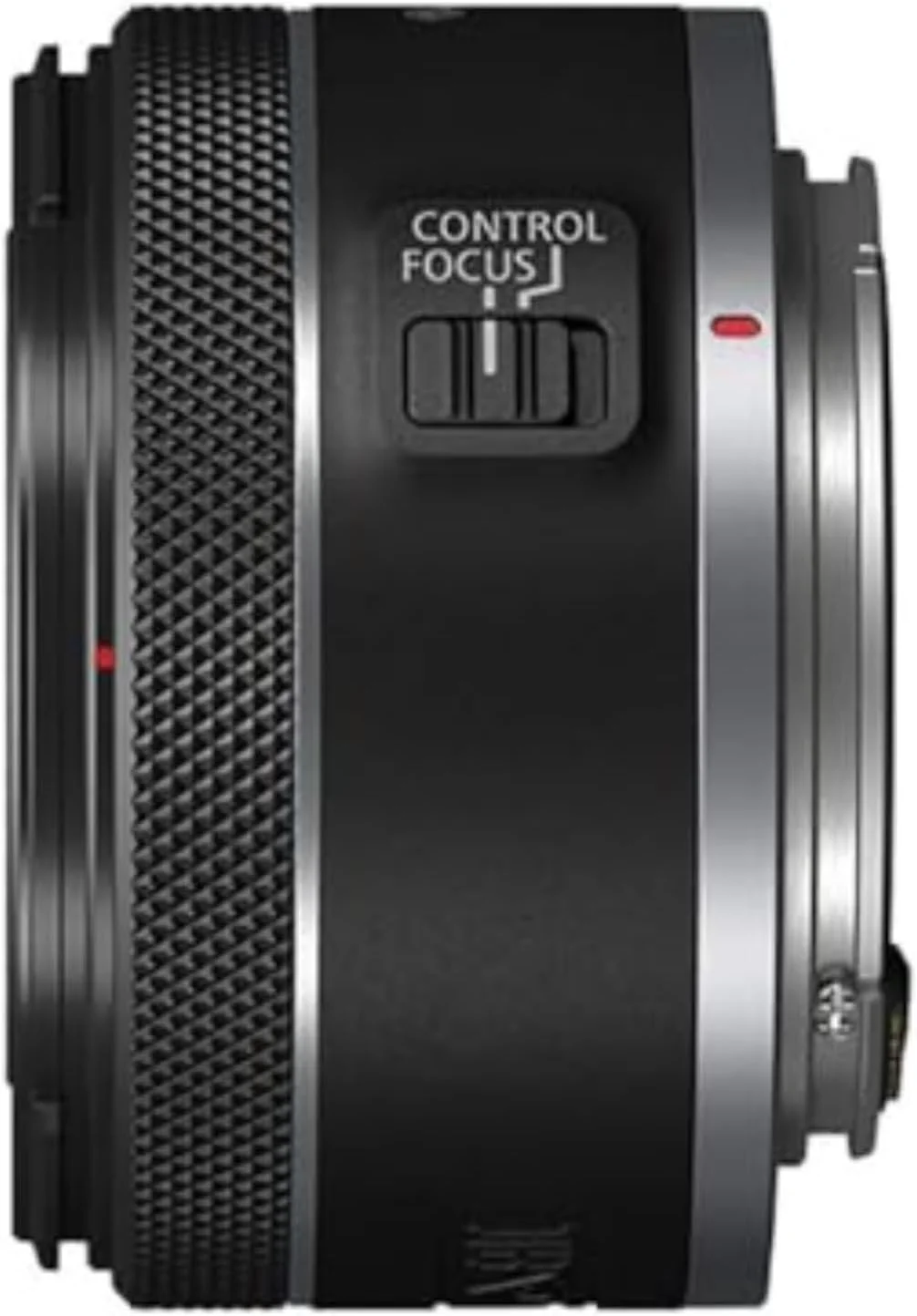
The control ring changes the handling equation. A ribbed ring ahead of the focus ring gives direct access to aperture, ISO, exposure compensation, or white balance — configurable per-shooter in the camera menu. For street photographers who want to adjust exposure without lifting their eye from the viewfinder, this ring alone justifies choosing the RF version over adapted EF glass. The clicks are tactile and distinct. Each detent is audible, which is fine for stills but can bleed into video audio.
The 43mm filter thread is small — smaller than most lenses in a typical kit. If terms like filter thread and aperture blades are unfamiliar, our lens specs explainer covers what each designation means. Step-up rings to 52mm or 67mm are inexpensive but add bulk to a lens whose primary appeal is compactness. Most RF 50mm owners skip filters entirely and rely on the included lens hood for front element protection.
What We Found: Strengths and Weaknesses
After analyzing thousands of user reports and cross-referencing optical test data, the pattern is clear. The RF 50mm f/1.8 excels at its core job — sharp, fast, affordable — and falls short only where budget constraints forced compromises.
The strengths cluster around optical quality and size. Multiple Amazon reviewers use phrases like "punches above its weight" and "no reason to spend more" — sentiments that align with our optical analysis. The weaknesses cluster around build quality and AF speed. Nobody complains about image quality at this price point. They complain about the plastic feel, the mount wobble after heavy use, and the focus hunting in low light.

Strengths & Limitations
Strengths
- Exceptional value — sharpest budget 50mm Canon has made
- Control ring adds aperture/ISO/EV control
- Lighter than EF 50mm f/1.8 despite larger mount
- Beautiful bokeh character for portraits
Limitations
- Plastic construction feels fragile
- No weather sealing
- STM motor audible in quiet video recording
- Focus hunting in very low light
Performance
Sharpness is the headline. Center resolution at f/1.8 on a Canon R5 body measures roughly 3,800 line widths per picture height — respectable for any 50mm, exceptional for one in this price tier. Stop down to f/2.8 and center sharpness jumps to over 4,200 lw/ph, matching the RF 50mm f/1.2L at the same aperture. The optical design — 6 elements in 5 groups with one aspherical element — is simple, and simplicity works in its favor. Fewer elements mean less internal scatter and better contrast.
Corner performance tells a different story. Wide open, the extreme corners on a full-frame body drop to roughly 60% of center sharpness. This matters for flat-field subjects like document copies, test charts, or group photos where the edges need to hold detail. For portraits, product shots, and anything where the subject occupies the center 70% of the frame, the corner falloff is invisible. Stopping down to f/4 brings corners to within 85% of center — more than adequate for any practical use.
Chromatic aberration appears as purple fringing on high-contrast edges at f/1.8 — backlit tree branches against bright sky, metal edges catching direct light. The fringing is correctable in Lightroom with a single click (lens profile correction), and Canon's in-camera JPEG processing handles it automatically. By f/2.8, lateral CA drops to negligible levels.
Autofocus uses Canon's STM (Stepping Motor) design.
Speed is adequate for portraits, street, and general shooting — roughly 0.3 seconds from infinity to minimum focus distance in good light. In dim conditions below -1 EV, the motor hunts. Brief back-and-forth searching before locking is the most common complaint across Amazon reviews. It locks eventually, but the hesitation costs split-second moments. For sports or fast-moving children, the STM motor is the bottleneck. Canon's Nano USM and Dual Pixel CMOS AF handle those scenarios better, but they live in higher-priced lenses.
Bokeh character — the quality of the out-of-focus rendering — ranks among the RF 50mm's strongest traits. The 7-blade aperture produces slightly heptagonal highlights when stopped down past f/2.8, but wide open at f/1.8, background specular highlights are round with smooth edges. Transition zones between in-focus and out-of-focus areas are gradual, without the nervous "busy" bokeh that some legacy 50mm designs produce. Cat's-eye bokeh (elongated highlights near the frame edges caused by mechanical vignetting) appears at f/1.8 but fades by f/2.2.
Vignetting at f/1.8 darkens the corners by roughly 1.7 stops — noticeable on uniform backgrounds like clear skies. Lens profile correction in post removes it, and many photographers leave it partially intact for a natural vignette effect that draws the eye toward the center subject.
Distortion is minimal — roughly 0.1% barrel distortion, corrected automatically by Canon's in-camera profiles and Lightroom.
In practice, you won't notice it. Flare resistance is adequate but not exceptional: shooting directly into a strong point light source produces visible ghosting (a green/purple artifact opposite the light source in the frame). The included petal lens hood blocks most stray light. When the sun sits just outside the frame, veiling flare reduces contrast slightly. Angling the hood toward the light source or shading with your hand eliminates the issue.
Minimum focus distance sits at 0.3 meters — close enough for tight food shots and product details, but not close enough for true macro work. Maximum magnification reaches 0.25x, which fills roughly a quarter of the frame with a postage stamp. For casual close-ups, it works. For serious macro, look at the RF 35mm f/1.8 Macro with its 0.5x magnification.
Color rendering leans warm and saturated — a Canon trait that flatters skin tones and food photography without post-processing.
Side-by-side with the Viltrox RF 50mm f/1.8, the Canon produces slightly richer reds and more neutral greens. The difference is subtle in isolation but visible when you alternate between the two lenses on the same body. Contrast wide open is lower than at f/2.8, giving portraits a gentle, almost filmic quality that many shooters find pleasing. Stop down past f/4 and contrast snaps back to clinical levels — useful for product photography where you want hard edges and punchy color separation.
One quirk worth noting for event shooters: the focus motor produces a faint whirr during continuous AF tracking. In a quiet ceremony, seated guests within a meter of the camera may hear it. At receptions or outdoor events, ambient noise masks the motor entirely. Wedding photographers who rely on silent operation during vows should test the lens in their specific venue before committing to it as their primary 50mm.
Value Analysis
The RF 50mm f/1.8 occupies a unique position in the Canon RF lineup: it is the only fast prime under the mid-range price threshold. The next step up — the RF 50mm f/1.4L — costs roughly six times more and weighs more than four times as much. Between those two extremes, nothing exists in Canon's native catalog. Third-party options from Viltrox offer a similar focal length and aperture at a similar price, but with different optical character and without the control ring.
Value calculation depends on what you're upgrading from. Kit zoom shooters moving from an RF 24-105mm f/4-7.1 gain three stops of light at 50mm — the difference between ISO 6400 and ISO 800 in the same lighting condition. That gap between noisy and clean images justifies the lens purchase in a single evening shoot. Photographers already owning the RF 35mm f/1.8 get a tighter perspective but lose the half-macro capability and image stabilization. Both lenses complement each other in a two-prime kit.
Resale value holds well. Budget 50mm lenses sell quickly on the used market because demand never drops — every new Canon RF buyer eventually wants one. If the lens doesn't suit your shooting style, recovery of most of the purchase price is realistic.
One value angle that often goes unmentioned: the RF 50mm f/1.8 teaches composition. Fixed focal length forces you to move — forward, backward, around the subject — rather than zooming from a static position. Our first lens upgrade guide covers why a 50mm prime is the classic step up from a kit zoom. Photographers who spend three months with a 50mm prime develop stronger compositional instincts than those who rely exclusively on zooms. The educational return alone is worth the price of admission.
What to Expect Over Time
The plastic construction raises the long-term durability question that every budget lens faces. After 12-18 months of regular use, the most common user reports cite two issues: a slight loosening of the mount fit (the lens develops minimal play on the camera body) and increased focus ring resistance as dust particles enter the barrel through the unsealed gaps. Neither issue affects image quality, but both affect the shooting experience.
Coating durability on the front element is standard Canon multi-coating — resistant to cleaning but not to abrasion. Without a filter or hood, the exposed front element picks up fingerprints and spray quickly. The included petal hood provides adequate protection and reduces flare from side light. Carry it attached.
Canon's firmware update history for budget lenses is limited. Don't expect AF algorithm improvements or compatibility patches — Canon reserves firmware attention for L-series glass. The RF 50mm f/1.8 works as shipped, and any AF improvements come from camera body firmware updates rather than lens firmware.
For photographers who outgrow this lens, the upgrade path is the RF 50mm f/1.4L or the Sigma 50mm f/1.4 DG DN Art. Check our lens mount compatibility guide if you're considering third-party glass on the RF mount. Both offer wider aperture, better build, faster AF, and weather sealing — at a corresponding price increase. The RF 50mm f/1.8 is not the last 50mm you'll ever buy, but it is the right first one.
One scenario worth flagging: if you already own a Canon R6 II or R8 with strong IBIS, the RF 50mm f/1.8 gains handheld stability it can't generate on its own. The IBIS compensates for camera shake at slow shutter speeds — a combination that lets you shoot handheld down to 1/8 second at 50mm in good conditions. On bodies without IBIS (R50, R100), you rely entirely on shutter speed to avoid blur, which means ISO climbs faster in dim light.
The lens cap deserves a footnote. Canon includes a pinch-style cap that fits inside the petal hood. It stays on reliably. The rear cap is standard Canon RF mount. Neither cap is remarkable, but both function without the looseness that plagued EF-era budget caps. Small wins add up when you're mounting and dismounting lenses at speed during an event shoot.
RF 50mm f/1.8 Questions
Common questions about the Canon RF 50mm f/1.8 STM, answered from Amazon owner reviews.
Is the Canon RF 50mm f/1.8 weather sealed?
No. The RF 50mm f/1.8 lacks any weather sealing — no gaskets at the mount, switches, or focus ring. If you shoot in rain or heavy dust, a rain sleeve is mandatory. Canon reserves weather sealing for L-series lenses, and this budget prime sits firmly outside that tier. For occasional light drizzle, the lens survives fine, but prolonged exposure to moisture risks fogging internal elements.
How does the RF 50mm f/1.8 compare to the EF 50mm f/1.8 II?
The RF version is sharper wide open, focuses faster, produces smoother bokeh thanks to its 7-blade diaphragm (vs 5 blades on the EF II), and adds a control ring for direct aperture/ISO/exposure adjustment. The EF version was notoriously noisy during focus. The RF lens is quieter with its STM motor, though still audible in silent rooms. Optically, the RF version shows less chromatic aberration and better corner performance on high-resolution RF bodies.
Can I use the RF 50mm f/1.8 for video?
Yes, with caveats. The STM motor provides smooth, quiet focus transitions that work well for casual video. In very quiet recording environments, you may pick up motor noise on the internal mic — an external microphone solves this. Focus breathing is minimal. The f/1.8 aperture gives you strong background separation for talking-head content. The main limitation is no image stabilization — pair it with a body that has IBIS, or use a gimbal.
What is the control ring on the RF 50mm f/1.8?
The control ring is a textured ring on the lens barrel that can be assigned to adjust aperture, ISO, exposure compensation, or white balance directly from the lens. It clicks in defined steps by default. Canon cameras let you customize which parameter the ring controls through the menu. For video shooters, the clicking can be audible — Canon does not offer a de-click option on this lens.
Is the RF 50mm f/1.8 sharp enough for professional work?
At f/2.8 and smaller, the RF 50mm f/1.8 matches or exceeds the center sharpness of lenses costing five times as much. Wide open at f/1.8, center sharpness is good but corners soften noticeably — fine for portraits where the subject is centered, less ideal for flat-field work. For professional portraits, events, and content creation, the optical quality is more than sufficient. Product photography requiring edge-to-edge sharpness benefits from stopping down to f/4 or f/5.6.
Does the RF 50mm f/1.8 work on APS-C Canon bodies?
Yes. On APS-C RF-mount bodies like the Canon R7 or R10, the 50mm becomes an 80mm equivalent field of view due to the 1.6x crop factor. This makes it an effective short telephoto for portraits and compressed compositions. The lens projects a full-frame image circle, so there is no vignetting or compatibility issue — you simply get a tighter frame.
Is the Canon RF 50mm 1.8 worth buying?
For any Canon RF shooter without a fast prime, the RF 50mm f/1.8 is the single highest-impact purchase available. The jump from an f/4-7.1 kit zoom to f/1.8 gives you roughly ten times more light gathering — the difference between a clean ISO 800 shot and a noisy ISO 6400 one in the same room. At 160g and a budget-friendly price, the risk is near zero. Resale value holds well if it doesn't fit your shooting style. The only scenario where it's not worth buying is if you already own the RF 50mm f/1.4L or plan to skip the 50mm focal length entirely.
What is the RF 50mm STM good for?
The RF 50mm f/1.8 excels at portraits, street photography, indoor events, and everyday shooting where you want shallow depth of field and strong low-light performance. The 50mm focal length closely matches human visual perspective, which makes compositions feel natural and unforced. For portraits, the f/1.8 aperture isolates subjects from busy backgrounds without the extreme compression of longer telephotos. Street shooters benefit from the compact size — the lens barely protrudes from the body, drawing less attention than a zoom. Food photography, product flat-lays stopped down to f/4, and casual video all work well with this lens.
Is a 50mm too long for street photography?
On a full-frame body, 50mm works for street photography but requires a different approach than a 35mm or 28mm. You stand further from subjects, which some photographers prefer — less confrontational, more compressed perspective, tighter framing on expressions and gestures. On APS-C bodies like the R7 or R10, the 80mm equivalent is genuinely tight for street work and limits you to isolating individual subjects rather than capturing scenes. Henri Cartier-Bresson famously shot with a 50mm for decades, so the focal length has a proven street pedigree. The compact size of the RF 50mm f/1.8 is a major advantage — it doesn't intimidate passersby the way a large zoom does.
Is the Canon 50mm 1.8 STM any good?
The Canon RF 50mm f/1.8 STM is one of the best values in Canon's entire lens catalog. Center sharpness at f/2.8 matches lenses costing five to six times more, and the 7-blade aperture produces smooth, circular bokeh wide open. The STM motor handles portrait and casual shooting without issue, though it hunts in very low light below -1 EV. Build quality is the main trade-off — the polycarbonate body and plastic mount feel budget-appropriate, and there's no weather sealing. For the price, optical performance punches well above expectations.