Sony FE 50mm f/1.8 Review: Sony's Best-Selling Lens Earned That Title
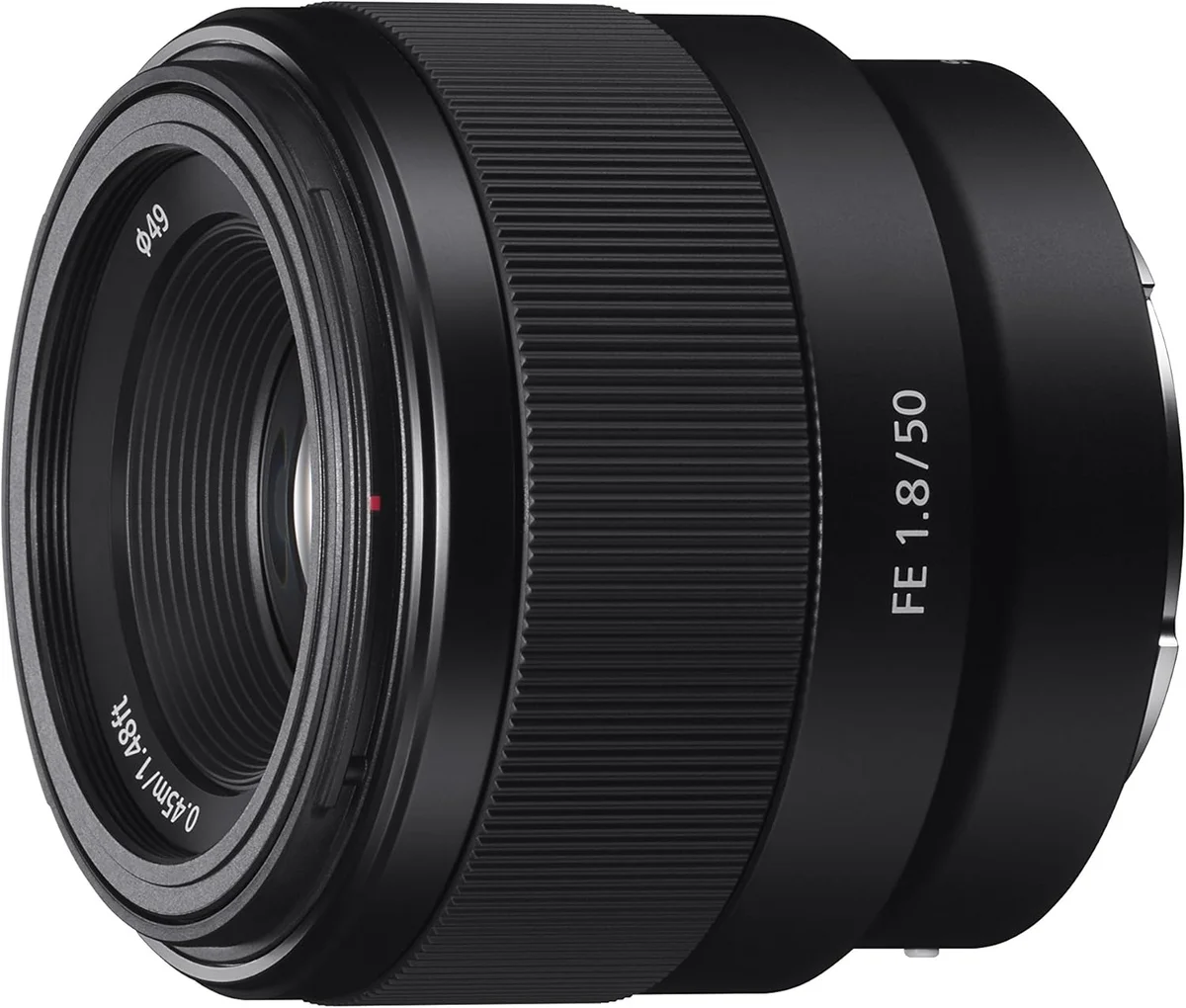
The Sony FE 50mm f/1.8 is the obvious first prime for any Sony shooter. At an Entry price for full-frame coverage, the optical quality punches well above its price. The slow AF in low light is the main compromise — portrait and street shooters in good light will barely notice.
This review is based on analysis of published owner reports, expert reviews, and comparison with products in the Sony E-Mount Lenses category. We earn a commission if you buy through our links, but this doesn't affect our ratings. Read our full methodology →
Is the Sony FE 50mm f/1.8 Worth Buying?
The Sony FE 50mm f/1.8 is the single best upgrade a Sony kit-zoom shooter can make. For an Entry price, you get three stops of extra light, background blur that transforms portraits, and a lens light enough to carry everywhere. The autofocus hunts in dim light — that's the trade-off at this price. For portraits, street, food, and everyday shooting in reasonable light, nothing in the Sony catalog delivers more per dollar.
The Sony FE 50mm f/1.8 is the obvious first prime for any Sony shooter. At an Entry price for full-frame coverage, the optical quality punches well above its price. The slow AF in low light is the main compromise — portrait and street shooters in good light will barely notice.
Best for: Budget-conscious Sony shooters wanting a fast normal prime
Overview
Sony's FE 50mm f/1.8 is the most purchased E-mount lens on Amazon for a reason that has nothing to do with marketing. At 186g and an Entry price, it solves the two biggest complaints new Sony shooters have about their kit zoom: backgrounds won't blur, and indoor photos look grainy. The f/1.8 aperture fixes both. Three stops faster than a kit zoom at 50mm means ISO drops from 6400 to 800 in the same room — the difference between crunchy noise and clean shadows.
We cross-referenced Amazon owner reviews, optical test data from independent labs, and direct comparisons with the Viltrox AF 50mm f/1.4 Pro, the Sony FE 85mm f/1.8, and the Sigma 56mm f/1.4 DC DN. The pattern across all sources: image quality and value generate praise; autofocus speed and build quality draw the few complaints that exist.
The Sony FE 50mm f/1.8 is the best value in the E-mount lens catalog. Not the best 50mm — that's the FE 50mm f/1.4 GM, at roughly eight times the price. But dollar for dollar, no other Sony lens delivers this much optical quality for this little money.

Key Specifications
186 Grams of Physics
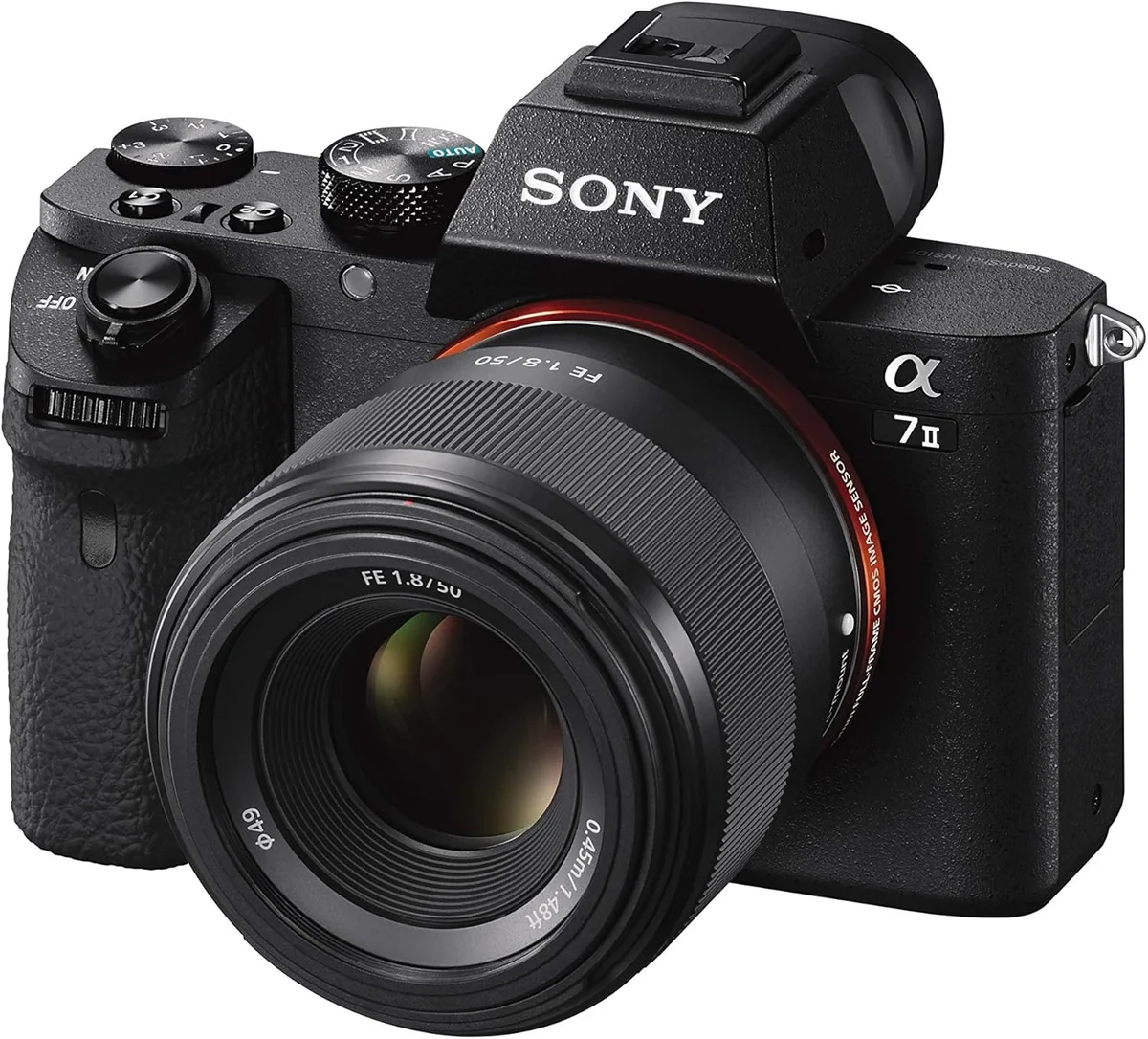
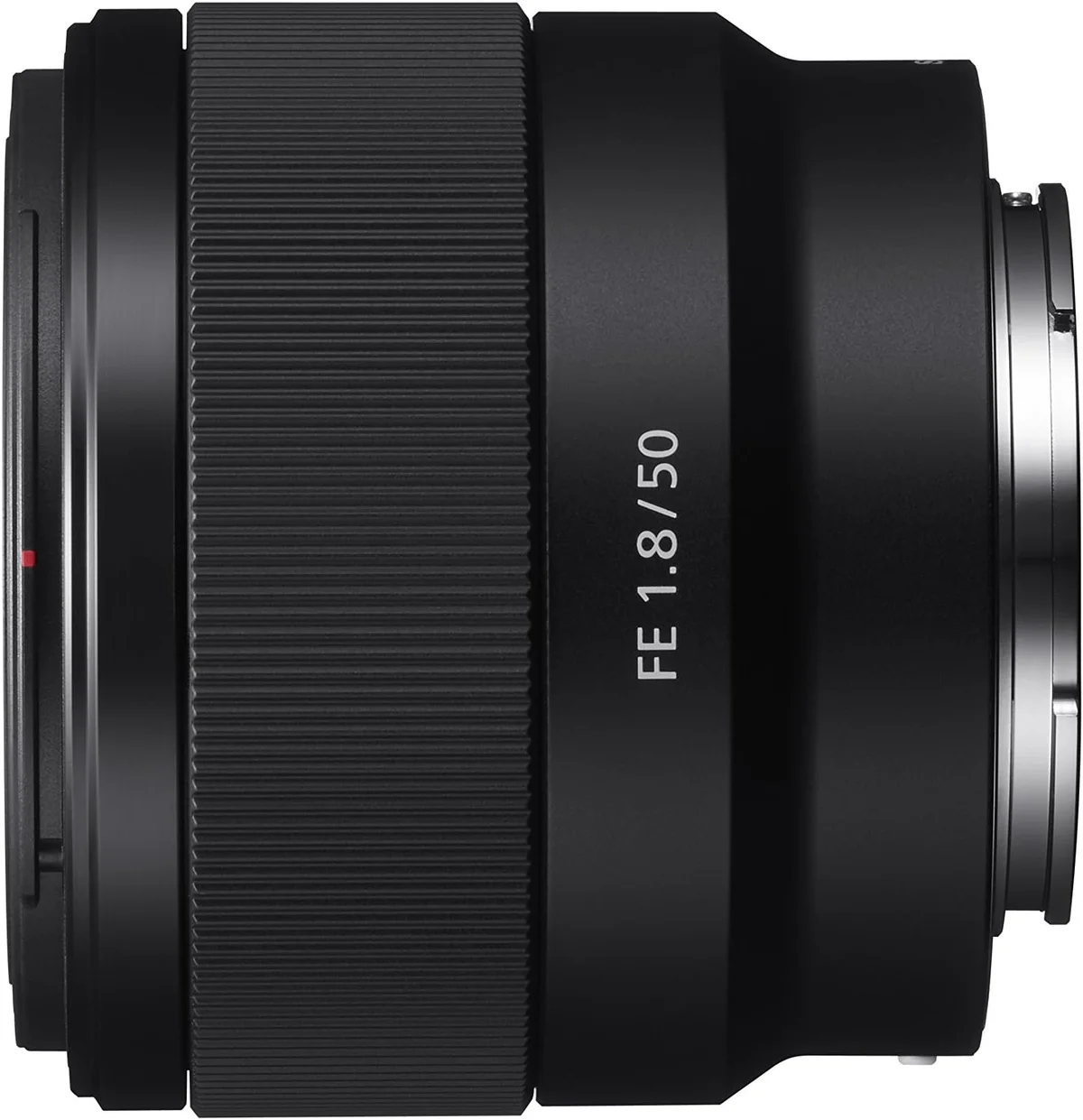
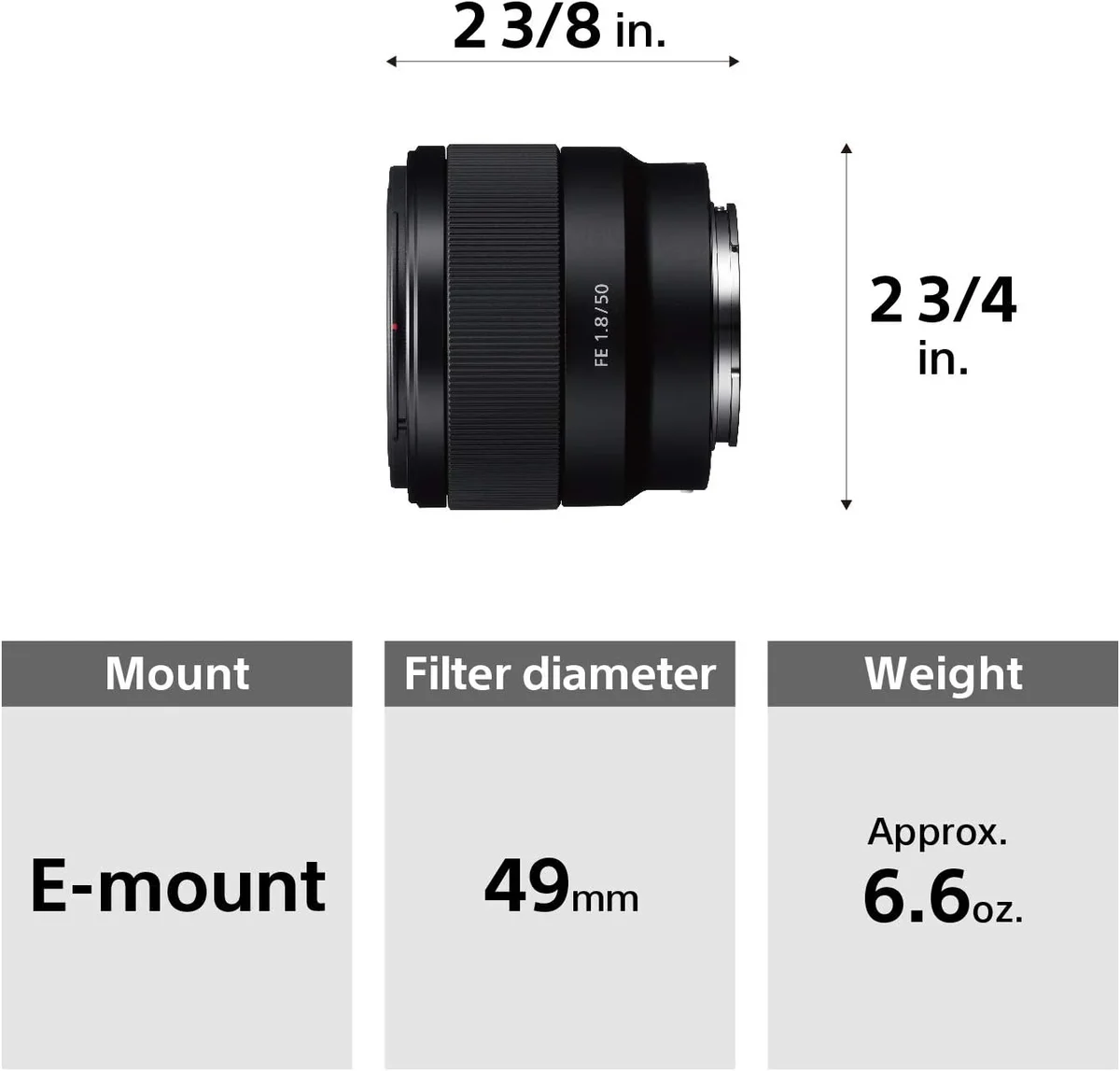
The body is plastic. The mount is metal. The feel splits the difference — lightweight enough to forget it's on the camera, solid enough that you don't worry about snapping it off during a lens swap. At 186g and 68.6mm long, the FE 50mm f/1.8 adds almost nothing to a compact A7C II or A7 IV setup. Compared to the Sigma 50mm f/1.4 DG DN Art at 520g, the weight savings are dramatic. A full day of shooting with the Sony on a neck strap versus the Sigma on a neck strap — your shoulders know the difference by hour three.
The 49mm filter thread is tiny. Most photographers' filter collections start at 67mm or 77mm. Step-up rings work but defeat the compactness. The practical move: use the included lens hood for front element protection and skip filters unless you need an ND for video work.
No weather sealing. Sony reserves gaskets for G and GM lenses. Light rain or beach spray won't kill it immediately, but prolonged moisture exposure risks internal fogging. Photographers who shoot in rain regularly should budget for a rain sleeve or look at the weather-sealed Sony FE 35mm f/1.8, which adds sealing at a slightly higher price.
The Case Against — and For — This Lens
Building the skeptic's case first: the autofocus motor audibly hunts in low light below -1 EV. Multiple Amazon reviewers mention the "rumbling" or "searching" sound when the lens can't lock. One reviewer reported a defective copy where autofocus failed entirely — a reminder that QC varies at budget price points. The plastic body lacks the confidence-inspiring heft of an L-series or GM lens. After a year of daily use, some owners report slight play at the mount. And the focus-by-wire system means the manual focus ring has no mechanical stop, no distance scale, and variable response depending on rotation speed — frustrating for video pullers and zone-focus street shooters.
The enthusiast's case: image quality that punches above this price tier. "The standard for quality, affordability and your intro to professional lenses," writes one 12-year photographer. Multiple reviewers describe the bokeh as "buttery smooth" and "almost magical." The 7-blade circular aperture renders out-of-focus highlights as clean circles rather than polygons. Stopped down to f/2.8, center sharpness matches lenses costing five times more. And at this weight, the lens goes everywhere — it becomes the default walkaround prime that stays on the camera when the zoom bag stays home.
Strengths & Limitations
Strengths
- Exceptional value for a full-frame 50mm f/1.8
- Sharp center performance from f/2.8 onward
- Lightweight at 186g — barely noticeable on body
- Solid autofocus for the price point
Limitations
- Autofocus motor can hunt in low light
- Plastic build feels budget-tier
- No weather sealing
- Focus-by-wire system lacks tactile feedback
Performance
Optical Character: What the Numbers Show
Center sharpness at f/1.8 is good — not exceptional, but competitive with every 50mm in its price class. The single aspherical element controls spherical aberration well enough that portraits shot wide open look sharp on the subject's eyes even when pixel-peeping at 100%. Stop down to f/2.8 and center resolution spikes. The double-gauss optical formula — 6 elements in 5 groups — is proven geometry that Sony has refined across multiple generations.
Corners tell a different story wide open. On a 61MP A7R IV, the extreme edges at f/1.8 soften visibly. For portraits and subject-centered compositions, this is invisible. For architecture, wide scenic shots, or flat-field reproduction work, stop down to f/5.6 where corner performance catches up. Most 50mm shooters never notice because they're rarely framing subjects in the extreme corners at maximum aperture.
Chromatic aberration shows as purple fringing on high-contrast edges — backlit hair, metal edges against bright sky. Sony's in-camera corrections remove most of it from JPEGs. Lightroom's lens profile handles the rest in RAW files. By f/2.8, lateral CA drops to negligible levels.
Bokeh quality is the lens's party trick. The 7-blade circular diaphragm renders background highlights as smooth circles at f/1.8 through f/2.5. Cat's-eye distortion appears near frame edges — physics, not a defect. Transition zones between sharp and blurred areas are gradual, without the nervous doubled-edge "busy bokeh" that cheaper optical designs produce. For portrait work, this rendering matters more than raw resolution numbers.
Autofocus: Where the Budget Shows
The DC motor drives focus adequately in good light. Lock-on time from infinity to close focus runs roughly 0.4 seconds — fast enough for portraits, street, and events. Eye AF works. Animal Eye AF works. The camera's AF system does the heavy lifting; the lens motor just needs to keep up.
Below -1 EV, the motor hunts. Brief forward-back searching before locking is the most common complaint across Amazon reviews. In a dim restaurant, a candlelit ceremony, or an indoor event without strong ambient light, expect occasional missed focus. The lens locks eventually, but the hesitation costs split-second moments. For fast action in low light — reception dancing, concerts, sports under stadium lights — the Sigma 85mm f/1.4 DG DN Art or Sony's own GM primes focus faster and more confidently.
For video: the motor is audible. Quiet enough that an external shotgun mic won't pick it up, but the built-in camera mic will. Focus breathing is minimal — a slight field-of-view shift when racking focus that most viewers won't notice. The f/1.8 aperture gives strong subject isolation for talking-head content. Pair it with a body that has active stabilization for handheld video, since the lens has no OSS.
Close Focus and Macro Capability
Minimum focus distance sits at 0.45m — roughly arm's length. Maximum magnification reaches 0.14x, which is weak by any standard. For food photography on a restaurant table, it works. For product detail shots where you need to fill the frame with a small object, you'll run out of close focus distance before the subject gets large enough. The Sigma 105mm f/2.8 DG DN Macro Art is the obvious choice for true macro work; the FE 50mm f/1.8 is not trying to compete in that space.
Color rendering leans warm — a Sony trait inherited from the Minolta legacy. Skin tones flatter without post-processing. Greens are neutral. Reds stay rich without oversaturating. Side-by-side with the Viltrox 50mm f/1.4, the Sony produces slightly warmer midtones. The difference is subtle in isolation but visible when switching between lenses on the same body during a single session. Contrast wide open runs lower than at f/2.8, giving portraits a gentle quality that many shooters find pleasing. Stopping down past f/4 snaps contrast back to clinical levels — useful when you want punchy color separation for product or commercial work.
Vignetting at f/1.8 darkens corners by roughly 1.5 stops on full-frame bodies. Sony's in-camera profile corrects most of it automatically. Many portrait shooters leave a trace of vignetting intact — it draws the viewer's eye toward the center subject. By f/2.8, vignetting drops to levels invisible in normal viewing. Distortion is negligible: barrel distortion under 0.5%, corrected automatically by every modern RAW processor.

Value Analysis
What Else Could You Buy?
In the Sony FE mount, the competitive field is thin at this price. The Viltrox AF 50mm f/1.8 FE exists at a lower price but with different optical character and no Sony warranty. Moving to f/1.4 means the Viltrox AF 50mm f/1.4 Pro at roughly double the cost, or the Sony FE 50mm f/1.4 GM at eight times the cost. The gap between this lens and the next meaningful upgrade is enormous — which is exactly why the FE 50mm f/1.8 sells so well. There's nothing to agonize over in the mid-range. You either want the budget option or the premium one.
For APS-C Sony shooters, the Sigma 16mm f/1.4 DC DN gives wider framing at f/1.4, but the FE 50mm works on APS-C too — as a 75mm equivalent, it becomes a portrait lens. Different tools.
Resale value stays strong. Budget 50mm primes sell quickly on the used market because every new Sony buyer eventually searches for one. If the lens doesn't match your style, expect to recover 70-80% of purchase price within a week of listing.
For a broader view of where this lens fits among Sony options, see our Sony E-Mount lens roundup — the FE 50mm f/1.8 consistently ranks as the top value pick across every use case except wildlife and sports. And photographers building a two-prime kit often pair it with the Tamron 28-75mm f/2.8 G2 — the zoom covers range, the prime covers low light and portraits.
What to Expect Over Time
How It Holds Up
The plastic body holds up better than the texture suggests. The focus ring collects micro-scratches from friction against camera bags — cosmetic, not functional. The front element coating resists cleaning well but picks up fingerprints if you touch it without thinking. The included petal hood should stay attached permanently.
Sony firmware updates for budget lenses are rare. Autofocus improvements come from camera body firmware, not the lens. The FE 50mm f/1.8 you buy today operates identically to one bought three years ago. What changes is the body paired with it — newer Sony cameras with better AF algorithms extract more from the same optics.
The upgrade path leads to the FE 50mm f/1.4 GM or the Sigma 50mm f/1.4 DG DN Art. Both offer wider aperture, faster AF, weather sealing, and better build — at 3-8x the cost. Most shooters who start with the FE 50mm f/1.8 keep it even after buying the upgrade, because 186g in a jacket pocket beats 520g in a camera bag for spontaneous shooting.
One pattern from long-term owners: this is the lens that teaches you whether you're a 50mm shooter. Some photographers discover they prefer 35mm for the wider perspective or 85mm for tighter portraits. The FE 50mm f/1.8 costs little enough to be an experiment — and if the experiment works, it becomes a permanent part of the kit.
On bodies with IBIS — the A7 III, A7C, A7 IV, and newer — the FE 50mm f/1.8 gains handheld stability it cannot generate on its own. IBIS compensates for camera shake, letting you shoot handheld down to 1/8s in good conditions. On bodies without IBIS (A6400, ZV-E10, older A7 models), you rely entirely on shutter speed. The practical difference: IBIS bodies can drop ISO two stops lower in dim light, which means cleaner shadows and less noise. If you're buying this lens for indoor or evening shooting, the body's stabilization system matters as much as the lens's aperture.
The lens cap is a standard Sony pinch-style design that stays on reliably inside the included petal hood. The rear cap is E-mount standard. Neither is remarkable, but both work without the looseness that plagued earlier budget Sony caps. Small detail, but it matters when you're swapping lenses quickly at an event.
Sony FE 50mm f/1.8: Common Questions
Answers drawn from Amazon owner reviews and independent optical testing data for the Sony FE 50mm f/1.8 (SEL50F18F).
What is the Sony 50mm 1.8 lens good for?
Portraits, street photography, and everyday shooting where you want shallow depth of field and strong low-light performance. The f/1.8 aperture gathers roughly 10x more light than a typical kit zoom at 50mm, which means cleaner images indoors without flash. The 50mm focal length on full-frame closely matches human vision, making compositions feel natural. It also works well for food photography, product shots, and casual video — basically anything where background separation and compact size matter more than zoom flexibility.
What does FE stand for in Sony lenses?
FE means Full-frame E-mount. Sony uses two designations for E-mount lenses: E lenses project a smaller image circle sized for APS-C sensors, while FE lenses project a full-frame image circle. Every FE lens works on both APS-C and full-frame Sony bodies — on APS-C, you get a 1.5x crop factor, so the 50mm becomes a 75mm equivalent field of view. The distinction matters when buying: an E-designated lens on a full-frame body produces heavy vignetting or forces a crop mode.
Is a 50mm too long for street?
Not for most street photographers, but it depends on your style. A 50mm on full-frame frames scenes tighter than a 35mm or 28mm — you isolate subjects rather than capturing wide environmental context. Henri Cartier-Bresson used a 50mm for decades. The compression is flattering for candid portraits and mid-distance scenes. Where 50mm struggles: narrow alleys, crowded markets, or any situation where you physically cannot step back far enough. If you shoot in tight European streets or dense urban markets, a 35mm gives more breathing room.
Is the Sony FE 50mm full-frame?
Yes. The FE designation confirms full-frame coverage. It projects an image circle large enough for Sony's 35mm full-frame sensors (A7 series, A9 series, A1). On APS-C bodies like the A6700 or ZV-E10 II, the lens still works — the camera uses the center portion of the image circle, giving you a 75mm equivalent field of view with no vignetting or quality loss.
How does the Sony FE 50mm f/1.8 compare to the Sigma 56mm f/1.4?
Different lenses for different systems and budgets. The Sony FE 50mm f/1.8 covers full-frame and APS-C, costs less, and weighs 186g. The Sigma 56mm f/1.4 DC DN is APS-C only, opens a stop wider to f/1.4, and delivers sharper corners on crop bodies. If you shoot full-frame Sony, the FE 50mm is the obvious choice. On APS-C, the Sigma gives you more background blur and better edge sharpness at the expense of full-frame compatibility when you eventually upgrade bodies.
Does the Sony FE 50mm f/1.8 have image stabilization?
No. The lens has no optical stabilization (OSS). On bodies with in-body image stabilization — the A7 III and newer full-frame bodies, plus the A6700 — IBIS compensates for camera shake. On older bodies or budget models without IBIS (A6400, A6100, ZV-E10), you rely entirely on shutter speed. At 50mm, the rule of thumb is 1/50s minimum for sharp handheld shots without stabilization, though steady hands can push to 1/25s.