Tamron 28-200mm f/2.8-5.6 Review: The Travel Zoom That Starts at f/2.8
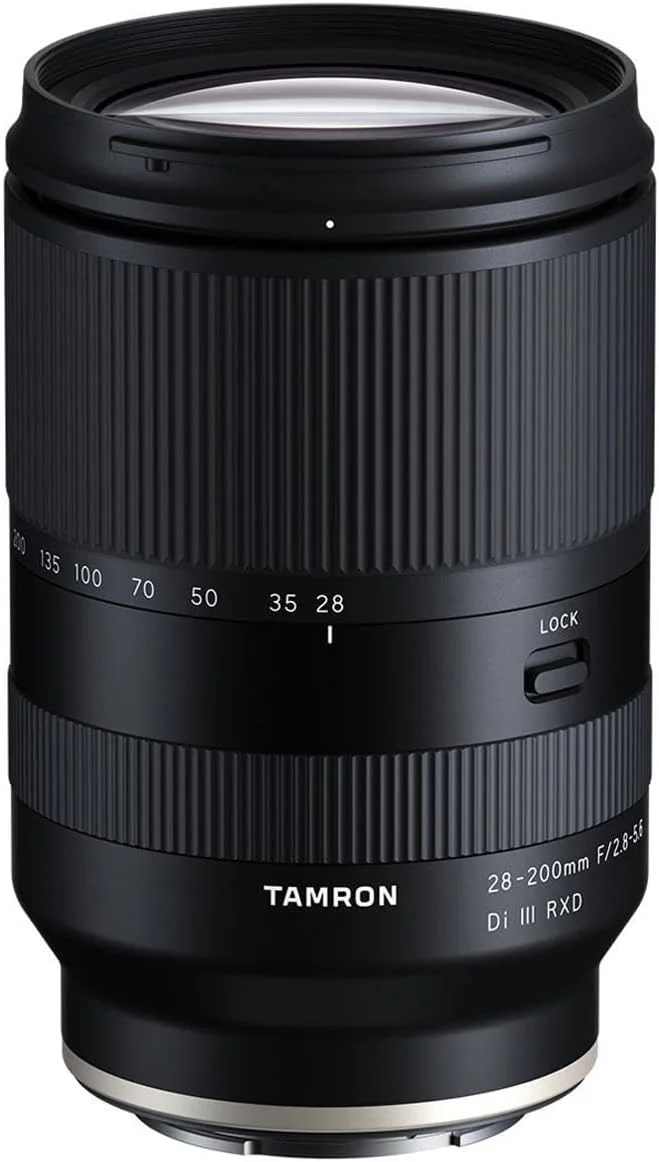
The Tamron 28-200mm is the best travel superzoom for Sony. Starting at f/2.8 is the key differentiator — you actually get usable indoor and low-light performance at the wide end. The tradeoff at 200mm is real, but for a single-lens travel solution, nothing else comes close.
This review is based on analysis of published owner reports, expert reviews, and comparison with products in the Third-Party Lenses category. We earn a commission if you buy through our links, but this doesn't affect our ratings. Read our full methodology →
The Single-Lens Travel Solution
The Tamron 28-200mm f/2.8-5.6 is the best all-in-one travel zoom for Sony full-frame.
Starting at f/2.8 gives it genuine low-light capability that no other superzoom matches. The 28-200mm range eliminates second-lens decisions for 90% of travel and event situations. At 575g, it weighs less than many lenses covering half the range. Image quality at 150-200mm is the honest compromise — usable but not sharp enough for critical work at the pixel level. For photographers who prioritize range and weight over telephoto image quality, the 28-200mm is the single-lens answer. For the broader travel lens decision, see our travel lens guide and our Sony E-mount roundup.
The Tamron 28-200mm is the best travel superzoom for Sony. Starting at f/2.8 is the key differentiator — you actually get usable indoor and low-light performance at the wide end. The tradeoff at 200mm is real, but for a single-lens travel solution, nothing else comes close.
Best for: Travel photographers wanting one lens for everything
Overview
No other all-in-one zoom starts at f/2.8. That opening aperture is the Tamron 28-200mm's defining advantage and the reason it displaced dedicated two-lens travel kits for thousands of Sony shooters. At 28mm and f/2.8, this superzoom gathers as much light as a standard zoom costing twice the price. By 200mm, the aperture narrows to f/5.6 — standard for this class — but the wide end capability sets it apart from every competitor in the category.
We read Amazon owner reviews and cross-referenced field reports from Dustin Abbott, The Phoblographer, and extensive Reddit discussion threads. The consensus across these sources: the Tamron 28-200mm is the best all-in-one zoom for Sony mirrorless. Reviewers consistently praise the focal range coverage and the f/2.8 wide-end performance. The recurring criticism is telephoto image quality — sharpness drops at 150-200mm, particularly in the corners, and the f/5.6 maximum aperture at 200mm limits the lens in low light at the focal lengths where you need the most light.
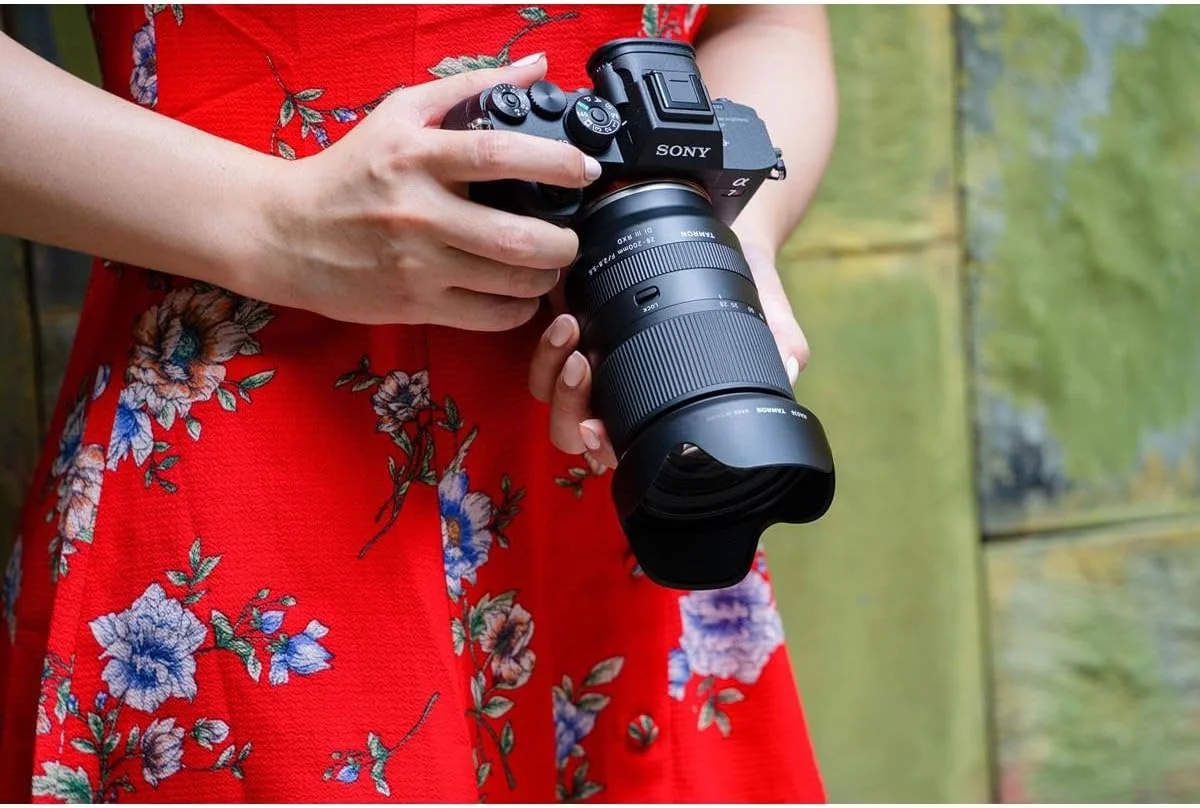
At 575g and 4.6 inches collapsed, the Tamron 28-200mm is lighter and shorter than many standard zooms that cover half the focal range. The Sony 24-105mm f/4 G weighs 663g and stops at 105mm. The Tamron 28-75mm f/2.8 G2 weighs 540g but covers only 28-75mm. The 28-200mm gives up corner sharpness at the telephoto end and stabilization for a zoom range that simply eliminates the need for a second lens on most trips.

Key Specifications
575 Grams for 28-200mm: The Physics of Compact Design
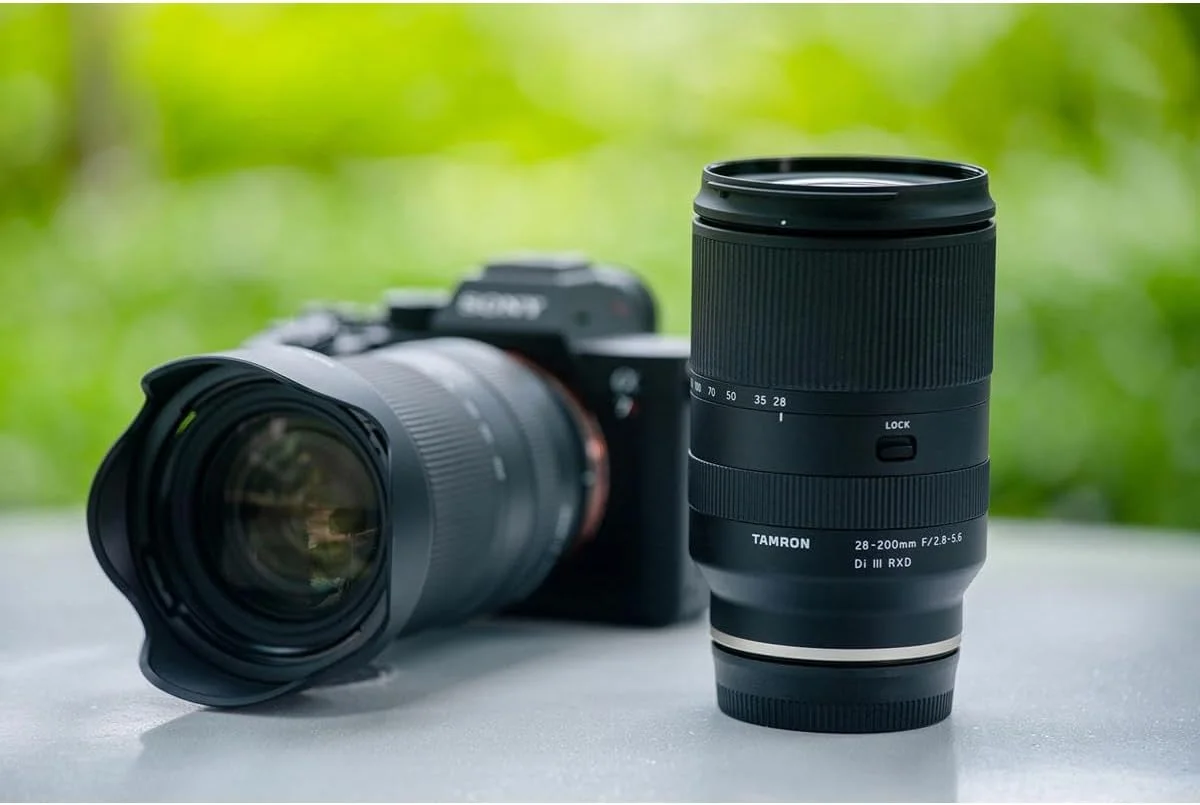
Tamron achieved the compact size through an 18-element optical design that balances resolution against weight. The 67mm filter thread keeps the barrel narrow — small enough to share filters with Tamron's f/2.8 G2 zooms and many Sony primes. Moisture-resistant construction with a fluorine front coating handles light rain and humidity. The zoom lock switch at 28mm prevents barrel creep when carrying the lens pointed downward. Pick it up after handling the Sony 24-105mm G and the weight difference is immediately apparent — 88g lighter with 95mm more reach.
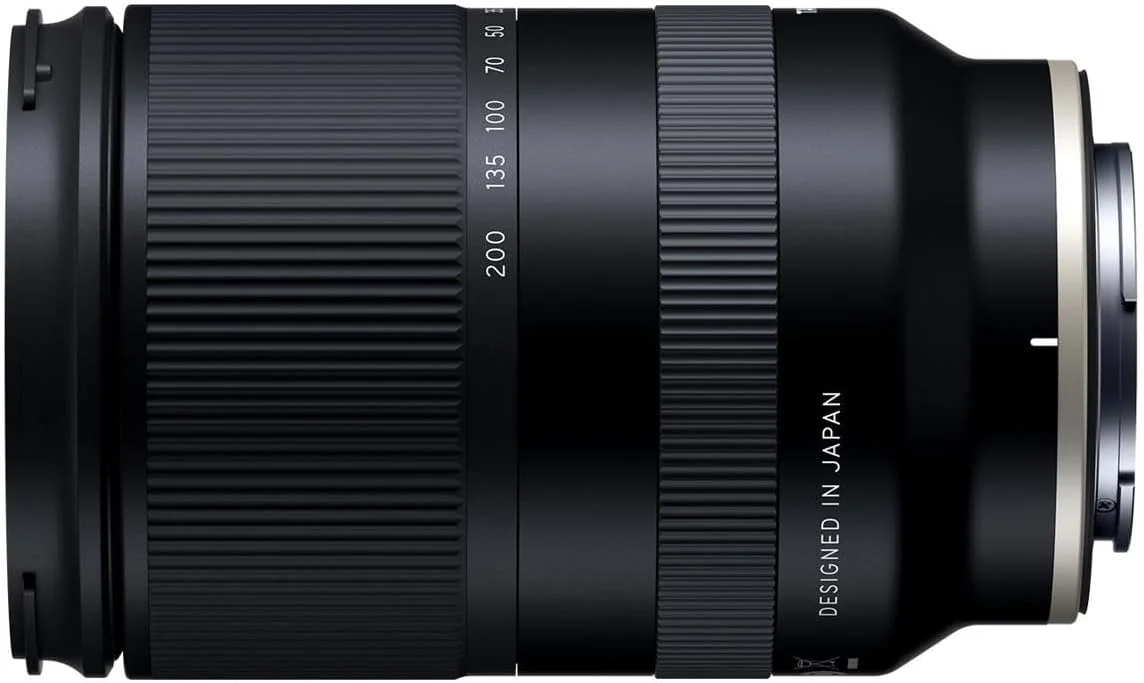
The extending barrel design means the lens lengthens at telephoto settings.
At 200mm, the barrel extends roughly 2 inches beyond its collapsed position. Some photographers find the extending barrel catches on bag openings or jacket pockets. Others note the zoom ring stiffens slightly near 200mm, which adds resistance against accidental zooming but requires more force for quick focal length changes. The design is a deliberate choice: internal zoom would add weight and bulk that defeats the purpose of a travel superzoom. Tamron chose reach and compactness over structural rigidity, and for the target audience — travelers carrying one body and one lens for weeks at a time — that priority is correct.
RXD Autofocus: Fast Enough, Quiet Enough
Tamron's RXD (Rapid eXtra-silent stepping Drive) motor is quieter than their older motor designs and produces no audible noise during video recording on most bodies.
Autofocus speed is fast at 28-100mm — face and eye detection lock reliably on the A7 IV and A7C II. At 150-200mm, focus acquisition slows slightly and the motor can hunt in low-contrast scenes like overcast skies or flat-toned walls. One reviewer shooting birds from a balcony noted the AF would occasionally miss initial lock at 200mm when the subject sat against a busy background — a pattern consistent with stepping motor limitations at long focal lengths.
For street photography and travel, the AF speed is more than adequate. Subjects moving at walking pace through city scenes lock within a fraction of a second. Eye detection works reliably through the zoom range. The main AF limitation is action at the long end — birds in flight at 200mm will challenge the motor, and a dedicated telephoto like the Tamron 150-500mm is the correct tool for that job. For the 28-200mm's intended use — travel, events, daily carry — the RXD motor does its job without drawing attention to itself.
The Honest Assessment
Against this lens: image quality at 150-200mm is the weakest link.
Corner sharpness drops noticeably, and even center resolution cannot match a dedicated telephoto. The f/5.6 maximum aperture at 200mm means ISO 1600-3200 for indoor or overcast telephoto shots — noise becomes a factor on older Sony bodies. No optical stabilization means IBIS does all the work, which limits handheld telephoto shutter speeds compared to lenses with built-in VC like the Tamron 70-180mm f/2.8 G2. Focus hunting at the long end in low contrast is a real operational frustration. And 28mm is not wide enough for architecture, interiors, or group shots in tight spaces — the Sony 24-105mm starts 4mm wider, which matters in those situations.
For this lens: owner reviews tell the story.
"I never imagined such a compact and lightweight combination to get almost every type of photo I need" — that quote represents the majority experience. The f/2.8 wide end enables indoor and low-light shooting that no other superzoom matches. The 28-200mm range means leaving the hotel room with one lens and one body, knowing every situation is covered from wide to telephoto. At the mid-range price tier, it costs less than a Sony 24-70mm f/4 kit lens while delivering 130mm more reach. One videographer described it as the lens that "simplified gear and enhanced workflow with excellent results in almost any situation" — for hybrid shooters who refuse to carry two zooms, that convenience has real value.
Strengths & Limitations
Strengths
- f/2.8 at wide end is fastest-in-class for a superzoom
- 28-200mm covers 90% of travel situations
- Surprisingly sharp for such a wide zoom range
- Only 575g — lighter than most two-lens combos
Limitations
- Image quality drops at the long end
- f/5.6 at 200mm is limiting for action
- Some focus hunting in low contrast scenes
- RXD motor is fast but not as refined as VXD
Performance
Image Quality: The Focal Length Performance Curve
At 28mm and f/2.8, center sharpness is excellent. Corners are good — not at the level of the Sony 24-70mm GM II, but sharp enough for landscape prints and architectural shots without visible softness at normal viewing distances. Stopping down to f/4 brings corners into line. This wide-end performance is the Tamron's calling card: at f/2.8, it produces images that look like they came from a standard zoom, not a superzoom.
The 35-70mm range is the optical sweet spot. Center and corner sharpness at f/4-f/5.6 are strong enough for professional delivery. Chromatic aberration is well-controlled. Distortion is minimal and correctable in software. This is where the lens does its best work — and conveniently, it covers the focal lengths most travel photographers use most often.
From 100-200mm, the compromises become visible. Center sharpness remains acceptable through 150mm at f/5.6. At 200mm, center resolution drops to a level that prints well at 8x10 but shows softness in large prints or 100% crops. Corner sharpness at 200mm is the weakest point — soft enough that landscape shooters should stop down to f/8 for edge-to-edge work. For portraits at 135-200mm, the center sharpness is fine (subjects are centered) and the background is already blurred enough to hide corner softness.
Close Focus: The Hidden Strength
The minimum focus distance is remarkably short for a superzoom: 0.19m (7.5 inches) at the wide end with a maximum magnification of 1:3.1. At 200mm, minimum focus extends to 0.80m (31.5 inches) with 1:3.8 magnification. Both figures exceed what most standard zooms offer. The practical benefit is immediate: shoot a street scene at 28mm, notice an interesting texture or detail, zoom to 200mm and lean in close — the lens focuses. No macro lens swap needed. Food photography, market stalls, botanical details, architectural ornaments — the close-focus capability adds a creative dimension that standard zooms miss.
At 28mm and 0.19m, the ultra-close perspective creates dramatic foreground-to-background compositions that wide-angle macro adapters typically produce. The effect is distinctive: a flower or shell in sharp focus filling the lower frame with a sweeping landscape behind it. This is not a substitute for true 1:1 macro work, but for travel photographers who want occasional close-up capability without a dedicated macro lens, the 28-200mm delivers more than expected.
Value Analysis
The One-Lens Travel Kit
Pair the Tamron 28-200mm with a Sony A7C II (515g) and the total system weighs 1,090g — a full-frame kit covering 28-200mm under 1.1kg. For comparison, a two-lens kit of Tamron 28-75mm G2 plus Tamron 70-300mm weighs 1,085g in lenses alone — before adding the body. The single-lens approach eliminates weight, bag space, and the risk of sensor dust from lens changes in the field.
For travelers who want a backup for low light, the Sony FE 50mm f/1.8 at 186g adds an f/1.8 option for restaurants, evening streets, and dimly lit venues. The two-lens travel kit — 28-200mm zoom plus 50mm f/1.8 prime — weighs 761g total and covers every photographic situation from wide architecture to telephoto details to low-light candids. Our travel lens guide compares this approach against alternatives in detail.
Versus the Tamron 18-300mm (Sony E), the 28-200mm offers better image quality and a faster wide-end aperture. The 18-300mm covers APS-C sensors and provides 100mm more reach with a wider starting point. For full-frame Sony shooters, the 28-200mm is the correct choice. For APS-C Sony bodies (A6700, ZV-E10 II), the 18-300mm covers more range with a matched sensor size. Choose based on your sensor format.
What to Expect Over Time
Video Performance: One Lens for Hybrid Shooters
Hybrid shooters — those who switch between stills and video throughout a session — are the Tamron 28-200mm's ideal audience.
The RXD motor is quiet enough for built-in microphone recording. Focus transitions at 28-100mm are smooth and predictable. At the telephoto end, focus racks show visible breathing (field of view narrows), which Sony's breathing compensation partially corrects on compatible bodies. The lack of optical stabilization is the main video limitation: handheld footage at 150-200mm shows more shake than stabilized lenses, and IBIS alone cannot fully compensate at those focal lengths. For content creators shooting walkthrough videos, B-roll, and talking-head content at 28-85mm, the lens performs well without a gimbal. Above 100mm, a support system improves results.
The variable aperture creates exposure shifts when zooming during video — a characteristic of all variable-aperture lenses that requires manual compensation or auto-ISO to manage. Locking a focal length before recording eliminates this, but it removes the ability to zoom during a shot. For run-and-gun documentary-style shooting where zooming mid-clip is common, constant-aperture zooms like the Tamron 28-75mm G2 handle this more gracefully.
Years of Owner Data
The Tamron 28-200mm launched in 2020 and has accumulated substantial long-term user data. The moisture-resistant construction holds up through extended travel in humid and dusty environments. The fluorine coating continues to repel fingerprints and water spots after years of cleaning. The zoom ring maintains smooth, consistent tension — no reports of the loosening or stiffening that affects some heavily-used zooms. The zoom lock mechanism works reliably and has not developed play.
Tamron has released firmware updates improving AF compatibility with newer Sony bodies (A7C II, A7R V, A9 III). The Tamron Lens Utility software allows firmware updates via USB from a computer, without shipping the lens to a service center. The RXD motor shows no degradation in focus speed or accuracy after extended use based on reviewer reports spanning two to three years.
Used market prices remain strong at 70-75% of retail. The 28-200mm has no direct successor — Tamron has not announced a G2 version — and no competing all-in-one zoom matches its wide-end aperture. This lack of competition keeps demand steady. For photographers considering resale, the lens holds its value better than most third-party zoom options. The 67mm filter thread means existing filter investments carry over to other Tamron zooms in the G2 lineup.
Tamron 28-200mm — Travel and Range Questions
Answers based on Amazon owner reviews, optical test data from Dustin Abbott, and cross-referenced travel photography field reports for the Tamron 28-200mm f/2.8-5.6 Di III RXD (A071).
Is the Tamron 28-200mm sharp enough for professional work?
At 28-70mm, center sharpness is strong enough for professional prints and commercial delivery. The lens peaks between 35-50mm at f/4-f/5.6, where it rivals dedicated standard zooms. From 70-135mm, quality remains solid for portraits, events, and editorial work. At 150-200mm, center sharpness drops — usable for web and social media, but pixel-peeping reveals softness that a dedicated telephoto like the Tamron 70-180mm f/2.8 G2 avoids. For professionals who need one lens covering 90% of situations with acceptable quality, the 28-200mm delivers. For clients demanding pixel-level sharpness at every focal length, pair it with a prime for critical shots.
How does the Tamron 28-200mm compare to the Sony 24-105mm f/4 G?
The Tamron covers nearly twice the focal range (28-200mm vs 24-105mm) and starts at f/2.8 at the wide end — faster than the Sony's constant f/4. The Sony is sharper at shared focal lengths, especially in the corners, maintains f/4 throughout its range (the Tamron slows to f/5.6 by 200mm), and includes OSS optical stabilization. The Sony also starts 4mm wider at 24mm. Weight favors the Tamron: 575g versus 663g. For one-lens travel where reach matters most, the Tamron wins. For consistent optical quality and stabilization, the Sony wins.
Does the Tamron 28-200mm have image stabilization?
No. The Tamron 28-200mm does not include optical stabilization (OIS/VR/VC). It relies entirely on in-body image stabilization (IBIS) from your Sony camera. On current bodies like the A7 IV, A7C II, and A7R V, IBIS provides 5-5.5 stops of stabilization. At 28-50mm, IBIS alone is sufficient for handheld stills down to 1/15 second in most conditions. At 200mm, IBIS effectiveness drops — expect 1/100 second as a practical minimum for sharp handheld shots. For video, IBIS handles 28-100mm handheld reasonably well, but 150-200mm benefits from a tripod or gimbal.
What is the Tamron 28-200mm best used for?
Travel photography is the primary use case. The 28-200mm focal range covers architecture (28mm), street and environmental portraits (50-85mm), and wildlife or sports details (150-200mm) without a lens change. Event photography — conferences, parties, outdoor ceremonies — works well because you never miss a moment reaching for a second lens. Content creators shooting for social media benefit from the one-lens convenience. Landscape photography works at 28-50mm but the lack of a wider angle limits compositions. Not ideal for: low-light events (f/5.6 at the long end), studio portraits (prime bokeh is superior), or wildlife where 200mm is rarely long enough.
Is f/2.8 at 28mm actually useful on this lens?
Very useful. Most superzooms start at f/3.5 or f/4. Starting at f/2.8 gives the Tamron 28-200mm genuine low-light capability at the wide end — restaurant interiors, dimly lit streets, indoor events without flash. The f/2.8 aperture also enables subject separation that f/3.5 or f/4 zooms cannot match at 28mm. Background blur is visible and pleasant at close focus distances. One reviewer shooting a three-week European trip noted the f/2.8 wide end was the difference between usable and unusable photos in churches, museums, and evening street scenes.