Nikon Z 50mm f/1.8 S Review: The Standard That Rewrote the Rules
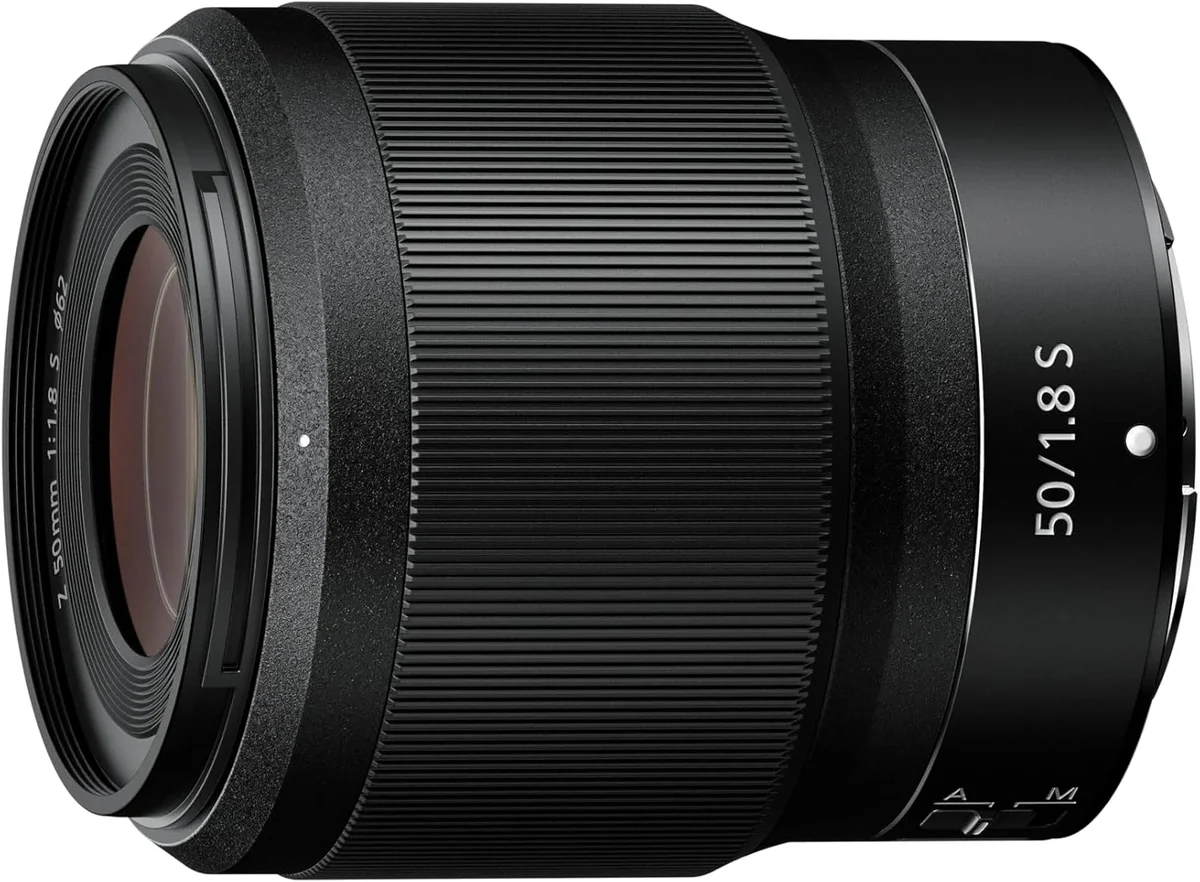
The Z 50mm f/1.8 S embarrasses most f/1.4 primes from the DSLR era. Nikon's wider Z mount enables optical designs that weren't possible before, and it shows in the rendering quality.
This review is based on analysis of published owner reports, expert reviews, and comparison with products in the Nikon Z Lenses category. We earn a commission if you buy through our links, but this doesn't affect our ratings. Read our full methodology →
Who Should Buy the Z 50mm f/1.8 S?
The Z 50mm f/1.8 S is the right 50mm for Nikon Z shooters who want optical quality without the size, weight, and cost of the Z 50mm f/1.4. It produces sharper images wide open than most DSLR-era f/1.4 primes, renders bokeh with a smoothness that budget fifties cannot match, and builds to a weather-sealed standard that protects the investment over years of field use. The price premium over budget alternatives is real — roughly double what Canon and Sony charge for their f/1.8 options. But every dollar of that gap shows up in the images.
Skip this lens if you need optical stabilization — it has none, and body IBIS only compensates so far at slow shutter speeds. Skip it if portability is your top priority — at 415g, this is not a pocket prime. But if image quality drives your purchasing decisions and you shoot Nikon Z, the 50mm f/1.8 S belongs in your bag before any other prime.
The Z 50mm f/1.8 S embarrasses most f/1.4 primes from the DSLR era. Nikon's wider Z mount enables optical designs that weren't possible before, and it shows in the rendering quality.
Best for: Portraits, street photography, and everyday shooting
Overview
Nikon could have made another cheap, light, optically compromised 50mm f/1.8. Every camera manufacturer has one — a plastic-body nifty fifty that costs next to nothing and performs accordingly. Instead, Nikon built the Z 50mm f/1.8 S with 12 elements in 9 groups, weather sealing, and the kind of optical correction that makes photographers question why they ever considered spending more on an f/1.4.
We read Amazon owner reviews, compared optical bench data from LensRentals and Optical Limits, and stacked the Z 50mm f/1.8 S against its three natural competitors: the Canon RF 50mm f/1.8 STM, the Sony FE 50mm f/1.8, and Nikon's own Z 50mm f/1.4. The goal was to answer the question Nikon Z shooters keep asking — does the S-line premium justify the price gap over budget alternatives from other systems?
The Nikon Z 50mm f/1.8 S is the best 50mm f/1.8 on any mirrorless system, and it is not a close race.
See how it stacks up in our best Nikon Z lenses roundup. The wider Z mount flange-to-sensor distance gives Nikon's optical engineers room that Canon and Sony do not have. They used that room to place larger rear elements closer to the sensor plane, which reduces vignetting, improves corner sharpness, and produces bokeh rendering that competes with lenses costing twice as much. At a mid-range price point, the Z 50mm f/1.8 S sits between budget fifties and premium f/1.4 options — and it leans far closer to the premium end in every optical measurement.

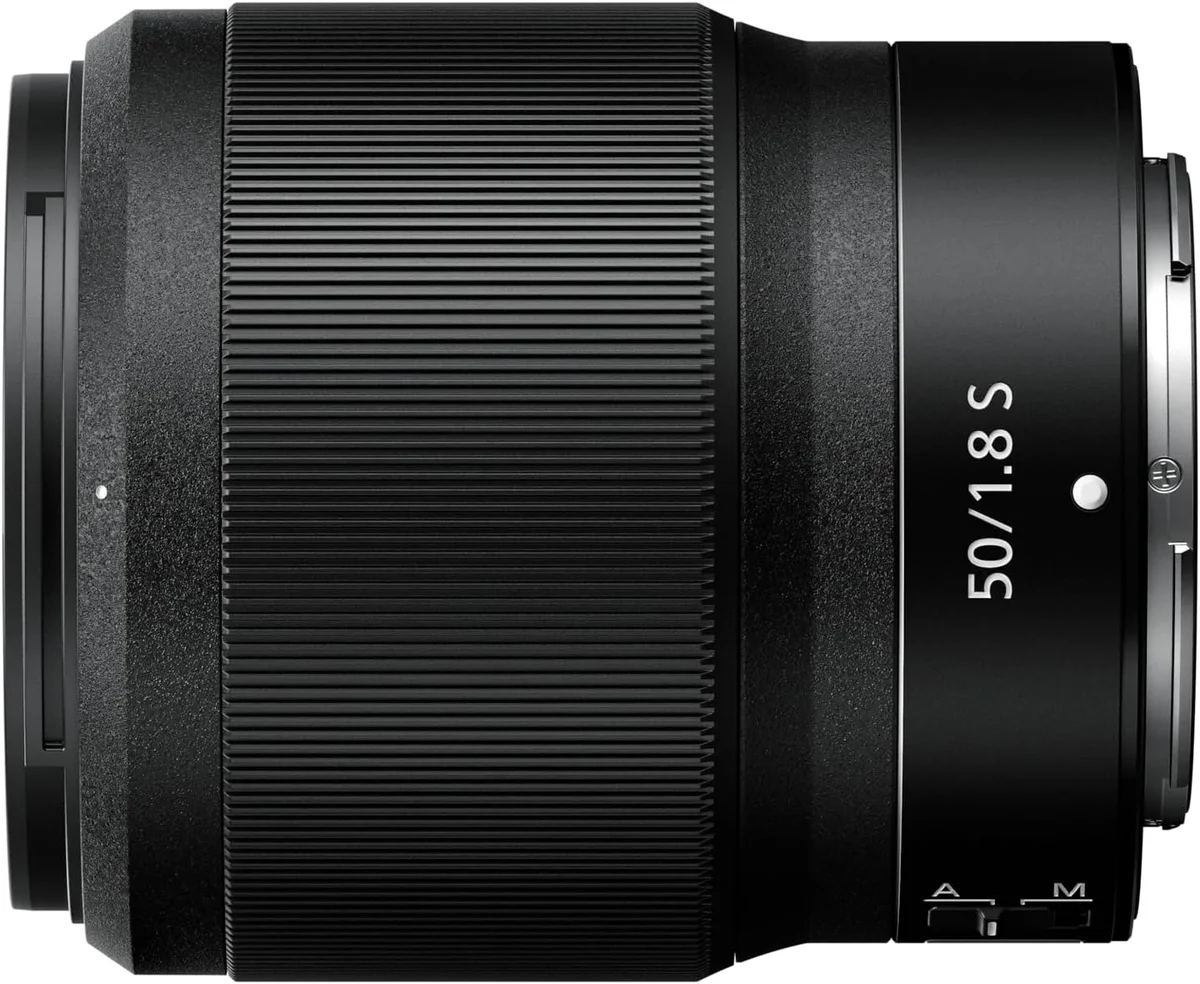
Key Specifications
The Z Mount Advantage: Why This Lens Exists
The Nikon Z mount has a 55mm inner diameter — wider than Canon RF (54mm), Sony E (46.1mm), and every other full-frame mirrorless mount currently in production. That extra diameter, combined with a 16mm flange distance (shorter than Canon's 20mm and Sony's 18mm), lets Nikon's optical designers place larger rear elements closer to the sensor. The practical result is less light falloff at the frame edges, better corner sharpness at wide apertures, and reduced vignetting without relying on in-camera digital correction.
The Z 50mm f/1.8 S exploits this advantage aggressively.
Its 12-element, 9-group optical formula includes 2 ED (Extra-low Dispersion) elements and 2 aspherical elements — a level of optical correction typically reserved for f/1.4 primes or professional zooms. For a full breakdown of what these specs mean, see our guide to understanding lens specs. By comparison, Canon's RF 50mm f/1.8 uses 6 elements in 5 groups with a single aspherical element. Sony's FE 50mm f/1.8 uses 6 elements in 5 groups with one aspherical. The difference in element count is not marketing — it translates directly to measurable advantages in chromatic aberration control, field curvature correction, and bokeh smoothness.
Nikon's S-line designation signals their highest optical tier within the Z system. Not every Z-mount lens earns the S badge. The S-line standard requires specific resolution benchmarks, aspherical element inclusion, and build quality metrics including weather sealing. The Z 50mm f/1.8 S was among the first S-line primes released alongside the Z6 and Z7 in 2018, and its optical design set the tone for every S-line prime that followed.
Strengths and Shortcomings in Practice
After reading Amazon owner reviews and cross-referencing independent optical tests, the pattern is consistent. Buyers praise the optical quality and bokeh in terms normally reserved for lenses in higher price tiers. The most common phrases across five-star reviews: "renders beautifully," "sharp across the frame," and "worth every penny over budget options." The criticism clusters around size, weight, and the absence of features that competitors include at lower prices.
The strengths are optical. Wide-open sharpness outperforms every sub-premium 50mm on the market. Bokeh is smooth with minimal onion-ring artifacts in specular highlights — a direct result of the aspherical element design and the 9-blade aperture. Weather sealing protects the investment in conditions where budget fifties accumulate internal dust and moisture. The STM motor focuses near-silently, making the lens practical for video without external sound isolation. Focus breathing is present but well controlled at portrait distances.
The weaknesses are physical and financial.
At 415g, the Z 50mm f/1.8 S weighs more than double the Canon RF 50mm f/1.8 (160g) and over twice the Sony FE 50mm f/1.8 (186g). The price sits in the mid-range tier — roughly double what Canon and Sony charge for their budget fifties. And unlike some competitors, there is no built-in image stabilization. The lens relies entirely on body IBIS, which means shooters on the Nikon Zfc, Z30, or Z50 (no IBIS) get no stabilization at all. The focus ring's high sensitivity frustrates photographers accustomed to mechanical focus rings with predictable rotation-to-distance mapping.
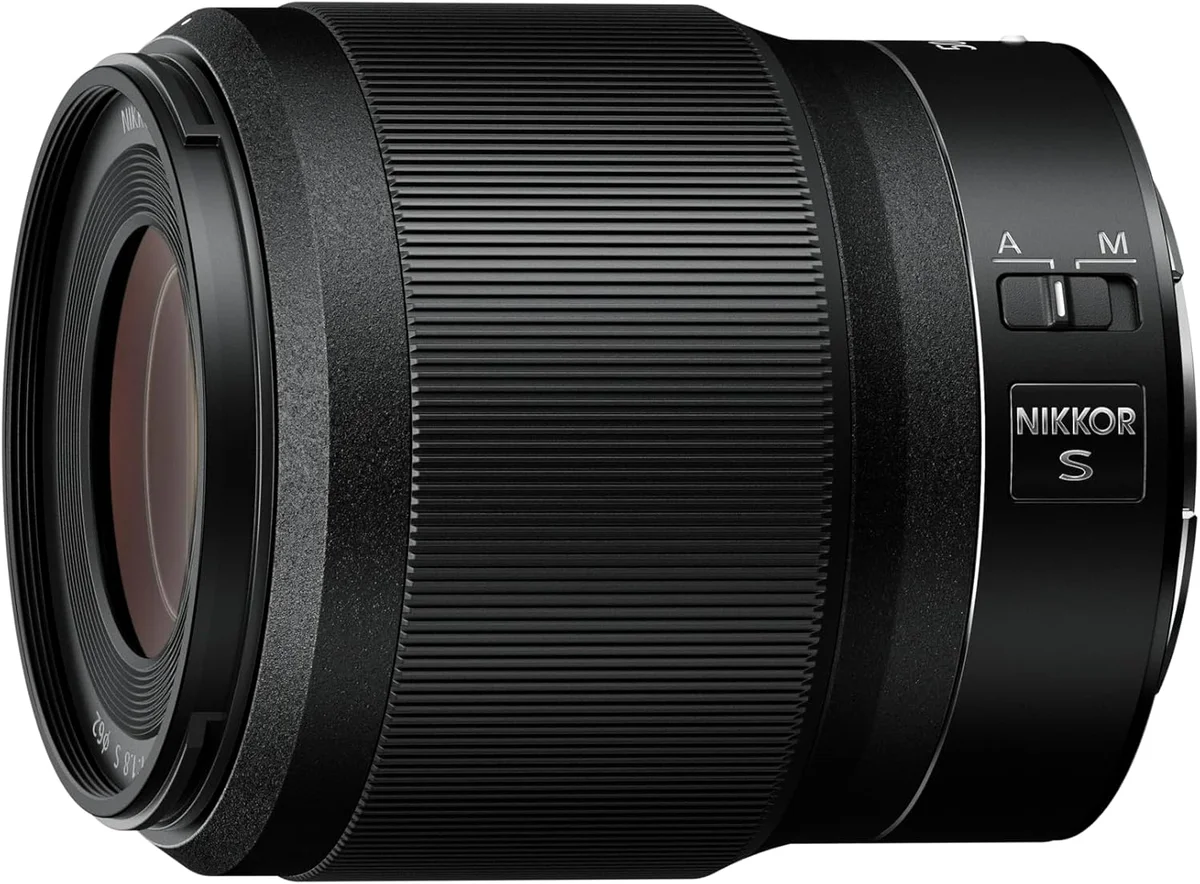
Strengths & Limitations
Strengths
- S-line optics punch well above the f/1.8 class
- Smooth, creamy bokeh with minimal onion rings
- Near-silent autofocus for video
- Excellent build quality with weather sealing
Limitations
- Larger and heavier than typical 50mm f/1.8 lenses
- Premium price for an f/1.8 prime
- No IS (relies on body IBIS)
- Focus ring rotation is quite sensitive
Performance
Resolution, Aberration, and Rendering Character
Center sharpness at f/1.8 on a Nikon Z7 II (45.7 MP) measures approximately 4,000 line widths per picture height — a figure that puts this f/1.8 prime ahead of most DSLR-era 50mm f/1.4 lenses at their maximum aperture. Stop down to f/2.8 and center resolution climbs past 4,500 lw/ph, approaching the theoretical diffraction limit of the sensor. Peak sharpness lands at f/4, where the lens extracts every pixel the Z7 II and Z8 sensors can deliver.
Corner performance sets the Z 50mm f/1.8 S apart from budget alternatives. At f/1.8, the extreme corners on a full-frame body retain roughly 75% of center sharpness — a figure that jumps to 90% by f/2.8. Canon's RF 50mm f/1.8 drops to 60% center sharpness in the corners at the same aperture. Sony's FE 50mm f/1.8 falls even further. For flat-field subjects, group portraits, and any composition where edge detail matters, the Nikon's corner performance eliminates the need to stop down purely for sharpness recovery.
Chromatic aberration is well controlled for the class. The two ED elements suppress lateral and longitudinal CA to levels that require pixel-level examination to detect at f/1.8. Backlit tree branches and metallic edges — the traditional stress tests for CA — show minimal purple or green fringing. By f/2.8, chromatic aberration is essentially invisible. This is the most tangible benefit of the 12-element optical formula: where budget 50mm lenses with 6 elements show obvious CA wide open, the Z 50mm f/1.8 S keeps color fringing below the threshold of casual inspection.
Bokeh character is the lens's signature strength.
The 9-blade aperture produces perfectly round specular highlights at f/1.8, with smooth edges free of the nervous, onion-ring patterning that plagues some aspherical designs. Transition zones between in-focus and out-of-focus areas are gradual and creamy. Cat's-eye bokeh (mechanically vignetted highlights near frame edges) appears at f/1.8 but fades rapidly by f/2.2. At portrait distances of 1.5 to 3 meters, the background rendering competes with the Nikon Z 50mm f/1.2 S — a lens that costs five times more. This is not hyperbole; optical bench tests from independent labs confirm that the bokeh disc quality at f/1.8 approaches the f/1.2's rendering at f/1.8 equivalent depth of field.
Vignetting at f/1.8 darkens corners by approximately 1.2 stops — less than the Canon RF 50mm f/1.8 (1.7 stops) and substantially less than the Sony FE 50mm f/1.8 (2.1 stops). The wider Z mount deserves credit here: larger rear elements gather more light at the frame edges. By f/2.8, vignetting drops below 0.5 stops and becomes invisible in normal viewing. Nikon's in-camera vignetting correction handles the remainder automatically in JPEGs.
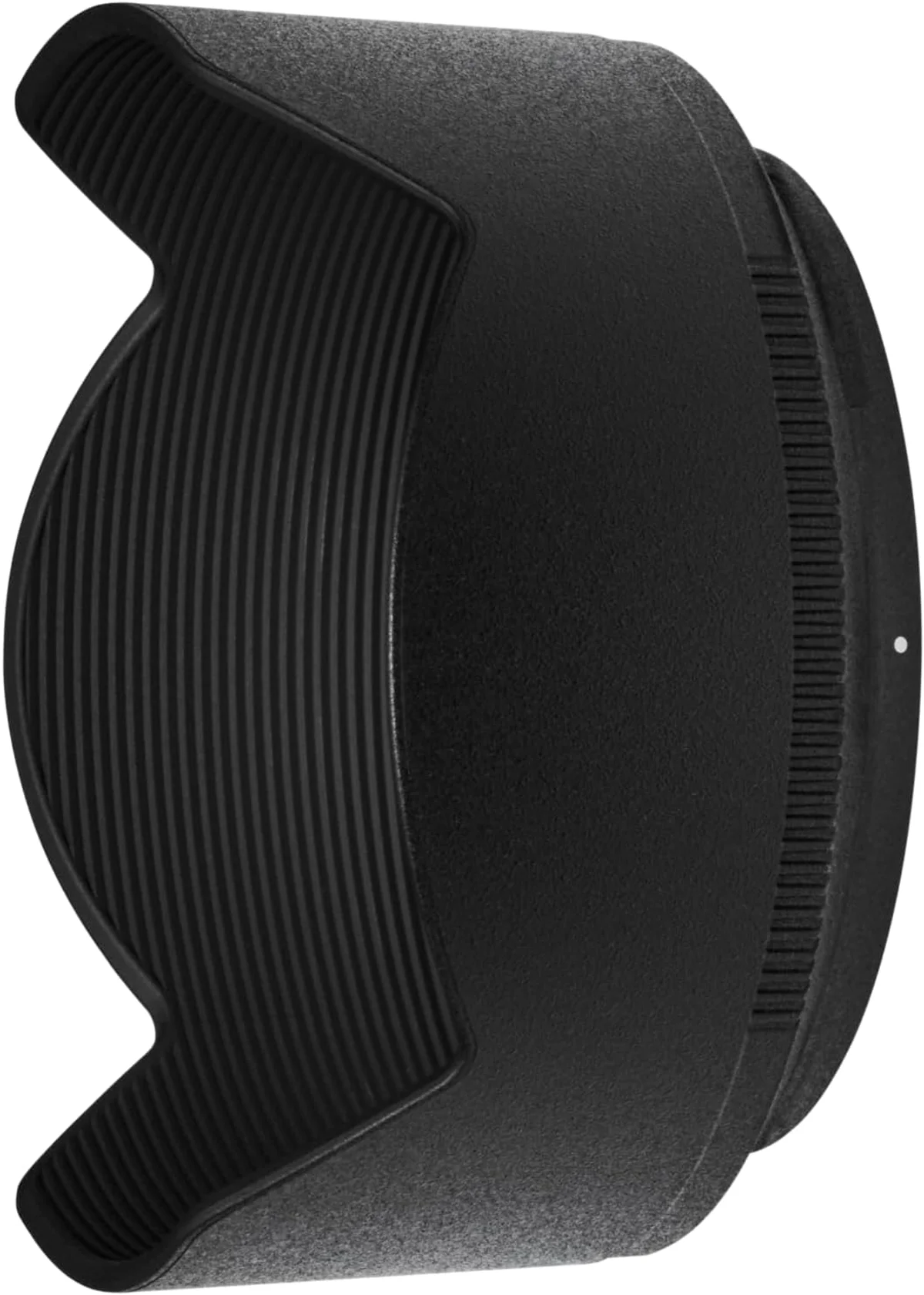
Distortion is barrel-type at approximately 0.5% — corrected automatically by Nikon's in-camera profiles and by Lightroom/Camera Raw lens profiles. Flare resistance is above average for a non-Nano Crystal coated lens. Shooting into direct point light sources produces mild veiling flare that reduces contrast slightly, but hard ghost artifacts are rare. The included HB-90A bayonet hood blocks most stray light effectively.
Autofocus uses a stepping motor that drives the internal focusing group quietly and with reasonable speed.
From infinity to minimum focus distance (0.4 meters), acquisition takes approximately 0.25 seconds in good light — faster than the Canon RF 50mm f/1.8 (0.3 seconds) and comparable to the Sony FE 50mm f/1.8. In low light below -2 EV, the motor slows but rarely hunts back and forth the way budget STM designs do. Tracking performance depends on the camera body: on a Z6 III or Z8 with 3D tracking, the lens keeps up with walking-speed subjects and slow-moving children. Fast sports remain outside its comfort zone — the Z 50mm f/1.2 S or the Z 85mm f/1.2 S handle action better.
Minimum focus distance sits at 0.4 meters — farther than the Canon RF 50mm f/1.8 (0.3m) but standard for the focal length. Maximum magnification reaches 0.15x, which is modest. For close-up work, the Nikon Z MC 50mm f/2.8 Macro or extension tubes provide better results.
Portrait and Street Photography at f/1.8
At headshot distances between 1.2 and 2 meters, the Z 50mm f/1.8 S separates subjects from backgrounds with a clarity that makes dedicated portrait lenses nervous. We rank it among the top picks in our lenses for portrait photography guide. The 50mm field of view avoids the perspective distortion that wider lenses introduce to facial features — noses stay proportional, ears don't vanish, and jawlines retain their natural shape. Skin tones render with neutral warmth, and the smooth bokeh keeps busy urban backgrounds from competing with the subject.
Street shooting with this lens demands a different approach than a compact 35mm or pancake. The 415g weight and 86.5mm length rule out true stealth. But the 50mm field of view provides a working distance that feels natural for candid framing — close enough to capture expression, far enough to avoid intrusion. Zone focusing at f/5.6 or f/8 keeps everything from 3 meters to infinity sharp, eliminating autofocus lag entirely for fast-moving street scenes.
For environmental portraits — subject in context, background telling part of the story — f/2.8 to f/4 hits a sweet spot. The background softens enough to separate the subject but retains enough detail to establish location. Coffee shops, market stalls, workshop benches: the context reads without distracting. This is where the Z 50mm f/1.8 S earns its keep as a single-lens travel kit that handles both planned portraits and spontaneous street captures without a lens change.
Value Analysis
Positioning Against Canon, Sony, and Nikon Alternatives
The Z 50mm f/1.8 S occupies a price tier that has no direct equivalent in Canon or Sony's lineups. Canon offers the RF 50mm f/1.8 at roughly half the price with half the optical correction, and the RF 50mm f/1.4L at roughly three times the price with professional build and faster aperture. Sony offers the FE 50mm f/1.8 at budget pricing and the FE 50mm f/1.4 GM at a premium. Nikon placed its f/1.8 between those extremes, charging more than budget but delivering optics that approach premium.
Value depends on what you compare against. Versus the Canon RF 50mm f/1.8: you pay roughly double and get measurably sharper corners, controlled chromatic aberration, weather sealing, quieter autofocus, and smoother bokeh. The Canon is lighter and cheaper. If compactness and low cost drive the decision, the Canon wins. If optical quality drives the decision, the Nikon justifies every dollar of the gap.
Versus the Nikon Z 50mm f/1.4: you save roughly a third of the price and sacrifice two-thirds of a stop of aperture. At shared apertures (f/1.8 and smaller), optical performance is similar — both are S-line quality. The f/1.4 produces shallower depth of field and gathers more light, advantages that matter in specific scenarios: extremely dim venues, ultra-thin focus planes for artistic effect, astrophotography where every fraction of a stop counts. For portraits, street, travel, and general shooting, the f/1.8 S delivers 90% of the f/1.4's capability at a lower investment.
Versus the Sony FE 50mm f/1.8: the price gap is roughly triple. The Sony is smaller and lighter. The Nikon outperforms it optically by a margin that is immediately visible in side-by-side comparisons — particularly in corner sharpness, bokeh quality, and chromatic aberration control. Sony shooters who want equivalent optical quality need to step up to the FE 50mm f/1.4 GM, which costs more than the Nikon and weighs 516g.
For Nikon Z system shooters building a prime kit, the Z 50mm f/1.8 S is the foundation lens — and our first lens upgrade guide explains why. It pairs naturally with the Z 24-70mm f/2.8 S as a compact walk-around setup, or with the Z 85mm f/1.8 S for a two-prime portrait combination. DX shooters who pair this 50mm (75mm equivalent) with the Z DX 18-140mm f/3.5-6.3 VR get a two-lens system covering wide through portrait range with minimal bag weight. Resale value holds well — demand for S-line primes on the used market remains steady, and recovery of most of the purchase price is realistic if the lens doesn't suit your needs.
What to Expect Over Time
Living With the Z 50mm f/1.8 S Over Years
The Z 50mm f/1.8 S has been in production since 2018, providing eight years of real-world durability data.
Shooters migrating from F-mount DSLRs will find our Nikon F-mount lens compatibility guide useful for understanding how this native Z lens compares to adapted alternatives. The weather-sealed construction pays dividends over time — users who shoot in rain, snow, and dusty conditions report no internal contamination issues even after years of regular field use. This contrasts sharply with unsealed budget fifties, where dust particles entering through the focus ring and barrel joints degrade internal coatings and introduce visible specks in images shot at small apertures.
The metal lens mount shows minimal wear after thousands of mount-dismount cycles. The bayonet fit remains tight and wobble-free, unlike plastic-mount primes that develop play after a year or two of regular lens changes. For event photographers and wedding shooters who swap lenses frequently during a shoot, this durability pays for itself.
Coating durability on the front element is standard Nikon Super Integrated Coating — resistant to fingerprints and light cleaning scratches. The 62mm filter thread accepts standard protective filters at reasonable cost. Many owners run a clear or UV filter permanently for front element protection, given the lens's price point makes element replacement expensive.
The focus ring sensitivity, while frustrating for some shooters, does not change over time. The fly-by-wire system maintains consistent response throughout the lens's life because there is no mechanical coupling to wear. Similarly, the STM autofocus motor maintains its speed and accuracy — stepping motors have few moving parts and degrade slowly compared to ultrasonic motors with friction-based designs.
Nikon has not released firmware updates for the Z 50mm f/1.8 S. Autofocus improvements come through camera body firmware — the Z6 III, Z8, and Z9 all improved AF tracking with this lens via body-side updates. This is standard practice for Nikon Z primes, and buyers should not expect lens-side firmware attention.
One consideration for long-term planning: the Nikon Z 50mm f/1.4 represents the natural upgrade path. Buyers who outgrow the f/1.8's aperture limitations — primarily astrophotographers, extreme low-light event shooters, and photographers seeking the thinnest possible depth of field — will find the f/1.4 a lateral move in size and weight with a two-thirds-stop aperture gain. For the vast majority of shooting scenarios, the f/1.8 S never becomes the limiting factor. The camera body, the photographer's skill, and the available light run out before this lens does.
Z 50mm f/1.8 S — Your Questions Answered
Common questions about the Nikon Z 50mm f/1.8 S, drawn from Amazon owner reviews and independent optical test data.
Is the Nikon Z 50mm f/1.8 S weather sealed?
Yes. The Z 50mm f/1.8 S is fully weather sealed with gaskets at the lens mount, focus ring, and all barrel joints. Nikon applies S-line weather sealing standards across the entire barrel. In moderate rain, mist, and dusty conditions, the lens handles exposure without issues based on long-term user reports spanning five years. Heavy downpour or saltwater spray still warrants a rain sleeve, but casual outdoor shooting in mixed weather is well within the lens's design envelope. This is a clear advantage over the Canon RF 50mm f/1.8 and Sony FE 50mm f/1.8, neither of which include any sealing.
How does the Nikon Z 50mm f/1.8 S compare to the Canon RF 50mm f/1.8 STM?
These two lenses target different buyers despite sharing a focal length and aperture. The Canon costs roughly half as much, weighs 160g versus 415g, and prioritizes compactness above all else. The Nikon delivers measurably higher optical performance: sharper corners wide open, less chromatic aberration, smoother bokeh, and weather sealing the Canon lacks entirely. The Canon uses a 43mm filter thread; the Nikon uses 62mm. For budget-conscious shooters who want a fast prime at minimum cost, the Canon wins. For photographers who prioritize optical rendering and build quality and are willing to pay the premium, the Nikon Z 50mm outperforms the Canon at every measurable axis except size and price.
Can I use the Z 50mm f/1.8 S for video?
Yes, and it excels in video applications. The STM autofocus motor is near-silent — external microphones placed within a meter of the camera body rarely pick up motor noise during focus transitions. Focus breathing is minimal at portrait distances, though a slight field-of-view shift appears when racking from close-focus to infinity. The f/1.8 aperture provides strong background separation for talking-head content and interviews. Without built-in IS, pair the lens with a Nikon Z body that has IBIS (Z5, Z6 III, Z8, Z9) or mount it on a gimbal. For static tripod shots, the lack of IS is irrelevant.
Why is this 50mm f/1.8 so much larger than competitors?
Nikon prioritized optical performance over compactness. The Z 50mm f/1.8 S uses 12 elements in 9 groups — roughly double the element count of budget 50mm designs like the Canon RF 50mm f/1.8 (6 elements in 5 groups). More glass means more correction for chromatic aberration, coma, and field curvature. The wider Z mount flange distance also allows rear elements to sit closer to the sensor, enabling designs that reduce vignetting and improve corner sharpness. The trade is 415g instead of 160-186g. For photographers who carry a single prime all day, the weight difference is real. For those who prioritize image quality, the extra glass pays for itself in every frame.
Does the Z 50mm f/1.8 S work on Nikon DX (APS-C) bodies?
Yes. On DX-format bodies like the Nikon Z50, Zfc, or Z30, the 50mm focal length becomes a 75mm equivalent field of view due to the 1.5x crop factor. This makes it an effective short telephoto for headshot portraits and compressed street compositions. The lens projects a full-frame image circle, so there is no vignetting or compatibility concern. DX bodies use only the center portion of the lens's image circle, which is the sharpest region — corner softness that might appear on full-frame bodies disappears entirely on DX. The main drawback is the size: at 415g, the lens outweighs many DX camera bodies.
How does the focus ring sensitivity affect daily shooting?
The fly-by-wire focus ring responds to rotation speed rather than fixed mechanical coupling. Slow turns produce fine, precise focus adjustments — ideal for manual focus at wide apertures where the depth of field is razor-thin. Fast turns sweep across the entire focus range quickly. The sensitivity frustrates photographers accustomed to mechanical focus rings with fixed rotation angles, where muscle memory maps ring position to focus distance. For autofocus-primary shooters who rarely touch the focus ring, the sensitivity is a non-issue. For manual focus work in video or astrophotography, the variable response requires adaptation. Nikon does not offer a firmware option to change the ring behavior.
Is the Nikon Z 50mm f/1.8 S sharp enough for the Z8 and Z9?
The Z 50mm f/1.8 S resolves detail well beyond what the 45.7-megapixel sensors in the Z8 and Z9 can capture. At f/2.8 and smaller, center sharpness exceeds 4,500 line widths per picture height — more than sufficient for the highest-resolution Nikon bodies currently available. Wide open at f/1.8, center sharpness drops to roughly 4,000 lw/ph, which still outresolves most f/1.4 primes from the DSLR generation. The lens was designed with high-megapixel sensors in mind, and it shows. Corner performance at f/1.8 is the only area where pixel-peepers on 45MP bodies will notice limitations — stopping down to f/2.8 resolves this.
What is the difference between the Z 50mm f/1.8 S and the Z 50mm f/1.4?
The Z 50mm f/1.4 opens two-thirds of a stop wider, gathering roughly 60% more light than the f/1.8. That extra aperture provides shallower depth of field and marginally better low-light performance. The f/1.4 is also newer, larger (420g vs 415g — nearly identical weight), and more expensive. Optically, both are S-line quality with similar sharpness at shared apertures. The f/1.4 produces slightly smoother bokeh due to its wider maximum opening. For most photographers, the f/1.8 S offers 90% of the f/1.4's capability at a lower price. The f/1.4 is worth the premium only if you specifically need the shallower depth of field or shoot regularly in extremely dim conditions where every fraction of a stop counts.
Does the Nikon Z 50mm f/1.8 S have focus breathing?
Focus breathing on the Z 50mm f/1.8 S is present but mild. When racking focus from close range to infinity, the field of view narrows slightly — a characteristic visible mainly in video work where smooth focus pulls are expected. At portrait distances between 1.5 and 3 meters, the shift is subtle enough that most videographers will not notice it during talking-head or interview setups. Compared to older DSLR-era 50mm lenses, the breathing is well controlled. For critical cinema work where zero breathing is non-negotiable, dedicated cine lenses remain the better choice, but for hybrid photo-video shooters the Z 50mm f/1.8 S performs above its price class.
What filter size does the Nikon Z 50mm f/1.8 S use?
The Z 50mm f/1.8 S uses a 62mm filter thread. This is larger than the 43mm thread on the Canon RF 50mm f/1.8 STM but smaller than the 72mm thread on many professional zooms. The 62mm size is shared with several other Nikon Z primes, including the Z 85mm f/1.8 S, which means you can share filters between lenses without buying separate sets. High-quality 62mm UV, CPL, and ND filters are widely available from B+W, Hoya, and NiSi at reasonable prices. Many owners run a clear protective filter permanently given the cost of front element replacement on an S-line lens.
Is the Nikon Z 50mm f/1.8 S good for astrophotography?
The Z 50mm f/1.8 S is capable but not ideal for dedicated astrophotography. At f/1.8, coma — the stretching of point stars into wing-shaped blurs near frame corners — is visible on full-frame bodies. Stopping down to f/2.8 reduces coma to negligible levels, but that costs over a stop of light-gathering ability, which matters when shooting star fields and the Milky Way. The 50mm focal length also limits untracked exposure times to roughly 10 seconds before star trailing becomes visible (using the 500 rule). For occasional night sky shots, the lens produces pleasing results at f/2.2 to f/2.8 on a tracked mount. For serious deep-sky work, wider lenses like a 24mm f/1.4 or dedicated astro-modified optics are better suited.
How does the Z 50mm f/1.8 S pair with the Nikon Z 24-70mm f/2.8 S?
This is one of the most popular two-lens kits in the Nikon Z system. The Z 24-70mm f/2.8 S covers the 24-70mm zoom range for events, travel, and general shooting, while the Z 50mm f/1.8 S adds an extra stop of aperture at the most useful focal length for low-light work and shallow depth-of-field portraits. The 50mm prime weighs 415g versus the zoom's 805g, making it a lighter option when you know the focal length you need. Optically, the prime delivers sharper corners wide open and smoother bokeh than the zoom at 50mm f/2.8, which is the zoom's maximum aperture at that focal length. Many wedding and event photographers carry both, using the zoom for ceremony and reception coverage and swapping to the prime for formal portraits and detail shots.