Sony E 55-210mm f/4.5-6.3 OSS Review: The Budget Telephoto, Pros and Cons
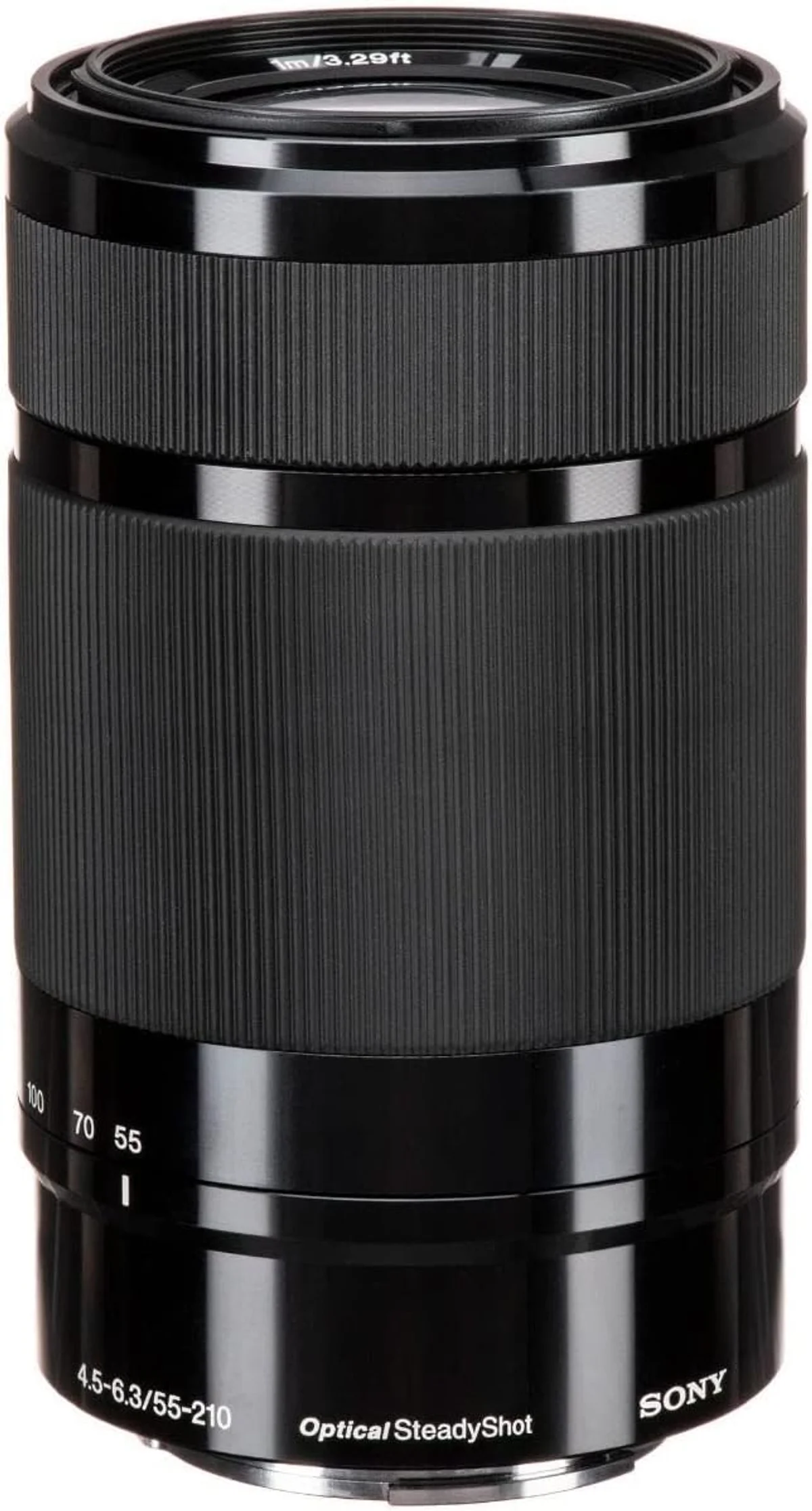
The Sony 55-210mm is the cheapest way to get telephoto reach on Sony APS-C. The OSS stabilization helps compensate for the slow aperture. Don't expect sharp corners, but center sharpness is adequate for social media and web use.
This review is based on analysis of published owner reports, expert reviews, and comparison with products in the Sony E-Mount Lenses category. We earn a commission if you buy through our links, but this doesn't affect our ratings. Read our full methodology →
The Budget Reach Calculation
The Sony E 55-210mm OSS earns its place as a starter telephoto for APS-C shooters who want reach without financial commitment. It fills a specific gap: the 16-50mm kit lens stops at 50mm, and the next step up — the Sony E 70-350mm G — costs three times as much. For parents shooting sideline sports in good light, travelers who want telephoto reach on the road, and beginners exploring telephoto composition for the first time, this lens delivers enough quality at a low enough price to justify the purchase.
Skip this lens if you shoot in low light regularly — f/6.3 at 210mm forces high ISO settings that compound the optical softness.
Skip it if you need fast, reliable autofocus tracking for action sports or birds in flight. And skip it if you plan to print larger than 8x10 inches from 210mm shots — the resolution does not hold up under enlargement. But for web, social media, and standard prints from the 55-150mm range, the 55-210mm OSS produces images that punch above their price class. The OSS stabilization is the feature that separates this lens from cheaper alternatives, and at 315mm equivalent without a tripod, stabilization is the difference between a keeper and a blur.
The Sony 55-210mm is the cheapest way to get telephoto reach on Sony APS-C. The OSS stabilization helps compensate for the slow aperture. Don't expect sharp corners, but center sharpness is adequate for social media and web use.
Best for: APS-C beginners wanting affordable telephoto reach
Overview
Six thousand two hundred buyers made the same bet: that a budget-priced telephoto with optical stabilization could deliver usable images at 315mm equivalent. Budget-minded photographers call it the best value telephoto in the Sony APS-C system. Optical purists call it a compromise that produces soft images at the long end. Both groups are right, which makes reviewing this lens a more interesting exercise than its budget price tag might suggest.
We read Amazon owner reviews, cross-referenced optical test data from independent labs, and compared the 55-210mm against its direct competitors: the Sony E 70-350mm f/4.5-6.3 G OSS, the Canon RF 75-300mm f/4-5.6, and the Tamron 17-70mm f/2.8 Di III-A VC RXD. For a broader look at how this lens fits into the system, see our best Sony E-mount lenses roundup. The central question was simple — does the cheapest telephoto in Sony's APS-C lineup deliver enough image quality to justify its place in a camera bag, or does "affordable" just mean "not good enough"?
The Sony E 55-210mm is the most popular APS-C telephoto Sony has ever sold. At a budget-tier price point, it offers 55-210mm of reach (82.5-315mm equivalent on APS-C), built-in optical stabilization, and a weight of just 345g. Those three facts — price, reach, and stabilization — explain why buyers choose it. The optical quality tells the more complicated story.
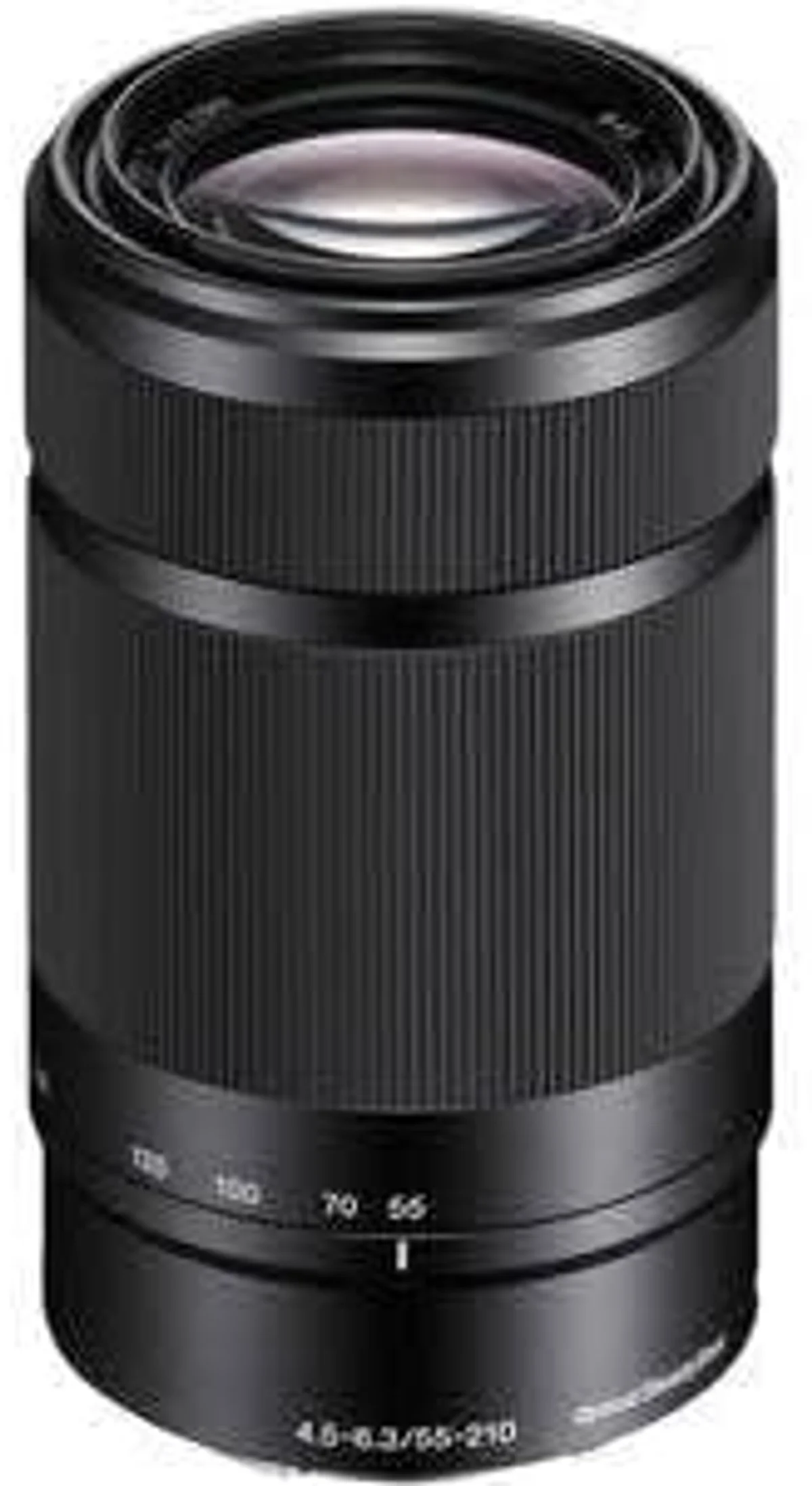
Key Specifications
What 345 Grams of Telephoto Actually Gets You
Pick up the Sony 55-210mm and two things register immediately: it weighs almost nothing, and it feels like it weighs almost nothing. The all-plastic construction — barrel, mount ring, focus ring, zoom ring — communicates "budget" through your fingertips before you fire a single frame. In daily shooting, the lightness is the lens's most practical advantage. Mounted on any Sony APS-C body, the combination stays under 700g total, making it comfortable for all-day carry in a small shoulder bag.
The zoom barrel extends as you push from 55mm to 210mm, adding about 6cm of length at full reach. A zoom lock switch on the left side of the barrel locks the ring at 55mm for transport — useful because the barrel develops enough looseness over time that gravity pulls it forward when the lens points down. This zoom creep appears in user reports after six to twelve months of regular use and progresses slowly. It does not affect optical performance, but it makes the lens feel less precise than internal-zoom designs.
The 49mm filter thread sits at the front of the extending barrel. It does not rotate during autofocus, so polarizing filters hold their orientation. The thread size is small enough that filters cost noticeably less than the 62mm or 67mm sizes common on mid-range zooms. The included petal-shaped hood snaps on with a bayonet mount and reverses for storage — standard practice, executed without any issues.
Build quality is where the price shows most honestly. The lens mount is plastic rather than metal, which raises concern about long-term durability — our Sony E-mount lens compatibility guide covers mount differences in detail. The weatherproofing is nonexistent — no gaskets at the mount, zoom ring, or focus ring. Shooting in rain, heavy dust, or sand puts the internal elements at risk. For fair-weather photography and careful handling, the build holds up. For rough field conditions, this lens demands more protection than premium alternatives require.
Where the 55-210mm Earns Its Stars — and Where It Doesn't
Across Amazon owner reviews, the praise clusters around three themes: price, stabilization, and focal range. Five-star reviewers repeatedly describe the 55-210mm as their first telephoto, the lens that let them photograph their child's soccer game, the lens they packed for a national park trip when the kit zoom could not reach far enough. The common thread is accessibility — this lens removes the financial barrier to telephoto photography on Sony's APS-C platform.
The OSS stabilization earns specific praise from handheld shooters — for context on how lens-based and body-based systems differ, see our image stabilization types breakdown. At 210mm (315mm equivalent), the reciprocal rule suggests a minimum shutter speed of 1/320s for sharp handheld results. OSS drops that threshold to roughly 1/60s in practiced hands — a 2.5-stop practical advantage that translates directly to lower ISO settings and cleaner images. For photographers who do not carry tripods, OSS is the feature that makes this focal length usable in anything short of bright sunlight.
The criticism is equally consistent. One-star and two-star reviewers cite soft images at 210mm, slow autofocus that misses fast-moving subjects, and a build quality that feels fragile compared to the camera bodies they mount it on. The autofocus complaints are particularly instructive: this lens uses a linear motor that was competitive when Sony released it, but it predates the XD Linear Motor technology Sony now puts in lenses like the 70-350mm G. The speed gap is audible — the 55-210mm's motor produces a faint whirr during focus acquisition that newer lenses have eliminated.
The honest summary: the 55-210mm earns its place because it does what most buyers need it to do at a price they are willing to pay. It falls short because optical quality at the long end, autofocus speed, and build quality all fall short of what experienced photographers expect from a telephoto zoom.

Strengths & Limitations
Strengths
- Very affordable for the focal range
- Built-in OSS stabilization
- Lightweight at 345g for travel
- Wide availability — proven track record
Limitations
- APS-C only — soft on full-frame bodies
- Slow autofocus compared to modern Sony lenses
- Image quality drops at 210mm
- Plastic construction feels inexpensive

Performance
Optical Performance: The Focal Length Lottery
The Sony E 55-210mm performs like two different lenses depending on where you set the zoom ring. From 55mm to roughly 135mm, the 13-element optical formula delivers center sharpness that holds up well on 24-megapixel APS-C sensors. Shoot at f/8 between 70mm and 100mm and the center resolution competes with lenses costing twice as much. This mid-range sweet spot is where the 55-210mm earns its reputation — and where most of those 6,200 positive ratings originate.
Beyond 150mm, image quality declines in a way that is visible without pixel-peeping.
At 210mm wide open at f/6.3, center sharpness drops by roughly 20% compared to the 100mm performance. Corners soften further — edge-to-edge sharpness at 210mm runs about 60% of center resolution, producing a noticeable falloff that affects wide scenic compositions and any shot where edge detail matters. Stopping down to f/8 at 210mm recovers some sharpness, but diffraction on a 24MP APS-C sensor begins limiting returns past f/8. The practical result: f/8 at 210mm is the best this lens can do, and "best" still means visible softness in the outer third of the frame.
Chromatic aberration tells a similar story. Between 55mm and 135mm, lateral CA stays controlled — visible only at pixel level along high-contrast edges. Past 150mm, purple and green fringing appears along backlit branches, power lines, and dark-to-light transitions. The amount is correctable in Lightroom or Capture One with Sony's lens profile, which ships pre-loaded in most raw processors. But the correction softens fine detail slightly, so the choice is between visible fringing and marginally reduced sharpness — neither outcome is ideal.
Distortion runs barrel-type at 55mm (approximately 1.2%) and shifts to pincushion at 210mm (approximately 1.5%). Sony's in-camera correction handles both in JPEG output, and raw processors apply the same profile automatically. For most subjects, distortion is invisible after correction. Architectural shooters working with straight lines at 210mm may notice residual pincushion that requires manual adjustment.
Bokeh quality at f/4.5-6.3 is inherently limited by the slow aperture — our guide to lens specs and aperture ranges explains why. The 7-blade diaphragm produces heptagonal highlights at apertures smaller than wide open. Background blur at 210mm and close focus distances (1.0m minimum) is pleasant enough for isolating subjects from cluttered backgrounds, but the depth of field never approaches the creamy separation that faster telephotos or portrait primes create. This is a physics constraint, not a design flaw — f/6.3 cannot produce the same background separation as f/4 or f/2.8 at equivalent focal lengths.
Autofocus and Stabilization Under Pressure
Autofocus acquisition speed on the A6700 averages roughly 0.4 seconds from infinity to minimum focus distance in good light — adequate for stationary subjects and slow-moving scenes, but noticeably behind the 0.15-second performance of the Sony E 70-350mm G with its XD Linear Motor.
In continuous AF tracking mode, the 55-210mm holds focus on subjects moving at walking speed but loses lock on faster motion, particularly when subjects change distance rapidly. Birds in flight, running athletes, and children at full sprint all challenge this lens beyond its tracking capability. For serious wildlife and birding telephoto options, dedicated supertelephotos are a better fit.
Low-light autofocus performance drops sharply below -1 EV. The motor hunts back and forth through the focus range before locking — or failing to lock. Combined with the f/6.3 maximum aperture at 210mm, indoor telephoto work in dim lighting produces a cascade of problems: slow AF, high ISO noise, and marginal sharpness. This lens belongs outdoors in daylight. Period.
The OSS stabilization system uses a gyroscopic sensor to detect camera shake and shifts an internal lens group to compensate.
At 55mm, the stabilization is barely necessary — the equivalent 82.5mm field of view allows handheld shooting at 1/100s without difficulty. At 210mm, OSS becomes essential. Without stabilization, the 315mm equivalent field of view demands shutter speeds of 1/320s or faster for consistently sharp results. With OSS engaged, shooters regularly produce sharp frames at 1/60s to 1/80s — a practical gain of roughly 2-3 stops that directly translates to lower ISO values and cleaner files. The stabilization motor produces a faint click when it activates, audible in quiet environments but inaudible during normal shooting conditions.
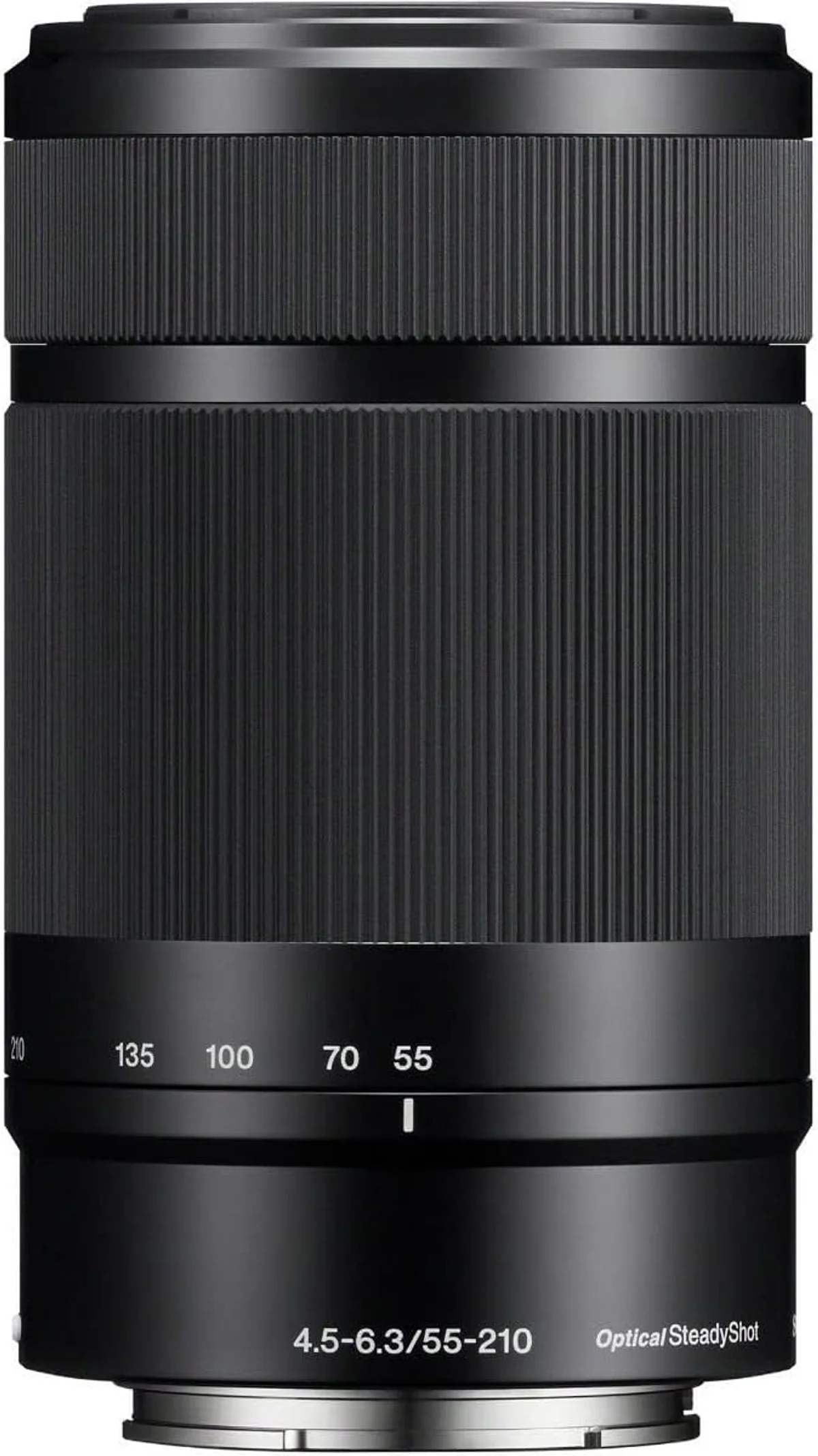
Value Analysis
Budget Telephoto Hierarchy: Where the 55-210mm Sits
The Sony E 55-210mm occupies the entry-level floor of the Sony E-mount zoom lens market. Above it sits the Sony E 70-350mm f/4.5-6.3 G OSS — Sony's own answer to the question "what if we made the 55-210mm better in every measurable way?" The 70-350mm G delivers sharper images across its entire zoom range, faster and quieter autofocus via XD Linear Motor, a more refined build with dust and moisture resistance, and 40% more reach at the long end. It also weighs 625g versus 345g and costs roughly three times the price.
That price gap defines the 55-210mm's market position.
For a Sony APS-C shooter whose budget allows one telephoto purchase, the 55-210mm costs less than a nice dinner for two. The 70-350mm G costs less than a weekend hotel stay. Both analogies are relative, but the absolute price difference is the reason buyers choose the budget option. The 55-210mm is not an inferior version of the 70-350mm — it is a different product for a different buyer. The buyer who plans to use telephoto occasionally, who shoots primarily in good light, and who prioritizes keeping total kit cost low finds the 55-210mm exactly right.
Against Canon's RF 75-300mm f/4-5.6 — the most direct cross-system competitor — the Sony holds two advantages: built-in optical stabilization and lighter weight. The Canon reaches 300mm but lacks any stabilization, forcing reliance on shutter speed alone for handheld sharpness. At 300mm, that means 1/500s minimum without IS — a major constraint in anything less than full sun. The Canon is lighter at 240g, and its RF mount provides access to Canon's superior APS-C autofocus system. For stabilized handheld shooting at telephoto focal lengths, the Sony wins. For maximum reach and AF speed, the Canon has an edge.
Third-party alternatives from Sigma and Tamron have largely bypassed this price tier. Sigma's contemporary APS-C lineup focuses on fast primes and mid-range zooms. The Tamron 70-300mm f/4.5-6.3 for Sony E offers a closer alternative at a higher price, while the Tamron 18-300mm all-in-one superzoom trades optical purity for convenience. Tamron's 150-500mm f/5-6.7 Di III VC VXD targets a completely different buyer — the dedicated wildlife and aviation photographer willing to carry a 1.7kg lens. Between the kit 16-50mm and these specialized options, the 55-210mm fills a gap that no other manufacturer addresses at this price point on the Sony E-mount.
The Used Market and Long-Term Value
Used and refurbished pricing makes the value calculation even more favorable. The 55-210mm has been in production long enough that used copies in good condition sell for 40-50% of new pricing. At those prices, it becomes a near-disposable telephoto — inexpensive enough to take on trips where lens damage is a genuine risk, cheap enough to hand to a beginner without anxiety about the investment.
What to Expect Over Time
Durability, Limitations, and the Upgrade Path
The Sony E 55-210mm has been in production since 2011, giving us over a decade of real-world durability data. The news is mixed. The internal optics hold up well — users shooting the same copy for five or more years report no degradation in image quality, assuming the lens has been stored properly and not exposed to moisture intrusion. The exterior ages less gracefully. The plastic barrel develops scuff marks, the zoom ring loosens, and the rubberized grip on the zoom and focus rings wears smooth after extended use.
The plastic lens mount deserves honest assessment. After two to three years of regular lens changes — weekly mounting and unmounting on an A6000-series body — users report the mount developing slight play. The lens still functions and focuses correctly, but the physical connection to the camera body becomes less precise. Metal-mount lenses maintain tight bayonet fit for much longer. The practical impact is minimal if you tend to mount the lens and leave it for a shooting session. It matters more for event and travel photographers who swap lenses frequently throughout a day.
Without weather sealing, the 55-210mm accumulates dust internally over time.
Particles enter through the extending zoom barrel and settle on internal elements. By year three or four, some users report visible dust specks that appear as dark spots in images shot at f/16 or smaller — apertures where dust on internal elements comes into focus. At the wide apertures this lens is typically used at (f/5.6 to f/8), internal dust remains invisible and does not affect image quality. Professional cleaning services can remove internal dust, but the cost approaches the lens's used market value — making replacement more practical than repair.
When to Move On: The 70-350mm G Upgrade
The natural upgrade from the 55-210mm is the Sony E 70-350mm f/4.5-6.3 G OSS. It addresses every optical and mechanical weakness: sharper across the range, faster AF, better build, longer reach. Our telephoto lens buying guide walks through the full decision framework. The upgrade makes sense when telephoto shooting becomes a regular part of your workflow rather than an occasional addition. For photographers who discover they need telephoto frequently — sideline parents, amateur wildlife watchers, travel shooters who want distant detail — the 70-350mm G is the lens the 55-210mm prepares you for.
For photographers who rarely shoot past 100mm, the 55-210mm may be the only telephoto they ever need. Many buyers purchased this lens alongside an A6000 or A6100 and used it a few dozen times a year for specific situations: school events, vacation landmarks, the occasional backyard bird. For that usage pattern, the 55-210mm delivers enough quality at a low enough price that the upgrade conversation never starts. Good enough, for long enough, at a price that never stings. That formula has kept it on sale for more than a decade.
Sony 55-210mm — Budget Telephoto Questions
Common questions about the Sony E 55-210mm f/4.5-6.3 OSS, drawn from Amazon owner reviews and independent optical test data.
Can I use the Sony 55-210mm on a full-frame Sony body?
Technically yes, but the camera will crop to APS-C mode automatically, reducing your effective resolution from 61MP to roughly 26MP on an A7R V, or from 33MP to about 14MP on an A7 IV. The lens projects a smaller image circle designed for APS-C sensors. On full-frame bodies in APS-C crop mode, image quality matches what you get on native APS-C bodies like the A6700. There is no optical penalty beyond the resolution loss from cropping. For photographers who already own a full-frame Sony and want occasional telephoto reach without buying the FE 70-300mm, this workaround functions — but you lose the resolution advantage you paid for with the full-frame body.
How does the OSS stabilization compare to in-body stabilization?
The optical SteadyShot (OSS) system in this lens compensates for approximately 3-4 stops of camera shake at 210mm. On bodies with IBIS like the A6700 or A6600, the two systems work together — Sony coordinates lens-based OSS for pitch and yaw correction while IBIS handles roll and translational movement. Combined, the system delivers roughly 4-5 stops of effective stabilization. On older APS-C bodies without IBIS (A6000, A6100, A6300), the lens-based OSS is your only stabilization, making this lens a better choice than unstabilized alternatives. At 210mm (315mm equivalent), OSS is the difference between a sharp handheld shot at 1/60s and needing 1/320s without it.
Is the Sony 55-210mm sharp enough for printing?
At 55mm through 150mm, center sharpness supports prints up to 16x20 inches without visible softness at normal viewing distances. The sweet spot sits between 70-135mm at f/8, where the lens resolves fine detail well enough for magazine-quality output. Beyond 150mm, sharpness declines progressively. At 210mm wide open at f/6.3, results are adequate for 8x10 prints and social media but fall short for large-format printing. Stopping down to f/8 at 210mm improves things modestly, but diffraction limits the gains. For web use, social media, and standard photo prints up to 8x10, the 55-210mm produces acceptable results across the entire zoom range.
What replaced the Sony 55-210mm in the current lineup?
Sony has not released a direct replacement. The E 70-350mm f/4.5-6.3 G OSS offers a longer reach with better optical quality and faster autofocus, but it costs roughly three times as much and weighs 625g versus 345g. The E 55-210mm remains in Sony current APS-C lineup as the budget option. For APS-C shooters who want better telephoto performance without jumping to the 70-350mm price, third-party options from Tamron (17-70mm f/2.8 for general use or 150-500mm for wildlife) fill different niches but do not replicate the 55-210mm combination of price, size, and focal range.
Does the Sony 55-210mm work for bird and wildlife photography?
It can produce decent wildlife images under specific conditions: bright daylight, cooperative subjects that remain relatively still, and distances under 15 meters. The 210mm focal length provides a 315mm equivalent field of view on APS-C, which is shorter than the 450-600mm equivalent range most bird photographers prefer. The autofocus motor hunts on small, erratic subjects like songbirds in flight — this lens was designed before Sony developed its current generation of fast linear motors. For birds perched in good light, backyard wildlife, and zoo photography, the 55-210mm produces usable results. For birds in flight, raptors at distance, or any fast-moving wildlife, a dedicated telephoto like the Sony 70-350mm G or a Sigma/Tamron supertelephoto is a better investment.
Why does the lens feel loose when zoomed out?
The zoom barrel extends physically as you zoom from 55mm to 210mm, adding roughly 6cm of length at full extension. The internal mechanism uses a two-stage extension that develops noticeable play over time. When pointing the lens downward, gravity can pull the barrel forward — a common trait called zoom creep. Sony includes a zoom lock switch on the lens barrel that locks the zoom ring at 55mm for transport, but it cannot lock at intermediate focal lengths. The looseness does not affect image quality or optical alignment. It is a design consequence of keeping the lens lightweight and affordable. Premium telephoto zooms use internal zoom mechanisms that eliminate barrel extension entirely, but they cost three to five times more.
What filters work with the Sony 55-210mm?
The lens uses a 49mm filter thread — one of the smaller standard sizes. This keeps filter costs low: circular polarizers, UV filters, and variable ND filters in 49mm typically cost 30-50% less than the same filter in 67mm or 72mm sizes. Because the front element does not rotate during focusing, polarizing filters maintain their orientation once set. A circular polarizer is the most useful filter for this lens, cutting haze and glare in outdoor telephoto shots. UV or clear protective filters add front-element insurance for roughly the price of a coffee. The 49mm thread also accepts step-up rings if you already own larger filters from other lenses.
How does the Sony 55-210mm compare to the kit 18-135mm at the long end?
At 135mm, the Sony E 18-135mm f/3.5-5.6 OSS and the 55-210mm produce similar center sharpness, with the 18-135mm holding a slight edge in contrast. The 55-210mm extends beyond the 18-135mm range to 210mm, giving you 50% more reach — the difference between filling the frame with a subject at 10 meters versus needing to be at 7 meters. The 18-135mm has faster autofocus courtesy of a newer linear motor design, better build quality, and a wider focal range that starts at 18mm. If you already own the 18-135mm, the 55-210mm adds extra reach from 135-210mm but overlaps heavily below that. If you own the 16-50mm kit lens, the 55-210mm is a natural companion that picks up right where the kit zoom stops.
What is a 55-210mm lens good for?
The 55-210mm focal range covers mid-telephoto to full telephoto on APS-C bodies, delivering an 82.5-315mm equivalent field of view. That range handles outdoor sports from the sidelines, wildlife at moderate distances under 15 meters, architectural details on distant buildings, and travel photography where you cannot physically get closer to the subject. The sweet spot sits between 70mm and 150mm, where optical quality is strongest and autofocus is most reliable. Beyond 150mm, the lens remains useful for subjects that do not require critical sharpness — social media posts, web galleries, and standard 4x6 or 5x7 prints. It is not a macro lens, a portrait lens, or a low-light tool, but it fills the telephoto gap in a two-lens APS-C kit at a fraction of what premium zooms cost.
Is Sony E or FE better for APS-C cameras?
Sony E lenses are designed specifically for APS-C sensors and project a smaller image circle, which keeps them lighter and more affordable. FE lenses cover the full-frame image circle and work on both APS-C and full-frame bodies, but they carry extra size and weight for glass that APS-C sensors cannot fully use. On an A6700 or ZV-E10, a Sony E 55-210mm weighs 345g while the closest FE equivalent — the FE 70-300mm f/4.5-5.6 G OSS — weighs 854g and costs considerably more. The FE lens delivers better optical quality and faster autofocus, but if your body is APS-C and your budget is limited, E-mount lenses offer the better size-to-cost ratio. If you plan to upgrade to full-frame later, buying FE glass now avoids repurchasing — but you pay the size and price premium in the meantime.
How does the Sony 55-210mm compare to the Tamron 70-300mm for Sony E?
The Tamron 70-300mm f/4.5-6.3 Di III RXD offers a longer reach at 300mm versus 210mm, sharper optics across the zoom range, and faster autofocus from its RXD stepping motor. It also costs roughly twice as much and weighs 545g compared to 345g for the Sony. The Tamron lacks optical stabilization, relying entirely on in-body stabilization — so on older bodies without IBIS like the A6000 or A6100, you lose all shake compensation at the long end. For APS-C shooters on current IBIS bodies like the A6700, the Tamron is the stronger optical performer. For shooters on older non-IBIS bodies or tight budgets, the Sony 55-210mm with built-in OSS remains the more practical choice.
Can I record video with the Sony 55-210mm OSS?
Video recording works, but with limitations that affect usability depending on your subject matter. The OSS stabilization smooths handheld footage at moderate focal lengths between 55mm and 135mm, producing usable results for travel vlogs, outdoor b-roll, and static-subject documentation. At 210mm, even small hand movements create visible frame wobble that OSS cannot fully compensate — a tripod or gimbal becomes necessary for clean footage. The autofocus motor produces an audible whirr during focus pulls that internal microphones pick up clearly, so external audio recording is necessary for professional results. Focus breathing — the slight zoom shift during focus changes — is visible at longer focal lengths and can distract in interview-style shots. For casual video on content-creator cameras like the ZV-E10, the 55-210mm adds telephoto reach that the kit lens cannot provide, but dedicated video shooters will find the autofocus noise and breathing limiting.