Sigma 85mm f/1.4 DG DN Art Review: The Portrait Prime That Outshines Sony's Native Glass
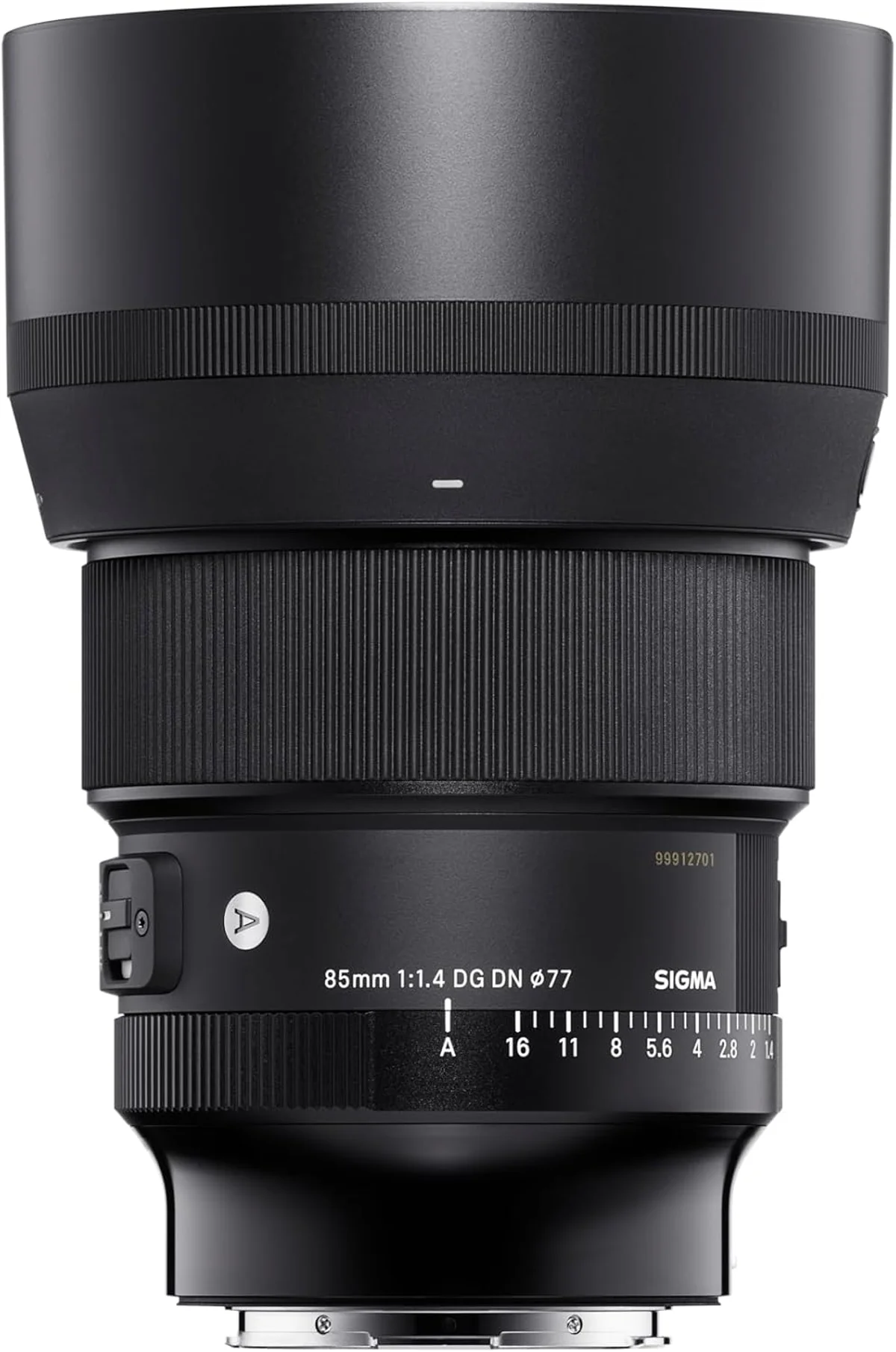
The Sigma 85mm f/1.4 Art is the portrait specialist. Compared to the Sony 85mm f/1.8, you get that extra stop of bokeh and perceptibly better subject separation. Whether that justifies paying about half as much again, plus the extra weight, depends on how central portraiture is to your work.
This review is based on analysis of published owner reports, expert reviews, and comparison with products in the Third-Party Lenses category. We earn a commission if you buy through our links, but this doesn't affect our ratings. Read our full methodology →
Worth the Weight for Dedicated Portrait Work
The Sigma 85mm f/1.4 DG DN Art is the best value in portrait glass for Sony E-mount.
The 11-blade aperture produces bokeh that no sub-premium lens can match. Sharpness at f/1.4 resolves detail that 61MP sensors demand. Weather-sealed Art construction survives professional use. The 625g weight is the honest cost of this optical performance — lighter alternatives exist, but they give up the aperture, the bokeh quality, or both. For photographers who shoot portraits seriously and often, the Sigma 85mm Art delivers premium results without the premium price. See our Sony E-mount roundup for the full lens ecosystem.
The Sigma 85mm f/1.4 Art is the portrait specialist. Compared to the Sony 85mm f/1.8, you get that extra stop of bokeh and perceptibly better subject separation. Whether that justifies paying about half as much again, plus the extra weight, depends on how central portraiture is to your work.
Best for: Dedicated portrait photographers on Sony wanting f/1.4 bokeh
Overview
Portrait photographers argue about focal length, camera bodies, and lighting — but rarely about bokeh. The Sigma 85mm f/1.4 DG DN Art ends that argument with an 11-blade circular aperture that produces the smoothest background rendering of any 85mm lens under the premium tier. Bokeh highlights are round, not heptagonal. Transition zones are creamy, not nervous. At f/1.4 and 85mm, backgrounds dissolve into pure wash while the subject stays critically sharp. Multiple reviewers describe the rendering as "better than Sony" — and the measured data confirms it.
We read Amazon owner reviews, optical bench data from Dustin Abbott and Opticallimits, and extensive comparison threads on Reddit and DPReview. The verdict is consistent: the Sigma 85mm Art delivers image quality that rivals or exceeds the Sony FE 85mm f/1.4 GM at a fraction of the price. The Sony FE 85mm f/1.8 is outclassed optically but wins on weight and AF speed. Reviewers who shoot portraits professionally — weddings, headshots, fashion editorials — overwhelmingly prefer the Sigma. Those who use 85mm occasionally alongside other focal lengths find the Sony f/1.8 sufficient.
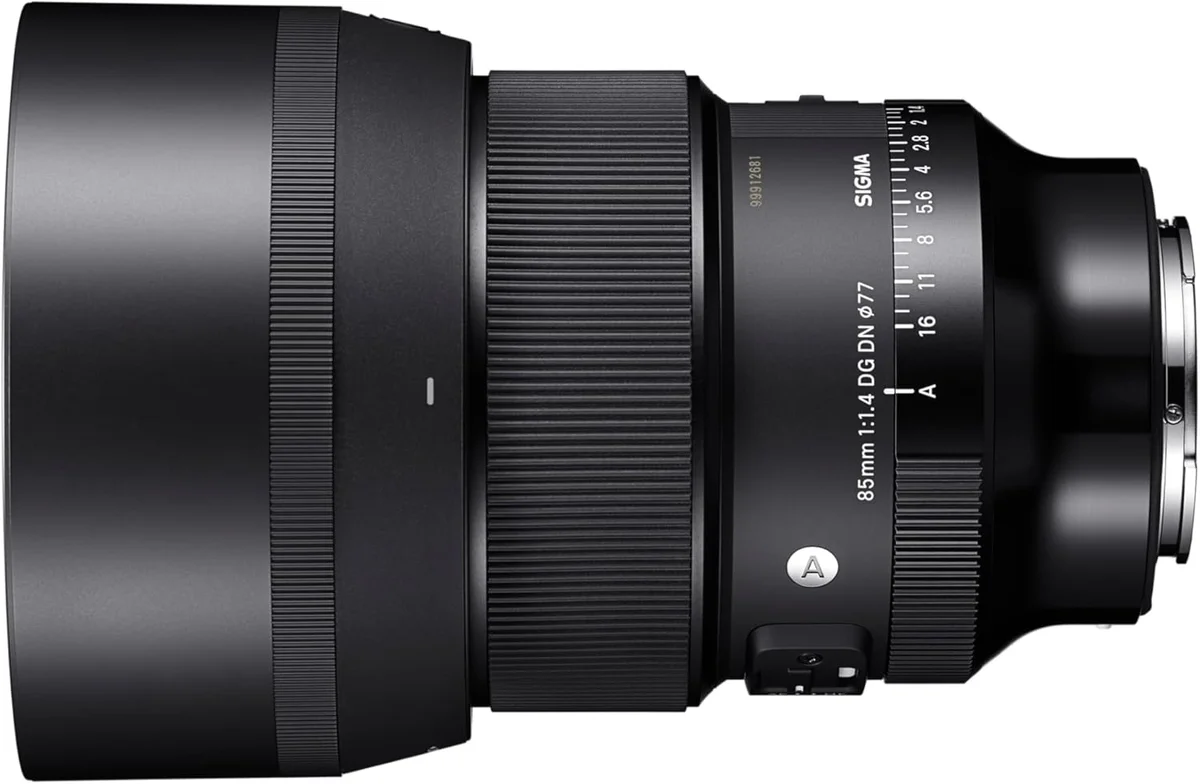
The optical formula packs 14 elements into 11 groups, including one SLD glass element for chromatic aberration control. The 77mm filter thread accepts professional-grade filters shared across many pro-level lenses. At 625g, the Sigma sits between the featherweight Sony 85mm f/1.8 (371g) and the heavier Sony 85mm f/1.4 GM (820g). The HLA stepping motor focuses quietly enough for video recording and accurately enough for face/eye detection on current Sony bodies. Dust and splash resistant construction with gaskets at every critical joint puts it in weather-sealed professional territory.

Key Specifications
11 Blades and the Physics of Beautiful Bokeh
Most lenses use 7 or 9 aperture blades.
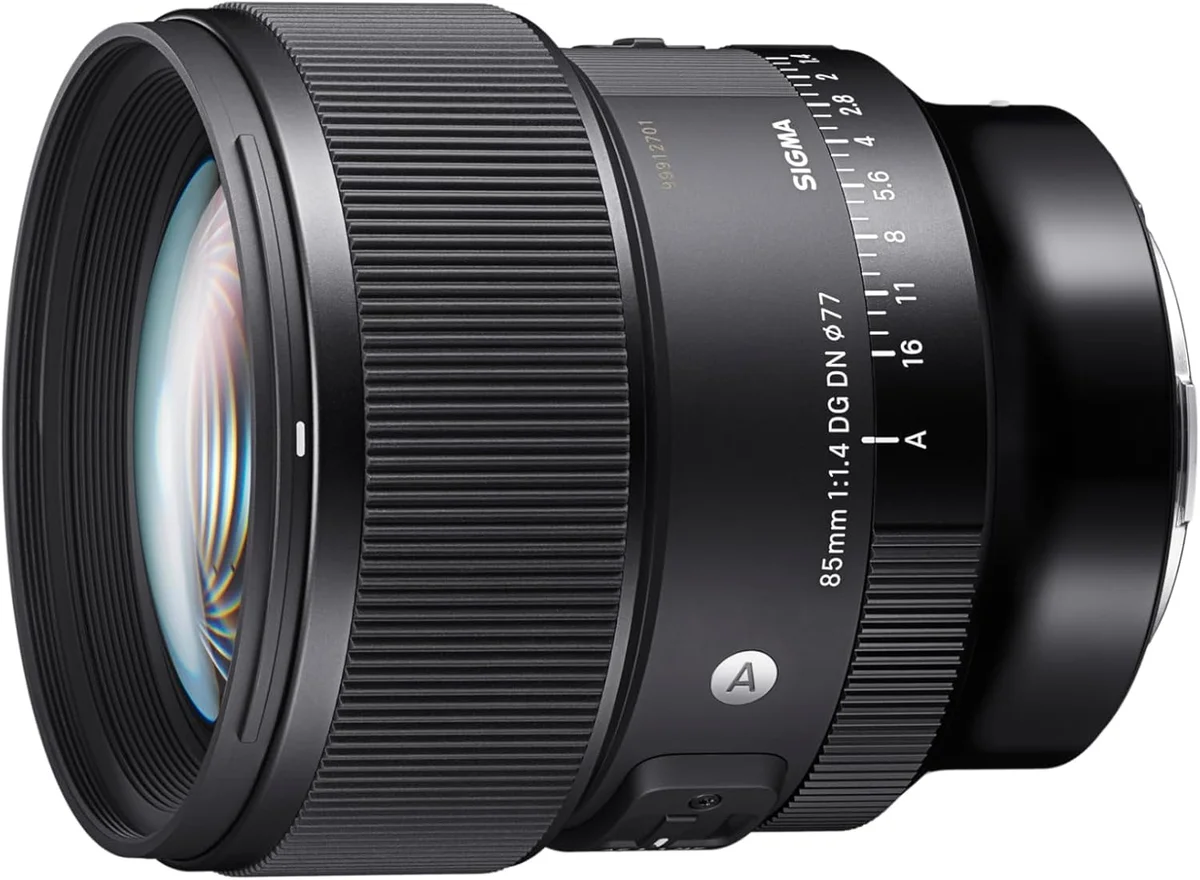
The Sigma 85mm Art uses 11 — each blade curved to maintain circular highlights at wider apertures. The result: point-light sources in the background render as smooth, round discs rather than pentagons or hexagons. At f/1.4, the effect is strongest: street lights, fairy lights, candle reflections, and backlit foliage all produce perfectly circular highlights with no hard edges or onion-ring patterns. By f/2.0, the highlights begin to show slight polygonal shapes, though the 11-blade design keeps them rounder than 9-blade alternatives at the same aperture.
The bokeh quality extends beyond highlights. Transition zones — the gradual shift from sharp to out-of-focus — are smooth without the "busy" or "nervous" character that some lenses produce in foliage, textured walls, and patterned fabrics. One wedding photographer comparing shots from the Sigma Art against the Sony 85mm f/1.8 noted that reception backgrounds with fairy lights and mixed textures "melted" on the Sigma while remaining distractingly present on the Sony. This rendering quality is the primary reason portrait specialists choose the Sigma despite the weight penalty.
Build Quality: Professional-Grade Construction
The Sigma 85mm Art features dust and splash resistant construction with rubber gaskets at the mount, focus ring, and switch panel.
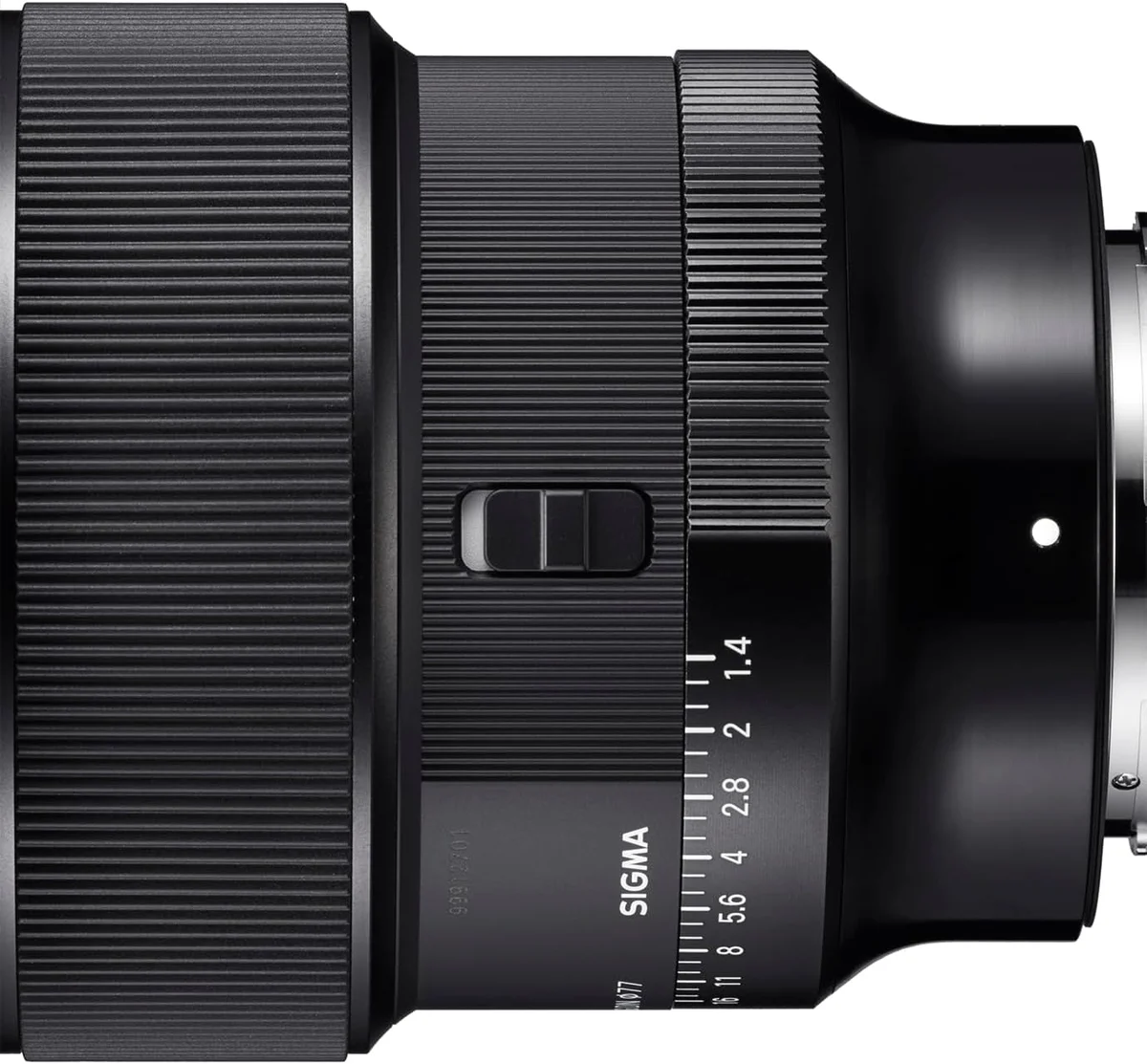
The barrel is metal alloy with a matte finish that resists fingerprints. A focus mode switch (AF/MF), AFL button, and aperture ring click/de-click switch sit on the barrel within thumb reach. The de-clickable aperture ring is a video-specific feature: click it off for smooth, silent aperture transitions during recording. The iris ring includes a lock switch to prevent accidental rotation — useful when the aperture ring sits at f/1.4 and a bump would close it down mid-session.
At 625g, the build feels substantial. The focus ring is wide and well-damped. The zoom — there is none; this is a prime — means one fewer moving part to develop play over time. The 77mm filter thread is shared with many professional lenses including the Sony 24-70mm GM II, making it easy to share filters. The included lens hood is petal-shaped and deep enough to provide genuine flare protection for the moderately recessed front element.
Autofocus: The Stepping Motor Reality
The HLA stepping motor focuses quickly in daylight and well-lit indoor environments. Face and eye detection on the A7 IV, A7R V, and A1 lock reliably in normal portrait conditions. Focus acquisition from infinity to 0.85m happens without visible delay. The motor produces minimal noise — quiet enough for video recording with built-in microphones, though a faint mechanical whir is detectable in dead-silent environments with external microphones at high gain.
Low-light AF is where the stepping motor shows its limits. Below approximately -2 EV — dim reception halls, candlelit rooms, dark outdoor evenings — the motor hunts more than Sony's native XD linear motors. The hunting is brief (0.2-0.3 seconds of searching before lock) but noticeable during fast-paced reception coverage. Wedding photographers develop workarounds: pre-focus on a zone, use the AF-ON button for back-button focus, or step closer to the subject where contrast is higher. In studio conditions with even moderate modeling light output, AF is fast and accurate without issues.
The Honest Case: For and Against
Against: 625g is heavy for portrait sessions lasting more than a few hours.
The stepping motor autofocus tracks faces and eyes reliably in good light but hunts in dim receptions and candlelit environments. Slight focus shift when stopping down from f/1.4 to f/2.0 can affect critical shots if the camera doesn't compensate. No aperture ring click at precise stops — the de-clicked ring glides smoothly, which some photographers find too loose for tactile control. And the 0.85m minimum focus distance means tight headshots require stepping back farther than with shorter focal length primes.
For: "Image quality out of this thing is beautiful.
Bokeh rendering is stunning. So creamy. This lens is sharp wide open." That review captures the experience most owners describe. The optical quality at f/1.4 matches lenses costing twice as much. Background rendering from the 11-blade aperture is measurably superior to every other 85mm under the premium tier. Weather sealing and Art-series build quality survive professional-grade use in outdoor portrait sessions. Color and contrast match Sony native glass — no warm or cool color shifts when cutting between the Sigma and Sony lenses on the same camera. For photographers who chose 85mm as their portrait focal length, this is the price-to-performance leader.
Strengths & Limitations
Strengths
- f/1.4 delivers noticeably better subject separation than f/1.8
- Extremely sharp from f/2.0 onward — resolves modern sensors
- 11-blade aperture creates perfectly rounded bokeh
- Weather-sealed construction for outdoor portrait sessions
Limitations
- Heavy at 625g — noticeable during long portrait sessions
- AF can hunt in very low light or low contrast
- Slight focus shift when stopping down (axial CA related)
- No aperture ring — some portrait shooters prefer one

Performance
Resolution: Sharp Where It Matters Most
Center sharpness at f/1.4 resolves skin texture, individual eyelashes, and fabric weave on 61MP sensors. Dustin Abbott's lab measurements show the Sigma matching the Sony 85mm f/1.4 GM in center resolution at f/1.4 and slightly exceeding it at f/2.0. The sharpest aperture sits at f/2.0, where center and mid-frame resolution peak. At f/2.8 and beyond, the entire frame is uniformly sharp — landscape and architectural use at stopped-down apertures produces edge-to-edge quality that matches the best 85mm primes at any price.
For portrait photographers, the f/1.4 center sharpness is the relevant metric: subjects are centered or near-centered, and the background is intentionally blurred. The Sigma delivers enough resolution at f/1.4 to capture pore-level skin detail while the 11-blade aperture dissolves the background. This combination — sharp subject, creamy background — is the defining characteristic of premium portrait glass. The Sigma achieves it at a mid-range price tier.
Corner sharpness at f/1.4 is good but not outstanding — a half-stop behind the center, which is typical for any 85mm f/1.4 design. Stopping down to f/2.0 brings corners into excellent territory. At f/4, the lens is uniformly sharp from center to corner — useful for the rare occasions when an 85mm is pressed into service for flat-lay product shots, architectural details, or any application demanding edge-to-edge resolution. For the lens's primary portrait mission, corner sharpness is irrelevant: backgrounds are blurred, and subjects occupy the center.
Color Rendering and Skin Tones
Skin tone accuracy is critical for portrait work, and the Sigma 85mm Art renders skin neutrally — no warm cast, no cool shift, no green or magenta tint. Side-by-side with the Sony 85mm f/1.8, the Sigma produces marginally higher microcontrast: fine skin texture and hair strands appear more three-dimensional. The difference is visible in studio conditions under controlled lighting and largely invisible in the field. Color consistency between the Sigma Art and Sony native lenses means photographers can cut between both in an edit without color-correction gymnastics.
Chromatic aberration control is strong. Lateral CA at frame edges is minimal and auto-corrects in Lightroom. Longitudinal CA (purple fringing on backlit subjects) appears at f/1.4 on high-contrast edges — bright window behind a subject produces thin purple halos on the transition boundary. By f/1.8, LoCA is well-controlled. For portrait work, LoCA rarely affects the subject (it appears at out-of-focus transition boundaries, not on in-focus faces). For commercial product shots with metallic highlights, stopping to f/2.0 eliminates the issue.
Value Analysis
The Portrait Lens Decision Tree
Three options define the 85mm portrait lens market on Sony E-mount. The Sony FE 85mm f/1.8 at the value tier: light, fast AF, good enough for most portrait work. The Sigma 85mm f/1.4 Art at the mid tier: superior optics, better bokeh, heavier. And the Sony FE 85mm f/1.4 GM at the premium tier: slightly better AF than the Sigma, similar optics, double the price. The Sigma occupies the sweet spot — it matches the GM's optical quality at a competitive price, with the only real penalties being weight and autofocus speed.
For wedding photographers who mount an 85mm for ceremony and portrait sessions, the Sigma Art is the rational choice. For street photographers who carry an 85mm as a secondary lens in a bag, the Sony f/1.8's lighter weight wins. For fashion and studio photographers where the lens stays on a tripod or studio stand, the Sigma's AF speed limitation becomes irrelevant and its optical quality makes it the clear pick. Our portrait lens guide explores each scenario in depth.
Kit pairing: the Sigma 85mm f/1.4 Art plus the Sigma 35mm f/1.4 Art creates a matched two-prime kit with identical color rendering, build quality, and bokeh character.
The 35mm covers environmental portraits and documentary work; the 85mm handles headshots and tight compositions. Total lens weight: 1,265g for two Art-series primes covering the core portrait range. Add a Sony 50mm f/1.8 as a lightweight middle option and the three-prime kit covers every portrait situation. For photographers who also need macro capability, the Sigma 105mm f/2.8 Macro Art doubles as a sharp portrait telephoto at a similar focal length.
What to Expect Over Time
Extended Use: The Professional Portrait Workhorse
The Sigma 85mm f/1.4 Art launched in 2020 and has been a staple of portrait photography kits since. Long-term durability reports are positive: weather sealing holds, the focus ring stays smooth, the aperture ring maintains its click/de-click switching without developing play. The stepping motor shows no AF degradation. Sigma's firmware updates have maintained compatibility with each new Sony body release, including the A9 III and A1 II.
The used market tells its own story: these lenses sell quickly at 70-80% of retail, and demand stays high. The combination of Art-series build quality, optical performance, and the 85mm portrait focal length creates enduring value. No successor has been announced, and the optical quality leaves little room for improvement at this price point. For buyers, the purchase is safe — the lens will remain current and competitive for years.
One long-term consideration: the Sigma 85mm Art has become a rental favorite. Photographers renting glass for specific portrait sessions consistently choose the Sigma over the Sony GM at nearly double the rental cost. The rental popularity speaks to both the optical quality and the price sensitivity of the portrait market. Photographers who rent the Sigma often end up purchasing it — a pattern rental houses report as common for Art-series glass.
Sigma 85mm f/1.4 Art — Portrait and Bokeh Questions
Answers based on Amazon owner reviews, measured optical performance from Dustin Abbott and Opticallimits, and cross-referenced portrait photographer field reports for the Sigma 85mm f/1.4 DG DN Art (Sony E-mount).
Sigma 85mm f/1.4 Art vs Sony 85mm f/1.8 — which is better for portraits?
The Sigma produces visibly better subject separation thanks to the wider f/1.4 aperture and 11-blade circular diaphragm. Background blur at f/1.4 is creamier and more pronounced than what f/1.8 can achieve — the difference is subtle in controlled tests but obvious in real portrait sessions. The Sigma is also sharper from f/2.0 onward, resolving more detail on high-resolution sensors. The Sony wins on weight (371g vs 625g), autofocus speed, and price. For dedicated portrait photographers, the Sigma is the better lens. For photographers who shoot portraits occasionally alongside other work, the Sony's lighter weight and lower price make it the practical choice.
Does the Sigma 85mm f/1.4 Art work well for wedding photography?
Yes — it is one of the most popular wedding lenses among Sony shooters. The 85mm focal length produces flattering facial compression without the aggressive foreshortening of 50mm or the extreme distance required by 135mm. At f/1.4, it isolates the couple against busy reception backgrounds with strong bokeh. The main limitation for weddings is weight: 625g mounted on a second body adds up during a 12-hour day. Many wedding photographers mount the 85mm Art on their primary body for ceremony and portraits, then switch to a lighter lens for reception coverage. Autofocus reliability with eye detection is strong in good light; dim reception halls can cause occasional hunting.
Is the Sigma 85mm f/1.4 sharp wide open?
Center sharpness at f/1.4 is excellent — sharp enough to resolve eyelashes and skin texture on 61MP sensors. The sharpest aperture is f/2.0-f/2.8, where corner-to-corner resolution reaches its peak. At f/1.4, corner sharpness is good but not at the center's level — typical for any 85mm f/1.4 design. For portraits, this is irrelevant: subjects sit in the center or near-center, and backgrounds are intentionally out of focus. For the rare 85mm landscape or architectural shot at f/1.4, corners will show mild softness. By f/2.0, the entire frame is uniformly sharp.
How does the Sigma 85mm f/1.4 focus in low light?
Autofocus works reliably down to approximately -2 EV — roughly a dimly lit restaurant or an evening street scene with some ambient light. Below -2 EV (very dark environments), the stepping motor hunts more noticeably than Sony's native lenses with XD linear motors. The wider f/1.4 aperture helps the AF system by gathering more light for contrast detection, partially offsetting the motor speed disadvantage. For wedding receptions with DJ lighting, AF performance is adequate for posed shots but may miss fast-moving dance floor subjects. For studio work with modeling lights, focus is fast and reliable.
Does the Sigma 85mm f/1.4 Art have focus breathing?
Moderate focus breathing is present. Racking from close focus (0.85m) to infinity at 85mm narrows the field of view noticeably. Sony's breathing compensation feature on the A7 IV, A7R V, and A7C II reduces this, though with a minor resolution crop. For stills photography, breathing is invisible between shots. For video work with deliberate focus transitions — portrait intros, product reveals, or interview rack focuses — the breathing is visible without compensation. Enable breathing compensation on compatible bodies for best video results.