Tamron 70-300mm f/4.5-6.3 Review: 300mm at an Entry Price
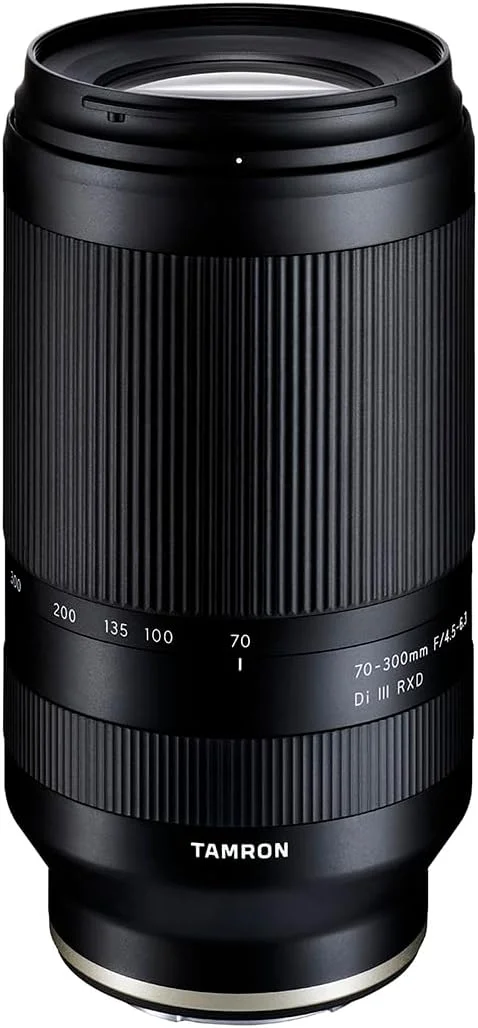
The Tamron 70-300mm is the default telephoto for budget Sony shooters. At an Entry price, it costs less than the Sony 70-300mm G and delivers comparable results through most of its range. The 300mm end is soft — if you regularly shoot at 300mm, spend more.
This review is based on analysis of published owner reports, expert reviews, and comparison with products in the Third-Party Lenses category. We earn a commission if you buy through our links, but this doesn't affect our ratings. Read our full methodology →
Should You Buy the Tamron 70-300mm?
The Tamron 70-300mm f/4.5-6.3 is the right first telephoto for Sony full-frame shooters. At an Entry price, it is cheap enough to buy without hesitation. Sharpness from 70-200mm matches lenses costing far more. 300mm softness is the one real compromise — acceptable for casual use, limiting for serious wildlife or sports work. If your telephoto needs are occasional and your budget matters, this lens earns its place in your bag.
The Tamron 70-300mm is the default telephoto for budget Sony shooters. At an Entry price, it costs less than the Sony 70-300mm G and delivers comparable results through most of its range. The 300mm end is soft — if you regularly shoot at 300mm, spend more.
Best for: Budget-conscious Sony shooters wanting telephoto reach
Overview
Most Sony full-frame shooters hit a wall after buying their first prime or standard zoom: nothing in the bag reaches past 85mm.
The Tamron 70-300mm f/4.5-6.3 Di III RXD exists to solve that problem for the lowest possible cost. At an Entry price and 545g, it adds four times the focal length of a 50mm prime without the weight penalty of premium telephoto glass. Across Amazon owner reviews, the verdict is consistent: strong value through 200mm, adequate at 300mm, and priced to make the decision easy.
We read those owner reviews alongside optical test data, comparisons with the Sony FE 70-300mm f/4.5-5.6 G OSS and the Tamron 150-500mm f/5-6.7, and real-world feedback from wildlife beginners, sports parents, and travel photographers. The pattern: this is the entry-level telephoto that gets the job done — not the best at 300mm, but the best value across the range.
For Sony shooters adding telephoto reach on a budget, the Tamron 70-300mm is the obvious first step. The question isn't whether it's good enough — it's whether you need more than 300mm.
Key Specifications
Built Light, Built to Travel
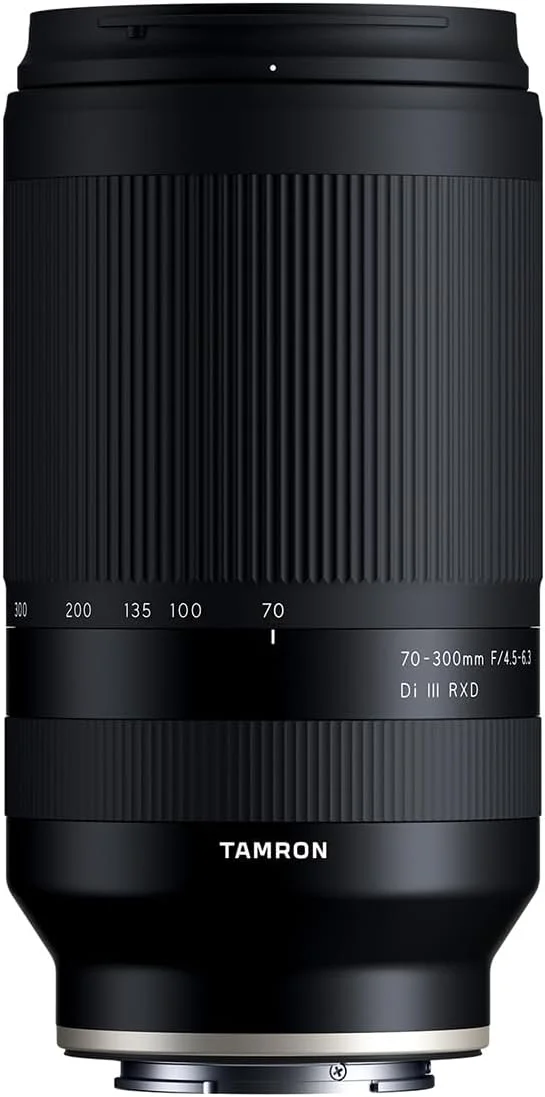
At 545g, the Tamron 70-300mm weighs roughly half as much as the Sony 70-200mm f/2.8 GM II. The trade-off is obvious — slower aperture, variable instead of constant — but the weight savings transform how you carry a telephoto. This lens fits in a messenger bag alongside a standard zoom and a prime. It doesn't demand a dedicated camera backpack or a padded compartment. For travel photographers who measure their kit in grams, that matters.
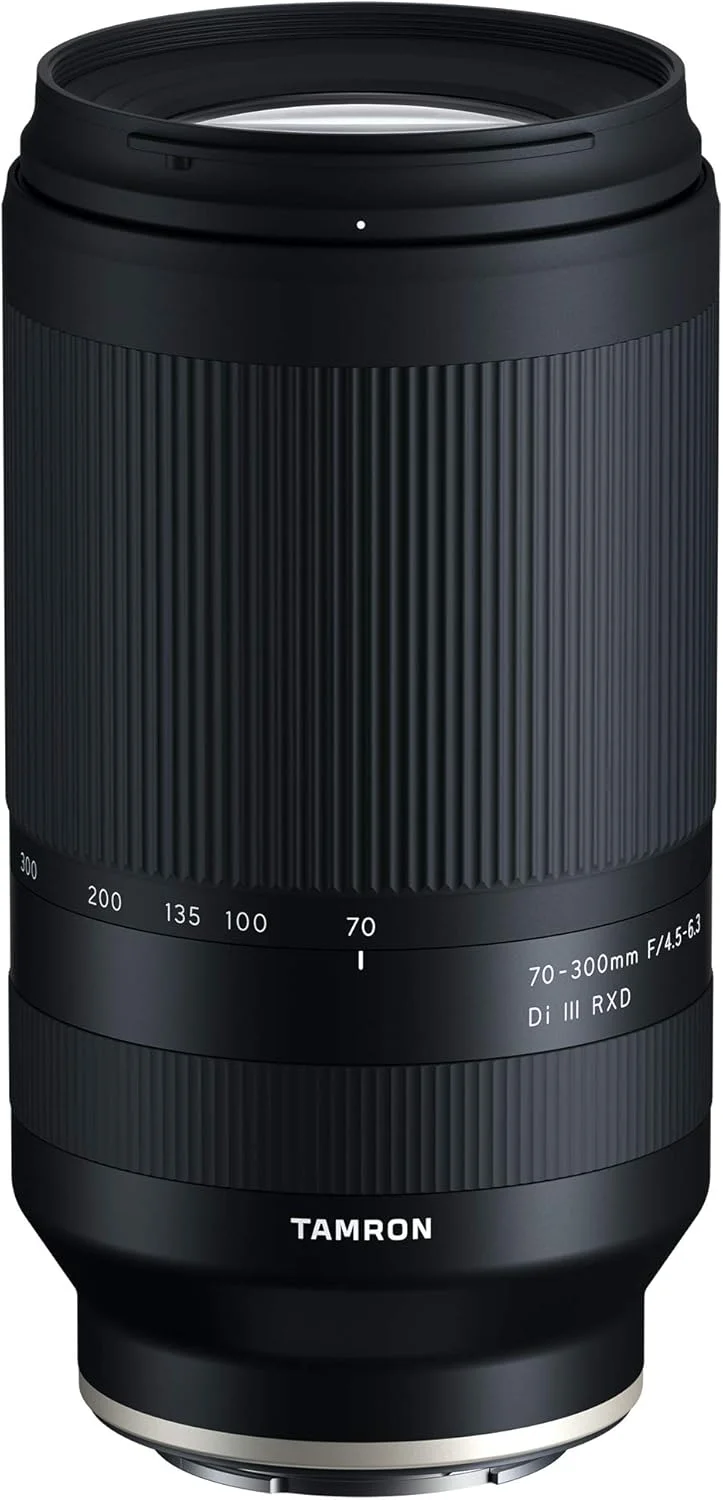
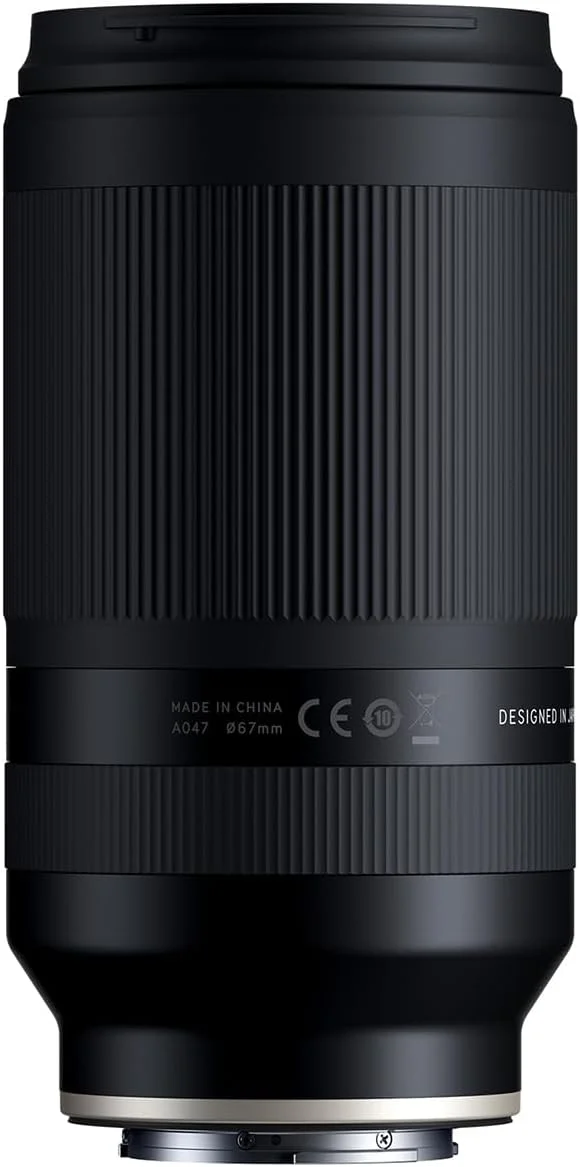
The barrel extends when zooming to 300mm, adding roughly 60mm to the physical length. Extension is smooth with no wobble. The moisture-resistant construction seals the extending joints against light rain and dust — a genuine advantage over the original non-sealed version. The 67mm filter thread keeps filter costs aligned with the rest of your kit.
The zoom ring rotates with consistent torque. No stiff spots at either end. The focus ring is narrow but functional for manual focus override. The mount is plastic — consistent with Tamron's approach at this price tier. Functionally, the plastic mount locks firmly with no play. Cosmetically, it scratches faster than metal mounts after heavy lens-swapping.
The Budget Telephoto Reality Check
The enthusiast's case: "an absolute steal" is the recurring description.
At this price, you get full-frame telephoto coverage, fast RXD autofocus, moisture resistance, and sharp images through most of the zoom range. The 70-200mm portion of this lens performs at a level that makes dedicated 70-200mm f/4 lenses hard to justify at higher prices. Weight is low enough for all-day carry. And at an Entry price, there's no agonizing — you buy it, try telephoto, and decide later if you need more reach.
The skeptic's case: 300mm is where this lens shows its price.
Sharpness at 300mm on high-resolution bodies falls behind the Sony G version and well behind dedicated 100-400mm options. The f/6.3 maximum aperture at 300mm limits usable shutter speeds — on a cloudy day, ISO climbs quickly to maintain motion-stopping speeds. No optical stabilization means relying entirely on IBIS, which at 300mm provides roughly 2-3 usable stops of shake reduction versus the 4-5 stops at shorter focal lengths. And the slow aperture rules out serious low-light telephoto work — indoor sports, twilight wildlife, and evening events need faster glass.
Strengths & Limitations
Strengths
- Remarkably affordable for a full-frame 70-300mm
- Sharp from 70-200mm — competitive with more expensive options
- Lightweight at 545g for easy travel
- RXD motor is fast and nearly silent
Limitations
- Sharpness drops noticeably past 250mm
- Slow aperture limits low-light usability
- No stabilization — relies on body IBIS
- Plastic build feels budget compared to Sony G
Performance
Sharp Where It Counts, Soft Where You'd Expect
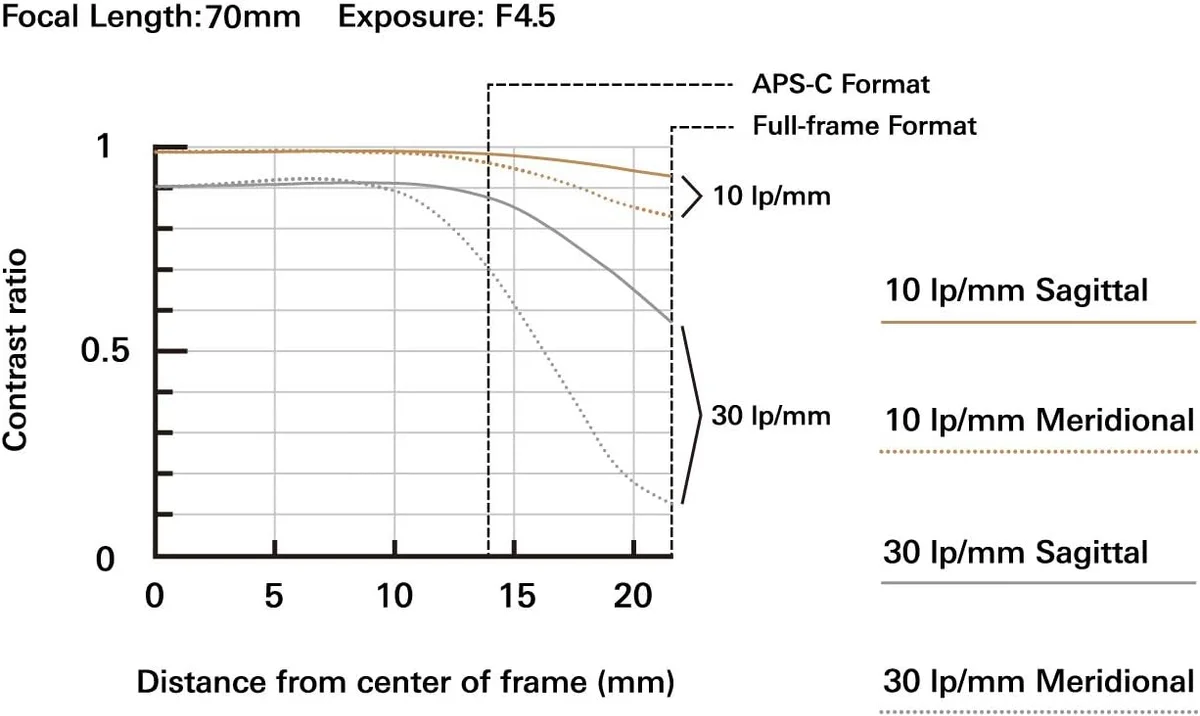
Center sharpness from 70mm through 200mm is strong. At 100mm f/5, the center of the frame resolves detail at levels that compete with lenses costing twice as much or more. At 135mm — the sweet spot for many portrait and event photographers — performance peaks. Images from this range printed at 24x36 inches hold up under inspection. The 15-element optical design with LD (Low Dispersion) elements controls chromatic aberration effectively across this range.
At 250mm, center sharpness drops a step. Still usable, still printable at moderate sizes, but the decline is visible in direct A/B comparison with 200mm shots. At 300mm f/6.3, the softness becomes the lens's defining limitation. On a 33MP A7 IV, 300mm center sharpness looks acceptable at screen size but doesn't survive heavy cropping. On the 61MP A7R V, the softness is hard to ignore. If 300mm is your primary shooting distance, this isn't your lens.
Corner performance follows the same pattern: good through 200mm, declining toward 300mm. For subjects centered in the frame — wildlife, sports, portraits — corner quality is irrelevant. For landscape telephoto compression where edge detail matters, stop down to f/8 at any focal length for the best results.
Autofocus: The RXD Motor in Practice
The RXD stepping motor is Tamron's mainstream AF system — fast, quiet, and adequate for most subjects. Initial lock-on in good light is quick enough for youth sports, dog parks, and garden wildlife. Eye AF tracking on modern Sony bodies works reliably through 200mm. At 300mm, tracking accuracy drops slightly because the aperture narrows to f/6.3, reducing the light available to the phase-detect AF system.
For fast-moving subjects — birds in flight, motorsports, sprinting athletes — the RXD motor can lag behind the VXD motor found in Tamron's premium lenses. It locks, but the initial acquisition takes a fraction longer, and tracking through erratic movement occasionally drops. For 90% of telephoto scenarios a casual or intermediate photographer encounters, the AF speed is more than sufficient.
Motor noise is minimal. Video shooters using external microphones won't hear the focus motor. Built-in camera microphones may pick up a faint pulse during continuous AF — quieter than many competitor lenses, but audible in dead silence. For wildlife video at close range, consider manual focus to eliminate any motor risk.
Minimum Focus and Close-Up Work
Minimum focus distance at 70mm is 0.8m — close enough for tight compositions of nearby subjects. At 300mm, minimum focus increases to 1.5m, which limits how tightly you can frame small subjects at maximum reach. Maximum magnification of 0.11x at 300mm won't replace a macro lens but allows useful detail shots of flowers, insects, and textures at moderate distances.
Color, Contrast, and the Tamron Look
Color rendering is neutral-to-warm — consistent with Tamron's other Di III lenses for Sony. Skin tones at 85-135mm flatter naturally, making this an effective budget portrait telephoto in good light. Greens hold their natural saturation. Blues in sky backgrounds stay deep without purple shifts. The LD elements help maintain color purity across the zoom range, with no visible color shift between 70mm and 300mm.
Contrast is good through 200mm and drops at the long end. At 300mm, images can appear slightly flat compared to 135mm shots from the same session — a combination of the slower aperture reducing micro-contrast and the optical design reaching its limits. A modest contrast boost in post-processing restores punch to 300mm images. Through the 70-200mm range, contrast is high enough for direct-from-camera use.
Chromatic aberration is well-controlled through 200mm. At 300mm, some purple fringing appears on high-contrast edges — backlit branches, wire fences against bright sky. Lightroom's lens profile corrects it. By f/8 at any focal length, CA drops to negligible levels. Flare resistance is adequate: the included lens hood blocks most stray light, and shooting with the sun just outside the frame produces minimal veiling flare.
Bokeh at f/4.5-6.3 is less prominent than on faster lenses, but at 200-300mm the long focal length still separates subjects from backgrounds. The 7-blade aperture produces slightly heptagonal highlights stopped down, but at typical telephoto distances with distant backgrounds, the rendering is smooth and pleasing. For headshots at 200mm f/5, the background blur matches what many photographers expect from an 85mm f/1.8 at similar framing.
Vignetting at maximum aperture is moderate — roughly 1-1.5 stops at 70mm, less pronounced at longer focal lengths. Tamron's lens profile in Lightroom handles it automatically. On APS-C bodies, the crop eliminates the vignetted corners entirely, making this lens perform slightly better optically on crop sensors than on full-frame.
Value Analysis
What Else the Same Money Gets You in Sony Telephoto
The Sony FE 70-300mm f/4.5-5.6 G OSS is the primary competitor — roughly half as much again, heavier at 854g, but with optical stabilization and a brighter f/5.6 aperture at 300mm. For shooters on bodies without IBIS, the Sony's OSS is a genuine advantage. For anyone on an A7 III or newer, IBIS covers the gap.
Photographers who know they need more reach should look at the Tamron 150-500mm f/5-6.7 or the Tamron 50-300mm f/4.5-6.3. The 150-500mm costs more but starts where this lens's useful range ends. The 50-300mm offers wider starting coverage but at a slower aperture on the wide end.
The pairing that many budget Sony shooters land on: the Tamron 28-75mm f/2.8 G2 for standard coverage and this Tamron 70-300mm for telephoto. Two lenses, 28-300mm covered, total weight under 1.1kg. That kit handles travel, events, sports, and wildlife for a fraction of what an equivalent Sony native setup costs. See our third-party lens roundup for more pairing options, and our wildlife and birding guide for reach-focused recommendations.
Resale value is moderate. Budget telephoto zooms sell reliably on the used market because demand from beginners and travel photographers is steady. Expect to recover 55-65% of purchase price on a well-maintained copy. At this lens's Entry price, the potential loss from resale is low enough that buying this lens to test whether you need telephoto reach is financially low-risk. For video shooters, the 70-300mm range works well for outdoor documentary work — interviews from a comfortable distance, B-roll compression of architectural details, and wildlife footage in daylight.
What to Expect Over Time
Living with Budget Telephoto Glass
The moisture-resistant construction handles travel conditions well. Light rain, high humidity, and moderate dust exposure are within its tolerance. The extending barrel accumulates fine grit faster than internal-zoom designs — occasional cleaning of the barrel surface with a lens cloth prevents buildup from affecting zoom smoothness.
Long-term owners report consistent AF performance — no degradation of the RXD motor over time. The zoom ring maintains its torque. The focus ring stays smooth. The plastic mount, while cosmetically inferior to metal, shows no structural wear after regular use.
Tamron provides firmware updates through their Lens Utility desktop application, though updates for this lens are rare.
The RXD motor and optical design are mature — what you buy is what you keep. AF improvements come from camera body updates, not lens firmware. Newer Sony bodies with improved phase-detect algorithms extract noticeably better tracking performance from this lens compared to older A7 II-era cameras. The lens stays the same; the body makes it better. That's a hidden benefit of buying into a mature optical design.
On APS-C bodies, this lens becomes a 105-450mm equivalent — serious telephoto reach that puts it into wildlife and distant sports territory without the weight penalty of a dedicated super-telephoto.
The f/6.3 aperture at 300mm (450mm equivalent on APS-C) does limit usability to bright conditions, but for daytime outdoor subjects at distance, the reach is genuinely useful. Many APS-C Sony shooters find this lens provides enough telephoto coverage that they never need to upgrade — the crop factor effectively gives them a 450mm lens at an Entry price.
The upgrade path depends on what you shoot most at 300mm. If 300mm is rarely enough, the Tamron 150-500mm extends reach dramatically. If 300mm is enough but you want sharper results at that distance, the Sony 70-300mm G OSS or the Sony E 55-210mm on APS-C bodies offer alternatives. For most budget telephoto users, though, this Tamron stays in the kit until the photographer outgrows 300mm entirely.
Tamron 70-300mm: Buyer FAQ
Answers based on Amazon owner reviews and independent optical data for the Tamron 70-300mm f/4.5-6.3 Di III RXD (Sony E).
Is the Tamron 70-300 worth it?
For the price, unquestionably yes. At an Entry price, it costs less than the Sony FE 70-300mm f/4.5-5.6 G OSS and delivers comparable image quality through the 70-200mm range. The lens is sharp, lightweight at 545g, and the RXD motor focuses quickly. The main compromise is softness past 250mm — if you shoot primarily at the long end, spend more on a dedicated 100-400mm or 150-500mm. For occasional telephoto reach with strong mid-range performance, the value is excellent.
Is Tamron 70-300 sharp?
Sharp from 70mm through roughly 200mm — center sharpness at these focal lengths matches lenses costing twice as much. At 250mm, sharpness begins to soften. At 300mm, the drop is noticeable on high-resolution bodies. On a 33MP A7 IV, 300mm results are acceptable at web sizes but show softness in large prints. The practical takeaway: this lens performs best as a 70-200mm zoom with bonus reach to 300mm, rather than as a dedicated 300mm lens.
What is a Tamron 70-300mm lens used for?
Sports from stadium seats, wildlife from moderate distances, concert photography, outdoor portraits with compressed backgrounds, and travel telephoto work. The 70-300mm range covers youth soccer from the sideline, birds in a garden, deer at park distances, and tight architectural details from street level. The slow aperture (f/4.5 at 70mm, f/6.3 at 300mm) limits indoor use — this is primarily an outdoor telephoto.
What is the difference between Sony 70-300mm and Tamron 70-300mm?
The Sony FE 70-300mm f/4.5-5.6 G OSS has optical image stabilization (OSS), a brighter aperture at the long end (f/5.6 vs f/6.3), and slightly better 300mm sharpness. The Tamron is lighter (545g vs 854g), significantly cheaper, has moisture-resistant construction, and focuses nearly as fast. Both lack weather sealing. If you have a body with IBIS, the Tamron's lack of OSS matters less. For weight-sensitive travel, the Tamron wins. For maximum 300mm performance, the Sony G edges ahead.
Can the Tamron 70-300mm shoot wildlife?
Yes, for wildlife at moderate distances — garden birds, deer in parks, zoo animals. The 300mm reach on full-frame frames subjects adequately at 10-30 meters. For small, distant subjects like birds in flight or shy wildlife at 50+ meters, 300mm is often not enough. The f/6.3 aperture at 300mm limits shutter speed in anything less than full daylight, which affects the ability to freeze fast movement. For dedicated wildlife work, the Tamron 150-500mm f/5-6.7 provides more reach and a faster aperture at equivalent focal lengths.
Does the Tamron 70-300mm have image stabilization?
No. The lens relies on in-body image stabilization (IBIS) from the camera. All Sony full-frame bodies from the A7 III onward include IBIS, providing 4-5 stops of stabilization. At 300mm, this helps with camera shake but cannot freeze fast subject movement. On APS-C bodies without IBIS (A6100, ZV-E10 original), you need fast shutter speeds — 1/500s or faster at the 300mm equivalent.