Tamron 18-300mm f/3.5-6.3 Review: One Lens, Zero Excuses
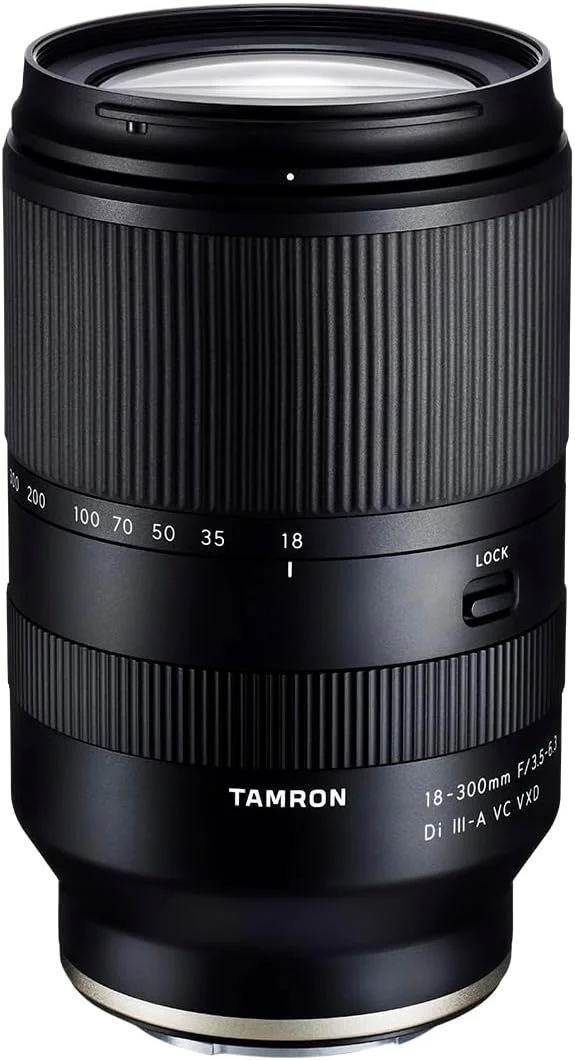
The widest-ranging single lens for Sony APS-C. From wide-angle landscapes to distant wildlife, the 18-300mm covers it all. Image quality won't satisfy pixel-peepers at the extremes, but for travel and everyday use, the convenience factor is unmatched.
This review is based on analysis of published owner reports, expert reviews, and comparison with products in the Third-Party Lenses category. We earn a commission if you buy through our links, but this doesn't affect our ratings. Read our full methodology →
The One-Lens Travel Kit
The Tamron 18-300mm belongs in the bag of every Sony APS-C shooter who refuses to carry three lenses.
It covers architectural interiors at 18mm, environmental portraits at 35-50mm, compressed street scenes at 100mm, and distant wildlife at 300mm — all without removing the lens from the body. For wildlife reach beyond 300mm, the Tamron 150-500mm picks up where this lens leaves off. The VXD autofocus keeps pace with moving subjects. The built-in VC prevents blurry telephoto shots in fading light. And the 0.5x close-focus capability adds a pseudo-macro function that most superzooms lack entirely.
Skip this lens if you print large or crop aggressively from the 250-300mm range — edge softness at the telephoto extreme will frustrate you.
Skip it if you shoot in dim venues regularly — f/6.3 at 300mm starves the sensor for light, and even f/3.5 at 18mm is a full stop slower than the Sigma 18-50mm f/2.8. But if your priority is covering every shooting scenario with one lens, one body, and one small bag, the Tamron 18-300mm is the answer to a question every travel photographer eventually asks. And at a mid-range price, it costs less than any two-lens combination that covers the same range.
The widest-ranging single lens for Sony APS-C. From wide-angle landscapes to distant wildlife, the 18-300mm covers it all. Image quality won't satisfy pixel-peepers at the extremes, but for travel and everyday use, the convenience factor is unmatched.
Best for: APS-C travel and one-lens convenience
Overview
A 16.7x zoom ratio in a lens that weighs 620 grams. The Tamron 18-300mm f/3.5-6.3 Di III-A VC VXD covers everything from 27mm wide-angle to 450mm super-telephoto in 35mm equivalent terms — on a single Sony APS-C body, with a single lens mount twist. No bag full of primes. No mid-hike lens swaps on exposed ridgelines. No "I wish I had more reach" regret when a hawk lands 40 meters away.
We read Amazon owner reviews, cross-referenced optical test data from independent labs, and compared the 18-300mm against both its direct competitors (the Sony 18-135mm f/3.5-5.6 and Sigma 18-50mm f/2.8) and its own physics-imposed limitations. For context on how third-party glass stacks up against native options, see our third-party vs native lens breakdown. The central question: does a 16.7x superzoom deliver enough image quality to justify replacing a two- or three-lens kit?
If you're building a travel photography lens kit, the Tamron 18-300mm is the most flexible single lens available for Sony APS-C cameras. It won't outresolve a dedicated prime or a shorter-range zoom at any given focal length — physics prevents that. But it eliminates the need to choose between wide and telephoto before leaving the house. For travelers, hikers, parents at sporting events, and photographers who value flexibility over pixel-level perfection, this lens removes the hardest decision in photography: which lens to bring.
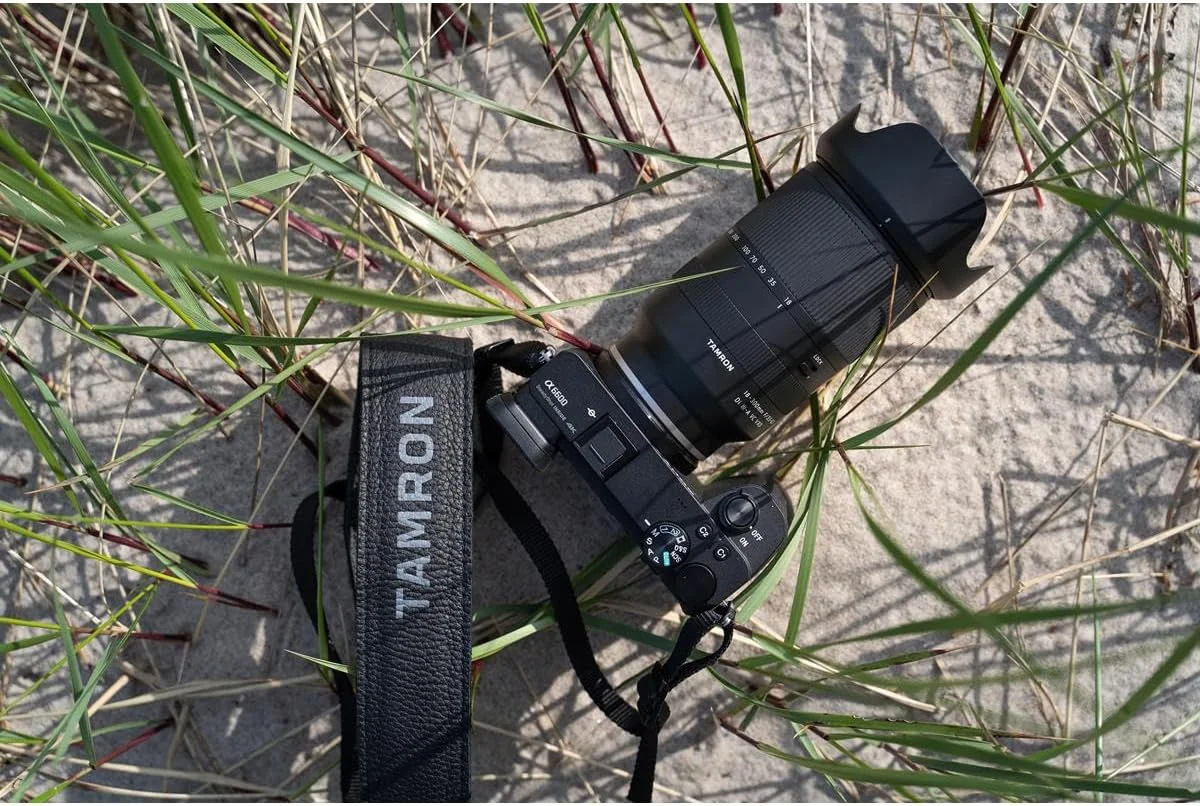
Key Specifications
What 16.7x of Zoom Range Actually Means in the Field
Zoom ratio numbers are abstract until you shoot with them. At 18mm on an APS-C sensor, the Tamron delivers a 27mm equivalent field of view — wide enough for hotel room interiors, narrow European streets, and group photos where backing up isn't an option. Twist the zoom ring to 50mm (75mm equivalent) and you're framing tight headshots with background compression. Push to 200mm (300mm equivalent) and you're isolating details from across a plaza — architectural ornaments, market vendor expressions, birds on a distant branch.
At the full 300mm (450mm equivalent), the lens reaches into territory that typically requires a dedicated telephoto. On a beach in Costa Rica, that's the difference between photographing "some birds near the water" and isolating a single roseate spoonbill mid-stride. In the Italian Dolomites, it's the difference between a wide mountain vista with a distant refuge and a tight crop of the refuge's weathered wooden door. The reach changes what stories you can tell without changing glass.
The 19-element, 15-group optical design includes two hybrid aspherical elements and elements with specialized coatings to control ghosting and flare. The 7-blade diaphragm produces acceptable bokeh at portrait focal lengths, though background rendering lacks the smoothness of faster primes. Tamron's BBAR-G2 coating reduces internal reflections, and the fluorine-coated front element sheds water and resists fingerprint smudges — a practical benefit when you're shooting in rain without time to clean the glass.
Where the Superzoom Excels and Where Physics Wins
Across Amazon owner reviews, the consensus divides cleanly. Five-star reviews praise the range, the build quality, the close-focus capability, and the convenience of never swapping lenses. The phrase "only lens I brought" appears in hundreds of travel reviews. One- and two-star ratings cluster around three complaints: telephoto softness, slow aperture at the long end, and occasional AF hesitation in low contrast scenes.
The strengths are real and measurable.
A 16.7x zoom ratio in 620 grams means you carry less weight than a two-lens kit covering the same range — a Sony 18-135mm plus a Sony 70-350mm weighs 1,065 grams combined and still leaves a gap at the wide end. See our Sony E vs Canon RF comparison if you're deciding between mounts. Built-in VC stabilization works on every Sony APS-C body, including the a6400 and ZV-E10 that lack IBIS. The 0.15-meter minimum focus distance at 18mm with 0.5x magnification gives genuine close-up capability without carrying a separate macro lens. VXD autofocus is fast, quiet, and tracks moving subjects well enough for sports sideline shots in bright daylight.
The weaknesses follow from physics, not poor engineering.
Any lens that zooms from 18mm to 300mm makes optical compromises that shorter-range zooms avoid. At 300mm, the maximum aperture narrows to f/6.3 — dim enough that indoor sports, overcast wildlife scenes, and golden-hour telephoto work push ISO uncomfortably high. Barrel distortion at 18mm measures roughly 3-4%, correctable in post but visible in architectural shots if you forget to apply lens profiles. Edge sharpness at 250-300mm drops enough that pixel-level examination reveals visible softening. And because the lens covers only APS-C image circles, full-frame shooters need to look elsewhere.
Strengths & Limitations
Strengths
- 16.7x zoom ratio covers 27-450mm equivalent
- Solid VXD autofocus performance
- Built-in VC stabilization
- Compact for the extreme zoom range
Limitations
- Image quality drops at extreme telephoto end
- Slow f/6.3 at 300mm needs bright light
- Some barrel distortion at 18mm
- APS-C format only
Performance
Optical Performance Across the Zoom Range
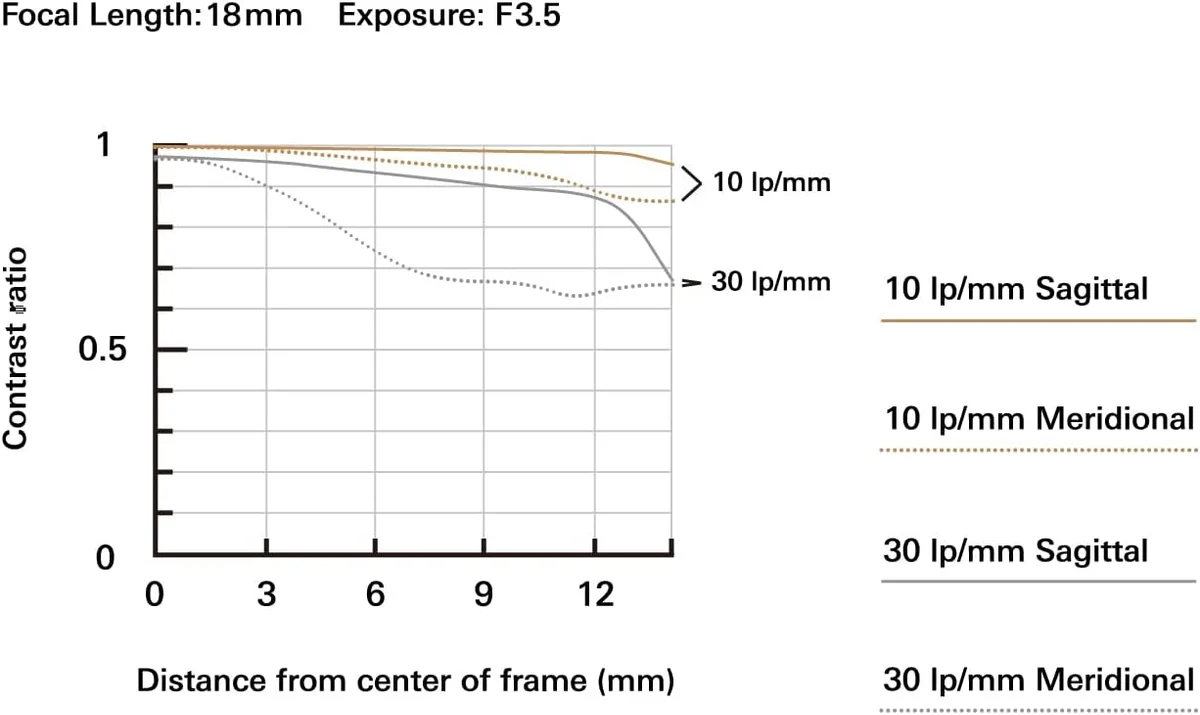
The Tamron 18-300mm's optical performance follows a predictable curve: strong at the wide end, peaking in the mid-range, and declining at the telephoto extreme. This is the fundamental bargain of a superzoom — you trade peak sharpness at the extremes for the convenience of continuous coverage.
At 18-35mm, center sharpness on a 26-megapixel APS-C sensor (Sony a6700) is strong enough for critical work. Edge-to-edge performance at f/5.6 approaches what the Sony 18-135mm delivers at the same focal lengths. Color fringing is well controlled, with lateral chromatic aberration kept below the threshold of visibility at normal viewing distances. Barrel distortion at 18mm is the most aggressive geometric flaw — roughly 3.5% — but Sony's in-camera correction and Lightroom profiles correct it automatically. At 35mm, distortion drops below 1% and is practically invisible.
The sweet spot falls between 35mm and 135mm. Here, the Tamron resolves detail at a level that prints well at large sizes and crops cleanly for social media. Center sharpness at 70mm f/5.6 closely matches the Sony 18-135mm, and edge performance remains acceptable through f/8. Chromatic aberration stays minimal. Flare control is good — the BBAR-G2 coating handles sidelight and backlight without the veiling haze that plagued older superzooms.
Beyond 200mm, the compromises appear. Center sharpness at 300mm f/6.3 drops roughly 20-25% compared to the 50mm position. Edge resolution falls further — corners at 300mm on the a6700 show visible softening that stopping down to f/8 only partially recovers. Longitudinal chromatic aberration increases at 300mm, producing faint color fringing on high-contrast edges. For web-resolution output and standard-size prints, the 300mm end is serviceable. For large gallery prints or heavy cropping, staying under 200mm produces better results.
Autofocus performance is a genuine bright spot. Tamron's VXD linear motor acquires focus quickly across the zoom range — approximately 0.2 seconds from infinity to close focus in good light. On the Sony a6700, eye-AF tracks human and animal subjects reliably through 200mm. At 300mm, tracking accuracy dips slightly due to the narrower aperture and longer focal length, but single-shot AF remains dependable. The motor operates quietly enough for video work, and focus transitions are smooth without the stepped, jerky movements that plagued Tamron's older stepper motor designs.
VC stabilization provides approximately 2.5-3 stops of hand-holdable shutter speed reduction at 300mm with lens VC alone. On the a6700 with dual stabilization active, we see user reports of sharp handheld shots at 300mm down to 1/30 second — a roughly 4-stop advantage. For a 450mm equivalent focal length, that is the difference between usable and unusable shots in late-afternoon light. The VC system adds a faint whir audible in silent environments, but it is inaudible in normal outdoor shooting conditions.
Close-Focus Capability That Replaces a Macro Lens
Minimum focus distance separates the Tamron 18-300mm from every competing superzoom. At 18mm, this lens focuses to 0.15 meters — roughly six inches from the front element to the subject. At that distance, magnification reaches 0.5x, capturing subjects at half life-size. Most superzooms top out at 0.25x-0.33x magnification. The Tamron doubles their close-up capability.
The working distance at 0.5x is impractical for skittish subjects — your lens hood nearly touches a butterfly at maximum magnification. But for controlled close-up work, the capability is practically useful. Food photographers at restaurants can capture plating details without a lens swap. Product photographers on location can shoot jewelry and small items without packing a dedicated macro. Botanical shooters get petal-level detail on flowers without leaving the trail to retrieve a different lens from a backpack.
At 300mm, minimum focus distance extends to 0.99 meters with 0.25x magnification — still strong for a telephoto focal length. This creates a practical two-mode macro workflow: switch to 18mm for maximum magnification on cooperative subjects, or stay at 300mm for frame-filling shots of insects and small animals from a meter away. Neither mode replaces a true 1:1 macro lens for publication-quality entomology or studio product work. Both modes exceed what any competing all-in-one zoom offers for casual close-up photography.
Video Performance and Handling on Sony APS-C Bodies
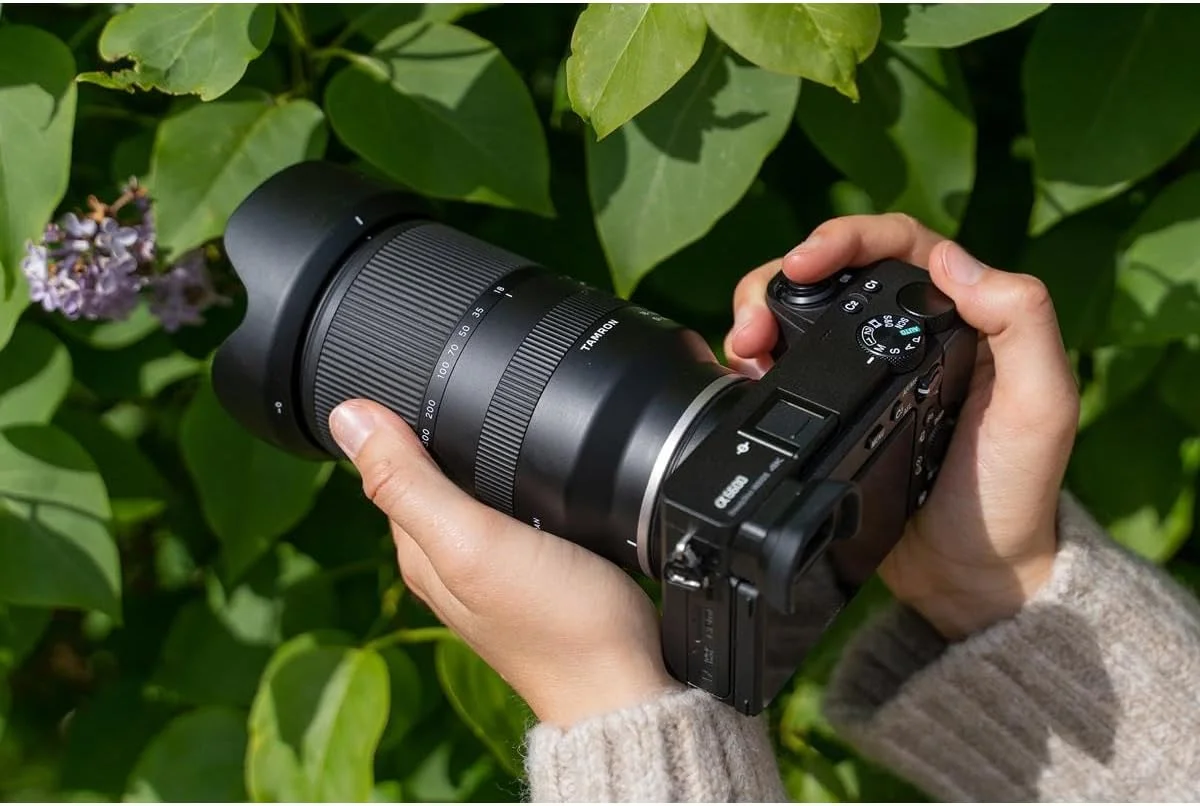
The Tamron 18-300mm pulls double duty as a video lens on the Sony a6700, ZV-E10 II, and FX30. For more on what makes a good video lens, see our video and YouTube lens guide. The VXD autofocus motor operates quietly enough that on-camera microphones rarely pick up motor noise during focus transitions — a marked improvement over Tamron's older stepper motor designs. Focus racks are smooth and predictable, without the micro-corrections that create a jittery, "breathing" look in footage.
Focus breathing — the field-of-view shift when pulling focus between distances — is moderate. At 300mm, breathing is visible during rack-focus sequences, narrowing the frame slightly as focus moves to closer subjects. At wider focal lengths, breathing is minimal and unlikely to bother anyone outside professional cinema work. Sony's in-camera breathing compensation (available on the a6700 and FX30) reduces the effect further, though it crops the frame slightly to do so.
For vlog and travel video content, the zoom range is the primary selling point. A single lens covers establishing wide shots, medium talking-head frames, and tight B-roll details without a cut. The VC stabilization combined with a6700 IBIS produces walkable footage that is usable without a gimbal — not cinema-smooth, but acceptable for YouTube and social content. The 620-gram weight keeps the rig balanced on small APS-C bodies without the front-heavy tilt that larger telephoto zooms create.
Value Analysis
How the 18-300mm Stacks Up Against Competing Strategies
Evaluating the Tamron 18-300mm against individual lenses misses the point — our best Sony E-mount lenses roundup covers the alternatives in detail. This lens competes against kits — combinations of two or three lenses that cover the same focal range. The most common alternatives for Sony APS-C shooters break down into three strategies, each with distinct cost and weight implications.
Strategy one: the Sony 18-135mm f/3.5-5.6 plus a dedicated telephoto like the Sony 70-350mm f/4.5-6.3. This two-lens kit covers 18mm to 350mm with better per-focal-length sharpness than the Tamron. Combined weight: 1,065 grams. Combined price at mid-range tier: roughly double the Tamron alone. You gain optical quality at each focal length but lose the unbroken coverage — there's a lens swap between 135mm and 200mm where neither lens covers the gap. You also lose stabilization on the 18-135mm (it has no OIS), and you carry twice the weight and bulk.
Strategy two: the Sigma 18-50mm f/2.8 plus the Tamron 70-300mm f/4.5-6.3.
This pairing covers a similar range with a fast standard zoom and a lightweight telephoto. Combined weight: approximately 830 grams. The Sigma gives you a full stop more light at the wide end, and its optical quality from 18-50mm outclasses the Tamron superzoom at those focal lengths. The gap between 50mm and 70mm is small but real. Combined price runs higher than the single Tamron. For photographers who shoot primarily at wide-to-normal focal lengths and only occasionally need telephoto reach, this two-lens strategy makes sense. For travelers who need everything in one lens, it doesn't.
Strategy three: the Tamron 18-300mm alone.
Total weight: 620 grams. Total cost: one mid-range lens price. Total coverage: 27mm to 450mm equivalent, plus 0.5x macro at the wide end. You sacrifice peak sharpness at every focal length compared to dedicated lenses. You accept f/6.3 at the long end instead of f/4.5. You give up the Sigma's f/2.8 light-gathering advantage at normal lengths. What you gain is simplicity — one lens, one body, no decisions, no missed moments during a lens swap. For travel, hiking, family events, and general-purpose photography, simplicity usually wins. If you want a faster APS-C zoom with less range, the Tamron 17-70mm f/2.8 is the middle ground.
Resale value on the Tamron 18-300mm holds reasonably well. Sony APS-C remains popular with travel photographers and content creators, and demand for all-in-one zooms stays consistent. Expect to recover roughly 60-70% of the purchase price on the used market within the first two years.
What to Expect Over Time
620 Grams Through Airports, Trails, and Daily Life
The Tamron 18-300mm has been available for Sony E-mount since 2021, providing nearly five years of real-world durability data from a large user base. The moisture-resistant construction holds up well under regular outdoor use — travel photographers who carry the lens through Southeast Asian monsoons, Patagonian gales, and Saharan dust report no internal contamination issues through extended trips. The fluorine coating on the front element maintains its water-repellent properties for roughly two years of regular use before gradually losing effectiveness, at which point a replacement UV filter provides equivalent protection at minimal cost.
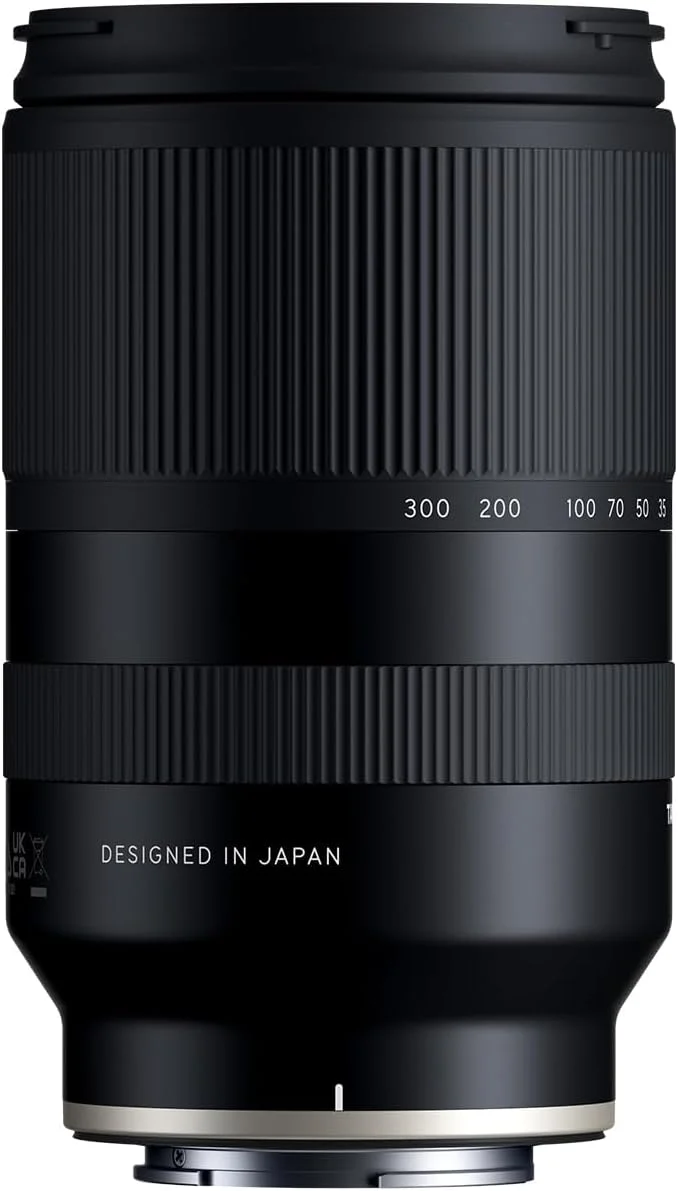
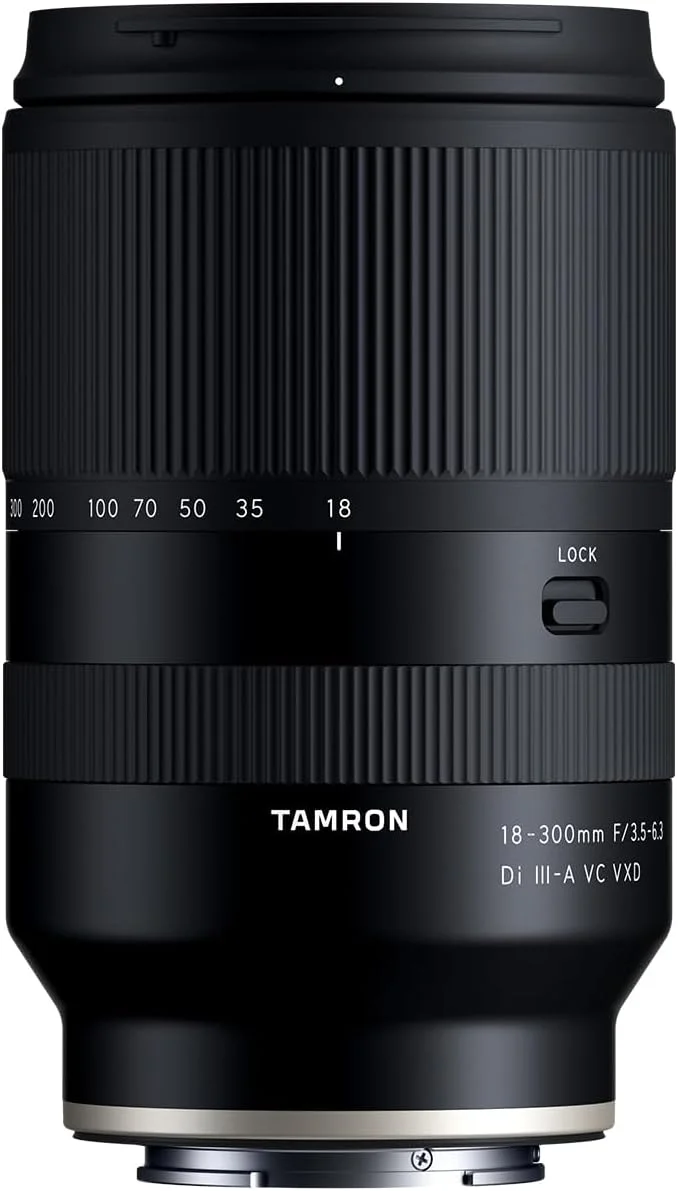
The zoom ring develops a slightly looser feel after a year or more of heavy use — the barrel extends under gravity when pointing downward if you don't engage the zoom lock switch. Tamron includes the lock switch for exactly this reason, and regular users learn to flick it instinctively when stowing the lens. The focus ring maintains its smooth, damped feel over time because the VXD system uses electrical signaling rather than mechanical coupling.
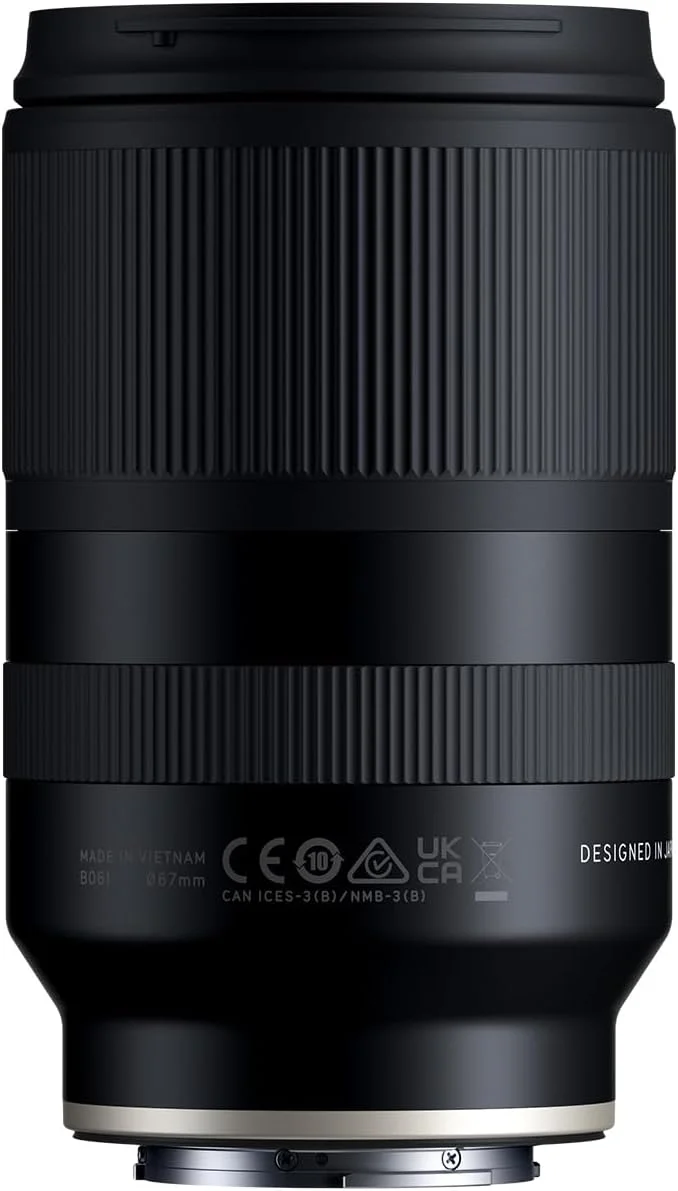
Build quality at the mount is metal, and the bayonet connection stays tight after thousands of mount cycles. The lens hood (HA036) is a petal-type plastic design that attaches firmly and reverses for storage. The 67mm filter thread is standard enough that replacement caps and filters are inexpensive and widely available at any camera shop worldwide — a genuine convenience for travel photographers who lose lens caps in foreign countries.
Firmware updates arrive periodically through Tamron's Lens Utility software. Updates have improved AF performance, added compatibility with newer Sony bodies, and refined VC behavior. The USB-C port on the lens (via the optional Tamron Lens Utility dock, or directly with newer Tamron models) makes firmware application a five-minute process. Not every update delivers noticeable improvement, but the ongoing software support is reassuring for a third-party lens purchase — it signals that Tamron maintains active development rather than shipping and forgetting.
After three years of user data, the most common long-term complaint is zoom creep — the barrel extending under its own weight when the lens points down. The zoom lock addresses this completely. The second most common issue is a desire for faster aperture at the telephoto end, which is not a durability concern but a physics limitation that no firmware update can change. For photographers who accept f/6.3 at 300mm from the start, the lens delivers reliable, consistent performance year after year without degradation.
Tamron 18-300mm Sony — Superzoom Questions
Common questions about the Tamron 18-300mm f/3.5-6.3 for Sony E-mount, drawn from Amazon owner reviews and independent optical comparisons.
Does the Tamron 18-300mm work on full-frame Sony cameras?
The Tamron 18-300mm is designed for APS-C Sony E-mount bodies like the a6700, a6400, and ZV-E10. You can physically mount it on a full-frame Sony body (a7 IV, a7R V, a9 III), but the camera will automatically crop to APS-C mode, reducing resolution to roughly 10-11 megapixels on a 24MP sensor. At that point, you lose the resolution advantage of the full-frame sensor. If you own a full-frame Sony body and want a similar all-in-one zoom, the <a href="/reviews/tamron-28-200mm-f2-8-5-6-sony-e/">Tamron 28-200mm f/2.8-5.6</a> covers full-frame and offers better aperture at every focal length.
How does VXD autofocus compare to Sony native lens AF?
Tamron's VXD (Voice-coil eXtreme-torque Drive) linear motor delivers autofocus speed comparable to Sony's native mid-range lenses. In good light, acquisition from infinity to close focus takes approximately 0.2 seconds — fast enough for street photography and casual action. Eye-AF and animal-AF tracking work with VXD on the a6700 and a6400, though native Sony lenses still hold a slight edge in tracking consistency during rapid, erratic subject movement. For video, the VXD motor is nearly silent, and focus transitions are smooth without the micro-stutter that older Tamron stepper motors produced.
Is the Tamron 18-300mm weather sealed?
Yes. Tamron applies moisture-resistant construction at the lens mount, zoom ring, and barrel joints. A fluorine coating on the front element repels water droplets and fingerprints. This is not IP-rated waterproofing — prolonged rain exposure or submersion will damage the lens. But for shooting in light rain, morning mist, dusty trails, and beach environments, the sealing provides adequate protection. Pair it with a weather-sealed body like the Sony a6700 for full environmental coverage.
What is the minimum focus distance and can it do macro?
The Tamron 18-300mm focuses as close as 0.15 meters (about 6 inches) at the wide end, delivering 0.5x magnification — half life-size. This is unusually strong close-focus capability for a superzoom and exceeds what many dedicated macro lenses in this price range offer. At 300mm, minimum focus distance extends to 0.99 meters with 0.25x magnification. The 0.5x wide-angle macro mode is excellent for flowers, insects, food photography, and product shots. True 1:1 macro still requires a dedicated macro lens, but the 18-300mm gets closer than any competing superzoom.
How much image quality do I lose at 300mm compared to 18mm?
Image quality degrades progressively as you zoom beyond 200mm — a physical limitation of all superzooms, not a Tamron-specific flaw. At 18-70mm, center sharpness is strong enough for large prints and detailed crops. From 70-200mm, sharpness remains good at the center but edges soften. At 250-300mm, center sharpness drops by roughly 20-25% compared to the wide end, and corner sharpness falls further. Stopping down from f/6.3 to f/8 at 300mm recovers some of that loss. For web use, social media, and standard-size prints, the 300mm end delivers acceptable results. For large prints or heavy cropping, keep focal lengths under 200mm.
Does VC stabilization work with Sony body IBIS?
Yes, on bodies with IBIS like the Sony a6700, the Tamron's optical VC and the body's IBIS work together in a coordinated dual-stabilization mode. Sony bodies without IBIS (a6400, a6100, ZV-E10 first generation) rely on the lens VC alone. With dual stabilization on the a6700, we see reports of handheld shots at 300mm (450mm equivalent) down to 1/30s with usable sharpness — roughly 4 stops of compensation. VC alone provides about 2.5-3 stops. For video, the combined stabilization smooths walking footage enough for casual vlog content, though a gimbal still outperforms it for smooth tracking shots.
How does the Tamron 18-300mm compare to the Sony 18-135mm f/3.5-5.6?
The Sony 18-135mm costs less, weighs 325g (half the Tamron), and offers sharper optics across its entire range. The Tamron counters with more than double the focal length reach (300mm vs 135mm), built-in stabilization (the Sony relies on body IBIS only), and the 0.5x close-focus capability. If your photography rarely exceeds 135mm, the Sony is the better optical performer and easier to carry. If you need wildlife reach, sports coverage, or travel flexibility without carrying multiple lenses, the Tamron's extra 165mm of range changes what you can shoot. Most travelers and one-bag photographers choose the range.
Is the 67mm filter thread compatible with common filters?
The 67mm filter thread is one of the most common sizes across camera lenses, making filters affordable and widely available. Standard UV/clear protectors, circular polarizers, and ND filters from B+W, Hoya, and NiSi all work without compatibility issues. A circular polarizer is particularly useful on this lens for scenic and nature work at the wide end. Note that at 18mm, thick filter rings may cause minor vignetting in the extreme corners — use slim-profile filters if you shoot wide-angle scenics frequently.