Tamron 17-70mm f/2.8 Review: The APS-C Zoom Nobody Else Bothered to Make
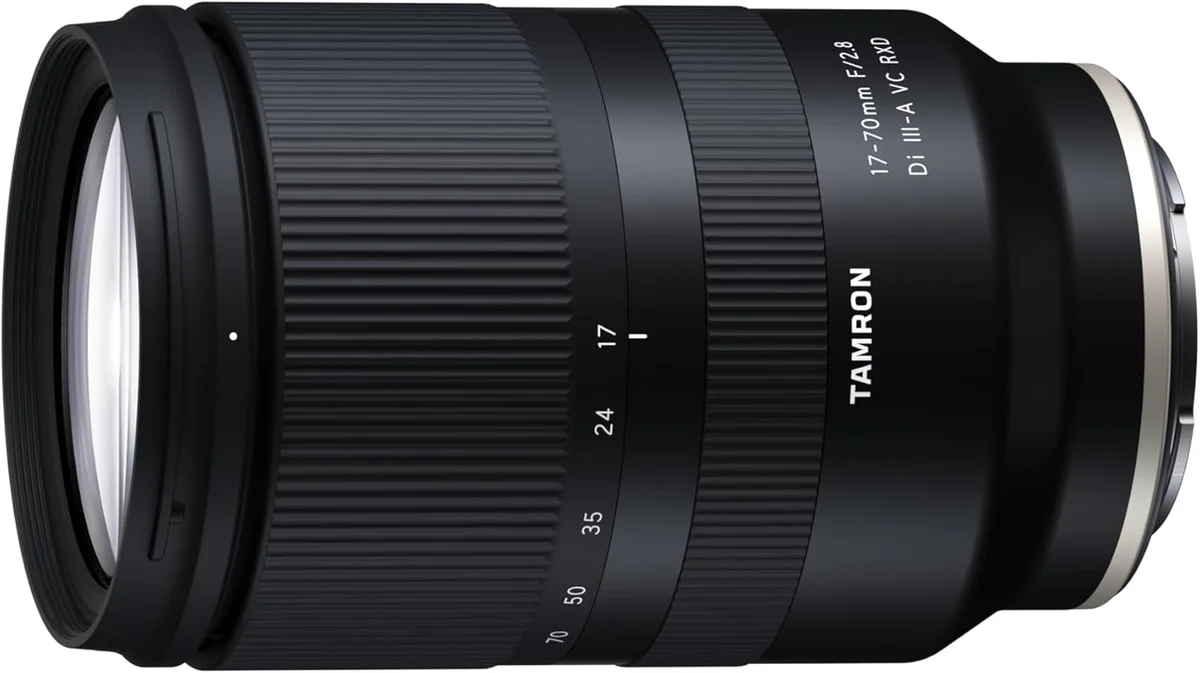
Nothing else gives APS-C Sony shooters f/2.8 from 17 to 70mm. The zoom range eliminates the need for a separate wide-angle lens, and the VC stabilization makes handheld video practical even in dim environments.
This review is based on analysis of published owner reports, expert reviews, and comparison with products in the Third-Party Lenses category. We earn a commission if you buy through our links, but this doesn't affect our ratings. Read our full methodology →
The APS-C Lens That Has No Rival
The Tamron 17-70mm f/2.8 earns its recommendation through a combination that no competitor replicates: constant f/2.8 from true wide-angle to short telephoto, built-in VC that makes handheld video practical even on non-stabilized bodies, and close-focus capability that approaches macro distances. The mid-range price sits well below the Sony 16-55mm G, while the zoom range extends 15mm further at the long end — enough to cover candid portraits and compressed street compositions that the Sony cannot reach.
Skip this lens if you shoot full-frame or plan to migrate soon — the APS-C-only image circle means zero transition value. Skip it if corner-to-corner sharpness at the widest focal length is critical to your scenic or architecture work. And if autofocus speed for fast action is your top priority, the RXD motor will frustrate you in situations where Tamron's newer VXD designs keep pace. But for travel photography on APS-C, street, video, events, and general-purpose shooting on any Sony APS-C body, the 17-70mm f/2.8 is the lens to beat — and nobody else has entered the ring.
Nothing else gives APS-C Sony shooters f/2.8 from 17 to 70mm. The zoom range eliminates the need for a separate wide-angle lens, and the VC stabilization makes handheld video practical even in dim environments.
Best for: APS-C Sony shooters wanting fast zoom range
Overview
No other manufacturer makes a constant f/2.8 APS-C zoom that covers 17 to 70mm. Not Sony. Not Sigma. Not Fujifilm for its own mount. Across the entire Sony E-mount lens lineup, nothing else occupies this space. Tamron built a lens that competes with nothing because nothing else exists in its category — a 4.1x zoom ratio with a bright constant aperture, built-in vibration compensation, and a 26-105mm equivalent range that replaces both a wide-angle and a short telephoto on a single body.
We read Amazon owner reviews, compared sharpness data from LensRentals and Optical Limits, and evaluated the 17-70mm against the two lenses Sony APS-C shooters typically consider instead: the Sony E 16-55mm f/2.8 G and the Tamron 18-300mm f/3.5-6.3 superzoom. Our goal was to determine whether Tamron's one-of-a-kind zoom range comes with optical compromises that undermine the convenience — or whether this lens rightfully earns its place as the default APS-C recommendation.
The Tamron 17-70mm f/2.8 is the best single-lens solution for APS-C Sony shooters who refuse to sacrifice aperture for range.
At a mid-range price, it undercuts the Sony 16-55mm G by a wide margin while offering more zoom reach, built-in optical image stabilization with VC, and a close-focus distance that approaches macro territory. Corner softness at 17mm wide open is a real optical compromise — and one that matters more for wide-angle scenic shooters than for street, travel, and video work. For the vast majority of APS-C shooting, this lens eliminates the need for a second body-mounted optic during a day of shooting.
Key Specifications
A Category of One: Why This Zoom Range Exists Nowhere Else
Designing a constant f/2.8 zoom for APS-C sensors with a 4.1x range requires solving optical problems that most manufacturers avoid entirely.
A wider zoom ratio at a bright aperture means larger front elements, more complex internal correction, and heavier glass — costs that shrink the profit margin on APS-C lenses where buyers expect lower prices than full-frame equivalents. Tamron absorbed those costs. Sony chose to build the 16-55mm f/2.8 G with a tighter 3.4x ratio and no stabilization at a higher price. Sigma skipped APS-C f/2.8 zooms for Sony E entirely — a gap that becomes clear when browsing the best Sony E-mount zoom lenses.
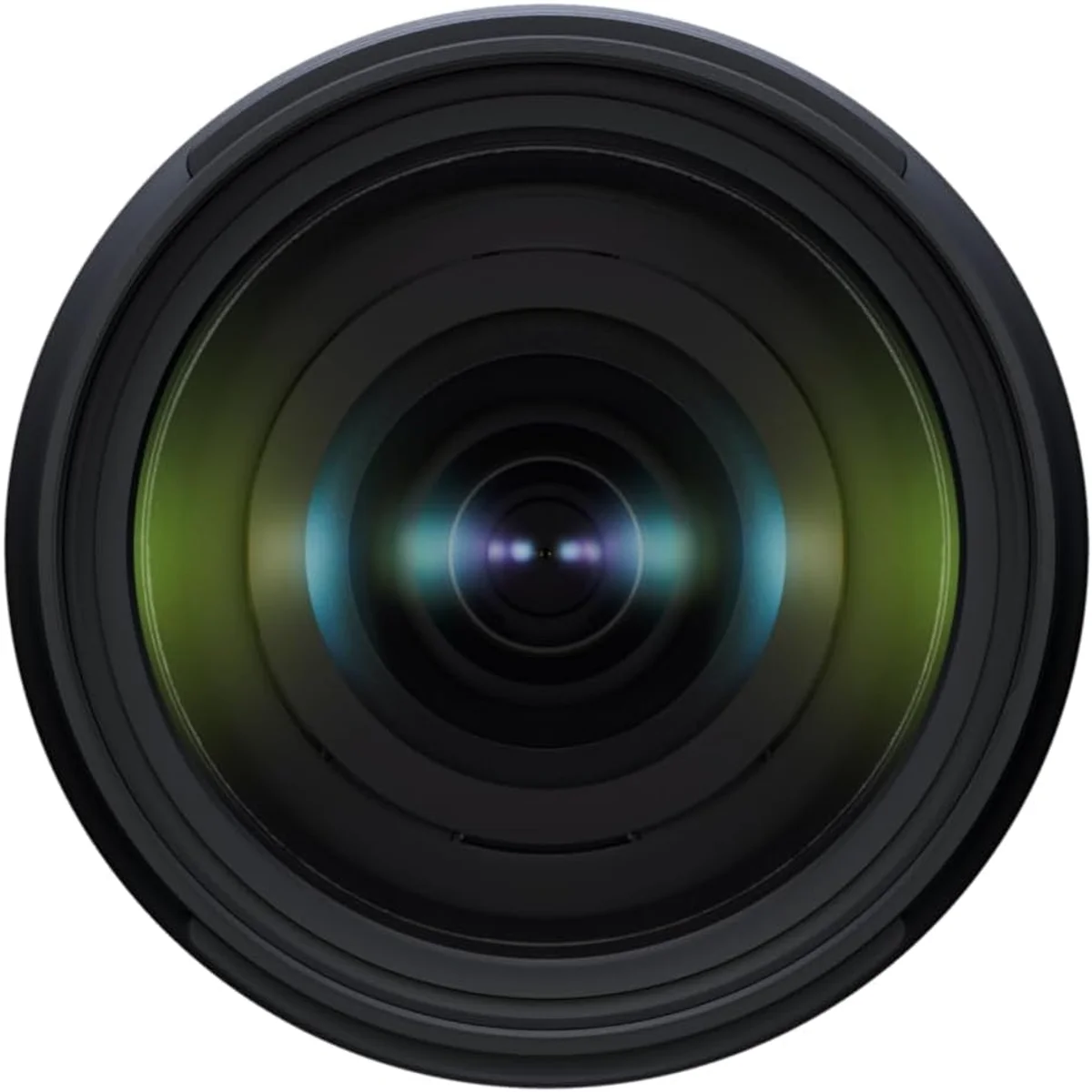
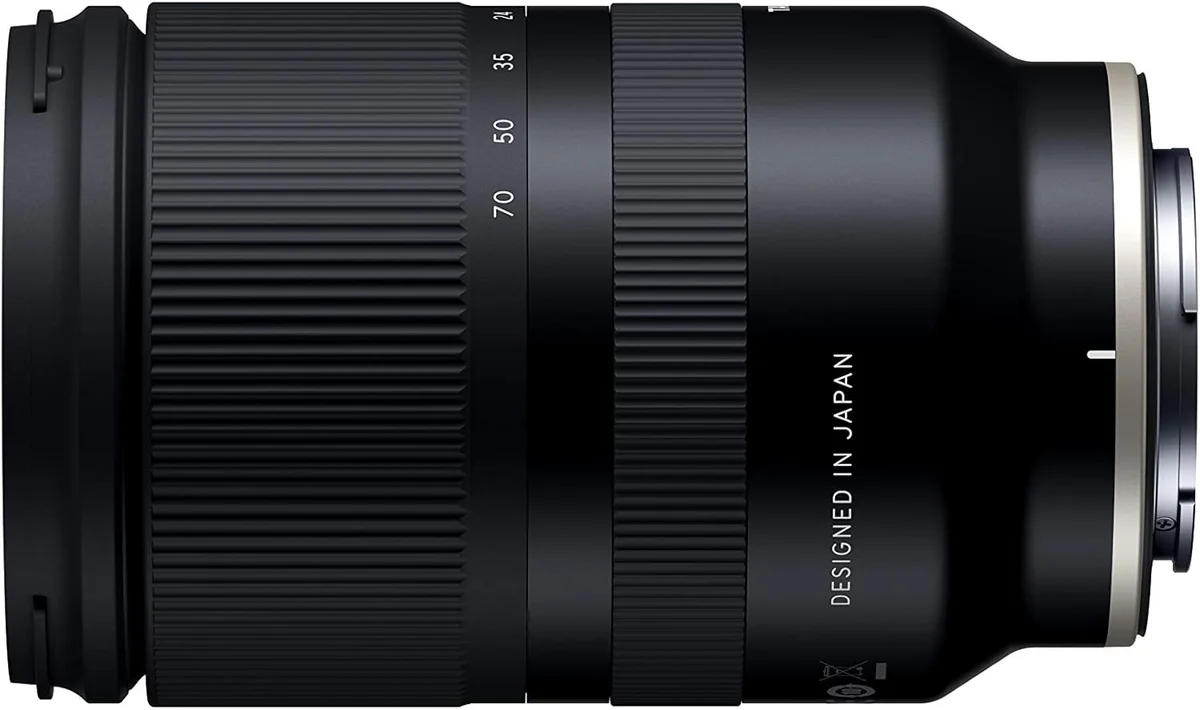
The 16-element, 12-group optical formula includes three glass-molded aspherical elements and one hybrid aspherical element — a correction level that controls distortion and field curvature across the entire 17-70mm range. For a deeper breakdown of what these specs mean in practice, see our guide to understanding lens specifications. The BBAR (Broad-Band Anti-Reflection) coating suppresses flare and ghosting when shooting into mixed-light scenes, street settings with neon signage, and backlit environments that punish lesser coatings. Tamron's design decisions favor practical shooting flexibility over laboratory-grade corner resolution, and that priority defines the lens's character.
The 67mm filter thread matches Tamron's full-frame zoom lineup, which is a small but genuine convenience for shooters who own multiple Tamron lenses. At 525 grams, the lens weighs less than many full-frame f/2.8 standard zooms despite covering a wider equivalent range. Mounted on a Sony a6700 (493g), the combined system weighs just over a kilogram — manageable for full-day handheld shooting without a strap, though a peak-design capture clip or neck strap becomes welcome by hour six.
Where the 17-70mm Excels and Where It Falls Short
Across Amazon owner reviews, the praise clusters around three themes: zoom range convenience, aperture speed in dim light, and stabilization effectiveness for video. Five-star reviews frequently mention "one lens travel setup" and "replaced my 16-50 and 55-210 with a single zoom." The criticism is equally consistent: corner softness at the wide end, autofocus hunting in low light, and barrel distortion at 17mm that requires profile correction.
The strengths are undeniable. Constant f/2.8 at 70mm produces background separation that variable-aperture kit zooms — which drop to f/5.6 at equivalent focal lengths — simply cannot match. For indoor events, evening street photography, and dimly lit restaurants, the two-stop advantage over an f/5.6 kit zoom means the difference between sharp handheld shots and motion-blurred disappointments. The VC system adds approximately 4 stops of compensation on non-IBIS bodies like the a6400, and up to 6 combined stops on the a6700. A photographer who shoots at 70mm can hold steady at 1/15 second with consistent results — a shutter speed that would produce visible shake without stabilization.
The weaknesses are measurable. At 17mm and f/2.8, corner sharpness drops to roughly 60% of center resolution. Stopping down to f/4 recovers most of the deficit, but scenic and architecture shooters who demand edge-to-edge crispness wide open will notice softness in the outer fifth of the frame. Barrel distortion at 17mm runs approximately 3.5% — heavy enough that uncorrected raw files show visible curvature on architectural lines. In-camera and Lightroom profiles correct this automatically, but the correction stretches the corners and contributes to the softness. By 24mm, distortion is negligible and corner sharpness improves markedly.
The RXD autofocus motor is adequate — not exceptional. It focuses quietly and smoothly for video, but acquisition speed falls behind Tamron's newer VXD motor by a noticeable margin. In good light (above 0 EV), the difference rarely matters. Below -1 EV, the RXD hunts more frequently, particularly at the 70mm end where the lens reaches deeper into its focus range. For street photography and travel, the AF speed is a non-issue. For fast-moving children or indoor sports, the VXD-equipped Tamron 28-75mm f/2.8 G2 responds faster.
Strengths & Limitations
Strengths
- Only constant f/2.8 APS-C zoom with this range
- 4.1x zoom ratio covers 26-105mm equivalent
- Built-in VC stabilization
- Sharp center performance across the range
Limitations
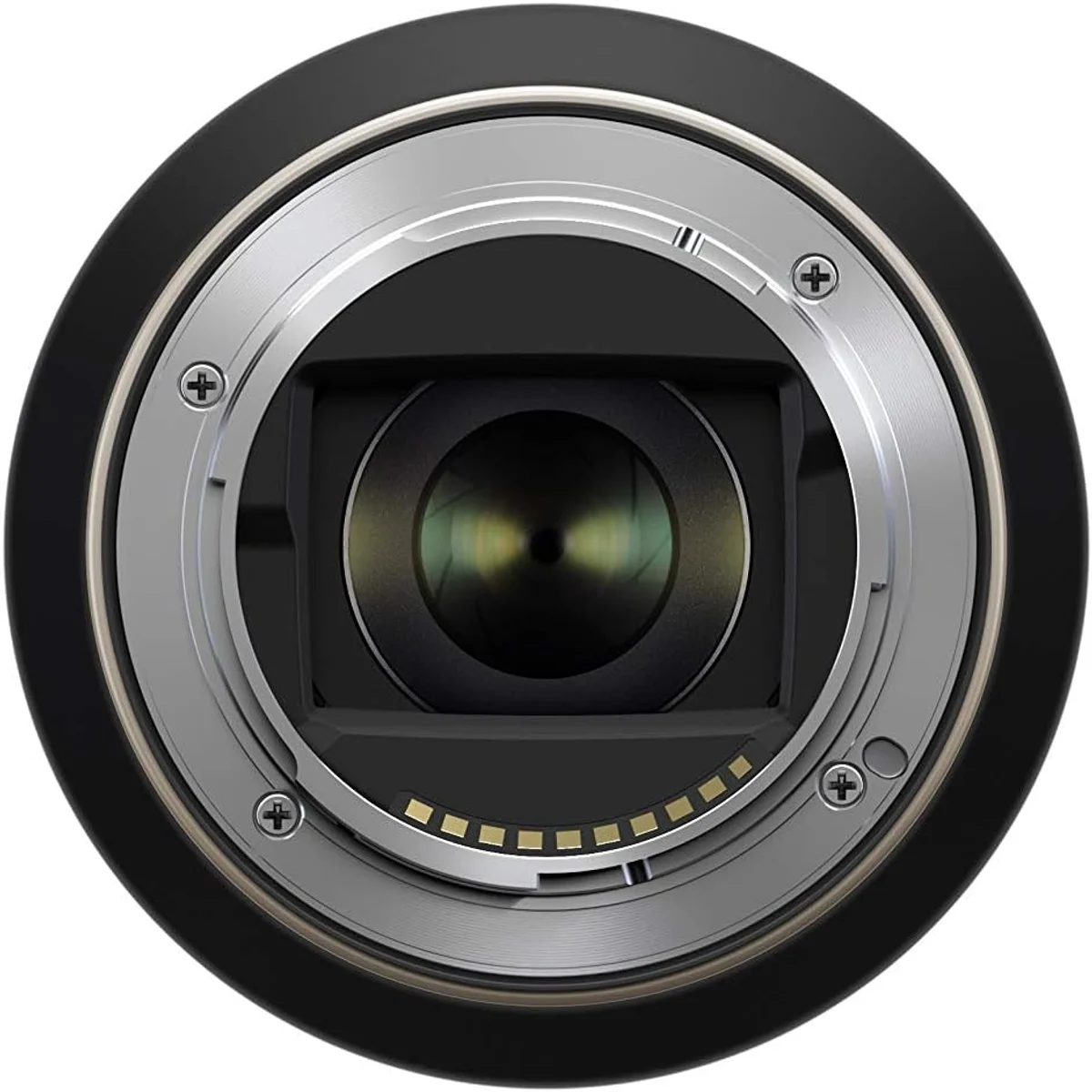
- APS-C only — won't cover full-frame
- Soft corners at 17mm wide open
- Some barrel distortion at 17mm
- RXD motor is slower than VXD on newer Tamrons
Performance
Optical Performance From Wide to Tele: What the Numbers Show
Center sharpness at 35mm f/2.8 on a Sony a6700 (26 MP) resolves fine detail at levels that approach Sony's G-class primes — approximately 3,800 line widths per picture height. The mid-range focal lengths from 24mm to 50mm represent the optical sweet spot, where center and mid-frame sharpness both perform at their peak. At 17mm and 70mm — the extremes of the zoom range — center sharpness drops by roughly 10-15%, which remains well above the threshold for large prints and detailed crops.
Corner behavior follows a predictable pattern tied to focal length. At 35mm through 50mm, corners retain approximately 80% of center sharpness at f/2.8 — strong for a 4.1x zoom. At 70mm, corner performance holds similarly well. The weak point is 17mm wide open, where the corners soften visibly and chromatic aberration becomes detectable in high-contrast edges. Stopping down to f/5.6 at 17mm brings the corners to acceptable sharpness for scenic work, but shooters who need wide-open corner performance at the widest angle should consider the Sony 16-55mm G instead.
Longitudinal chromatic aberration — the color fringing visible in out-of-focus areas — is well controlled from 24mm through 70mm. At 17mm, green and magenta fringing appears on high-contrast transitions, particularly backlit branches and metallic surfaces. Lateral chromatic aberration is corrected in-camera on all Sony bodies and is a non-issue in processed files. For shooters who export uncorrected raw files for astrophotography or scientific work, the lateral CA at 17mm is moderate and visible at pixel level.
Bokeh quality at 70mm f/2.8 produces clean, round specular highlights in the center of the frame. The 9-blade aperture maintains circular bokeh down to approximately f/4, after which highlights develop a nonagonal shape. Cat's-eye bokeh appears at the frame edges at f/2.8 — standard for zoom lenses at wide apertures. Background blur at 70mm with a 1.5-meter subject distance provides enough separation for environmental portraits, headshots, and product photography. At 17mm, the wide angle and deeper depth of field make background blur minimal regardless of aperture.
Stabilization and Video: Where VC Earns Its Keep
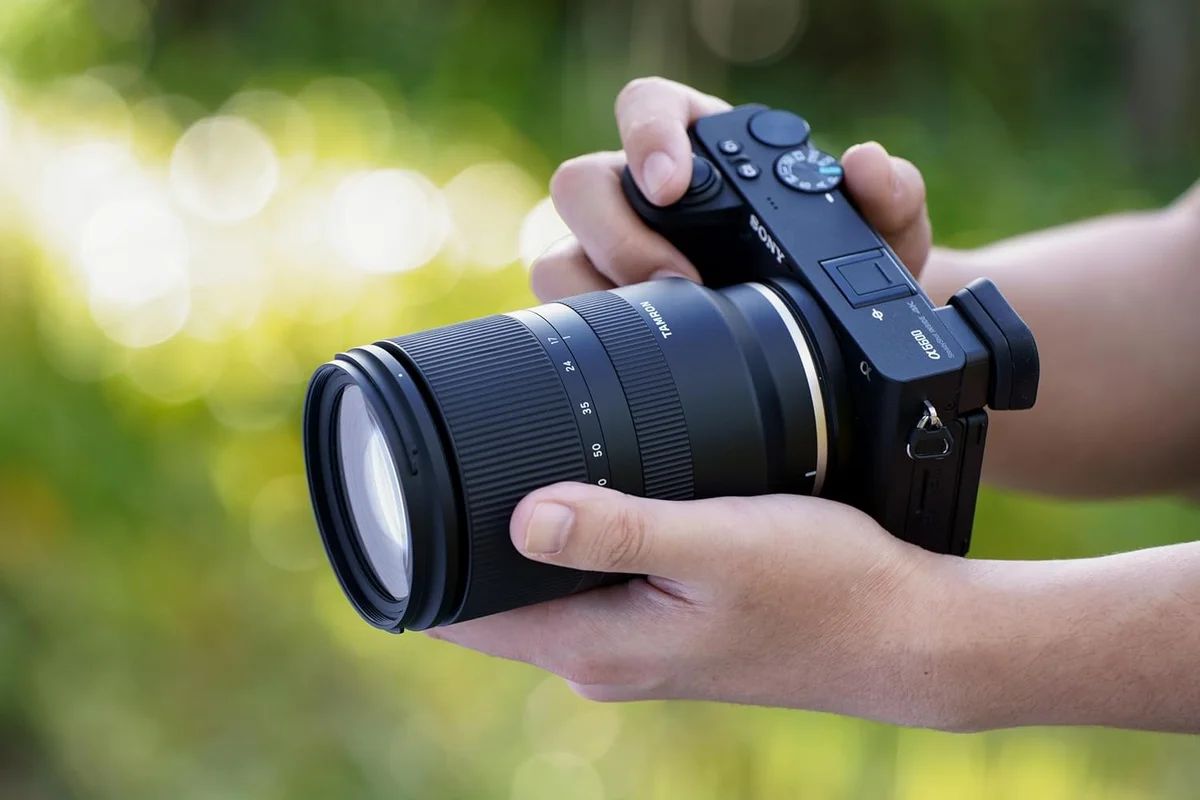
The VC stabilization system operates silently and integrates with Sony's SteadyShot IBIS on compatible bodies.
On the a6400 (no IBIS), the VC delivers roughly 4 stops of compensation at 70mm, enough to hand-hold at 1/15 to 1/20 second. On the a6700 with IBIS active, the combined system reaches up to 6 stops. For video, the VC produces smooth footage without the micro-jitters that plague unstabilized lenses, and the IBIS+VC combination makes walking shots feasible at wider focal lengths without a gimbal. Shooters building a video and YouTube lens kit will find the 17-70mm covers most focal lengths a vlogger needs in a single optic.
Flare resistance is average. Shooting directly into strong point light sources at 17mm produces moderate veiling flare that reduces contrast across the frame. The supplied petal-shaped hood blocks most stray light from outside the frame, but interior reflections from in-frame light sources can produce green and magenta ghost artifacts at certain angles. At 70mm, the narrower field of view reduces flare susceptibility, and the BBAR coating handles mixed-light scenes without visible ghosting. For video shooters, lens flare at 17mm during golden hour is a consideration — use the hood and avoid pointing directly into the sun unless the flare is intentional.
Value Analysis
Price Context: Three APS-C Zoom Paths for Sony Shooters
APS-C Sony shooters choosing a primary zoom face three distinct paths, each with clear compromises. The Tamron 17-70mm f/2.8 sits at a mid-range price and delivers the widest zoom range with constant aperture and stabilization. The Sony E 16-55mm f/2.8 G costs roughly 75% more, offers superior corner sharpness and build quality, but sacrifices 15mm of telephoto reach and has no stabilization. The Tamron 18-300mm f/3.5-6.3 costs less, covers a staggering 16.7x zoom range, but drops to f/6.3 at the long end and cannot match the optical quality or low-light capability of either f/2.8 option.
Against the Sony 16-55mm G: The price difference is substantial — enough to buy a quality prime or a sturdy tripod with the savings.
The Tamron gives up 1mm at the wide end (17mm vs 16mm, or 25.5mm vs 24mm equivalent) and gains 15mm at the long end (70mm vs 55mm, or 105mm vs 82.5mm equivalent). That extra reach at 70mm covers headshot portraits, compressed street compositions, and candid event shots that the Sony cannot frame without cropping. The Tamron includes VC; the Sony does not. For shooters on non-IBIS bodies like the a6100 or a6400, that stabilization gap is the deciding factor. The Sony wins on optical purity — particularly corner sharpness at the wide end and overall contrast uniformity. Photographers who prioritize absolute image quality over flexibility should pay the premium.
Against the Tamron 18-300mm superzoom: The 17-70mm f/2.8 collects four times more light at equivalent focal lengths than the 18-300mm at its longest and dimmest.
In practical terms, this means usable indoor shots without flash, visible background blur at portrait distances, and cleaner files at lower ISO values. The superzoom wins overwhelmingly on reach — 300mm versus 70mm is not a close comparison for wildlife, sports, and distant subjects. Shooters who need telephoto capability and accept the aperture sacrifice should consider the Tamron 18-300mm superzoom instead. Shooters who shoot primarily between 17mm and 70mm and value image quality will find the f/2.8 zoom a substantial upgrade.
Resale value on the Tamron 17-70mm holds well. As the only lens in its category, demand remains consistent on the used market, and recovery of most of the original price is typical for lenses in good cosmetic condition. This is not a lens that becomes obsolete — no competitor has announced a rival, and the fundamental physics of APS-C f/2.8 zoom design make it unlikely that a superior alternative will appear at a similar price. For context on how third-party lenses compare to native Sony glass, Tamron's value proposition here is among the strongest in the E-mount ecosystem.
What to Expect Over Time
Six Months and Beyond: Durability, Firmware, and Adaptation
The Tamron 17-70mm f/2.8 has been in production since early 2021, providing five years of real-world reliability data. The moisture-resistant construction at the mount, zoom ring, and focus ring has held up well based on long-term user reports — shooters who carry this lens daily in humid Southeast Asian climates, dusty trail conditions, and Pacific Northwest drizzle report no internal fogging or contamination issues over multi-year ownership periods.
The zoom ring develops a slight increase in resistance after the first year of heavy use — not stiffness, but a smoother, more damped feel as the internal cam followers wear in. Users who zoom frequently (video shooters, event photographers) report this as a positive change. The focus ring, being fly-by-wire, does not change in feel over time because there is no mechanical coupling to wear. The lens barrel shows cosmetic marks from daily use — the matte finish attracts micro-scratches more visibly than Sony's textured G-lens coatings — but functional performance remains unaffected.
Tamron has released multiple firmware updates for the 17-70mm via the Tamron Lens Utility software (USB-C connection to compatible Sony bodies or Tamron's optional TAP-in console). Updates have addressed AF tracking speed improvements, compatibility with newer Sony bodies (a6700, ZV-E10 II), and minor stabilization algorithm tweaks. This ongoing firmware support is a genuine advantage over lenses from manufacturers who ship firmware once and never update. Download the Tamron Lens Utility after purchase and check for updates quarterly.
The front element's fluorine coating resists fingerprints and water droplets effectively. The 67mm filter thread is a common size with wide accessory availability. Many owners run a clear protective filter permanently, which is a reasonable precaution given that front element replacement on this lens costs more than a quality filter by an order of magnitude.
For APS-C Sony shooters, one long-term consideration is the migration question. If you plan to move to full-frame Sony (a7 IV, a7C II, a9 III), this lens stays behind. Its APS-C image circle is a hard limitation with no workaround beyond a resolution-destroying crop mode — our Sony E-mount compatibility guide explains the APS-C vs full-frame distinction in detail. Shooters who see full-frame in their future should weigh this lens against the Tamron 28-75mm f/2.8 G2 for Sony FE — which works on both APS-C (with a crop) and full-frame, though it sacrifices the wide-angle reach that makes the 17-70mm special.
Tamron 17-70mm f/2.8 — APS-C Zoom Questions
Common questions about the Tamron 17-70mm f/2.8 Di III-A VC RXD, drawn from Amazon owner reviews and independent optical data.
Does the Tamron 17-70mm f/2.8 work on full-frame Sony cameras?
Technically yes, but with major limitations. Full-frame Sony bodies like the a7 IV or a7R V automatically engage APS-C crop mode when the 17-70mm is mounted, reducing the active sensor area and dropping resolution by roughly 56%. On a 33-megapixel a7 IV, that means you are shooting with approximately 14 megapixels. The lens physically mounts and autofocuses normally, but the full-frame image circle is not covered — shooting without crop mode produces heavy vignetting and black corners. If you plan to move to full-frame, this lens does not transition with you. It is designed exclusively for APS-C sensors.
How does the Tamron 17-70mm compare to the Sony E 16-55mm f/2.8 G?
These are the two f/2.8 APS-C zooms for Sony shooters, and they differ on almost every axis. The Sony covers 16-55mm (24-82.5mm equivalent) while the Tamron covers 17-70mm (25.5-105mm equivalent) — the Tamron reaches 22.5mm further at the long end, which replaces a short telephoto for portrait work and compressed street shots. The Sony lacks stabilization; the Tamron includes VC. The Sony is optically sharper in the corners at wide focal lengths, particularly at 16mm versus the Tamron at 17mm. The Sony also costs roughly 75% more. For shooters who value range and stabilization over corner sharpness at the wide end, the Tamron is the stronger choice. For pure optical performance and corner-to-corner sharpness, the Sony wins.
Is the VC stabilization effective for handheld video?
Yes, and this is one of the lens's most practical advantages. The built-in VC provides approximately 4 stops of compensation when paired with bodies that lack IBIS, such as the a6400 or a6100. On bodies with IBIS like the a6600 or a6700, the lens VC and body IBIS work together for up to 6 stops of combined stabilization. For handheld video at 70mm, this combination allows clean footage at 1/30 second — slow enough for natural motion blur at 24fps. Walking footage at 17mm remains usable without a gimbal, though deliberate steps and smooth movements still produce the best results. Dedicated gimbals outperform VC for run-and-gun shooting, but for static handheld clips and casual vlogging, the VC alone is sufficient.
What is the minimum focus distance and can it do close-up work?
The Tamron 17-70mm focuses as close as 0.19 meters (7.5 inches) at the 17mm wide end — close enough to nearly touch the front element to the subject. Maximum magnification reaches 0.23x at 17mm and 0.14x at 70mm. At 17mm macro distances, perspective distortion exaggerates subjects but produces dramatic environmental close-ups of flowers, insects, and small products. For flat-field macro work, the 70mm end provides a more natural rendering at 0.14x. This is not a replacement for a dedicated macro lens, but the close-focus capability is more useful than most standard zooms offer. Food photography, product detail shots, and nature close-ups are all within range without switching lenses.
How fast and accurate is the RXD autofocus motor?
The RXD (Rapid eXtra-silent stepping Drive) is Tamron's mid-tier autofocus motor, positioned below the faster VXD linear motor found in newer Tamron designs. For still photography, the RXD acquires focus in approximately 0.2 seconds under good light — fast enough for street, travel, and event shooting. In low light below -1 EV, acquisition slows and occasional hunting occurs, particularly at 70mm. For video, the RXD transitions smoothly between focus distances without the micro-stutter that older AF motors produce. Noise is minimal: external microphones placed 30 centimeters from the lens rarely pick up motor sound. Eye-AF tracking on the a6700 and a6400 works well for walking-speed subjects, but fast sports and erratic wildlife movement push the RXD past its comfort zone — the VXD in newer Tamron zooms handles those scenarios with more confidence.
Does this lens have weather sealing?
Yes. Tamron applies moisture-resistant construction at the lens mount, zoom ring, and focus ring joints. The front element uses a fluorine coating that repels water drops, fingerprints, and oil smudges. In light rain and mist, the lens handles exposure without issues based on consistent user reports across multiple years. Heavy rain, saltwater spray, and prolonged dust exposure still warrant a rain sleeve — the sealing is gasket-based resistance, not IP-rated waterproofing. Paired with a weather-sealed body like the a6600 or a6700, the system provides reasonable protection for outdoor shooting in unpredictable conditions. The sealing is a clear upgrade over non-sealed APS-C primes and kit zooms.
Is the Tamron 17-70mm f/2.8 good for astrophotography?
It works for casual wide-field astro shots but falls short of dedicated astro setups. At 17mm (25.5mm equivalent) and f/2.8, the lens gathers enough light for Milky Way shots with 15-20 second exposures at ISO 3200-6400 on APS-C. Center sharpness is acceptable for stars at f/2.8. The problems are in the corners: coma and astigmatism elongate star points in the outer third of the frame. Stopping down to f/4 improves corner stars but requires longer exposures or higher ISO, amplifying noise. For occasional astro attempts during travel, the lens delivers acceptable results. For dedicated astrophotography, a fast wide prime like the Sigma 16mm f/1.4 or Samyang 12mm f/2.0 produces cleaner results across the frame.
What filters work best with this lens and does the front element rotate?
The Tamron 17-70mm uses a 67mm filter thread — the same size as many Tamron full-frame zooms, which makes filter sharing convenient across a Tamron kit. The front element does not rotate during zoom or focus, so polarizing filters and graduated ND filters maintain their orientation. A 67mm circular polarizer works well at focal lengths from 24mm equivalent and longer. At 17mm (25.5mm equivalent), polarizers can produce uneven sky darkening in wide compositions — standard behavior for any ultra-wide angle. For video shooters, a variable ND filter in 67mm is the most practical addition, allowing f/2.8 shooting in bright daylight while maintaining cinematic shutter angles.
Is the Tamron 17-70mm a good lens for everyday use?
The Tamron 17-70mm f/2.8 is one of the strongest all-around APS-C lenses available for Sony shooters. Its 26-105mm equivalent range covers wide-angle landscapes through short telephoto portraits without a lens swap. The constant f/2.8 aperture handles dim interiors, evening street scenes, and indoor events where kit zooms fall apart. Built-in VC stabilization lets you shoot handheld at slower shutter speeds than unstabilized alternatives. At 525 grams, the lens stays manageable on compact APS-C bodies for full-day carry. The one compromise is corner softness at 17mm wide open — stopping down to f/4 resolves it for scenic work.
What is the Tamron 17-70mm f/2.8 equivalent to on full-frame?
On APS-C Sony bodies with a 1.5x crop factor, the 17-70mm range translates to approximately 25.5-105mm in full-frame equivalent terms. That means the wide end sits between 24mm and 28mm — wide enough for interiors and group shots but not ultra-wide territory. The long end reaches 105mm equivalent, which covers headshot portraits, compressed street compositions, and candid event shots at moderate distance. The closest full-frame equivalent in Tamron's lineup is the 28-75mm f/2.8 G2, though that lens covers a narrower 28-75mm range without the extra wide-angle reach. No single full-frame zoom matches both the wide and telephoto ends of this APS-C lens at the same f/2.8 aperture and price point.
What does RXD mean in Tamron lenses?
RXD stands for Rapid eXtra-silent stepping Drive — Tamron's mid-tier autofocus motor technology. It uses a stepping motor design that moves focus elements in small, precise increments rather than continuous rotation. The stepping design makes RXD nearly silent during focus transitions, which matters for video recording where microphones can pick up motor noise. RXD is positioned below Tamron's VXD (Voice-coil eXtreme-torque Drive) linear motor in the performance hierarchy — VXD acquires focus faster and tracks erratic subjects more reliably. For still photography in good light, the speed gap between RXD and VXD is minimal. The difference shows in low-light acquisition below -1 EV and when tracking fast-moving subjects.
Are Tamron lenses reliable on Sony E-mount cameras?
Tamron's Di III series is designed natively for Sony E-mount — these are not adapted lenses using a converter. The communication protocol between lens and body supports full autofocus functionality including eye-AF, real-time tracking, and in-camera lens corrections for distortion and vignetting. Sony bodies recognize Tamron Di III lenses in the EXIF data and apply focal-length-specific IBIS compensation automatically. Firmware updates through Tamron's Lens Utility software maintain compatibility as Sony releases new bodies — the 17-70mm has received updates for the a6700 and ZV-E10 II since launch. Tamron's E-mount lenses carry the same moisture-resistant construction and fluorine coating found on their full-frame models, and the 67mm filter thread standardization across the lineup simplifies accessory purchases.