Sigma 105mm f/2.8 DG DN Macro Art Review: Art-Series Optics at Macro Distances
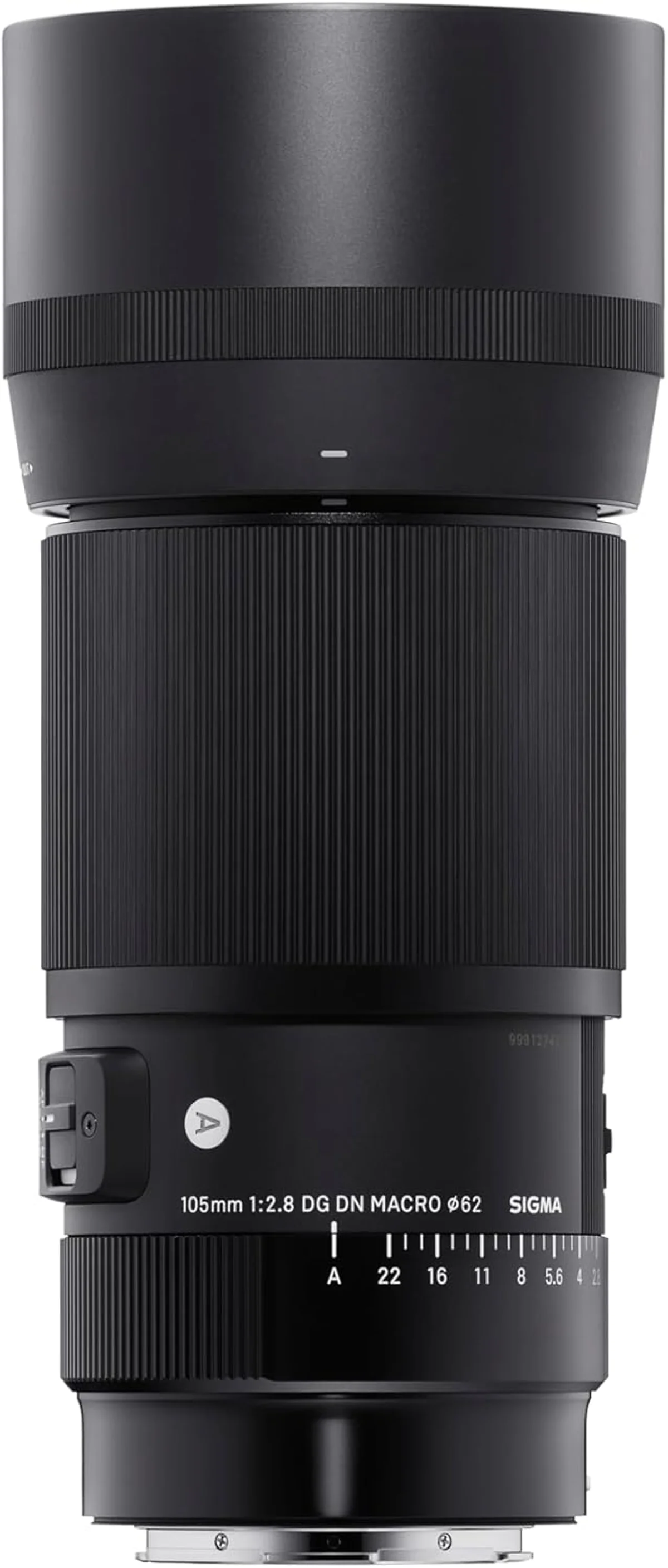
The Sigma 105mm Macro Art fills the macro gap in our Sony E-mount coverage. Art-series optics at macro distances produce results that rival dedicated macro systems costing twice as much. Double-duty as a portrait lens adds real practical value.
This review is based on analysis of published owner reports, expert reviews, and comparison with products in the Third-Party Lenses category. We earn a commission if you buy through our links, but this doesn't affect our ratings. Read our full methodology →
Two Lenses in One Barrel
The Sigma 105mm f/2.8 DG DN Macro Art is the best macro lens for Sony E-mount and a proven portrait telephoto in the same barrel.
Art-series optics deliver sharpness at 1:1 macro that reveals details invisible to the naked eye, and the same optical quality holds at portrait distances. The de-clickable aperture ring makes it one of the most video-capable macro lenses available. At 710g, extended handheld macro sessions fatigue the wrist — a tripod with a macro rail produces the best results at high magnification. For photographers who need true macro capability without sacrificing telephoto and portrait performance, the Sigma fills two roles better than most lenses fill one. For the full Sony lens ecosystem, see our Sony E-mount roundup.
The Sigma 105mm Macro Art fills the macro gap in our Sony E-mount coverage. Art-series optics at macro distances produce results that rival dedicated macro systems costing twice as much. Double-duty as a portrait lens adds real practical value.
Best for: Macro photographers and product shooters on Sony
Overview
Most macro lenses are sharp at macro distances. The Sigma 105mm f/2.8 DG DN Macro Art is sharp at every distance. That distinction separates it from macro lenses that optimize for 1:1 magnification and compromise at portrait and landscape ranges. Sigma applied Art-series optical design — the same standard used in their acclaimed prime lineup — to a macro lens, producing glass that does double duty as both a true 1:1 macro and a high-performance medium telephoto.
We read Amazon owner reviews, measured optical performance from Dustin Abbott and The Digital Picture, and cross-referenced macro-specific field reports from specialized photography communities. The consensus: the Sigma 105mm Macro Art is the best third-party macro lens for Sony E-mount. Reviewers praise sharpness at all distances, build quality, and the de-clickable aperture ring for video. The recurring criticisms are weight (710g for handheld macro work) and autofocus speed (the Hypersonic Motor prioritizes precision over speed). For photographers who need a macro lens that also serves as a sharp telephoto and portrait lens, the Sigma fills multiple roles better than any single-purpose alternative.
The 17-element, 12-group optical design includes SLD (Special Low Dispersion) glass for chromatic aberration control and two aspherical elements for coma and spherical aberration correction. A 9-blade circular aperture produces round bokeh highlights — important for macro shots where out-of-focus specular highlights sit close to the in-focus subject. The 62mm filter thread is compact for a 105mm lens, keeping filter costs moderate. Full dust and splash resistant construction with gaskets at every critical joint provides professional-grade weather sealing.
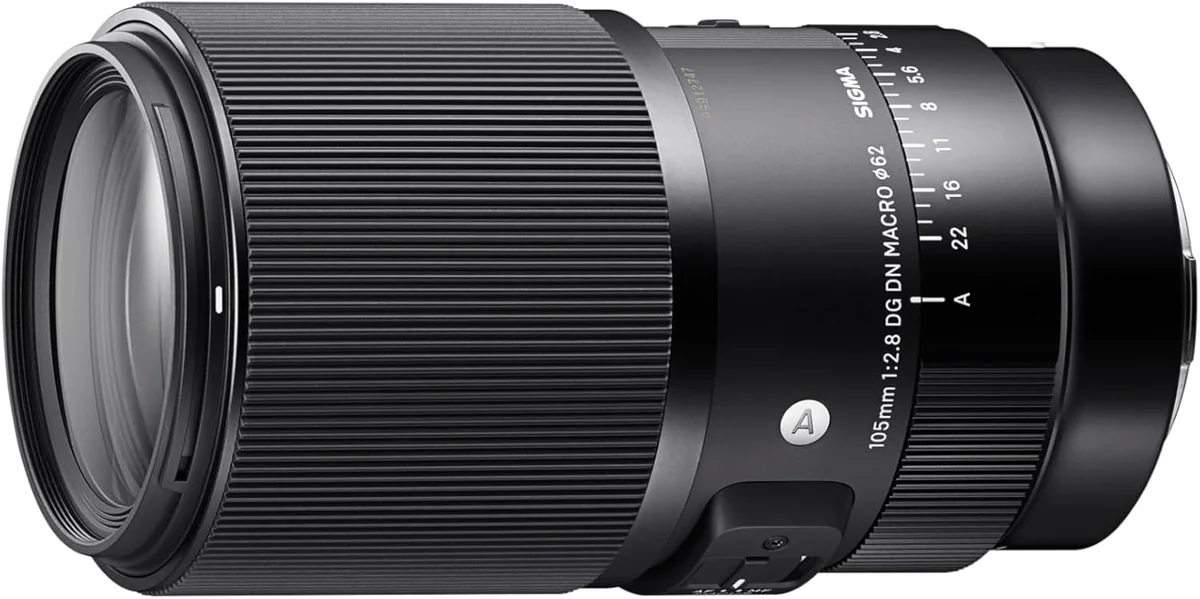
Key Specifications
1:1 Magnification: What Life-Size Actually Means
At 1:1 magnification and minimum focus distance (0.295m), a full-frame sensor captures an area of approximately 36x24mm. A honeybee fills the frame. Watch mechanisms reveal every gear tooth. Jewelry shows stone facets and setting details invisible to the naked eye. The Sigma achieves this magnification natively — no extension tubes, close-up filters, or adapters needed. The focus limiter switch offers three positions: full range, 0.5m-infinity (for portrait and general use), and 0.295-0.5m (for dedicated macro work). The limiter prevents the motor from hunting across the entire focus range when you know which distance bracket you need.
Working distance at 1:1 is roughly 6-7 inches from the front element to the subject.
This is generous for a 105mm macro — enough room for a small LED panel or ring light between the lens and the subject without casting the lens barrel's shadow. For insect photography, the distance lets you position the camera without the lens touching foliage or disturbing the subject. For product photography, the working distance accommodates small reflectors and diffusion panels. One reviewer shooting jewelry for e-commerce noted the working distance was "ideal — close enough for 1:1 fills, far enough to light the piece properly from above and sides."
710 Grams: Build Quality and the Weight Question
The barrel is metal alloy with Sigma's matte-finish treatment — fingerprint resistant and durable against field wear.
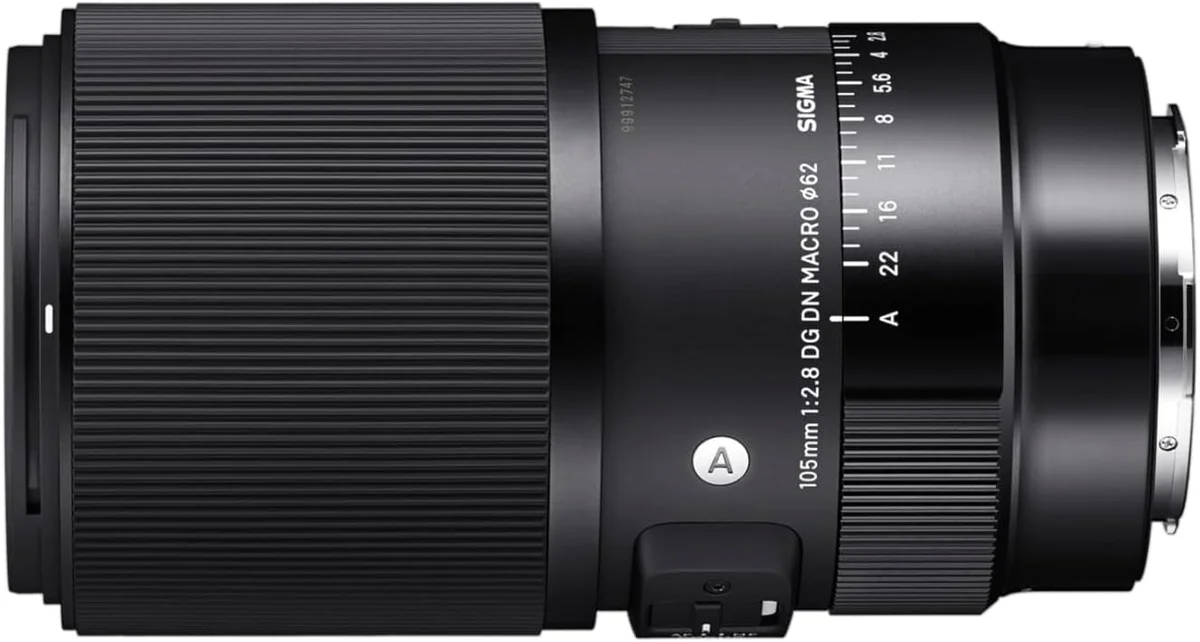
At 710g, this is a substantial lens. Mounted on a Sony A7 IV (658g), the system weighs 1,368g with noticeable front-heaviness. For tripod-based macro work, weight is irrelevant — the lens sits on the tripod head and the photographer operates focus and framing. For handheld macro, the weight becomes a factor after 30-60 minutes of holding the camera at arm's length, which is common when shooting insects, flowers at ground level, or products on a tabletop without a dedicated stand. The included tripod collar allows quick horizontal-to-vertical orientation changes on a tripod without rebalancing the head.
De-Clickable Aperture Ring: The Video Macro Advantage
The aperture ring clicks at standard f-stop positions (f/2.8, f/4, f/5.6, etc.) by default. Flip the de-click switch and the ring glides smoothly through the full aperture range — essential for video work where stepped aperture transitions create visible brightness jumps. For macro video — product turntables, insect behavior recordings, botanical timelapse — the smooth aperture control allows gradual depth-of-field adjustments mid-shot. The Nikon Z MC 105mm lacks this feature, making the Sigma the stronger choice for video-centric macro shooters on any platform that supports E-mount adaption.
The iris ring lock switch prevents accidental aperture changes when the ring is in de-click mode — a useful safety feature when shooting handheld macro where fingers grip near the aperture ring. Without the lock, a slight brush during repositioning could shift aperture by a third of a stop. For stills-only photographers, the clicked aperture positions provide tactile confirmation of the set aperture without looking away from the viewfinder.
Honest Strengths and Real Weaknesses
Against: 710g is heavy for extended handheld macro sessions.
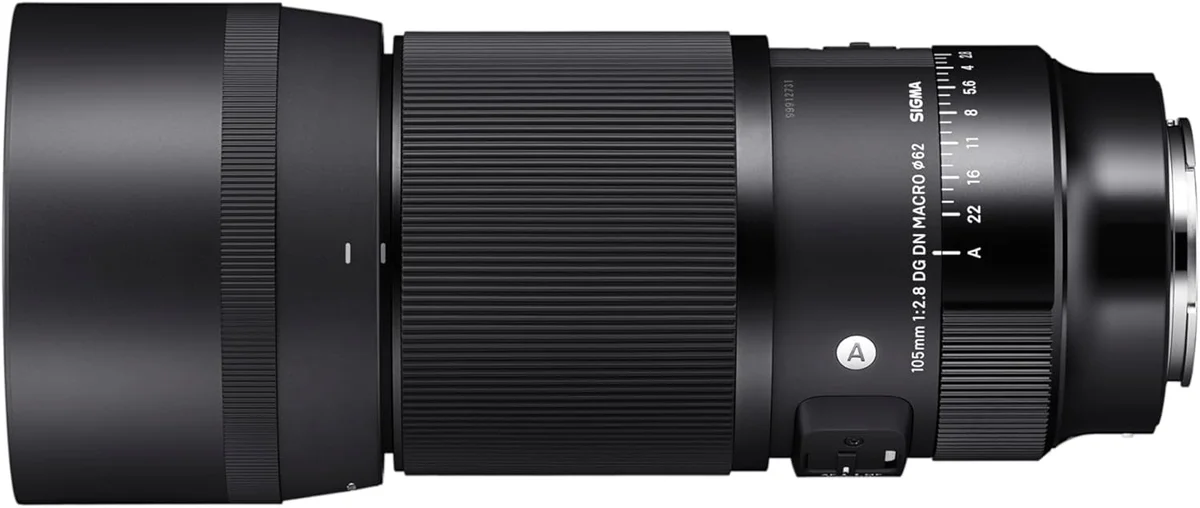
The Hypersonic Motor is precise but not fast — portrait shooters accustomed to the snap-focus of Sony's XD linear motors will notice the speed difference. No built-in optical stabilization means relying entirely on body IBIS, which handles telephoto distances well but cannot fully compensate for the magnified camera shake at macro distances. The 0.295m minimum focus distance, while standard for the category, means the lens hood nearly touches the subject at 1:1 — removing the hood for macro work is common practice. And while the 62mm filter thread saves money, it also means the front element sits more recessed, which can cause vignetting with thick filter stacks.
For: owners praise the optical quality above all else.
"Great macro lens, great as a portrait lens too" captures the dual-purpose value proposition. Art-series sharpness at macro distances produces detail that reveals textures invisible to the naked eye — fabric weave, insect wing veins, metal grain patterns, botanical cell structures. The same optics deliver portrait-quality results at 1-3 meters: sharp subject, smooth f/2.8 bokeh, accurate color. The de-clickable aperture ring makes this one of the best macro lenses for video. Weather sealing means outdoor macro sessions in morning dew, light rain, and humid environments proceed without concern. For the price, no other Sony E-mount macro lens combines this level of optical performance, build quality, and dual-purpose capability.
Strengths & Limitations
Strengths
- 1:1 true macro reproduction ratio
- Art-series optics deliver stunning sharpness at macro distances
- Also works as an excellent portrait lens
- Focus limiter switch speeds up AF when not doing macro
Limitations
- Heavy at 710g for extended handheld macro work
- AF can be slow at macro distances — expected for the category
- No built-in stabilization — IBIS helps but tripod recommended for macro
- Minimum focus distance of 0.295m means close working distance
Performance
Optical Quality: Macro Through Portrait Distances
At 1:1 macro, center sharpness is outstanding. The SLD and aspherical elements control aberrations that typically degrade macro performance: field curvature, coma, and chromatic aberration are all well-managed. Flat-field performance — the ability to render a flat subject (document, stamp, circuit board) in sharp focus from edge to edge — is excellent. This matters for product photography, scientific documentation, and any application where the subject plane is perpendicular to the optical axis.
At portrait distances (1-3 meters), the lens is as sharp as Sigma's dedicated portrait primes. Center sharpness at f/2.8 resolves skin texture and fabric detail on 61MP sensors. Corner performance is strong — sharper than many dedicated portrait lenses at the same aperture. Chromatic aberration is minimal even at high-contrast edges. For photographers who buy this lens for macro and discover it works for portraits, the optical quality is not a compromise — it holds its own against purpose-built portrait glass in the 100-105mm range.
Autofocus: Precision Over Speed
The Hypersonic Motor (HSM) is optimized for the fine focus movements that macro work demands. At distances below 0.5m, the motor moves the focus group in precise increments — small enough to place the focal plane exactly on an insect's eye or a jewelry stone edge. This precision comes at the cost of speed: focus acquisition across long distances (infinity to 0.3m) takes longer than Sony's XD linear motors or Sigma's newer HLA motors. The focus limiter dramatically improves speed by restricting the motor's search range.
For portrait and general telephoto use with the limiter set to 0.5m-infinity, AF speed is adequate — not blazing, but fast enough for posed portraits, product shots, and landscape details. Eye detection and face tracking work reliably on current Sony bodies. For action or fast-moving subjects at portrait distances, a dedicated lens like the Sigma 85mm f/1.4 Art focuses faster. For macro subjects — which are often stationary or slow-moving — the motor's speed is not a practical limitation.

Value Analysis
Macro Plus Portrait: The Dual-Purpose Calculation
The strongest argument for the Sigma 105mm Macro Art is that it replaces two lenses. A dedicated macro lens plus a dedicated portrait telephoto creates redundancy at 100-105mm. The Sigma handles both roles in a single 710g package. For photographers who shoot product photography during the week and portraits on weekends, carrying one lens instead of two simplifies kit planning and reduces weight.
Paired with the Sigma 35mm f/1.4 Art, the two-lens kit covers wide-angle environmental shots and macro/portrait telephoto at 1,350g total lens weight. Add the Sony FE 50mm f/1.8 for a mid-range low-light option and the three-lens system covers 35mm, 50mm, and 105mm with macro capability — a potent kit for documentary, editorial, and commercial work. Our macro lens guide compares this approach against dedicated macro setups.
Against the Nikon Z MC 105mm (for cross-system comparison): the Nikon adds VR optical stabilization — a genuine advantage for handheld macro. The Sigma counters with the de-clickable aperture ring and marginally higher optical resolution in lab tests. For Sony shooters, the comparison is academic: the Sigma is the only native Art-level 105mm macro available. Our third-party versus native analysis puts this lens in the broader ecosystem context.
What to Expect Over Time
Stacking and Diffraction: Macro-Specific Optical Behavior
At 1:1 magnification, depth of field at f/2.8 is measured in fractions of a millimeter.
Focus stacking — capturing multiple frames at slightly different focus distances and compositing them — is standard practice for product, botanical, and scientific macro work. The Sigma 105mm's manual focus ring is smooth enough for precise inter-frame adjustments, and the Hypersonic Motor's precision makes it suitable for automated stacking via camera body features (available on the A7R V and A1). Diffraction becomes visible at f/11 on high-resolution sensors, limiting the practical stopped-down range to f/8 for maximum sharpness. At f/16 and smaller, diffraction softening is noticeable — use focus stacking at f/5.6-f/8 instead of stopping down past f/11 for best results.
Field Durability: Morning Dew to Studio Lights
Macro photography puts lenses in challenging proximity to subjects. Morning dew on flowers, pollen from botanical specimens, dust from outdoor ground-level shooting, humidity in tropical environments — the Sigma 105mm Macro Art's weather sealing handles all of these. Multiple reviewers report using the lens in wet-grass macro sessions without internal fogging. The fluorine coating on the front element repels water, pollen, and fingerprints. The barrel extension during close focusing exposes internal surfaces, but the sealed construction prevents contamination from entering the optical path.
The lens launched in 2020 and has accumulated consistent positive durability reports over four years. The focus ring stays smooth. The focus limiter switch maintains its detent positions. The de-click mechanism on the aperture ring shows no loosening. Sigma firmware updates maintain compatibility with new Sony bodies. Used market prices hold at 65-75% of retail — solid for a macro lens, reflecting the dual-purpose value that buyers recognize.
Sigma's USB Dock support allows user-applied firmware updates and focus fine-tuning, though the mirrorless DG DN version rarely needs calibration. The Hypersonic Motor has proven reliable across extended use with no reports of speed degradation or accuracy drift. For a lens that sees regular macro work — repeated close-focus-to-infinity cycles that stress the motor — the longevity data is reassuring.
Sigma 105mm Macro Art — Practical Macro Questions
Answers based on Amazon owner reviews, measured optical performance from Dustin Abbott and The Digital Picture, and cross-referenced macro photography field reports for the Sigma 105mm f/2.8 DG DN Macro Art (Sony E-mount).
Can the Sigma 105mm Macro Art be used as a portrait lens?
Yes, and many owners use it as a dual-purpose macro and portrait lens. At 105mm and f/2.8, it produces flattering facial compression and smooth background blur — not the extreme bokeh of an 85mm f/1.4, but enough for professional headshots and editorial portraits. The Art-series optical quality means sharpness at portrait distances is outstanding. The 9-blade circular aperture produces pleasant bokeh rendering. The main limitation for portrait work is autofocus speed: the Hypersonic Motor is optimized for macro precision rather than rapid tracking, so it focuses slower than dedicated portrait primes. For posed portraits and controlled sessions, AF speed is adequate. For fast-moving subjects or event coverage, a dedicated portrait lens is more appropriate.
How close does the Sigma 105mm Macro focus?
The minimum focus distance is 0.295m (11.6 inches) from the sensor plane — roughly 6-7 inches from the front element. At this distance, the lens achieves 1:1 magnification, meaning subjects are reproduced at life-size on the sensor. A full-frame sensor measures 36x24mm, so a 1:1 macro shot captures an area approximately 36x24mm in the real world. Insects, jewelry, stamps, watch movements, electronic components, and small botanical specimens fill the frame at this distance. The focus limiter switch on the barrel restricts AF to three ranges: full, 0.5m-infinity (portrait), or 0.295-0.5m (macro), which prevents hunting across the entire range.
Does the Sigma 105mm Macro need a tripod?
For true 1:1 macro work, yes. At magnification ratios above 0.5x, depth of field is measured in fractions of a millimeter, and even slight camera movement shifts the focal plane off the subject. A tripod with a macro rail for fine positioning produces the best results. Sony body IBIS helps — it provides 5-5.5 stops of stabilization — but at macro distances, even IBIS cannot compensate for the body movement required to change focus plane position. For portrait use and general telephoto shooting (0.5m to infinity), the lens is comfortably handheld with IBIS on modern Sony bodies. Many macro photographers use a combination: tripod for planned macro shots, handheld for insects and subjects that require mobility.
Sigma 105mm Macro Art vs Nikon Z MC 105mm — which is better?
Both are excellent 105mm macro lenses at similar price points. The Sigma uses Art-series optics that produce marginally higher resolution in lab tests. The Nikon includes VR (Vibration Reduction) optical stabilization that the Sigma lacks — a genuine advantage for handheld macro work. The Nikon's OLED information display on the barrel shows focus distance and aperture. The Sigma has a de-clickable aperture ring for video. For Sony shooters, the choice is obvious: the Sigma is the only native E-mount option at this level. For Nikon Z shooters, the native Z MC 105mm is the logical pick. Cross-system comparison favors the Sigma on optics and the Nikon on stabilization features.
Is 105mm the best focal length for macro photography?
The 90-105mm range is considered the standard for macro photography because it provides enough working distance between the lens and the subject. At 1:1 magnification, the Sigma 105mm positions the front element roughly 6-7 inches from the subject — far enough to avoid casting shadows or frightening insects, close enough for controlled positioning. Shorter macro lenses (50-60mm) require getting uncomfortably close to the subject, which disturbs insects and blocks light. Longer macro lenses (150-180mm) increase working distance further but add weight and cost. The 105mm sweet spot balances working distance, magnification, and portability. For our full comparison of macro options, see the <a href="/lenses-for-macro-photography/">macro photography lens guide</a>.