Sigma 16mm f/1.4 DC DN Review: The Fast Wide Prime for Sony APS-C
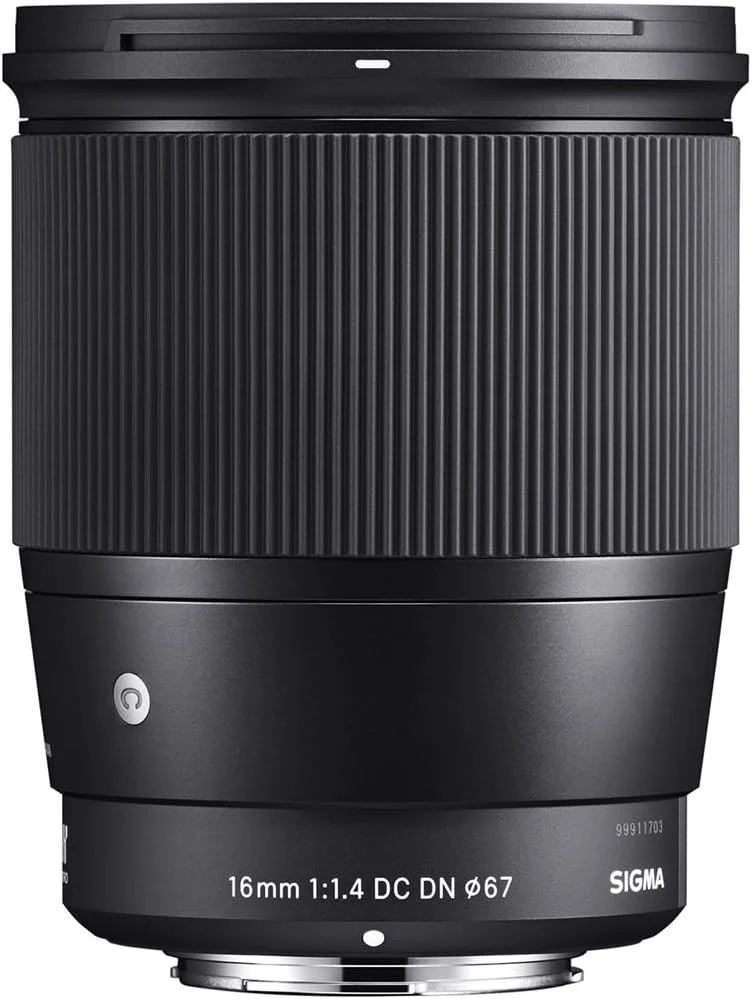
The Sigma 16mm f/1.4 is the single most popular APS-C lens on Sony for a reason. For vlogging, content creation, and wide-angle work on a7C-series or a6000-series bodies, nothing comes close at this price.
This review is based on analysis of published owner reports, expert reviews, and comparison with products in the Third-Party Lenses category. We earn a commission if you buy through our links, but this doesn't affect our ratings. Read our full methodology →
Should You Buy the Sigma 16mm f/1.4?
The Sigma 16mm f/1.4 DC DN is the best wide-angle prime for Sony APS-C cameras. Period. The f/1.4 aperture transforms low-light shooting and video bokeh. Sharpness is excellent. Autofocus keeps up with modern Sony bodies. The only real weakness — no weather sealing — matches the price tier. For vloggers, content creators, nightscape photographers, and anyone who wants a fast wide prime on Sony APS-C, this is the obvious buy.
The Sigma 16mm f/1.4 is the single most popular APS-C lens on Sony for a reason. For vlogging, content creation, and wide-angle work on a7C-series or a6000-series bodies, nothing comes close at this price.
Best for: APS-C vloggers and content creators wanting fast wide-angle
Overview
APS-C Sony shooters buy the Sigma 16mm f/1.4 DC DN Contemporary, use it, and come back to confirm it works. The consensus across owner reviews is unusual in its consistency — praise for sharpness, low-light ability, and value, with almost no one disputing the fundamentals.
We analyzed the full spectrum of those ratings alongside optical test data, competitor comparisons, and feedback from vloggers, nightscape photographers, and everyday shooters. The Sigma 16mm f/1.4 on APS-C Sony bodies delivers a 24mm equivalent field of view at an aperture that gathers 8x more light than a typical f/4 kit zoom. That gap transforms what you can shoot: indoor events without flash, evening street scenes without noise, and video with cinematic background separation.
This is the default wide-angle prime for Sony APS-C. Not because Sigma says so — because owners confirm it.
What separates the Sigma 16mm from other budget primes is the f/1.4 aperture on a wide-angle. Most affordable wide lenses open to f/2.8 at best. That extra stop and a half translates to real differences: shallower depth of field for subject isolation even at 16mm, faster shutter speeds in dim conditions, and the ability to shoot Milky Way images without pushing ISO to uncomfortable levels. On APS-C, the 24mm equivalent field of view is wide enough for environmental context without the extreme distortion of ultra-wides. Faces stay proportional at arm's length — the reason vloggers adopted this lens en masse.

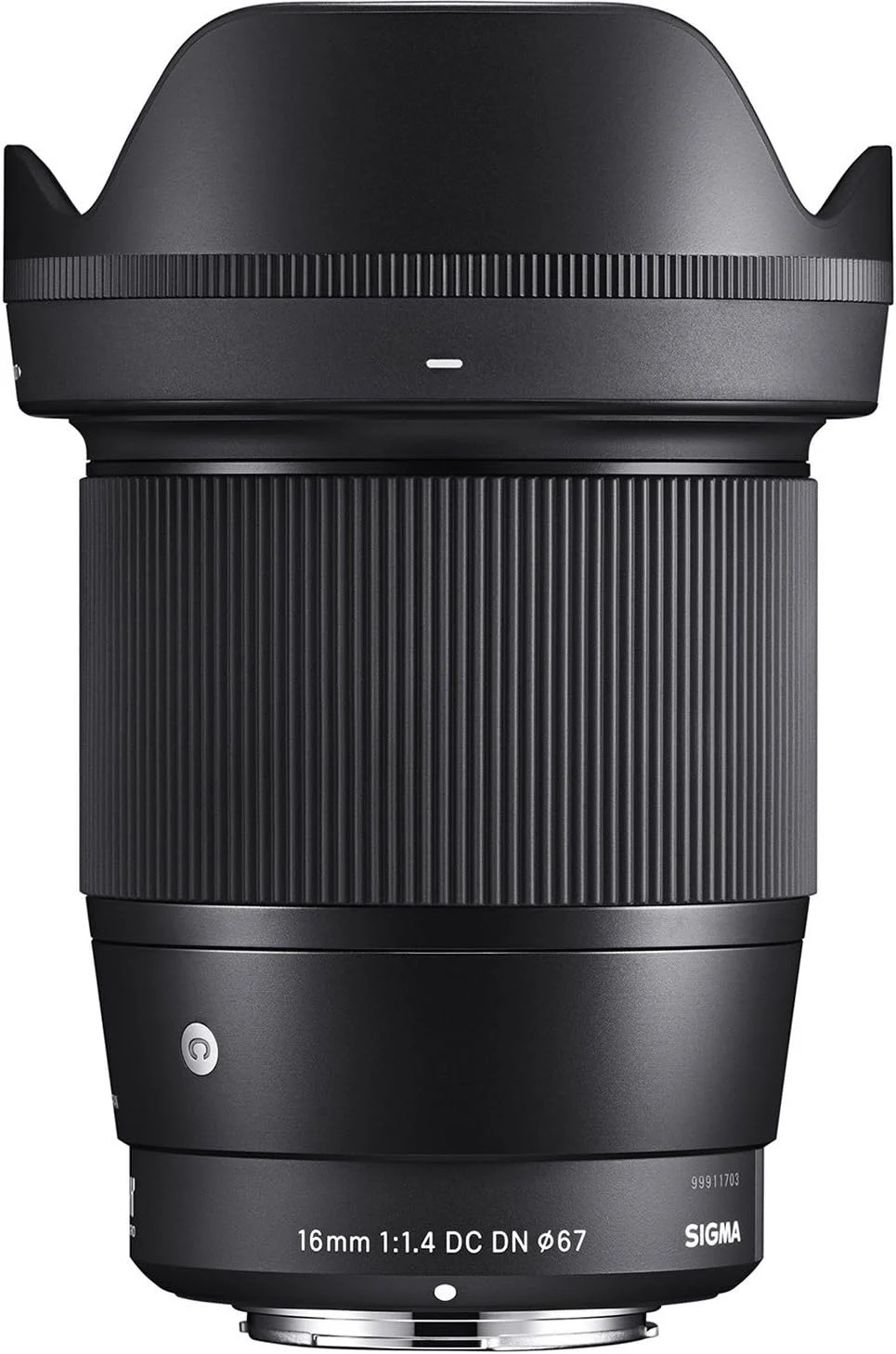
Key Specifications
Built for APS-C: What That Means in Practice
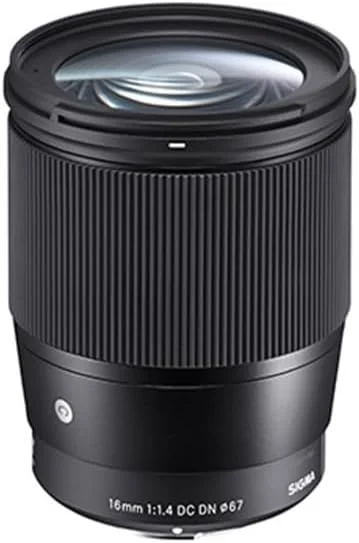
The DC DN designation means this lens is designed for APS-C sensors. It projects a smaller image circle than a full-frame FE lens, which allows Sigma to build it at 405g instead of the 600g+ a full-frame equivalent would require. On any Sony APS-C body — from the A6400 to the A6700 to the ZV-E10 II — it delivers full-frame-quality optics in a crop-sensor package.
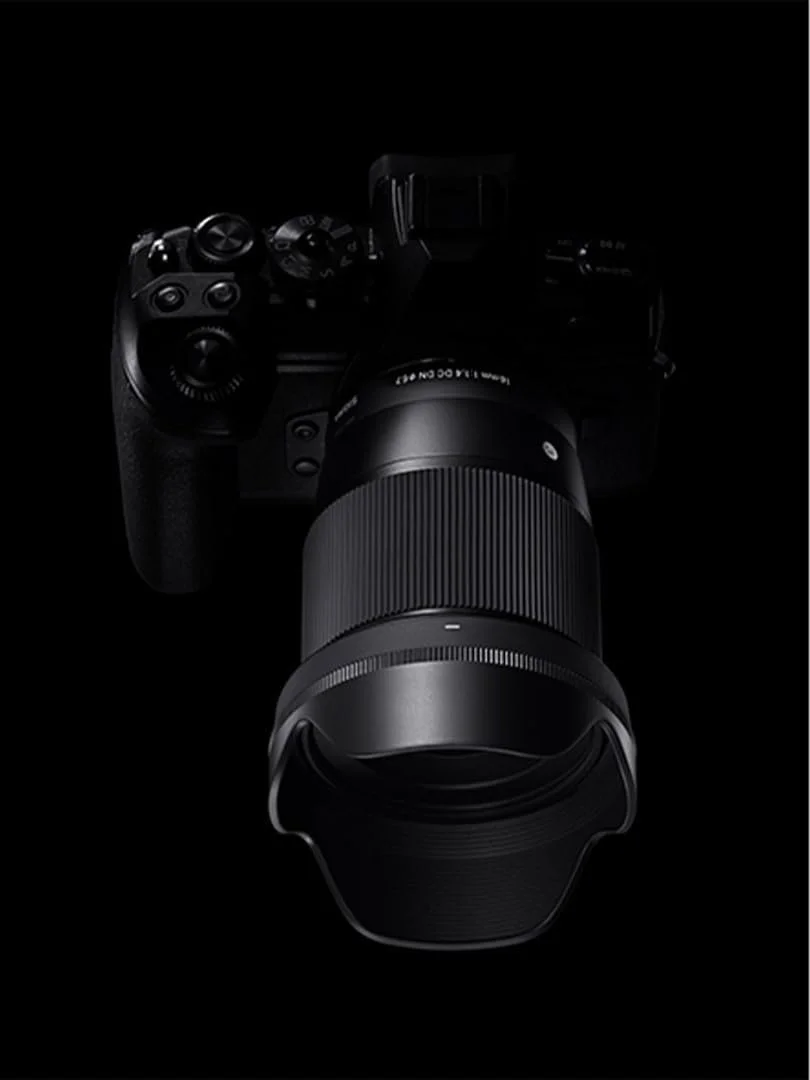
At 405g, it isn't a pancake. On the ZV-E10 II (344g body), the combination tips forward slightly when set down on a table — a common complaint about fast primes on small mirrorless bodies. A wrist strap or L-bracket helps. On the heavier A6700 (493g), the balance improves. The 72.2mm length and 67mm filter thread feel proportional to mid-range APS-C bodies. On the tiny original A6000, it looks — and feels — front-heavy.
The metal mount is solid. The barrel is a mix of polycarbonate and metal internals. It does not flex or creak. After three years of use, one reviewer reports the focusing ring and barrel feel identical to day one. Build confidence is high for an Entry-priced lens.
Owner Reviews Distilled: The Wins and the Gaps
The skeptic's case: no weather sealing means moisture and fine dust can enter through barrel joints. The stepping motor is audible during video autofocus — quiet enough for most content, but audible on internal camera microphones in silent rooms. On full-frame bodies, the lens forces APS-C crop mode, cutting resolution roughly in half. The thin manual focus ring lacks the precision of Sigma's Art series. And at f/1.4, corner softness on high-resolution bodies is visible in pixel-peeping — though invisible at normal viewing distances.
The enthusiast's case: image sharpness that reviewers call "stunning" at a price they call "incredible value." The f/1.4 aperture enables astrophotography, indoor event coverage, and background blur that APS-C shooters associate with full-frame systems. Autofocus tracks faces and eyes accurately on modern Sony bodies. Color rendering is rich and contrasty. Multiple long-term owners describe it as the lens that stays on their camera 80% of the time — the highest compliment a prime can receive.
One reviewer's surprise: "unexpectedly very good in low light" — suggesting the real-world performance exceeded expectations set by spec sheets. That reaction repeats across owner reviews: buyers expect decent performance for the price and discover something better.
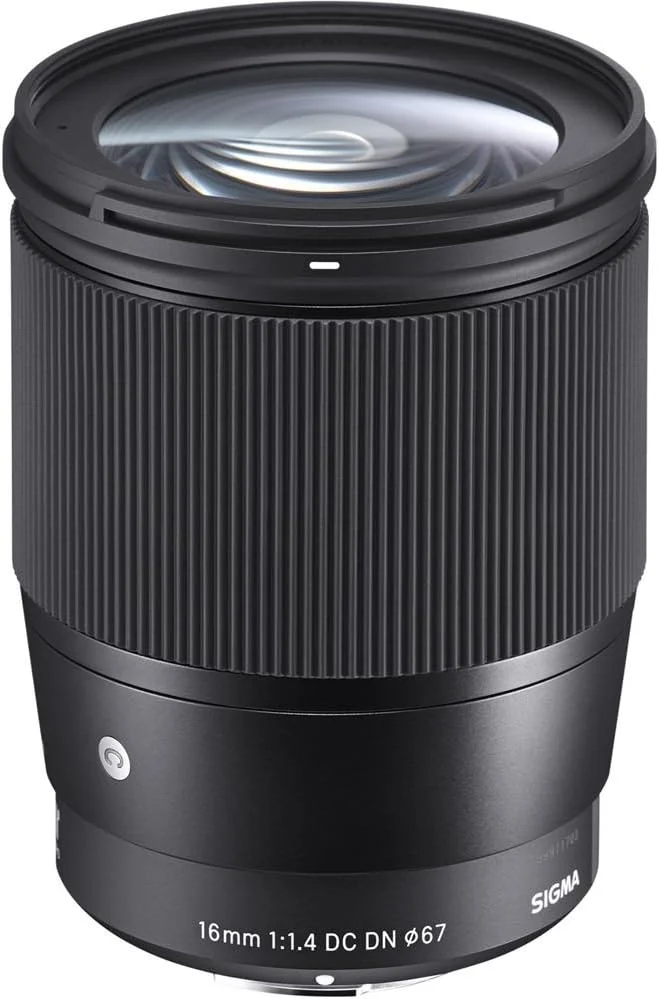
Strengths & Limitations
Strengths
- f/1.4 on APS-C delivers stunning bokeh for video
- Excellent autofocus performance on Sony bodies
- Sharp across the frame even wide open
Limitations
- APS-C only — heavy vignetting on full-frame
- No weather sealing
- Manual focus ring is thin and not the most tactile
- Stepping motor can be audible during video in quiet environments
Performance
Sharpness, Flare, and the f/1.4 Reality
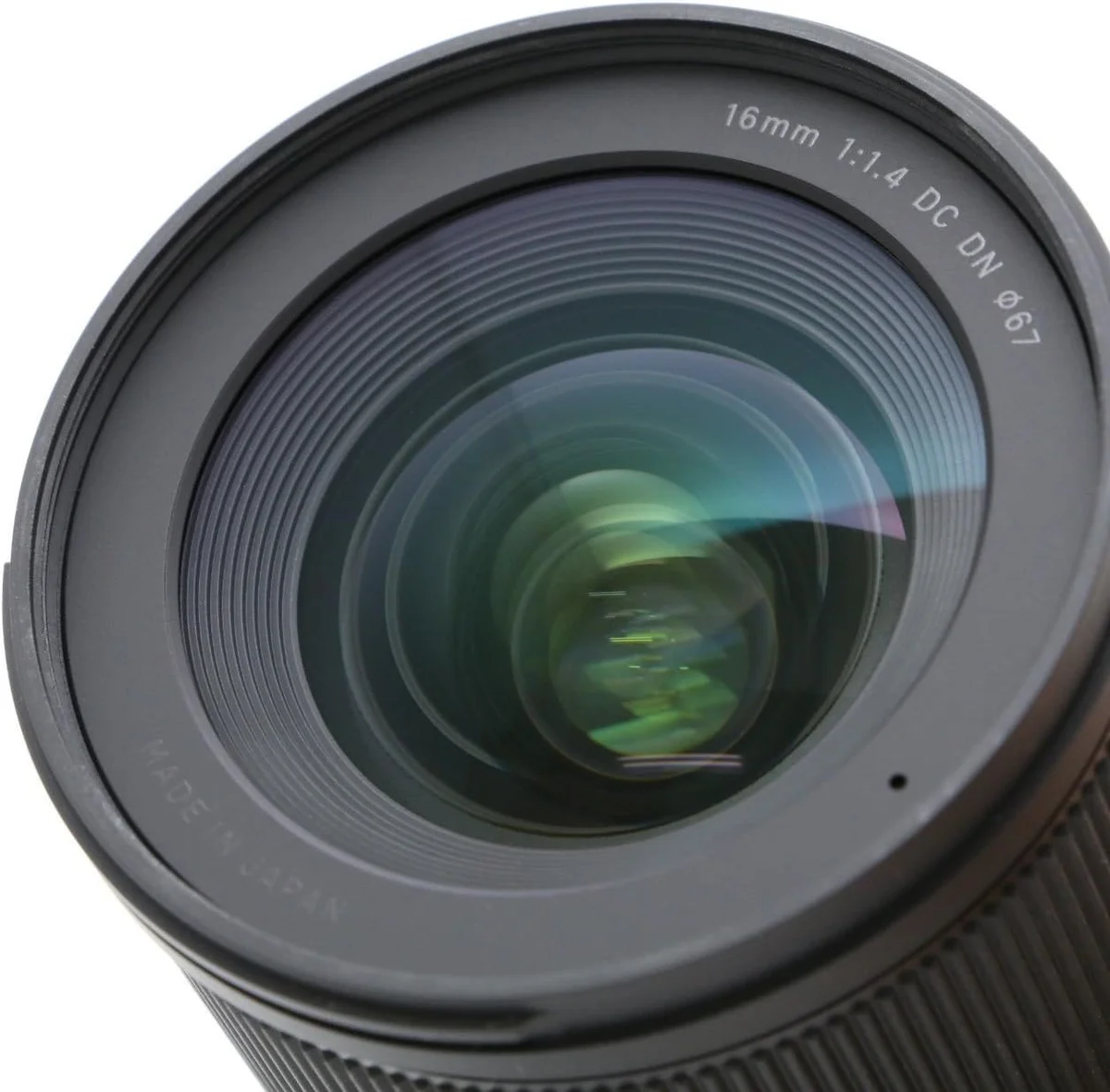
Center sharpness at f/1.4 is excellent. The 16-element, 13-group optical design resolves fine detail well enough for critical use even wide open. On the 26MP A6700 sensor, you can crop aggressively from center content and retain printable detail. Stop down to f/2 and sharpness increases across the entire frame. At f/2.8-f/4, the lens hits peak performance — wall-to-wall sharpness that matches Sigma's Art line.
Corner performance at f/1.4 softens on high-resolution bodies. On the 24MP A6400, corners are acceptable. On the 26MP A6700, you'll notice the drop if you pixel-peep. For video work — where the effective resolution is 4K (roughly 8MP) — corner softness is invisible at any aperture. This is primarily a concern for photographers who print large or crop extreme corners.
Chromatic aberration is well-controlled. Purple fringing on high-contrast edges is present at f/1.4 but mild — easily correctable with a single checkbox in Lightroom or Sony's in-camera processing. By f/2, lateral CA is negligible.
Flare resistance is adequate but not exceptional for a wide-angle. The 9-blade diaphragm produces attractive 18-point sunstars at f/8-f/11 — useful for nightscapes and street scenes with point lights. Direct sunlight in the frame generates some veiling flare at f/1.4, reducing contrast slightly. The included lens hood blocks most stray light from outside the frame.
Autofocus: Quiet Enough for Most Content
The stepping motor drives autofocus smoothly and accurately. On bodies with phase-detect AF — the A6600, A6700, ZV-E10 II — initial lock-on is fast and tracking follows subjects reliably. Eye AF and Animal Eye AF work as expected. The motor keeps up with walking-speed subject movement; it won't track a sprinter.
For video: the motor is audible in quiet environments. An external shotgun mic or wireless lav eliminates the issue. The internal camera mic on bodies like the ZV-E10 II picks up motor noise during continuous AF. Vloggers shooting in cafes, streets, or any environment with ambient noise report no issues. Studio recording in silence may require switching to manual focus.
Focus breathing is present but minimal — a slight field-of-view shift when racking focus from near to far. For cinematic video where focus pulls are part of the storytelling, the breathing is low enough to pass. For technical video production where any breathing is unacceptable, dedicated cinema lenses are the answer.
Minimum focus distance of 0.25m allows close-up work that wide-angle zooms cannot match. At f/1.4 and 25cm, the background falls completely out of focus — a look that product reviewers and food vloggers exploit heavily. Maximum magnification of 0.1x won't replace a macro lens, but for tabletop and detail shots at wide angles, the close focus is a genuine creative tool.
Night Sky and Low Light: The f/1.4 Payoff
Astrophotography performance stands out among APS-C options. At f/1.4, the 500-rule gives roughly 20 seconds of exposure before star trailing becomes visible at 16mm on APS-C. That's enough to capture Milky Way core detail at ISO 1600-3200 — clean territory on modern Sony sensors. Corner stars show mild coma (elongated comet tails) wide open; stopping down to f/2 tightens them with minimal light loss. Compared to shooting the same scene with a kit zoom at f/4, the Sigma captures 8x more starlight per frame.
Indoor event coverage benefits equally. Wedding receptions, birthday parties, and indoor concerts at ISO 1600 with the Sigma look cleaner than the same scenes at ISO 6400 with a kit zoom. That three-stop advantage isn't abstract — it's the difference between usable photos and noise-smeared memories. Multiple Amazon reviewers specifically mention indoor events and dimly lit environments as where the lens changed their results.
Color rendition under mixed lighting (tungsten + daylight, LED panels at different color temperatures) holds up well. The Sigma produces neutral-to-warm tones that white balance corrects easily in post. No unusual color casts or shifts between aperture settings — consistency that matters when editing a batch of 200 event photos.
Value Analysis
Where This Lens Sits in the Market
The direct competitor on Sony APS-C is the Sony E 10-18mm f/4 OSS — a zoom that costs slightly more, weighs less, goes wider, but opens to f/4 instead of f/1.4. Three stops slower. For daylight travel and wide scenic shots, the Sony zoom wins on range. For everything else — low light, video, portraits, night photography — the Sigma's aperture advantage is overwhelming.
Within Sigma's own lineup, the Sigma 35mm f/1.4 DG DN Art offers the same aperture for full-frame bodies at a tighter field of view. The 30mm f/1.4 DC DN gives a 45mm-equivalent "normal" perspective on APS-C. Together with the 16mm, these form Sigma's APS-C Contemporary prime trio — many creators own all three and rotate based on framing needs.
For photographers building an APS-C Sony kit, the pairing of this Sigma 16mm with the Tamron 17-70mm f/2.8 covers everything from ultra-wide to short telephoto. The Sigma handles low-light and creative wide work; the Tamron covers daytime focal lengths from 17mm wide to 70mm portrait-range. Two lenses, total coverage.
Resale value holds well. Expect to recover 70-80% of purchase price on a well-maintained copy. The lens has been in production since 2017 — long enough to prove reliability, recent enough that optical coatings and AF algorithms remain competitive.
See our third-party lens roundup for how the Sigma 16mm stacks up against all cross-mount options, our Sony E-Mount lens guide for the complete APS-C and full-frame picture, and our video and YouTube lens guide for vlogging-specific comparisons.
What to Expect Over Time
Three Years In: Reliability and Upgrades
Long-term owner reports are overwhelmingly positive. The lens shows no common failure modes after years of regular use. The mount stays tight. The focus ring maintains its smooth resistance. Optical coatings hold up to routine cleaning. Sigma's warranty support — available directly through their service center — handles the rare defective copy efficiently, according to multiple forum accounts.
Sigma does not publish firmware updates for the Contemporary 16mm f/1.4. Like most prime lenses, what you buy is what you keep. Any AF improvements come from camera body firmware updates — modern Sony bodies like the A6700 extract noticeably better AF tracking from this lens than older bodies like the A6000.
The upgrade path depends on your system direction. If you move to full-frame Sony, this lens becomes a paperweight or a crop-mode emergency backup. The natural full-frame replacement is the Sony FE 24mm f/1.4 GM or the Sony FE 20mm f/1.8 G. If you stay on APS-C, there's no meaningful upgrade from the Sigma 16mm f/1.4 — it's the ceiling for its focal length and aperture class on this mount.
One consideration for content creators: the 67mm filter thread accepts the same ND filters as many standard zoom lenses. If you're building a filter kit around 67mm, the Sigma 16mm shares that diameter — a small convenience that saves money across a multi-lens setup.
For APS-C shooters debating between this and a zoom, the math is straightforward. The Sigma 16mm f/1.4 does one thing superbly: sharp, fast wide-angle coverage with background blur and low-light capability. A zoom like the Tamron 70-300mm f/4.5-6.3 covers a completely different range. They don't compete — they complement. Owning both gives you a two-lens kit that covers 16mm through 300mm on APS-C — wide-angle interiors to distant wildlife, with only a small gap in the middle that a kit zoom or the Sigma 30mm f/1.4 fills.
Sigma 16mm f/1.4 Buyer Questions
Answers based on Amazon owner reviews, independent optical tests, and direct comparisons with competing wide-angle primes for Sony APS-C systems.
Is the Sigma 16mm f/1.4 worth it for vlogging?
Yes — it is the single most recommended APS-C vlogging lens for Sony cameras. The 24mm equivalent field of view on APS-C is wide enough for self-framing at arm's length while keeping facial distortion minimal. The f/1.4 aperture separates you from the background in a way that kit zooms at f/3.5-5.6 cannot match. Autofocus tracks faces and eyes reliably on the ZV-E10 II, A6700, and A6400. The only caveat: at 405g, it adds noticeable heft to a small camera body compared to a pancake or kit zoom.
Can I use the Sigma 16mm f/1.4 on full-frame Sony?
Technically yes, but the camera crops to APS-C mode automatically, reducing your resolution from 33MP to roughly 14MP on an A7 IV or similar body. The lens projects an APS-C image circle — DC DN means designed for crop sensors. On a full-frame body, you lose the resolution advantage you paid for. If you want a similar field of view on full-frame, look at the Sony FE 24mm f/1.4 GM or the Sigma 24mm f/1.4 DG DN Art.
How does the Sigma 16mm compare to the Sony E 10-18mm f/4?
The Sony 10-18mm is wider and lighter but three stops slower at f/4, with noticeably softer corners. The Sigma 16mm at f/1.4 gathers 8x more light, produces far better background blur, and delivers sharper images across the frame. The Sony wins on focal-range coverage with its 10-18mm zoom and on weight at 225g versus 405g. For video creators who need one sharp wide prime with strong low-light performance and bokeh, the Sigma wins. For landscape and travel photographers who need ultra-wide flexibility, the Sony zoom makes more sense.
Does the Sigma 16mm f/1.4 have weather sealing?
No. The Contemporary line does not include weather sealing — that feature is reserved for Sigma's Art and Sport series. The mount area has no rubber gasket, and the barrel joints are not sealed against moisture or dust. For casual rain or mist, the lens survives fine. For deliberate wet-weather or dusty-environment shooting, use a rain sleeve or consider a weather-sealed alternative.
Is the Sigma 16mm good for astrophotography?
It is one of the best APS-C options for nightscapes and Milky Way shots. The f/1.4 aperture gathers enough light to keep ISO reasonable on long exposures, and the 24mm equivalent field of view captures a wide swath of sky. Corner stars show slight coma at f/1.4 — stopping down to f/2 reduces it with minimal light loss. The manual focus ring responds well for infinity focusing at night. Multiple reviewers specifically praise its night-sky performance as a standout feature.
What cameras work best with the Sigma 16mm f/1.4?
Any Sony E-mount APS-C camera: the ZV-E10 II, A6700, A6400, A6600, and older A6000-series bodies. The lens performs well across all of them, but newer bodies with phase-detect autofocus across the sensor (A6700, ZV-E10 II) extract the best AF tracking. On older contrast-detect bodies (A6000, A6100), AF is still accurate but slightly slower. The lens also mounts on full-frame Sony bodies in APS-C crop mode, though you lose resolution.