Sigma 35mm f/1.4 DG DN Art Review: The Third-Party Prime That Beat Sony at 35mm
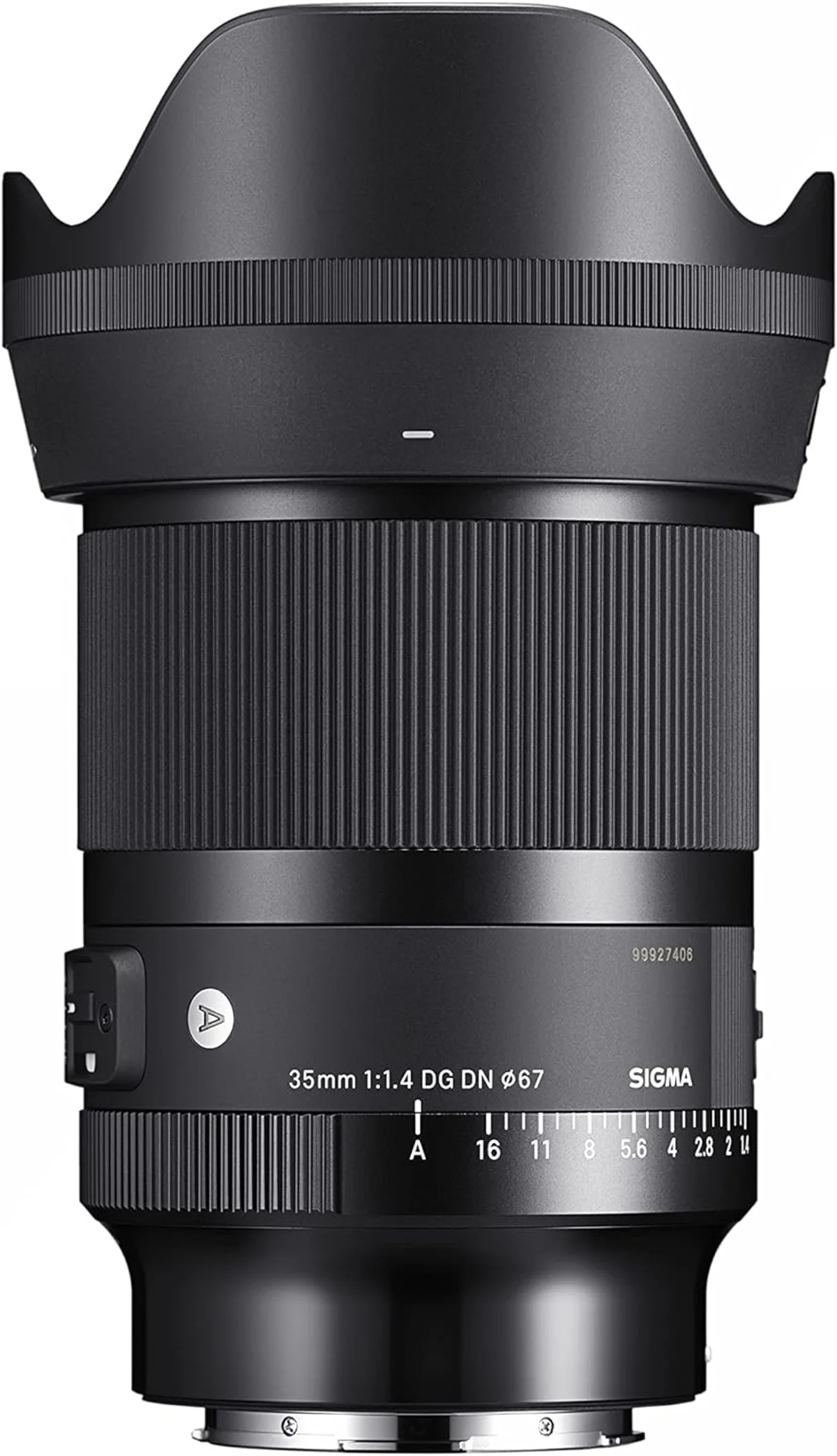
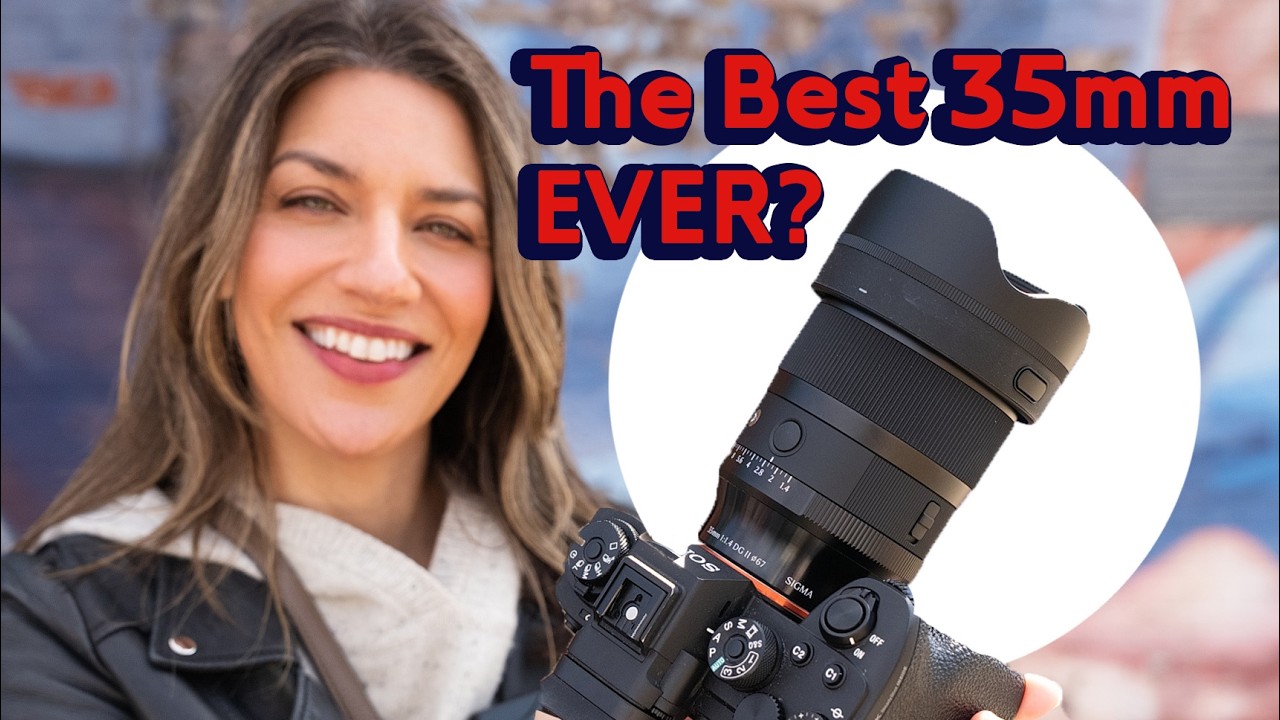
The Sigma 35mm f/1.4 Art is the lens that proved third-party glass could match and beat native options. Sharper than the Sony FE 35mm f/1.8 and faster at f/1.4, it trades compactness for optical perfection. If size matters more than the extra stop, the Sony is still a valid choice.
This review is based on analysis of published owner reports, expert reviews, and comparison with products in the Third-Party Lenses category. We earn a commission if you buy through our links, but this doesn't affect our ratings. Read our full methodology →
The Optical Benchmark at 35mm
The Sigma 35mm f/1.4 DG DN Art is the sharpest 35mm prime you can buy for Sony E-mount without entering the G Master price tier.
At f/1.4, it gathers 53% more light than f/1.8 alternatives and produces visibly stronger subject separation. The 11-blade aperture renders bokeh that zoom lenses and 9-blade primes cannot replicate. Weather-sealed Art build quality matches lenses costing more. The weight penalty is real — 640g is heavy for a prime — and the stepping motor is accurate but not the fastest in Sony's ecosystem. For street photographers, documentary shooters, and available-light specialists who accept the weight for the optics, this is the 35mm to own. For our full analysis of Sony E-mount options, see the Sony E-mount roundup.
The Sigma 35mm f/1.4 Art is the lens that proved third-party glass could match and beat native options. Sharper than the Sony FE 35mm f/1.8 and faster at f/1.4, it trades compactness for optical perfection. If size matters more than the extra stop, the Sony is still a valid choice.
Best for: Street and documentary photographers wanting a fast, sharp 35mm
Overview
Sigma built the original 35mm f/1.4 Art in 2012 and it changed the third-party lens industry overnight. The DG DN version — redesigned from scratch for mirrorless — carries that legacy forward while cutting 325 grams from the body. At 640g, it is still heavier than the Sony FE 35mm f/1.8 (280g), but the optical performance at f/1.4 is in a different category entirely. This lens exists for photographers who chose 35mm as their primary focal length and want the best possible image quality at that distance.
We read Amazon owner reviews and cross-referenced measured optical performance from Dustin Abbott's lab tests, Opticallimits MTF charts, and extensive Reddit comparisons.
Reviewers praise image quality above all else — "outstanding," "astonishing," and "extremely sharp" appear repeatedly. The consensus criticism is weight: 640g for a prime feels heavy when lighter alternatives exist. The stepping motor autofocus, while quiet and accurate, is not as fast as Sony's XD linear motors. For street shooters who prioritize speed and stealth, the Sony 35mm f/1.8 at half the weight remains a valid choice. For photographers who want optical perfection at 35mm, the Sigma Art has no equal in its price range.
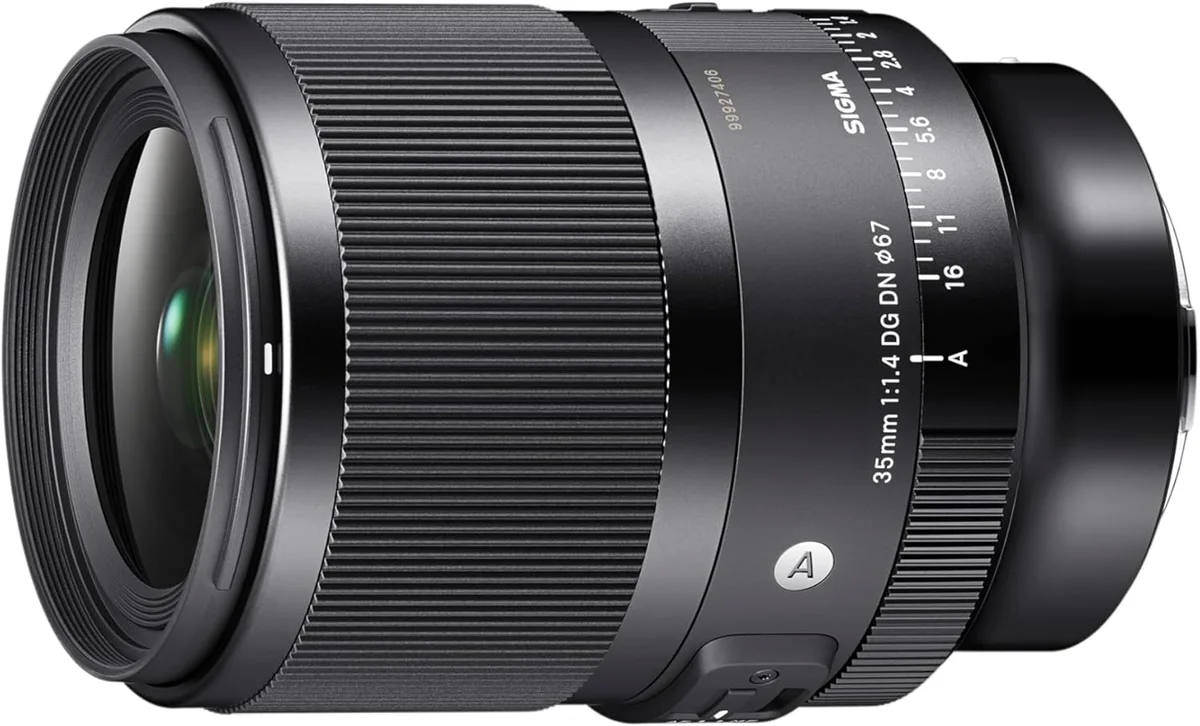
The optical design uses 15 elements in 11 groups, including SLD (Special Low Dispersion) glass for chromatic aberration control. The 11-blade circular aperture produces smooth, round bokeh at wider apertures — a visible step up from 7- and 9-blade designs that create hexagonal or heptagonal highlights. Weather sealing with gaskets at every joint puts it in professional-grade territory. The 67mm filter thread is shared with a wide range of Sony and Tamron lenses, keeping filter costs manageable.
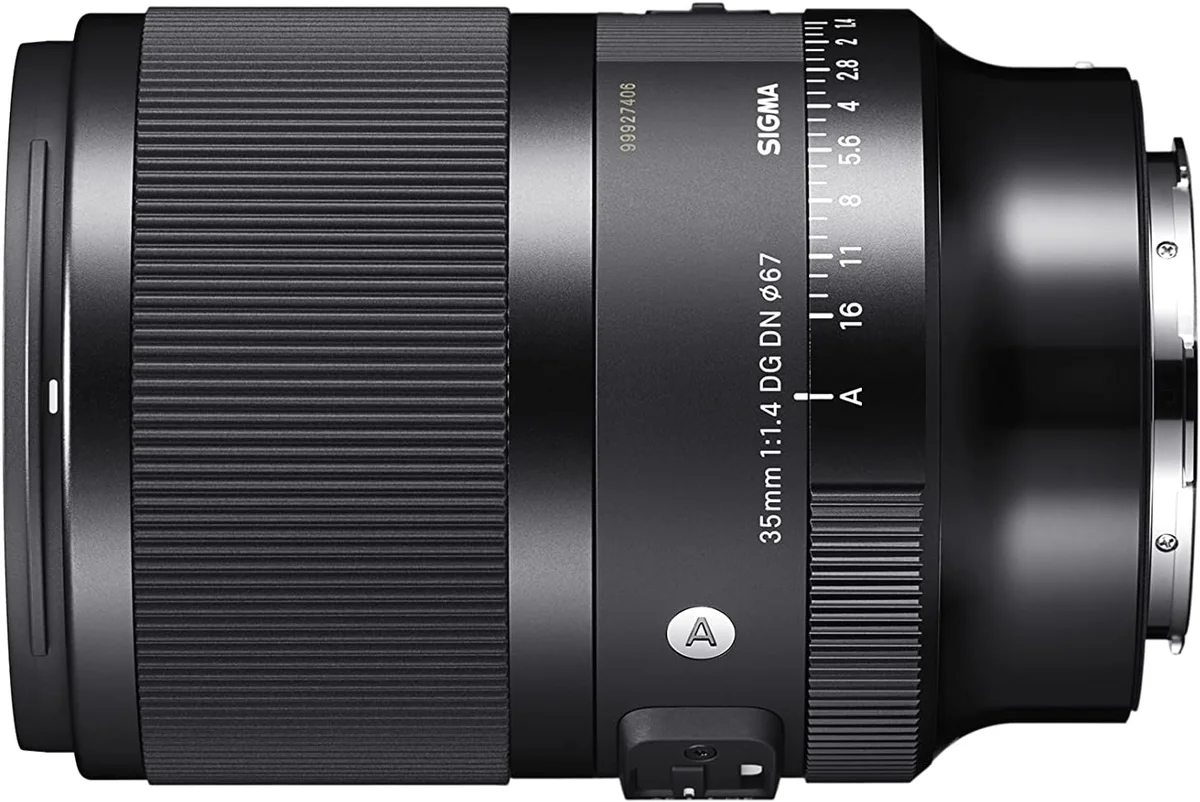
Key Specifications
What f/1.4 Actually Delivers Over f/1.8
The math says f/1.4 gathers 53% more light than f/1.8 — two-thirds of a stop.
In practice, that fraction of a stop is the difference between ISO 3200 and ISO 5000 in a dim restaurant, between 1/125 and 1/200 shutter speed for a moving subject, between a sharp grab shot and a blurred miss. For available-light photographers who refuse to use flash — wedding photojournalists, documentary shooters, street photographers working at night — every fraction of a stop matters. The Sigma at f/1.4 on an A7S III produces usable images in conditions where the Sony 35mm f/1.8 requires boosting ISO to a level that introduces visible noise.
Depth of field at f/1.4 and close focus distances is razor-thin. At 0.30m and f/1.4, only a few centimeters of depth remain in focus. Subject eyes are sharp while ears are soft. This demands precise focus — the stepping motor must nail the focus point without micro-corrections that shift the focal plane. For environmental portraits on the street, f/1.4 at 1-3 meters creates subject separation against busy backgrounds that f/1.8 cannot replicate. The difference is subtle in controlled comparisons but obvious in real-world shooting: backgrounds dissolve into creamy wash instead of remaining partially legible.
640 Grams: The Price of Optical Perfection
The weight is the most common criticism in reviews. At 640g, the Sigma 35mm Art weighs more than double the Sony FE 35mm f/1.8 (280g). On a Sony A7 IV (658g), the combination weighs 1,298g — noticeably front-heavy. During a full day of street photography, the extra weight accumulates. One reviewer who switched from the Sony 35mm f/1.8 to the Sigma Art described "immediately better photos, notably heavier camera bag" — a summary that captures the real decision.
The weight comes from glass, not filler. The 15-element optical design requires dense glass elements to achieve the aberration control that makes this lens sharp to the corners at f/1.4. The SLD elements are heavier than standard glass. The weather-sealed metal barrel adds structural weight. Sigma could build a lighter 35mm f/1.4 by using fewer elements and accepting more aberration — they chose optics over portability. For photographers who mount this lens on a camera and shoot for one to three hours at a time, the weight is manageable. For all-day carry, the Sony f/1.8 is the honest recommendation unless f/1.4 is non-negotiable.
What the Skeptic and the Enthusiast See
The skeptic's case: 640g for a single focal length is a lot to carry.
The stepping motor autofocus is fast but not instant — quick-draw street shots occasionally miss because the motor needs a fraction of a second longer than Sony's XD linear motors. No aperture ring means all aperture control happens on the camera body, which annoys video shooters who prefer tactile aperture adjustment. The lens is physically large — it protrudes further from the body than the Sony 35mm f/1.8, making it less discreet for street photography. And the price, while fair for the optical quality, buys the Sony 35mm f/1.8 with money left over for a second lens.
The enthusiast's response: "The quality of this lens is astonishing. I have not taken it off since it arrived." That reviewer speaks for most owners. At f/1.4, corner sharpness exceeds what many primes deliver at f/2.0. Bokeh from the 11-blade aperture is smooth without nervous edges or onion-ring patterns. The weather-sealed Art build survives conditions that would compromise lighter, unsealed alternatives. Color rendering is neutral and consistent — no warm or cool shift compared to Sony native glass. For documentary projects, wedding photojournalism, and personal work where image quality is the priority and weight is secondary, the Sigma 35mm Art sets the standard.
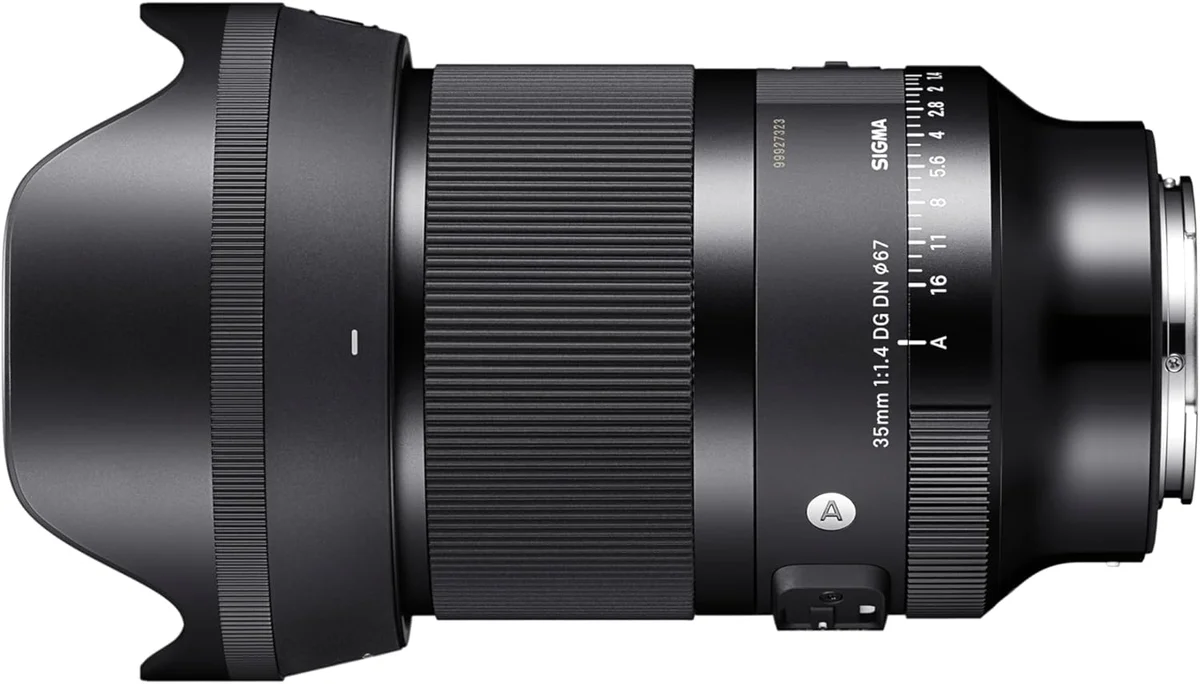
Strengths & Limitations
Strengths
- Optically outstanding — rivals any 35mm at any price
- f/1.4 with minimal coma and aberration
- Weather-sealed Art-series build quality
- Smooth, well-damped focus ring for video
Limitations
- Heavier than the Sony FE 35mm f/1.8 at 640g
- Large physical size for a 35mm prime
- Stepping motor AF can be slower than linear motors
- No aperture ring — aperture controlled via camera body only
Performance
Sharpness: Wide Open Through the Frame
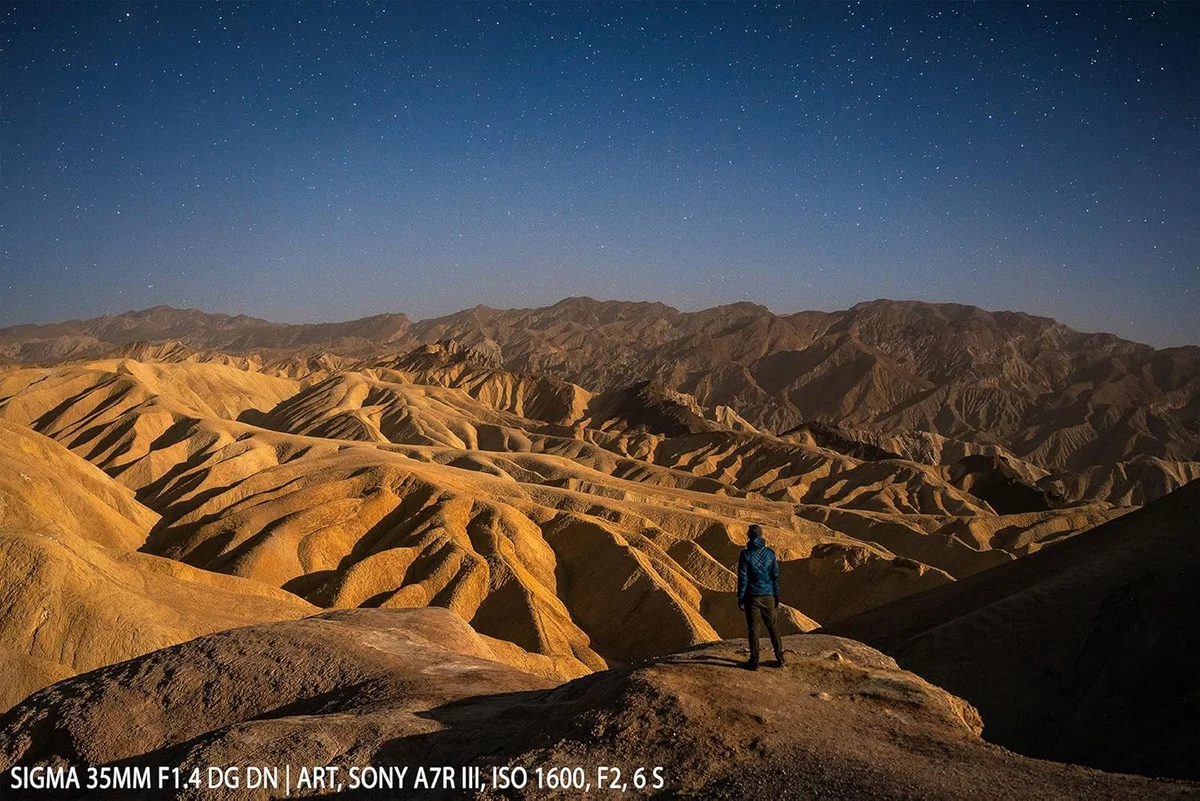
Center sharpness at f/1.4 is outstanding — among the highest measured for any 35mm prime on Sony E-mount. Dustin Abbott's lab data shows the Sigma resolving more line pairs per millimeter at f/1.4 than the Sony FE 35mm f/1.8 achieves at its sharpest aperture (f/2.8). Corner sharpness at f/1.4 is good and improves to excellent by f/2.0. At f/2.8, the entire frame is uniformly sharp — the kind of edge-to-edge consistency that landscape photographers and architectural shooters demand.
Chromatic aberration control, thanks to the SLD glass elements, is strong. Lateral CA at the frame edges is minimal and corrects fully in software. Longitudinal CA (purple fringing in out-of-focus highlights) is visible at f/1.4 on high-contrast transitions — bright backlit leaves against dark backgrounds show thin purple halos. By f/2.0, LoCA is well-controlled. This is typical for fast primes and not a weakness specific to the Sigma — it handles LoCA as well as or better than the Sony GM 35mm f/1.4 at a substantially lower price point.
Distortion, Flare, and Bokeh Character
Barrel distortion is low and corrects fully with in-camera or Lightroom profiles.
Flare resistance is good — Sigma's Super Multi-Layer Coating controls ghosting effectively, though direct point light sources in the frame can produce a visible green ghost at specific angles. The petal-shaped hood blocks most problematic light angles. Vignetting at f/1.4 darkens corners by roughly 1.5 stops — expected physics for any fast prime — and reduces to negligible levels by f/2.0. The 11-blade aperture produces circular bokeh highlights at wider apertures, transitioning to slightly polygonal shapes only when stopped past f/4. At f/1.4-f/2.0, the bokeh rendering is among the smoothest available at this focal length — cat-eye shapes near frame edges are mild compared to 9-blade designs.
Autofocus: Reliable but Not the Fastest
The stepping motor focuses accurately and quietly. For video, it produces no audible noise — a genuine improvement over the HSM motor in the older DSLR version. Focus acquisition in good light is fast enough for street photography: subject detection, lock, and capture happen without delay in daylight and well-lit indoor environments. Eye AF and face detection work reliably on current Sony bodies.
In low light — exactly the conditions where an f/1.4 lens is most valuable — the stepping motor hunts more than Sony's linear and XD motors.
The difference is small but measurable: an extra 0.1-0.2 seconds of focus time in very dim environments. For street photography at night, this can mean the difference between a captured moment and a near-miss. One reviewer noted reliable focus down to -2 EV, with noticeable hunting below that. For comparison, the Sony 35mm f/1.8 with its linear motor locks faster in dim conditions despite being optically slower. The Sigma compensates with the wider f/1.4 aperture gathering more light for the AF sensor to work with.
Value Analysis
Building a Kit Around a 35mm Prime
The Sigma 35mm f/1.4 Art works as a one-lens kit for street and documentary photography. Paired with a Sony A7C II (515g), the combination weighs 1,155g — heavier than the Sony 35mm f/1.8 equivalent but still under 1.2kg for a full-frame system with an f/1.4 prime. For photographers who shoot primarily at 35mm and add reach only for specific situations, pair the Sigma with the Sony FE 85mm f/1.8 (371g) for a two-prime kit covering street and portrait at 1,011g in lenses alone.
Against the Sigma 24-70mm f/2.8 Art II: the zoom covers a wider range but the 35mm prime gathers twice the light at f/1.4 and produces stronger background separation. For photographers torn between a fast prime and a standard zoom, the question is whether 35mm alone covers enough of your shooting — and for many street and documentary photographers, it does. Our street photography lens guide explores this decision in detail.
For the third-party versus native debate: the Sigma 35mm f/1.4 Art is one of the strongest arguments for choosing third-party glass. It matches or exceeds the optical quality of Sony's own 35mm lenses at a competitive price, with professional build quality and weather sealing. The only native advantage is autofocus speed (Sony's linear motors are faster) and weight (Sony's 35mm f/1.8 is far lighter). For photographers who prioritize optics, the Sigma wins.
What to Expect Over Time
APS-C Compatibility: 52.5mm Equivalent
On Sony APS-C bodies — the A6700, ZV-E10 II, FX30 — the 35mm becomes a 52.5mm equivalent. That is a classic normal focal length, ideal for documentary work, talking-head video, and general-purpose shooting. The f/1.4 aperture on APS-C still produces visible background blur, though depth of field is deeper than on full-frame at the same settings. For APS-C video shooters, the 52.5mm equivalent is a natural interview and B-roll focal length with enough subject separation for professional results.
Three Years Into the Art Legacy
The Sigma 35mm f/1.4 DG DN Art launched in 2021 and has accumulated consistent praise over three years of real-world use. Art-series build quality holds up: the weather sealing has proven effective through rain, coastal humidity, and dusty festival environments. The metal barrel shows no signs of wear beyond cosmetic marks from regular use. The focus ring maintains smooth, consistent resistance. The stepping motor shows no AF degradation or accuracy drift in long-term reports.
Sigma has released firmware updates maintaining compatibility with newer Sony bodies. The Sigma USB Dock (sold separately) enables user-applied firmware updates and focus calibration, though the DG DN mirrorless version rarely needs focus adjustment — the lack of a mirror eliminates the mirror-box alignment issues that plagued DSLR-era Art lenses. Used market prices remain strong, typically 70-80% of retail within days of listing. The combination of optical quality, build, and the Sigma Art brand carries strong resale demand.
No successor has been announced. Sigma's refresh cycle for Art primes tends to run 4-6 years, suggesting the current DG DN version will remain current through at least 2025-2026. For buyers considering whether to wait for a next-generation version, the current lens represents the state of the art at 35mm f/1.4 — improvements would likely come in weight reduction or autofocus motor upgrades rather than optical performance, which is already near the physical limits of the focal length and aperture combination.
Sigma 35mm f/1.4 Art — Street and Documentary Questions
Answers based on Amazon owner reviews, measured MTF data from Dustin Abbott and Opticallimits, and cross-referenced field reports for the Sigma 35mm f/1.4 DG DN Art (Sony E-mount).
Is the Sigma 35mm f/1.4 Art sharper than the Sony FE 35mm f/1.8?
Yes, at matched apertures. At f/1.8 (the widest overlap), the Sigma resolves more detail in both center and corners. The difference is most visible on high-resolution bodies like the A7R V — at 61MP, the Sigma's 15-element optical design with SLD glass produces measurably higher MTF numbers edge-to-edge. At f/4 and beyond, both lenses are sharp enough that the difference is academic. The Sigma also opens to f/1.4, which the Sony cannot match — a full stop more light and visibly stronger bokeh. The Sony wins on size (280g vs 640g) and autofocus speed (linear motor vs stepping motor).
Sigma 35mm f/1.4 DG DN Art vs the older DG HSM Art — what changed?
The DG DN version is designed exclusively for mirrorless — shorter flange distance allowed a completely new optical formula. The old DG HSM Art was a DSLR design with a mirrorless adapter. Key improvements: the DN is 325g lighter (640g vs 965g), sharper in the corners at f/1.4, has less chromatic aberration, and uses a stepping motor for quieter AF during video. The HSM used a Hyper Sonic Motor that was fast but audible. The DN also adds weather sealing that the HSM lacked. Image quality at f/2.8 and smaller is similar, but the DN is a better lens in every measurable way.
Is 35mm a good focal length for street photography?
It is the classic street photography focal length alongside 50mm. At 35mm on full-frame, the field of view captures a subject in their environment — wide enough to include context (storefronts, crowds, architecture) but narrow enough to isolate a specific moment. Compared to 50mm, 35mm forces you to get closer, which creates more immersive, dynamic compositions. Compared to 28mm, 35mm produces less perspective distortion on human subjects at close range. The f/1.4 aperture adds a creative dimension: isolate a subject against a busy street scene with shallow depth of field, something f/2.8 zooms struggle to achieve at 35mm.
Does the Sigma 35mm f/1.4 Art have weather sealing?
Yes. Sigma's Art line includes dust and splash resistant construction with gaskets at critical joints and the lens mount. The sealing is rated for light rain, fog, humidity, and dusty conditions — not submersion or heavy downpour. For street photography in light rain, outdoor portrait sessions with morning dew, or travel in humid tropical environments, the sealing provides adequate protection. The front element has a water-repellent coating that keeps water droplets from pooling. Pair it with a weather-sealed Sony body (A7 IV, A7R V) for a fully protected system.