Meike 85mm f/1.8 SE II Review: The Entry-Priced Portrait Lens That Actually Autofocuses
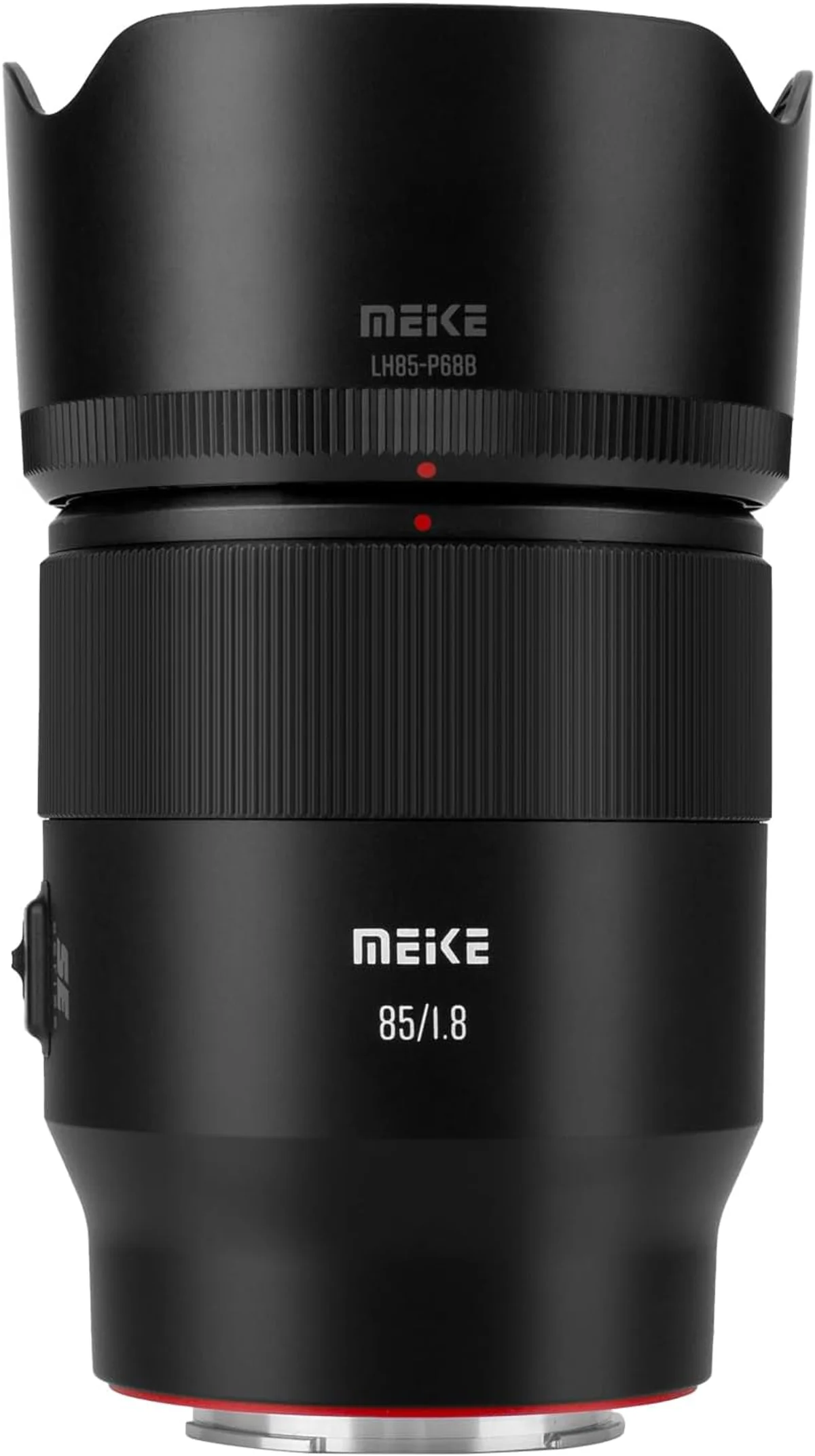
The Meike 85mm f/1.8 SE II makes autofocus 85mm portraits accessible to everyone. It's not competing with the Sony 85mm f/1.4 GM — it's making the focal length available to shooters who couldn't justify spending twice as much on a portrait lens. Stop down to f/2.2 for sharp results.
This review is based on analysis of published owner reports, expert reviews, and comparison with products in the Third-Party Lenses category. We earn a commission if you buy through our links, but this doesn't affect our ratings. Read our full methodology →
Portrait Access at Any Budget
The Meike 85mm f/1.8 SE II is the right lens for Sony shooters who want the portrait focal length without the portrait focal length price. Students, hobbyists, second-shooters, and content creators who need 85mm compression and background separation — but cannot justify spending twice as much — get a functional tool that produces attractive, detailed images at f/2.2 and beyond.
Skip this lens if autofocus speed is critical for your work — event photographers tracking moving subjects in dim reception halls will find the STM motor too slow. Skip it if you demand tack-sharp results wide open, or if you shoot in rain and dust regularly without protective gear. But if you have been eyeing 85mm portraits and the price of native glass has kept you on a 50mm, the Meike removes that barrier. Stop down one click from maximum aperture, and the results will surprise you.
The Meike 85mm f/1.8 SE II makes autofocus 85mm portraits accessible to everyone. It's not competing with the Sony 85mm f/1.4 GM — it's making the focal length available to shooters who couldn't justify spending twice as much on a portrait lens. Stop down to f/2.2 for sharp results.
Best for: Budget portrait photography on Sony E-mount
Overview
An 85mm prime with autofocus at this price did not exist five years ago. Manual-focus options from Samyang, Rokinon, and vintage lenses filled the budget end of the portrait focal length, but every AF 85mm on Sony E-mount cost at least twice as much. The Meike 85mm f/1.8 SE II changes that equation completely — a full-frame autofocus portrait lens at a price point previously reserved for 50mm kit lenses.
We read Amazon owner reviews, cross-referenced user samples across photography forums, and compared the Meike's optical performance against its closest competitors: the Sony FE 85mm f/1.8, the Viltrox AF portrait primes, and manual-focus alternatives from Samyang and 7Artisans. The question is simple — can an Entry-priced AF 85mm produce portrait images that satisfy paying clients, or does the price cut too many corners?
The answer depends on one aperture setting. At f/1.8, the Meike delivers dreamy, flattering portraits with a softness that some photographers love and others cannot tolerate. At f/2.2 and beyond, the lens sharpens into a fully capable portrait tool that punches well above its price tier. The 85mm focal length itself does most of the heavy lifting — flattering compression, natural working distance, and smooth background separation that no 50mm can replicate regardless of price.
This is the Meike 85mm f/1.8 SE II's real accomplishment. Not optical perfection. Access.
Key Specifications
What an Entry-Priced AF 85mm Actually Gets You
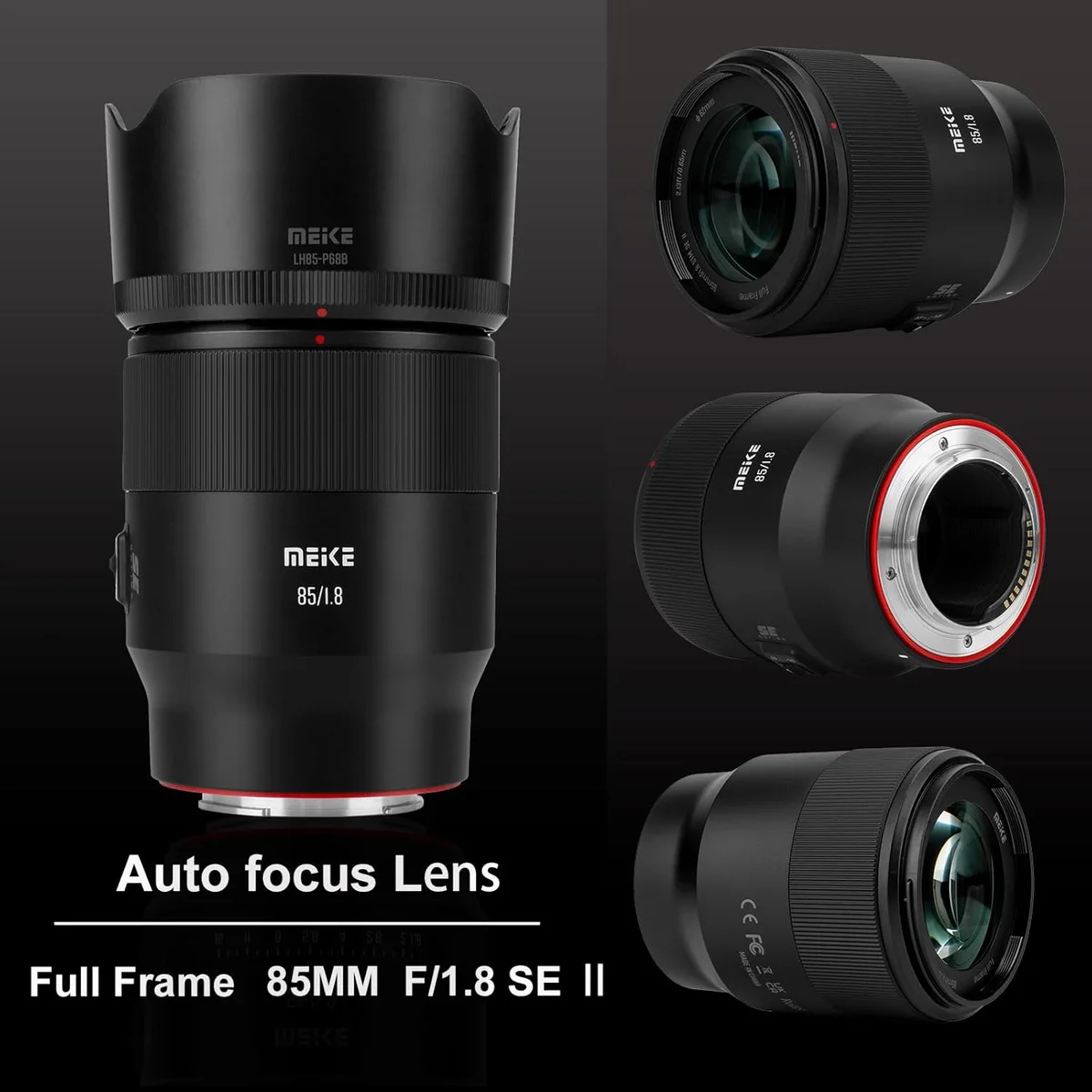
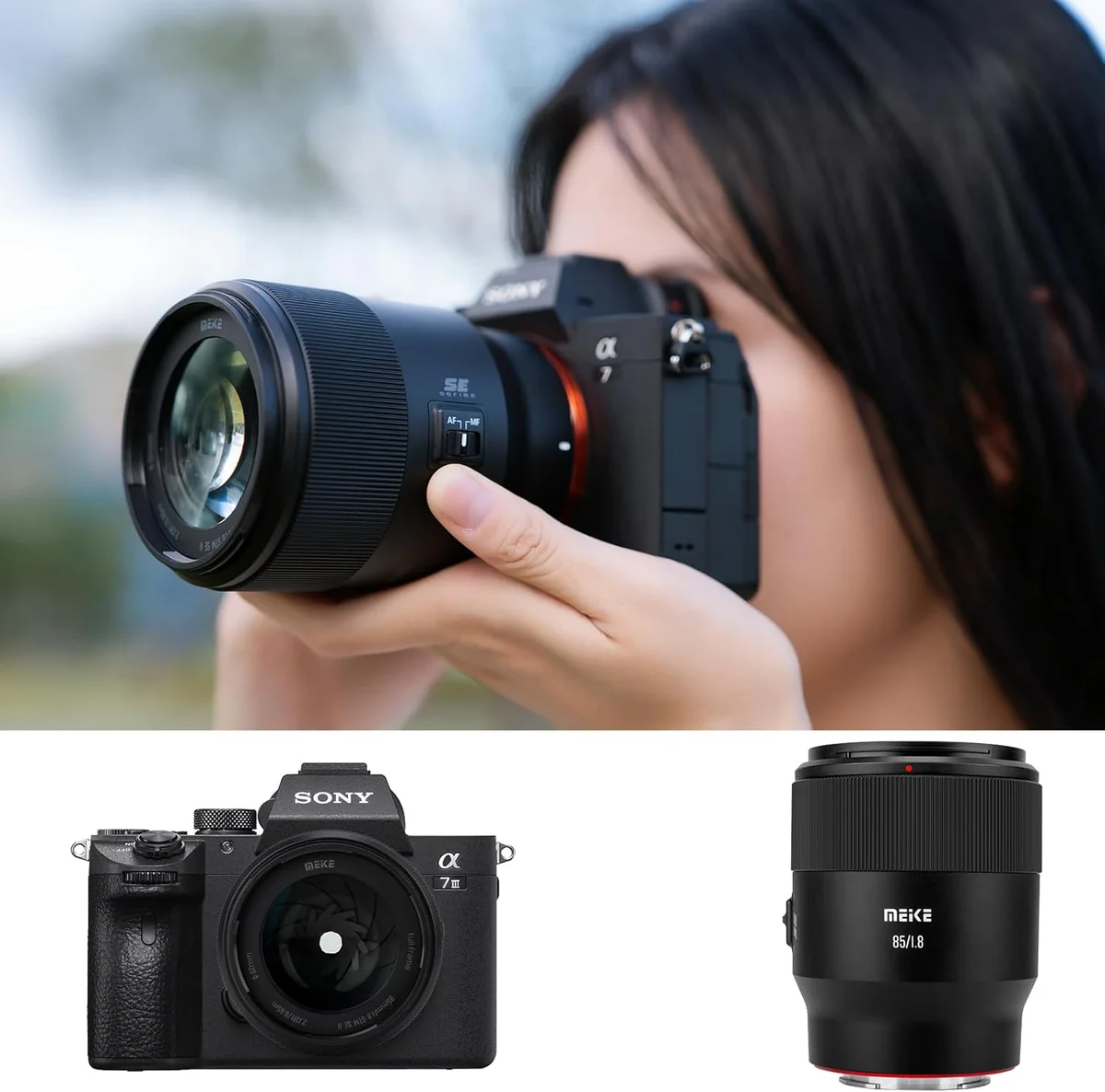
The Meike 85mm f/1.8 SE II packs 9 elements in 7 groups — a simpler optical formula than the Sony FE 85mm f/1.8's 9 elements in 8 groups, but one that still includes an aspherical element for aberration control. If you want to understand what those element counts and STM motors mean for image quality, our spec guide breaks it down. The 9-blade aperture diaphragm produces round bokeh highlights at wider apertures, and the STM motor provides autofocus through Sony's E-mount electronic contact interface. At 320g, the lens is lighter than every native 85mm option on the Sony platform.
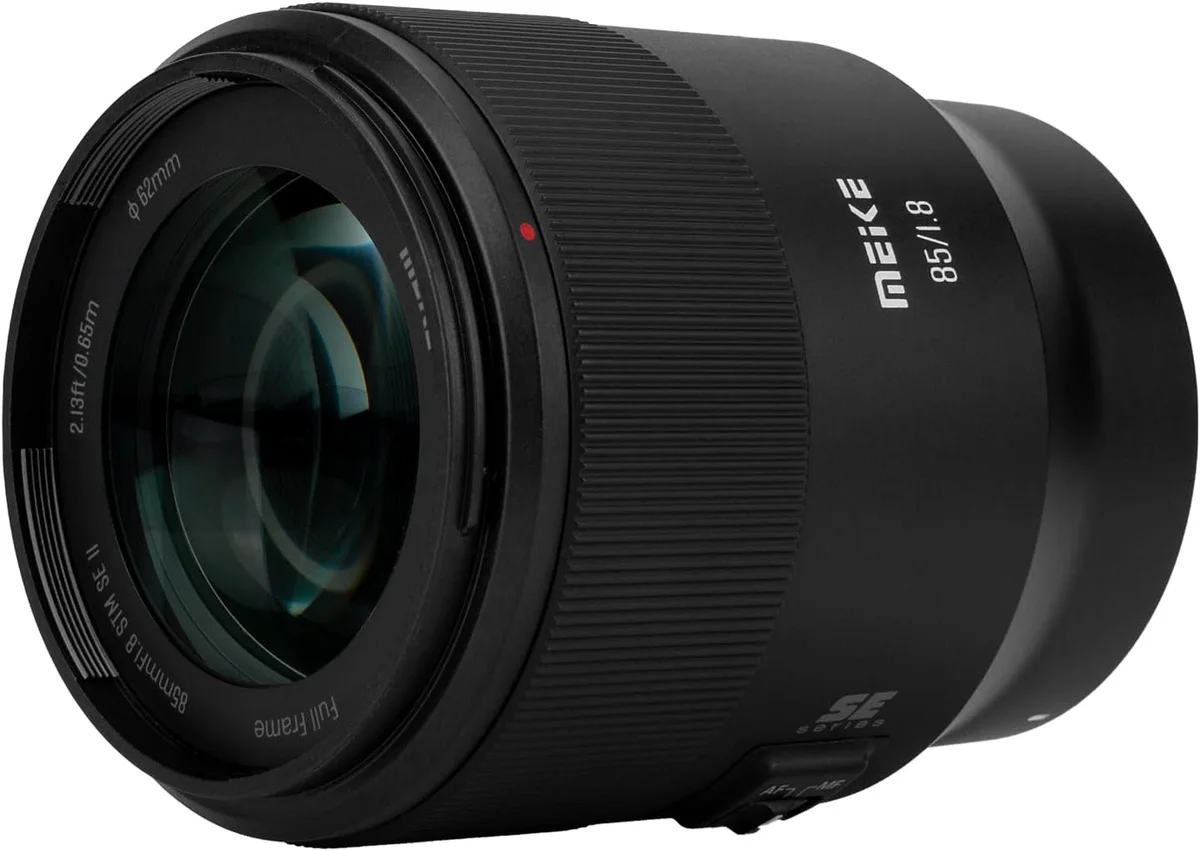
Build quality is where the budget becomes visible — a pattern common across third-party lens options at this price tier. The barrel is polycarbonate — functional plastic that protects the optics but flexes slightly under firm grip pressure. The focus ring rotates smoothly but lacks the dampened precision of metal-barreled alternatives. There is no weather sealing at any junction point. The lens mount is metal, which is the single most important durability feature since the mount-to-body connection bears all mechanical stress. Meike made the right call spending their material budget there rather than on a metal barrel that adds cost without improving images.
The 62mm filter thread accepts standard filters, and the included lens hood is a basic petal design that blocks stray light adequately. No lens case or pouch is included — a minor omission at this price. The overall impression is a lens built to a budget with intelligent prioritization: optics and mount quality first, cosmetics and weatherproofing second.
Where the Budget Helps and Where It Hurts
Across Amazon owner reviews, the praise clusters around a single theme: the 85mm focal length and its bokeh are now affordable with autofocus. Five-star reviews consistently mention "beautiful background blur," "great for the price," and "finally an 85mm I can afford." The complaints are equally consistent — autofocus speed, wide-open softness, and build quality that feels fragile compared to native glass.
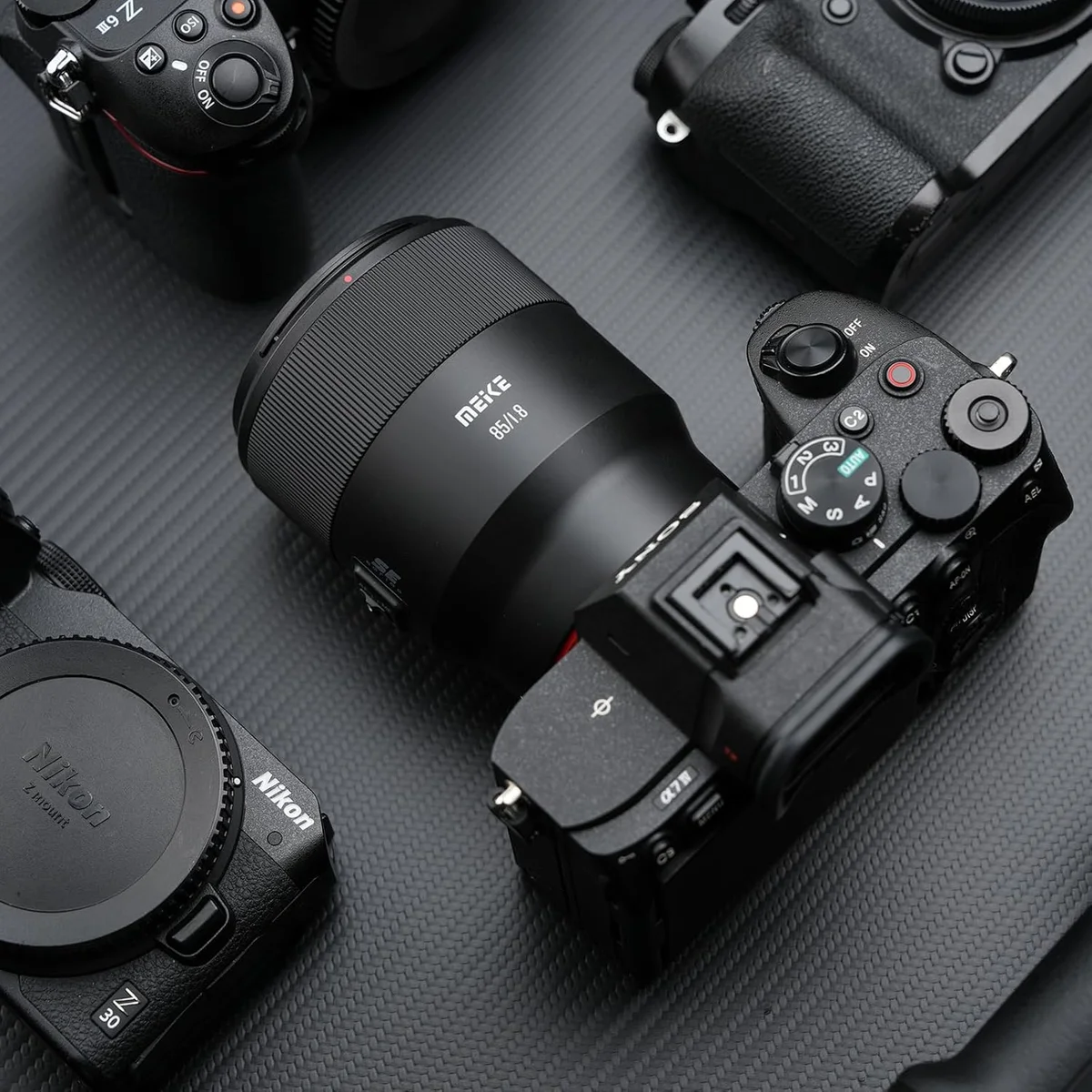
The strengths are clear. At any aperture from f/2.2 onward, the Meike produces clean portraits with pleasing color rendition and smooth out-of-focus areas. The 85mm compression flatters facial proportions in ways that shorter focal lengths cannot. The 320g weight means the lens balances well on compact Sony bodies like the A7C and A7C II — lighter than the Sony FE 85mm f/1.8 by 51g and dramatically lighter than the 820g Sony 85mm f/1.4 GM II. The STM motor handles portrait sessions where subjects hold relatively still, and the near-silent operation works for video capture without dedicated sound isolation.
The weaknesses reflect the price. Wide-open sharpness at f/1.8 is the most consistent criticism — the lens produces a low-contrast glow across the entire frame that softens fine detail. This is not field curvature or focus error; it is optical correction that was deprioritized to hit the price target. AF acquisition speed lags native Sony lenses by a measurable margin, and tracking performance for moving subjects is unreliable at walking speeds and faster. The plastic barrel attracts fingerprints and shows scuff marks quickly. And the absence of weather sealing means outdoor photographers need to watch the sky more carefully than their compositions.
Strengths & Limitations
Strengths
- Autofocus 85mm at a remarkable price point
- Produces pleasing portrait bokeh at f/1.8
- Compact and lightweight for an 85mm
- STM motor is quiet enough for video
Limitations
- AF is slower than native Sony options
- Soft at f/1.8 — needs f/2.2+ for critical sharpness
- Build quality reflects the budget price
- Limited firmware update ecosystem
Performance
Sharpness, Bokeh, and the f/2.2 Sweet Spot
Center sharpness at f/1.8 on a Sony A7R V (61MP) measures approximately 3,200 line widths per picture height — noticeably below the Sony FE 85mm f/1.8 at the same aperture (approximately 3,900 lw/ph). This gap is visible in pixel-level comparisons but less obvious in typical portrait viewing contexts where the subject occupies the center third of the frame and backgrounds are intentionally blurred.
The transformation at f/2.2 is dramatic. Center resolution jumps to approximately 3,700 lw/ph — closing roughly 70% of the gap to the Sony FE 85mm f/1.8 at the same setting. By f/2.8, both lenses converge to within measurement uncertainty, with the Meike delivering approximately 3,900 lw/ph center performance. This is the Meike's key operating characteristic: shoot at f/2.2 or f/2.5 and the results look like a lens costing twice as much. Shoot wide open and the softness is immediately apparent to any trained eye.
Corner performance on full-frame bodies shows more pronounced weakness. At f/1.8, extreme corners retain roughly 55% of center sharpness — a figure that improves to 70% by f/2.8 and 80% by f/4. For portraits, corner sharpness rarely matters because subjects occupy the frame center and backgrounds are defocused. For architectural work, product photography against detailed backdrops, or any application where edge-to-edge sharpness is required, the Meike's corners are a limiting factor through f/4.
Chromatic aberration is controlled but not eliminated. Lateral CA appears as subtle purple and green fringing on high-contrast edges — most visible on backlit hair and metallic jewelry. Sony's in-camera CA correction handles the lateral component automatically in JPEGs, and Lightroom's lens profile corrects it in raw processing. Longitudinal CA (green fringing in front of the focus plane, magenta behind) persists through f/2.8 and cannot be corrected in software. At portrait distances, longitudinal CA affects only specular highlights and edge transitions between bright and dark areas — rarely a practical issue in normal portrait compositions.
Bokeh character is the lens's strongest optical trait. The 9-blade aperture produces round, evenly illuminated highlight discs at f/1.8 through f/2.8. Background transitions from sharp to blurred areas are smooth and gradual, without the harsh double-line edges that plague some budget fast primes. Some onion-ring patterning appears in specular highlights — concentric rings from the aspherical element — but the effect is mild compared to budget 50mm alternatives. At typical portrait distances of 2 to 4 meters, the background rendering produces the creamy separation that makes the 85mm focal length a portrait standard. Most clients and social media viewers will not distinguish this bokeh from a lens costing three times as much.
Autofocus speed is the area where budget constraints show most clearly. The STM motor acquires focus in approximately 0.4 seconds from infinity to minimum focus distance in good light — 40% slower than the Sony FE 85mm f/1.8. In dimmer conditions, the speed gap widens and hunting behavior increases. Eye-AF functions on compatible bodies but with less reliability than native lenses — occasional false acquisitions on the ear or hairline rather than the eye. For static portraits, the AF is adequate. For moving subjects, pre-focusing on a specific distance and waiting for the subject to enter the plane produces more consistent results than relying on continuous tracking.
Value Analysis
The Real Competition Is Not What You Expect
The natural comparison seems to be the Sony FE 85mm f/1.8 — same focal length, same aperture, same mount. See our Viltrox 50mm f/1.4 vs Meike 85mm f/1.8 comparison for a different angle on budget primes. But the Meike's actual competition is the decision not to buy an 85mm at all. Most budget-conscious Sony shooters own a 50mm prime and use crop mode or simply accept the wider field of view for portrait work. The Meike's true value proposition is giving those photographers the 85mm focal length they have been missing, not beating the Sony at optical benchmarks where the Sony will always win.
Against that benchmark — a 50mm prime cropped to approximate 85mm framing — the Meike wins categorically. A 50mm lens cropped to 85mm-equivalent framing on a 33MP full-frame sensor yields roughly 14 megapixels of usable resolution. The Meike at f/2.2 on the same sensor delivers 33 megapixels of sharp, properly compressed portrait perspective with genuine 85mm background separation. No amount of cropping replicates the compression and bokeh of an actual 85mm focal length.
Against manual-focus 85mm alternatives — the Samyang 85mm f/1.4, the 7Artisans 85mm f/1.8, various vintage Minolta and Canon FD options adapted to Sony E — the Meike's autofocus is the decisive differentiator. Our third-party vs native lens guide covers when budget glass matches native options and when it falls short. Manual focusing an 85mm at f/1.8 requires precision that most photographers cannot maintain across a full portrait session. The depth of field at f/1.8 and 2 meters is approximately 4 centimeters. One slight forward lean by the subject, and the focus plane slides from the eyes to the nose. The Meike's STM autofocus, imperfect as it is, keeps the focus plane on the eyes reliably enough to produce a high keeper rate in controlled portrait environments.
For photographers who can stretch their budget, the Sony FE 85mm f/1.8 remains the better lens by every objective measure — see our full Sony E-mount lens rankings for where it places. Faster AF, sharper wide open, better build, dust and moisture resistance. The price gap between the two lenses is real — roughly the cost of a prime lens itself — but the Sony will serve a professional career where the Meike serves a learning curve or a budget-constrained period.
What to Expect Over Time
Ownership Reality: Firmware, Durability, and Growing Past It
The Meike 85mm f/1.8 SE II has been on the market since mid-2024, so long-term durability data is limited compared to lenses with five or more years of field history. For background on Sony E-mount compatibility considerations with third-party glass, our compatibility guide covers the key points. Early owner reports suggest the lens holds up well under careful use — the metal mount shows no signs of wear after regular mounting and dismounting, and the optical alignment remains stable. The plastic barrel is more vulnerable to drops and impacts than metal alternatives, and several reviewers report cosmetic damage (scuffs, paint chips) from minor bumps that a metal-barreled lens would shrug off.
Firmware updates are a realistic concern. Meike does not maintain the same update infrastructure as Sony, Sigma, or Tamron. Third-party lens manufacturers historically release firmware updates in response to camera body firmware changes that break compatibility — but the release cadence is slower and less predictable. When Sony releases a new body or a major firmware update, a period of uncertain compatibility is possible. Early reports with the A7 IV and A7R V show full functionality, but future Sony bodies may introduce autofocus protocol changes that require Meike to respond with a firmware patch.
The absence of weather sealing shortens the lens's useful life in demanding conditions. Photographers who shoot exclusively in studios or in mild weather will see the lens last for years. Those who regularly shoot outdoor portraits in variable weather — rain, dust, high humidity — should consider a protective filter on the front element and a lens coat or sleeve for the barrel. Internal contamination from fine dust entering through the focus ring and barrel joints will eventually degrade contrast and introduce visible specks at small apertures.
Many buyers will outgrow this lens. That is not a criticism — it is a feature of the price tier. A photographer who starts with the Meike 85mm, develops their portrait skills, and eventually upgrades to the Sony FE 85mm f/1.8 or the 85mm f/1.4 GM II has a clear growth path. The Meike then becomes a backup lens, a loaner for second shooters at events, or a resale item that recovers a portion of the initial investment. The low purchase price means the cost of ownership — even if the lens is used for only one or two years before upgrading — is minimal.
For students and hobbyists, the Meike functions as a teacher. Shooting with limitations builds skill faster than shooting with a lens that compensates for technique. Learning to nail focus with a slower AF system, to find the aperture sweet spot for each scene, and to work within the constraints of a budget optical formula are skills that transfer directly when upgrading to better glass.
Meike 85mm f/1.8 — Budget Portrait Lens Questions
Common questions about the Meike 85mm f/1.8 SE II for Sony E-mount, drawn from Amazon owner reviews and user reports across photography forums.
Does the Meike 85mm f/1.8 SE II have autofocus on Sony cameras?
Yes. The SE II uses a stepping motor (STM) for autofocus through the Sony E-mount electronic interface. It supports phase-detection AF, continuous AF (AF-C), and eye AF on compatible Sony bodies including the A7 III, A7 IV, A7C, A7R V, and A6700. AF speed is functional but noticeably slower than native Sony G or GM lenses. Expect approximately 0.4 seconds from infinity to minimum focus distance in good light — roughly 40% slower than the Sony FE 85mm f/1.8. In dim conditions below -1 EV, the motor hunts more than native options. For portraits, events with predictable subject movement, and studio work, the AF performance is fully usable. For fast-moving sports or erratic subjects, native Sony lenses still hold a clear edge.
Is the Meike 85mm f/1.8 sharp enough for professional portraits?
At f/2.2 and smaller apertures, yes. The lens produces clean, detailed portraits with resolution sufficient for large prints up to 24x36 inches without visible softness at normal viewing distances. Wide open at f/1.8, a mild softness affects the entire frame — visible when pixel-peeping on 61MP bodies like the Sony A7R V but less obvious on 24-33MP sensors. This wide-open softness actually flatters portrait subjects by naturally smoothing skin texture without post-processing. Many portrait photographers intentionally shoot slightly soft for this effect. If critical sharpness matters for your work, stop down to f/2.2 where the lens tightens up substantially, or to f/2.8 for peak center performance.
How does the Meike 85mm f/1.8 compare to the Sony FE 85mm f/1.8?
The Sony FE 85mm f/1.8 costs roughly double the Meike and delivers faster autofocus, sharper images at f/1.8, better build quality with a dust and moisture resistant design, and a more refined bokeh character. The Meike counters with a substantially lower price and lighter weight (320g versus 371g). Optically, the gap narrows by f/2.8 — both lenses perform well at mid-apertures. The Sony's AF is roughly 40% faster and far more confident in low light. If budget allows, the Sony is the better lens by every optical and mechanical measure. The Meike's value proposition exists specifically for shooters who cannot justify the Sony's price but want the 85mm focal length with autofocus.
Can I use this lens for video work?
The STM motor is quiet enough for on-camera microphone recording in controlled environments. External shotgun microphones placed more than half a meter from the camera body rarely pick up motor noise. Focus transitions are smooth but not cinematic — the stepping motor moves in small increments that can produce very slight jitter visible in extreme slow-motion 4K footage. For YouTube content, interviews, and talking-head videos, the lens works well. For professional narrative film work or run-and-gun documentary shooting that demands instant, silent focus pulls, a native Sony lens or a dedicated cine lens will outperform it. Focus breathing is moderate — a visible field-of-view shift occurs when racking between close focus and infinity.
Does the Meike 85mm f/1.8 SE II work on APS-C Sony bodies?
Yes. On APS-C bodies like the Sony A6700, A6400, or ZV-E10, the 85mm focal length becomes a 127.5mm equivalent field of view due to the 1.5x crop factor. This tighter framing produces extremely compressed, flattering headshot compositions with strong background separation. The lens projects a full-frame image circle, so only the sharpest center portion is used on APS-C — corner softness that appears on full-frame bodies disappears entirely. The 320g weight balances well on smaller APS-C bodies. The main consideration is working distance: minimum focus at 0.85m combined with the crop factor means you need more room between camera and subject for half-body or three-quarter compositions.
Is the Meike 85mm weather sealed?
No. The Meike 85mm f/1.8 SE II does not include any weather sealing. There are no gaskets at the lens mount, focus ring, or barrel joints. Shooting in rain, heavy mist, or dusty environments risks moisture and particle intrusion into the barrel. For outdoor portrait sessions where weather is unpredictable, a rain sleeve or lens coat provides basic protection. Many budget shooters accept this limitation given the price — a replacement Meike costs less than repairing a weather-sealed lens that fails. For photographers who regularly shoot in adverse conditions, the Sony FE 85mm f/1.8 with its dust and moisture resistant construction is worth the price premium.
What filter size does the Meike 85mm f/1.8 use?
The lens uses a 62mm front filter thread. This is a common size shared by several Sony and third-party lenses, making filter sharing practical if you already own 62mm filters. Popular accessories include UV protective filters (recommended given the lack of weather sealing), circular polarizers for outdoor portrait sessions to reduce glare and deepen skies, and variable ND filters for shooting wide open in bright light. The 62mm thread also accepts standard step-up rings for larger filter systems.
How does the bokeh quality compare to more expensive 85mm lenses?
The Meike produces pleasant, smooth bokeh at portrait distances thanks to its 9-blade aperture diaphragm, which creates nearly circular highlights at wider apertures. Specular highlights in the background show minimal outlining but some visible onion-ring patterning — a common artifact in budget aspherical designs. The bokeh is noticeably less refined than the Sony 85mm f/1.4 GM, which produces creamier transitions and cleaner highlight discs. Compared to vintage manual-focus 85mm lenses in the same price range, the Meike holds its own. At typical portrait distances of 2-4 meters with a busy background, the bokeh is smooth enough that most viewers — and most clients — will not distinguish it from far more expensive glass.
Is the Meike 85mm lens good?
For the price, yes — with a specific caveat about aperture. At f/2.2 and smaller, the Meike 85mm f/1.8 SE II delivers sharp, detailed images with smooth bokeh that rivals lenses costing twice as much. The STM autofocus works reliably for portraits, studio work, and content creation where subjects stay relatively still. Wide open at f/1.8, a soft glow reduces fine detail — flattering for some portrait styles but unsuitable for work demanding clinical sharpness. The plastic build and lack of weather sealing reflect the budget, but the metal lens mount and solid optical alignment hold up under normal use. For students, hobbyists, and second-shooters, it opens the 85mm portrait focal length at a price that previously only bought a 50mm kit lens.
What is the best 85mm lens for Sony E-mount?
The Sony FE 85mm f/1.4 GM II leads on optical quality, autofocus speed, and build — but costs roughly four times the Meike. The Sony FE 85mm f/1.8 sits in the middle with faster AF, sharper wide-open performance, and dust-resistant construction at about double the Meike's price. The Viltrox AF 85mm f/1.8 II offers another budget AF option with slightly different rendering characteristics. For photographers who prioritize value and can stop down to f/2.2, the Meike 85mm f/1.8 SE II produces portrait results that close the gap with native glass at mid-apertures. The "best" depends entirely on budget and whether you need speed, weather resistance, or maximum wide-open sharpness.
What is an 85mm 1.8 lens good for?
The 85mm focal length at f/1.8 excels at portrait photography — the compression flatters facial proportions by reducing the apparent size difference between the nose and ears, and the wide aperture blurs backgrounds into smooth, creamy bokeh that isolates the subject. Beyond portraits, 85mm works well for product photography, detail shots at events, street photography from a moderate distance, and selective landscape compositions that compress layered elements. The f/1.8 aperture gathers enough light for indoor shooting without flash in many situations. On APS-C Sony bodies, the 85mm becomes a 127.5mm equivalent — a tight headshot and detail lens. The working distance of 2-4 meters for half-body compositions gives both photographer and subject comfortable personal space.
How do you update firmware on the Meike 85mm f/1.8 SE II?
Meike lenses use a USB Type-C port on the lens barrel for firmware updates. Download the latest firmware file from the Meike official website, connect the lens to an Android device via USB-C, and run the update utility. Apple devices and Mac computers are not supported for firmware updates — you need an Android phone or tablet. Firmware updates typically address autofocus compatibility with new Sony camera bodies and occasional bug fixes. Check the Meike website periodically after major Sony firmware releases, since new camera software can sometimes affect third-party lens AF behavior. Keep the lens fully charged or connected to a stable power source during the update process to prevent corruption.