Sony FE 20mm f/1.8 G Review: The Ultra-Wide That Earns Its G Badge
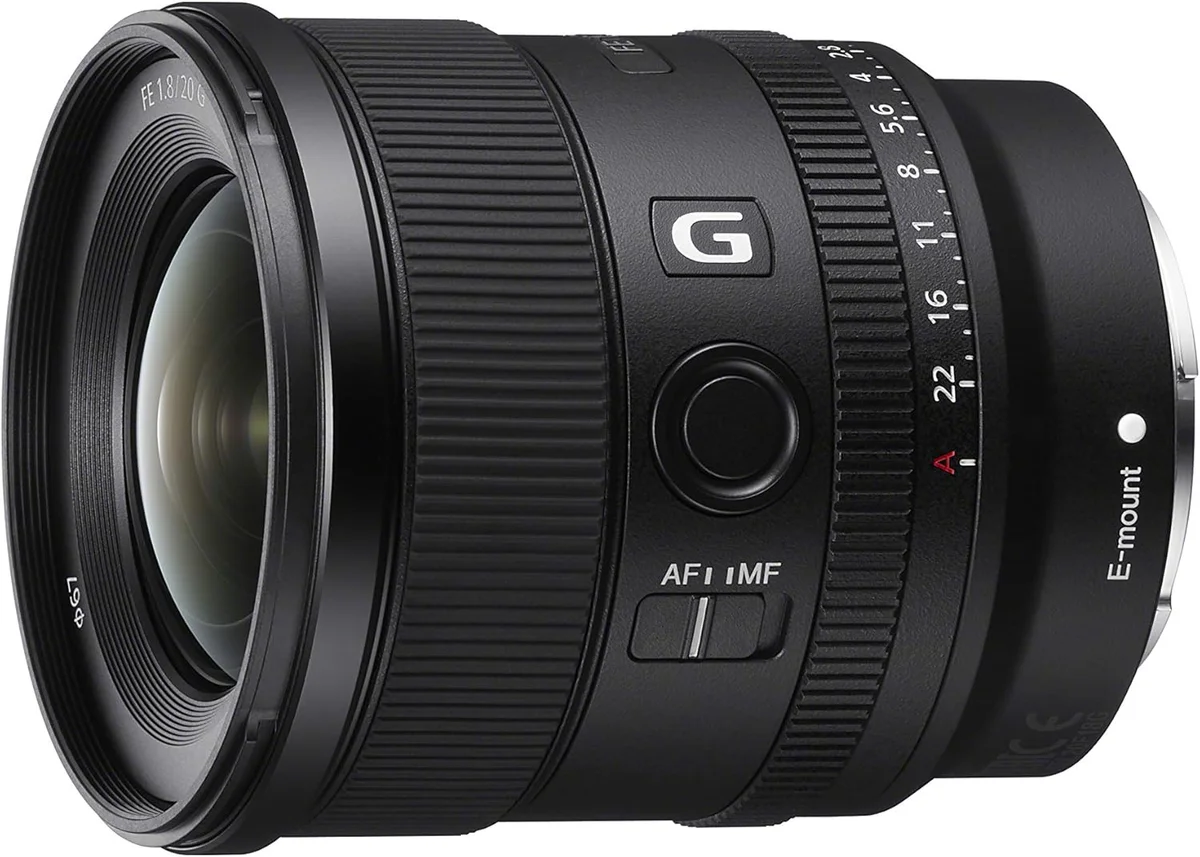
The Sony FE 20mm f/1.8 G is one of the best ultra-wide primes for any system. Astrophotographers will appreciate the near-zero coma, and vloggers benefit from the wide field of view and compact size.
This review is based on analysis of published owner reports, expert reviews, and comparison with products in the Sony E-Mount Lenses category. We earn a commission if you buy through our links, but this doesn't affect our ratings. Read our full methodology →
Should You Add the Sony 20mm f/1.8 G to Your Kit?
The Sony FE 20mm f/1.8 G is the best ultra-wide prime under the G Master tier for Sony full-frame.
Corner-to-corner sharpness at f/1.8 puts it in rare company. Coma control makes it an astrophotography reference lens. The 0.18m close focus opens creative possibilities other 20mm primes cannot match. At 373g with weather sealing, it handles real-world conditions without demanding a dedicated bag or a heavy gimbal. Barrel distortion needs software correction, the filter thread requires slim-profile rings, and the price reflects the G-series positioning. For anyone shooting night skies, wide landscape photography compositions, vlogs, or interiors on Sony mirrorless, this is the lens to measure every alternative against.
The Sony FE 20mm f/1.8 G is one of the best ultra-wide primes for any system. Astrophotographers will appreciate the near-zero coma, and vloggers benefit from the wide field of view and compact size.
Best for: Astrophotography, landscape, and vlog shooters wanting ultra-wide
Overview
Point this lens at the night sky and stars stay sharp in the corners. That single fact separates the Sony FE 20mm f/1.8 G from a crowded field of ultra-wide primes that promise edge-to-edge quality but deliver smeared stars and soft peripheries. The two XA (extreme aspherical) elements inside the barrel are doing the heavy lifting — they suppress coma and astigmatism at wide apertures where cheaper ultra-wides fall apart. For astrophotographers, this matters more than any spec sheet number.
We read Amazon owner reviews, cross-referenced optical performance data from Lenstip, Opticallimits, and Dustin Abbott's measured MTF charts, and compared this lens against the Sigma 16mm f/1.4 DC DN (APS-C alternative), the Sony FE 35mm f/1.8, and the Sigma 20mm f/1.4 DG DN Art. The pattern across reviews: astrophotographers and landscape photography shooters praise corner sharpness and coma control. Vloggers appreciate the ultra-wide field of view at a weight that doesn't wreck gimbal setups. The price is the sticking point — a premium ask for a single focal length.
At 373g, the FE 20mm f/1.8 G weighs less than most ultra-wide zoom alternatives. Sony packed 14 elements into 12 groups, including those two XA elements and three ED (extra-low dispersion) glass pieces, then wrapped the assembly in a dust and moisture resistant shell with a rubber mount gasket. The G designation slots it above Sony's budget primes but below the G Master tier — mid-level pro glass with pro-adjacent build quality.

Key Specifications
373 Grams of Optical Engineering
The body is compact enough to disappear inside a jacket pocket — or at least, it tries to.
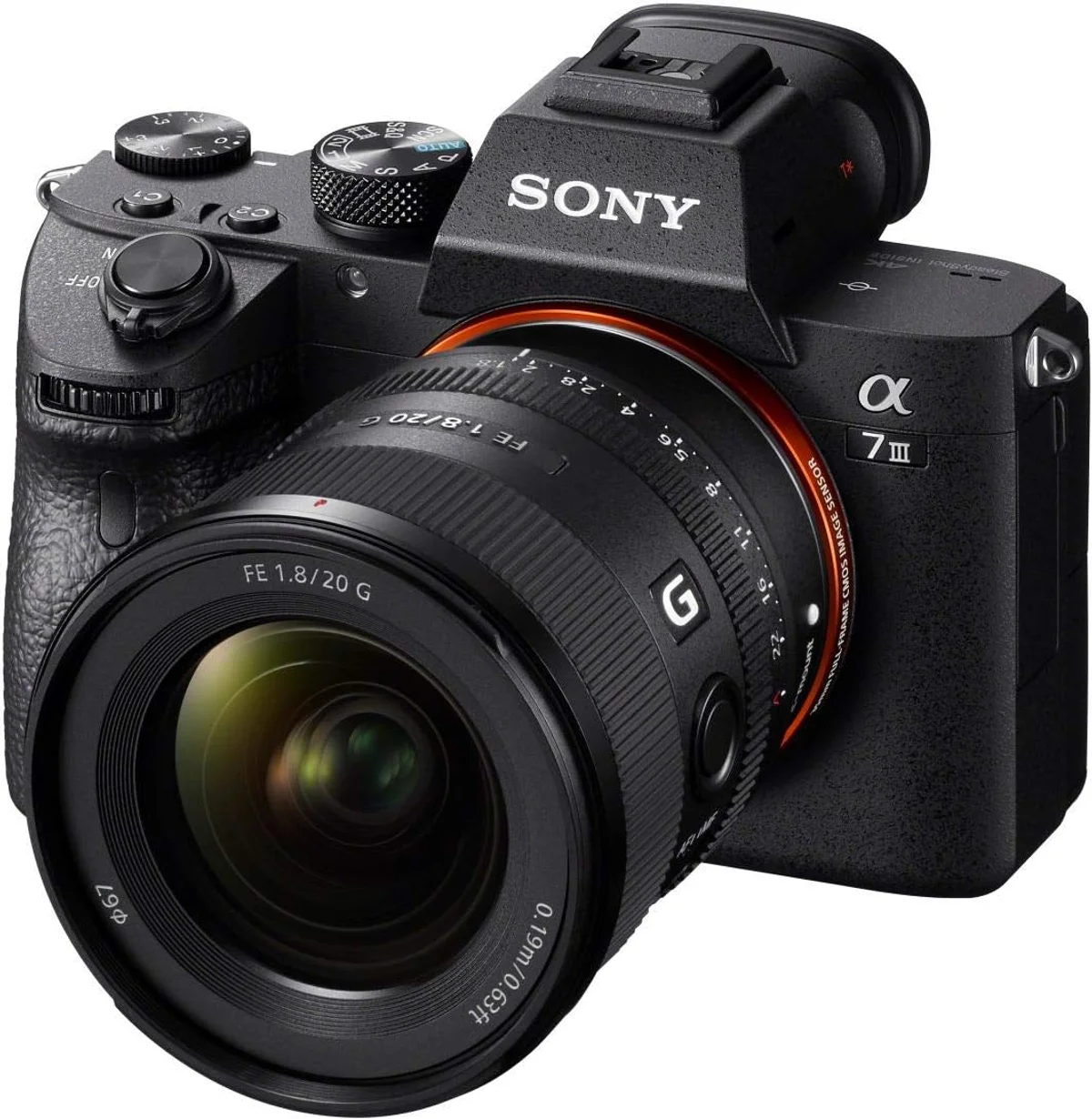
The 67mm filter thread and slightly protruding front element add bulk compared to a pancake, but for an ultra-wide f/1.8 prime, the envelope is small. Pick it up after handling a Sigma 20mm f/1.4 Art (630g) and the difference is immediately obvious. On an A7C or A7 IV, the camera-lens combination stays front-weighted but manageable for extended handheld sessions. After a full day of shooting in a canyon, your wrist notices the difference between 373g and 630g.
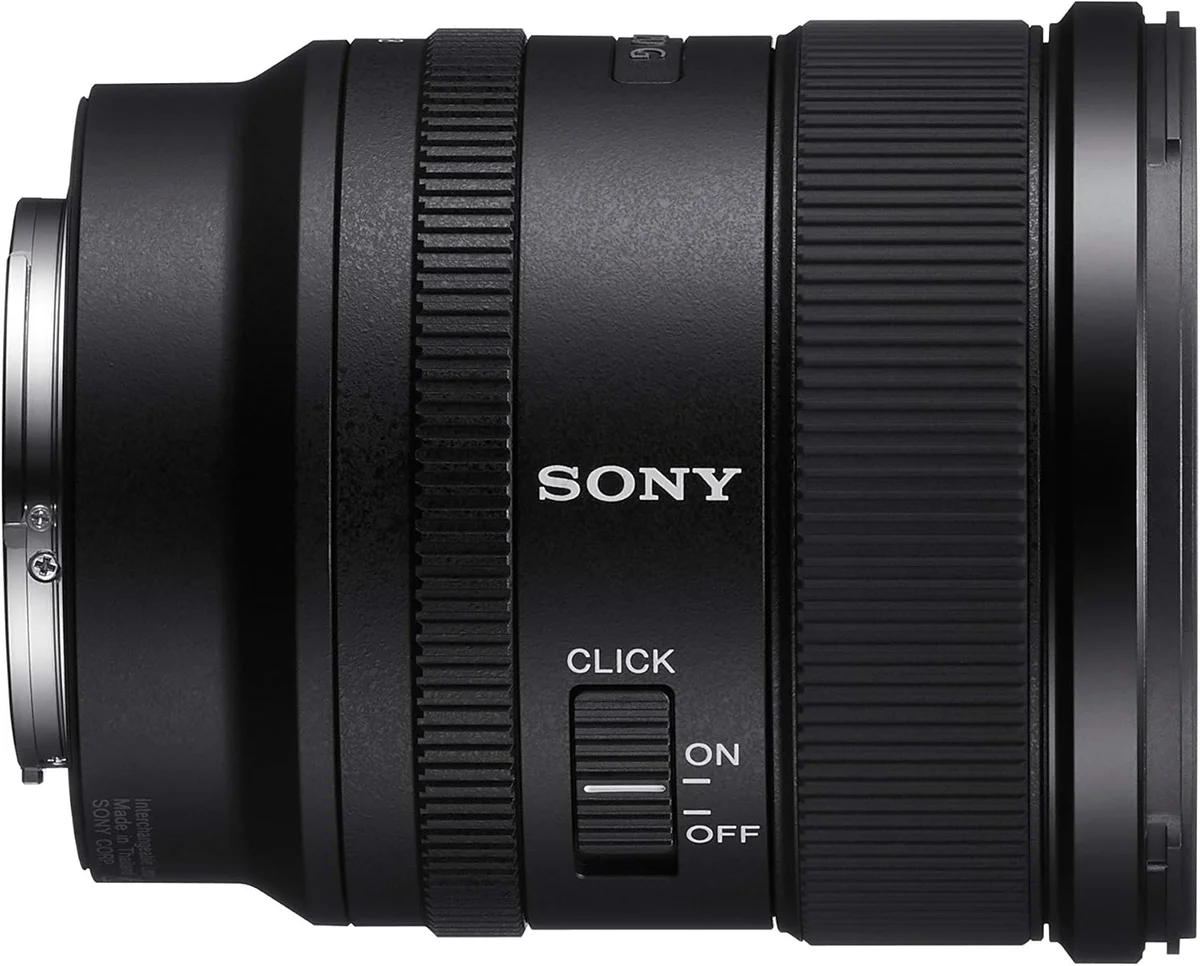
Build materials split between engineering plastic and internal metal reinforcement. The focus ring is smooth with consistent resistance — no dead zones, no gritty spots. The AF/MF switch clicks firmly. The FE 20mm f/1.8 G has an aperture ring with a click on/off switch, as confirmed in Sony’s announcement for this lens. Leave the clicks on for stepped adjustment, or switch them off for smooth aperture changes during video. The customizable focus hold button sits within thumb reach and can be remapped to Eye AF start, AEL, or other functions via the camera body menu.
The dust and moisture resistant construction includes gaskets at the mount ring, switch panel, and focus ring. The front element has a fluorine coating that repels water and oil — fingerprints wipe clean with a dry cloth. For dawn shoots in dewy fields or coastal landscape photography at sunrise, the sealing provides enough protection to work without a rain cover. One reviewer notes using this lens through light fog and mist over multiple seasons without any internal condensation issues.
Close Focus: 0.18m Changes What 20mm Can Do
Most ultra-wide primes focus to 0.25-0.3 meters. The FE 20mm f/1.8 G focuses to 0.18 meters — roughly seven inches from the front element — with 0.2x magnification. This isn't macro territory, but it opens creative possibilities that other 20mm lenses can't match. Place the lens close to a flower, a rock formation, or a textured surface, and the ultra-wide perspective exaggerates the foreground while the background stretches to infinity. The effect is distinctive and difficult to replicate in post.
At 0.18m, depth of field at f/1.8 becomes razor-thin even at 20mm. The foreground subject pops against a smoothly defocused background — unusual for an ultra-wide, where everything typically falls within the depth of field. This near-macro capability makes the lens a creative tool beyond its obvious landscape photography and astro applications. Food photographers, product shooters in tight spaces, and environmental portrait photographers all find uses for extreme-close wide-angle perspectives.
The Case For and Against
The enthusiast's argument: "This lens makes me want to actually take my camera and just find things to shoot" — a direct quote from one Amazon reviewer, and the sentiment repeats across other owner reviews.
Corner sharpness at f/1.8 is already excellent, and stopping down to f/2.8 produces frame-filling resolution that satisfies 61MP sensors. Coma is nearly absent wide open — a rare claim among ultra-wides at any price. The XD linear motors focus silently, fast enough for face tracking during vlog recording. The 0.18m close focus distance adds a creative dimension most ultra-wides lack. Weight stays under 400g. Weather sealing holds up in light adverse conditions.
The skeptic's argument is mostly about money and optical physics.
Barrel distortion is visible in architectural shots and needs software correction — the lens profile handles it automatically in Lightroom and Capture One, but the raw uncorrected image shows clear curvature at frame edges. Vignetting at f/1.8 darkens corners by roughly 1.5-2 stops, which is expected physics at this aperture and focal length but still requires correction for even-exposure landscape photography work. The filter thread protrudes slightly, meaning thick filters can vignette at wide apertures — slim-profile filters are mandatory. And the price positions this as a premium single-focal-length investment when a used 16-35mm f/4 zoom covers more range for less money.

Strengths & Limitations
Strengths
- Outstanding corner sharpness — exceptional for astrophotography
- Minimal coma and astigmatism at f/1.8
- Compact and lightweight at 373g for an ultra-wide
- Excellent close-focus at 0.19m for creative perspectives
Limitations
- Premium price for a single focal length
- Some barrel distortion needs profile correction
- No aperture lock switch
- Filter thread protrudes — needs thin filters to avoid vignetting
Performance
Optical Performance: Center to Corner
Center sharpness at f/1.8 is outstanding — high enough that the lens resolves detail on the A7R V's 61MP sensor without the softness that plagues many wide-angle primes wide open. The two XA elements are the engineering story here. Traditional aspherical elements can introduce onion-ring patterns in bokeh and leave residual aberrations at frame edges. XA elements are precision-molded to a surface accuracy of 0.01 microns, reducing those artifacts substantially.
Corner performance is where this lens earns its reputation. At f/1.8, corners are already sharp enough for landscape photography prints at large sizes — a claim very few 20mm f/1.8 lenses can make. By f/4, corner resolution nearly matches the center. For astrophotography, this translates to pinpoint stars across the full frame at f/2 or f/2.2, with only trace amounts of coma visible at the extreme corners wide open. Compare this to the Samyang/Rokinon 14mm f/2.8, which shows obvious coma at f/2.8 — a full stop narrower.
The three ED elements control chromatic aberration effectively. Lateral CA is minimal and corrects fully in software. Longitudinal CA (purple and green fringing in out-of-focus areas) appears at f/1.8 on high-contrast edges but is well-controlled compared to non-ED designs. By f/2.8, LoCA is essentially invisible.
Autofocus: The XD Linear Motor Advantage
Sony's XD (Extreme Dynamic) linear motors are a step above the standard linear motors in the FE 50mm f/1.8 and FE 85mm f/1.8. The XD motors move the focus group faster and with finer precision — the difference is measurable in AF acquisition time but more noticeable in tracking consistency during continuous shooting and video. Lock-on from infinity to close focus takes a fraction of a second. The motor produces zero audible noise.
For video, the silent operation is a requirement, not a bonus. The lens tracks subjects smoothly during focus transitions without the hunting or micro-corrections that plague older lens motor designs. Eye AF and face detection work reliably on current Sony bodies. One reviewer shooting real estate walkthrough videos notes the focus transitions are "smooth enough for client-facing content without post-stabilization." For vloggers on the ZV-E1 or A7C II, the combination of ultra-wide framing and fast face tracking means the camera maintains focus even during quick movements toward and away from the lens.
The focus-by-wire system means the focus ring has no hard infinity stop — a minor frustration for manual-focus astro work where you want to set infinity and leave it. The workaround: use the camera's focus magnification, nail infinity on a bright star, then tape the ring position. Most astrophotographers develop this habit quickly.
Flare, Distortion, and the Physics of 20mm
Barrel distortion is the unavoidable physics tax on any rectilinear 20mm lens. The FE 20mm f/1.8 G produces moderate barrel distortion — less than the Samyang 18mm f/2.8 but more than a 24mm prime. Sony's in-camera profile and Lightroom's automatic correction remove it cleanly, with no visible resolution loss after correction. For architecture and real estate, always apply the profile. For astro and landscape photography, the distortion is rarely noticeable because natural scenes lack straight reference lines.
Flare resistance is above average thanks to Sony's Nano AR coating.
With the sun in frame — a common composition choice at 20mm for sunstars and dramatic backlighting — ghosting is controlled. Small green or purple ghosts can appear when the sun sits near frame center, but they're faint and predictable. The lens hood is petal-shaped and effective, though the wide field of view means it can only block light from extreme angles. For sunrise and sunset landscape photography work where the sun sits just above the horizon, the hood makes a measurable difference in contrast retention.
The 9-blade circular aperture produces well-defined 18-point sunstars when stopped down to f/11 or f/16 — a visual effect landscape photographers specifically seek. The sunstar pattern from this lens is clean and symmetrical, without the irregular spikes that some 7-blade designs produce.
Value Analysis
Where This Lens Fits in a Sony Kit
The Sony FE 20mm f/1.8 G occupies a specific and somewhat narrow slot. It is not a general-purpose lens. It does not replace a 24-70mm zoom for event coverage or a 35mm for daily carry. It exists for photographers who know they need ultra-wide and fast — astrophotographers, landscape photography specialists who shoot dawn and dusk, vloggers who need maximum framing width, and real estate photographers who need to fit entire rooms in a single frame. For those uses, it is among the best options on any mirrorless system.
The natural kit pairing is with a mid-range standard prime. The Sony FE 35mm f/1.8 at 280g creates a two-lens kit weighing 653g total — wide and normal covered, both fast, both light. Add the Sony FE 50mm f/1.8 and you have a three-prime travel kit under 900g that covers 20-50mm at f/1.8 across the board. Compared to carrying a 16-35mm f/2.8 zoom (680g alone), the prime kit weighs more in total but each lens is individually lighter and optically superior at its focal length.
Against the Sigma 16mm f/1.4 DC DN, the comparison only works for APS-C shooters. The Sigma on an APS-C body gives a 24mm equivalent at f/1.4 — brighter but narrower. The Sony on full-frame gives a true 20mm at f/1.8 — wider but slower. They serve different systems and different perspectives. APS-C shooters on a budget should look at the Sigma first. Full-frame shooters who need true ultra-wide have no reason to consider the crop-sensor Sigma.
For the broader category perspective, our landscape photography lens guide covers how the 20mm f/1.8 G stacks up against zooms and other primes in that discipline. And for a full view of compatible glass, the Sony E-mount lens roundup puts this lens in context with every other option in the system.
APS-C Compatibility and Crop Factor Math
On APS-C Sony bodies — the A6700, ZV-E10 II, FX30 — the 20mm becomes a 30mm equivalent.
That is still wide, but it loses the dramatic ultra-wide perspective that defines 20mm on full-frame. For APS-C vloggers who want true ultra-wide framing, the Sigma 16mm f/1.4 DC DN gives a 24mm equivalent at a wider aperture and lower price. The Sony 20mm on APS-C makes more sense for photographers who plan to upgrade to full-frame eventually — the lens transitions without needing replacement. On the FX30 for cinematic video, the 30mm equivalent is a natural documentary focal length with enough width for two-person interview framing.
Resale value is strong. The FE 20mm f/1.8 G has no direct Sony competitor — there is no 20mm f/1.4 GM, and the 20mm f/1.8 G is the only Sony-branded ultra-wide fast prime shorter than 24mm. This lack of internal competition keeps demand steady on the used market. Copies sell at 70-80% of retail within days of listing.
What to Expect Over Time
Holding Up Under Night Skies
Astrophotography is the most demanding use case for any lens — repeated thermal cycles from warm car to cold night air, dew forming on the front element, hours of continuous use in dark conditions where autofocus hunts if the stars aren't bright enough. In the reports we've analyzed, a year of regular night sky sessions leaves the FE 20mm f/1.8 G with no signs of wear. The fluorine coating continues to bead water from dew. The focus ring maintains its smooth resistance without developing play. The XD motors lock focus on bright stars without hunting.
The dust sealing holds up through extended outdoor use. Multiple reviewers who shoot in sandy or dusty environments — deserts, beaches, construction-adjacent locations — report no internal dust visible on sensor-cleaning inspections. The rubber mount gasket blocks the most common contamination path. For a lens that spends much of its life pointed upward in open fields, this matters.
Sony has released firmware updates for this lens addressing compatibility with newer bodies and improving AF algorithms. The G-series designation carries ongoing support — unlike some budget primes that never receive firmware attention after launch. The lens launched in 2020 and remains current in Sony's lineup with no successor announced or rumored, which signals both market satisfaction and product longevity.
The upgrade path leads to the Sigma 20mm f/1.4 DG DN Art for photographers who want a wider aperture and marginally better optical performance at the cost of 257g more weight and a higher price. For most users, the Sony G is the terminal purchase — the performance at 373g is difficult to improve upon without a weight penalty that changes how the lens handles.
Sony 20mm f/1.8 G — Common Questions
Answers based on Amazon owner reviews, published MTF data, and cross-referenced expert reviews for the Sony FE 20mm f/1.8 G (SEL20F18G).
Is the Sony 20mm f/1.8 G good for astrophotography?
It is one of the best choices for Milky Way and night sky work on any mirrorless system. The 20mm field of view captures wide swaths of sky without the extreme barrel distortion of 14mm or 16mm lenses. At f/1.8, it gathers enough light for 15-20 second exposures at ISO 3200-6400 on a tripod. The two XA elements control coma — the smearing of stars near frame edges — better than most ultra-wide primes. Stars remain pinpoints from center to corner by f/2, and coma is already well-controlled wide open. For dedicated astro work, pair it with an A7S III or A7 IV for best high-ISO performance.
Does the Sony 20mm f/1.8 G have weather sealing?
Yes. Sony rates the FE 20mm f/1.8 G as dust and moisture resistant, with gaskets at critical joints and the lens mount. The G designation carries better sealing than non-G Sony primes like the FE 50mm f/1.8 or FE 35mm f/1.8, though it falls short of the full gasket coverage on G Master lenses. For shooting in light rain, fog, or high humidity — common in dawn and dusk landscape photography sessions — the sealing is adequate. Heavy rain or saltwater spray calls for a rain sleeve.
How does 20mm compare to 24mm for wide-angle photography?
The difference is larger than the 4mm suggests. At 20mm, horizontal field of view is roughly 94 degrees versus 84 degrees at 24mm — about 12% wider. In practice, this means more foreground in landscape compositions, more room for self-framing in vlogs, and more sky in astrophotography. The downside: 20mm introduces more visible barrel distortion and perspective exaggeration near frame edges. Faces close to the lens edges will stretch. For architecture and real estate, 20mm captures entire rooms that 24mm cannot. For environmental portraits, 24mm is safer.
Can I use the Sony 20mm f/1.8 G for video?
Yes, and many vloggers use it specifically because the ultra-wide field of view fits the creator and background into frame at arm's length or on a short selfie stick. The XD linear motors produce silent autofocus — no motor noise in audio recordings. Focus breathing is present but mild for a 20mm, and Sony bodies with breathing compensation (A7 IV, A7R V, FX30) reduce it further. The 373g weight keeps gimbal setups light. One limitation: the ultra-wide perspective exaggerates hand movement, so handheld footage benefits from IBIS or a gimbal more than it would with a 35mm or 50mm lens.
What filters work with the Sony 20mm f/1.8 G?
The lens uses a 67mm filter thread, which is one of the most common sizes and makes it easy to share filters with lenses like the Sony FE 85mm f/1.8 and many mid-range zooms. Standard-thickness circular filters work without issues. Some ultra-wide lenses require slim-profile filters to avoid vignetting at the widest apertures — Sony recommends slim filters for this lens, and at f/1.8 a thick filter ring can clip the corners. Graduated ND filters are popular for landscape work with this focal length. A slim circular polarizer is the most useful single filter to own for this lens.
Sony 20mm f/1.8 G vs Sigma 20mm f/1.4 DG DN Art — which should I buy?
The Sigma 20mm f/1.4 Art is optically superior in controlled conditions — a wider aperture, better corner performance wide open, and heavier build. It also weighs 630g versus 373g for the Sony, costs more, and the size difference is substantial. The Sony wins on portability, autofocus speed with Eye AF, and close-focus distance (0.18m versus 0.23m for the Sigma). For astrophotography where f/1.4 gathers 50% more light and every fraction of a stop matters, the Sigma is worth the weight. For travel, vlogging, and all-day carry, the Sony G at nearly half the weight is the practical choice.