Canon RF 16mm f/2.8 Review 2026 | High End Lenses
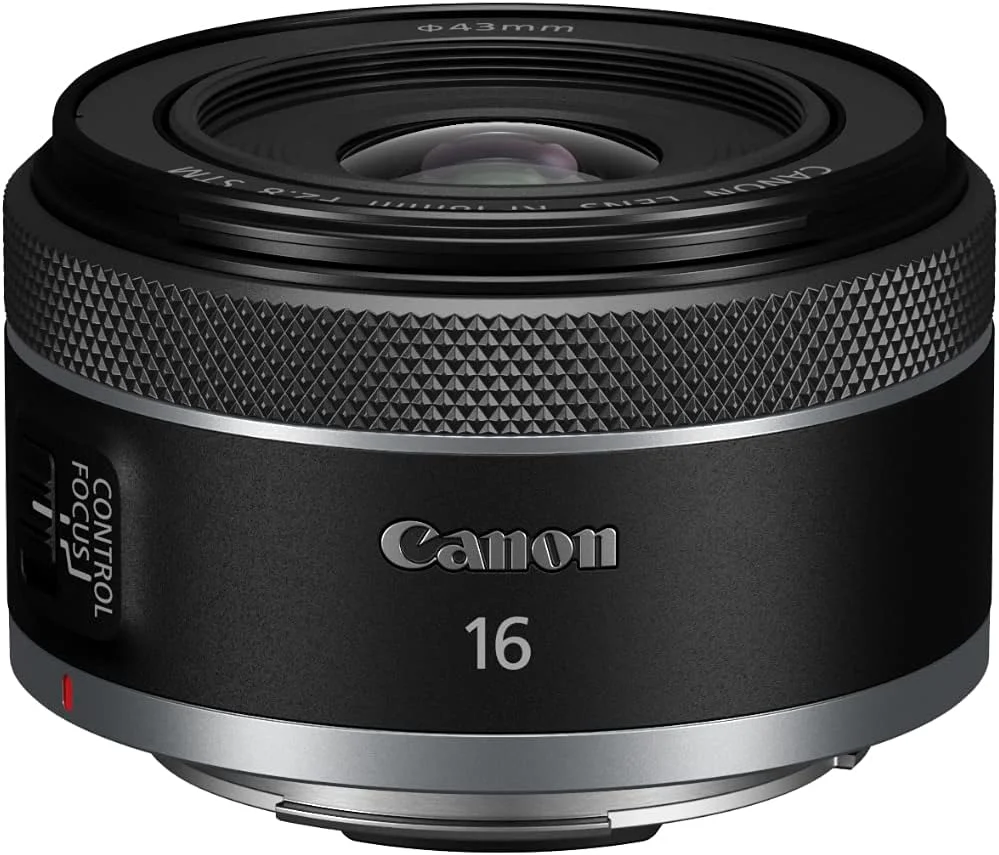
The RF 16mm f/2.8 is the lightest way to get ultra-wide on an RF body. Corner softness limits landscape work, but for vlogging, travel, and creative perspectives, the size-to-quality ratio is hard to beat.
This review is based on analysis of published owner reports, expert reviews, and comparison with products in the Canon RF Lenses category. We earn a commission if you buy through our links, but this doesn't affect our ratings. Read our full methodology →
Is the RF 16mm f/2.8 Worth Buying?
For vloggers, travel shooters, and anyone who values portability above all else, the RF 16mm f/2.8 earns a strong recommendation. The 165g weight and pancake profile mean it can live on the camera permanently without adding noticeable bulk. Stopped down to f/5.6 or f/8, optical quality is more than adequate for real estate listings, wide scenic shots, and environmental portraits with dramatic foreground-to-background depth.
Skip this lens if your primary work demands corner-to-corner sharpness wide open, or if you frequently shoot in rain or dusty environments without weather-sealed gear.
Scenic photographers who pixel-peep edges and architectural shooters who need absolute geometric precision are better served by the RF 14-35mm f/4L, despite its higher price and weight. If you are still deciding between this and a wider option, the Canon RF-S 10-18mm f/4.5-6.3 IS STM covers an even wider field of view on APS-C bodies. For everyone else — especially those building a compact travel kit or adding an ultra-wide perspective to a bag already anchored by a standard zoom — the RF 16mm f/2.8 delivers far more than its size and price suggest.
The RF 16mm f/2.8 is the lightest way to get ultra-wide on an RF body. Corner softness limits landscape work, but for vlogging, travel, and creative perspectives, the size-to-quality ratio is hard to beat.
Best for: Travel, vlogging, and real estate photography
Overview
At 165 grams and barely thicker than a body cap, this is the lens that makes you question why ultra-wide glass was ever heavy.
The Canon RF 16mm f/2.8 STM arrived in late 2021 as Canon's smallest RF-mount prime, and it immediately carved out a niche that no other Canon lens fills: an affordable, pocketable ultra-wide that mounts flush against the camera body. Vloggers, real estate shooters, and travel photographers adopted it fast. The price sits in budget-friendly territory — a fraction of Canon's L-series wide-angle options — and the optical design squeezes a 16mm rectilinear field of view from just 7 elements in 5 groups.
We read Amazon owner reviews, cross-referenced independent optical tests from LensRentals and Optical Limits, and compared the RF 16mm against the RF 15-30mm f/4.5-6.3 IS zoom, the Laowa 10mm f/2 Zero-D, and the premium RF 14-35mm f/4L IS USM. For context on how focal length, aperture, and motor type affect real-world shooting, see our guide to understanding lens specs. The pattern across user reports and lab measurements is consistent: strong center sharpness, weak corners wide open, and distortion that disappears with in-camera or software correction.
The RF 16mm f/2.8 is the lightest way to access an ultra-wide perspective on any RF-mount body, and it earns a spot on our best Canon RF lenses roundup for that reason. Its size-to-quality ratio stands apart from every other wide-angle option Canon sells. But the optical compromises at f/2.8 — soft corners, heavy barrel distortion before correction, no weather sealing — place real limits on what this lens can do without stopping down. Understanding where those limits sit is the difference between loving this lens and being frustrated by it.

Key Specifications
Design, Build, and Handling
The RF 16mm f/2.8 barely exists on the camera. Mounted to an R6 II, it extends less than 40mm from the lens mount — shorter than many body caps with integrated front-element protection. The polycarbonate construction keeps weight at 165g, making the camera-lens combination feel like a compact rather than an interchangeable-lens system. For walk-around shooting, that profile difference changes behavior: the camera goes in a jacket pocket or small sling bag instead of a padded camera bag.
Canon includes the same control ring found on the Canon RF 50mm f/1.8 STM and other budget RF primes. The ribbed ring sits ahead of the focus ring and can be assigned to aperture, ISO, exposure compensation, or white balance through the camera menu. Clicks are tactile and defined — useful for stills, potentially audible in quiet video recordings. There is no option to de-click the ring on this lens.
The 43mm filter thread is unusual. Most photographers own 52mm, 67mm, or 77mm filters, and finding quality options in 43mm requires more searching. Step-up rings work but add physical length to a lens whose selling point is compactness. Many RF 16mm owners skip filters entirely and use the included lens hood for front-element protection. The hood is small, bayonet-mount, and reverses for storage without adding noticeable bulk.
The plastic mount ring is the most common build complaint across user reviews. It works. It holds the lens securely. But the tactile impression when mounting and unmounting the lens feels budget-grade in a way that the optical quality does not. Canon saves cost and weight here — understandable given the price positioning — but photographers upgrading from L-series glass will notice the difference immediately. After several months of regular lens swaps, some users report slight play at the mount junction, though none of the reports we reviewed linked this to any optical or AF degradation.
The Close-Focus Advantage
Most ultra-wide lenses focus to 0.2m or 0.25m at best. The RF 16mm f/2.8 focuses to 0.13m — roughly 5 inches from the sensor plane, or about 2 inches from the front element. This unusually close minimum focus distance creates a shooting style unique to this lens: place a small subject inches from the glass, and the 16mm field of view captures both the subject in sharp detail and the full environment stretching behind it. The foreground-to-background scale difference is dramatic and impossible to replicate with longer focal lengths.
Real estate photographers use this for detail-in-context shots: a door handle with the hallway visible behind it, a countertop fixture with the full kitchen in frame. Vloggers hold small products close to the lens while their face and studio remain visible. Travel photographers building lightweight kits shoot food plates with the restaurant interior as backdrop. Maximum magnification at 0.26x is not macro-level, but it fills enough of the frame for social media and editorial use without switching to a dedicated close-up lens.
Video and Vlogging Performance
The RF 16mm f/2.8 found its largest user base among vloggers and content creators within months of its release — it consistently ranks among our top picks for video and YouTube lenses. The combination of ultra-wide coverage, autofocus, and minimal weight solves the self-filming problem: hold the camera at arm's length, and 16mm captures your face, upper body, and enough of the room behind you to establish context. On APS-C bodies, the 1.6x crop narrows the field to roughly 25.6mm equivalent — still usable for vlogging, though tighter framing requires a slightly longer arm or a small extension grip.
The STM motor produces smooth, gradual focus transitions between subjects at different distances. For talking-head content where you occasionally hold up a product or shift position, the AF tracks without the snap-and-lock behavior of USM motors. Focus breathing is minimal — shifting from 0.13m to infinity produces a slight field-of-view change, but not enough to distract in final footage. Audio pickup of the motor is faint; an external shotgun or lavalier mic eliminates it entirely.
The Size-vs-Sharpness Equation
The strengths concentrate around three areas: size, center sharpness, and close-focus capability. At 165g, nothing in Canon's RF lineup matches the size-to-coverage ratio. Center sharpness at f/2.8 is strong enough for vlogging and social media delivery without stopping down. And the 0.13m minimum focus distance opens creative possibilities that most ultra-wide lenses cannot match — close-up subjects with wide background context in a single frame.
The weaknesses trace directly to optical and build compromises. Corner softness at f/2.8 limits wide scenic and architectural work unless you stop down to f/5.6 or beyond. Barrel distortion is heavy in raw files, though automatic correction handles it invisibly for most workflows. No weather sealing restricts outdoor shooting in adverse conditions. And the plastic mount ring — while functional — communicates a build quality tier below what the optics deserve. These are known compromises at this price point, not design failures.
Strengths & Limitations
Strengths
- Extremely compact and lightweight at 165g
- Sharp center performance wide open
- Affordable entry into ultra-wide RF glass
- Smooth STM motor for video
Limitations
- Soft corners wide open, needs f/5.6+ for edge sharpness
- No weather sealing
- Plastic mount ring feels budget
- Visible barrel distortion requires correction
Performance
Center sharpness at f/2.8 is the optical highlight. On a 45-megapixel Canon R5, the central region delivers clean, well-resolved detail with good micro-contrast — strong enough for large prints where the subject occupies the middle of the frame. The 7-element optical design keeps things simple, and simplicity works: fewer glass surfaces mean less scatter, less ghosting, and better contrast under mixed lighting.
Corner performance is where the lens shows its budget DNA.
Wide open at f/2.8, the extreme corners on a full-frame sensor drop to roughly 55-60% of center resolution. This is visible in wide landscape compositions with fine detail extending to the edges — distant foliage, architectural lines, texture in stone or brick. The softness is not a defect; it is a design choice that allows the lens to be this small and this affordable. Stopping down to f/5.6 brings corners to approximately 80% of center sharpness. At f/8, edge-to-edge performance is clean enough for real estate listings and large prints up to 20x30 inches.
Barrel distortion is the most discussed optical characteristic in user reviews, and for good reason: uncorrected raw files show pronounced outward bowing of straight lines near the frame edges.
Vertical lines along walls, doorframes, and building edges curve visibly. Canon's in-camera JPEG and video processing corrects this automatically — the camera applies a distortion profile that straightens lines before the image is written to the card. Lightroom and Camera Raw apply the same profile on import. The correction costs roughly 5-8% of the total image area as a crop, narrowing the effective field of view slightly. For photographers who shoot raw and disable automatic correction, the distortion is a dealbreaker for architectural subjects.
Chromatic aberration appears as cyan-magenta fringing on high-contrast edges at f/2.8 — bright window frames against dark interiors, backlit tree branches, metal edges catching sunlight. The fringing is most visible in the outer third of the frame. Lens profile correction in Lightroom removes it with a single checkbox. By f/4, lateral CA drops to levels that are difficult to spot without zooming to 200% on screen.
Autofocus uses Canon's STM (Stepping Motor) design, the same motor class found in the RF 50mm f/1.8 and other budget RF primes. Focus speed from infinity to the 0.13m minimum distance takes roughly 0.4 seconds in good light — adequate for video, street, and general shooting. The motor is quiet enough for video recording with an external microphone, though the internal mic on most Canon bodies may pick up a faint whirr during focus pulls. In low light below -1 EV, the motor hunts briefly before locking — a consistent behavior pattern across STM lenses in the RF lineup.
Focus breathing is minimal. Shifting focus from minimum distance to infinity produces a slight field-of-view change, but it is less pronounced than many competing ultra-wide primes. For video shooters who rack focus between near and far subjects, the breathing is unlikely to be distracting in the final footage.
The 0.13m minimum focus distance deserves its own performance note because it changes what a 16mm lens can do.
At 5 inches from the sensor plane (roughly 2 inches from the front element), you can place a small subject — a flower, a piece of food, a hand holding an object — in sharp focus while the ultra-wide angle keeps the entire environment visible behind it. The resulting images have a dramatic, immersive quality: large foreground subject, deep contextual background, visible spatial relationship between the two. Maximum magnification reaches 0.26x, which is not macro territory but fills enough of the frame for detail-oriented creative work.
Flare resistance is adequate for a budget ultra-wide.
Shooting directly into a point light source — the sun, a bare bulb — produces ghosting artifacts (colored blobs opposite the light source in the frame). The included lens hood reduces flare from light sources outside the frame, but the hood is short due to the pancake design, limiting how much stray light it can block. When the sun sits just above or below the frame edge, veiling flare reduces overall contrast. This is manageable in post with a contrast curve adjustment, or by angling the camera slightly to move the light source further outside the frame.
Vignetting at f/2.8 darkens the corners by approximately 1.5 stops on a full-frame body. On APS-C bodies (R7, R10, R50), the crop eliminates corner darkening entirely since the sensor only uses the central portion of the image circle. Lens profile correction removes vignetting in post, and some photographers retain partial vignetting intentionally to draw attention toward the center of wide-angle compositions.
Value Analysis
The RF 16mm f/2.8 occupies a pricing position that makes it the cheapest ultra-wide option in Canon's native RF catalog. The next wider Canon option — the RF 14-35mm f/4L IS USM — costs roughly four to five times more and weighs 540g versus 165g. Between those two lenses, Canon offers the RF 15-30mm f/4.5-6.3 IS STM at a mid-range price point, but that zoom is slower (f/4.5-6.3 vs f/2.8) and heavier (390g vs 165g). For budget-conscious RF shooters who want ultra-wide coverage without the financial commitment of L-series glass, the RF 16mm f/2.8 is the only option in Canon's own lineup.
Measured against third-party alternatives, the value equation holds. The Laowa 10mm f/2 Zero-D offers a wider field of view and larger aperture, but it is manual-focus only — a dealbreaker for video shooters and anyone who relies on AF for moving subjects. The Samyang/Rokinon 14mm f/2.8 AF (available in RF mount via adapter) is larger, heavier, and priced similarly. Neither third-party option matches the RF 16mm's combination of autofocus, size, and Canon-native AF compatibility.
The cost-per-gram calculation is almost absurd. At a budget-friendly price and 165g, you get a lens that barely registers on a kitchen scale but adds an entire focal length category to your kit. For street photographers who prize compact, discreet lenses, and travel shooters who measure every gram in their bag, the RF 16mm f/2.8 is one of the highest-value additions available in any mount system.
Resale value on budget Canon primes tends to be strong. The RF 16mm sells quickly on the used market because demand from vloggers and travel shooters is consistent. If the ultra-wide perspective does not match your shooting style, recovering most of the purchase price is realistic within weeks of listing.
What to Expect Over Time
The plastic body and mount ring raise the durability question that follows every budget lens. After 12 to 18 months of regular use, the most common user reports mention two issues: a faint loosening of the mount fit (the lens develops subtle play on the body, noticeable during quick lens swaps) and dust particles visible on the rear element from the unsealed mount junction. Neither issue has been linked to optical degradation or AF problems in any user report we reviewed, but both affect the tactile experience of handling the lens over time.
The front element sits recessed inside the barrel, which provides some natural protection against accidental contact and scratches. The included petal hood adds another layer. Long-term, the multi-coating on the front element holds up well to regular cleaning with microfiber cloth. Users who skip the hood and carry the lens in a pocket without a cap report minor scuffing on the barrel finish — cosmetic, not functional, but worth noting for resale value.
Canon's firmware update history for budget primes is thin. Do not expect AF algorithm improvements or new feature additions — Canon directs firmware engineering resources toward L-series lenses and camera bodies. The RF 16mm f/2.8 will perform identically in five years to how it performs today. Any AF improvements for this focal length will come from camera body firmware updates and new body hardware, not from the lens itself.
For photographers who outgrow the optical limitations — corner softness, no weather sealing, no IS — our first lens upgrade guide maps the decision. The upgrade path leads to the RF 14-35mm f/4L IS USM. That lens covers a wider focal range (14-35mm), includes image stabilization, adds weather sealing, and delivers sharper corners. The price gap is substantial, and the weight triples. The RF 16mm f/2.8 and RF 14-35mm f/4L serve different philosophies: one prioritizes portability above optical perfection, the other prioritizes optical quality above everything else.
Accessories for this lens are limited by the 43mm filter size. Step-up rings to 52mm or 67mm expand filter options but add length and weight to a lens designed around compactness. Most RF 16mm owners report running the lens without filters, relying on the hood and the recessed front element for protection. A 43mm clear/UV filter from B+W or Hoya adds negligible weight and protects the front element for shooters working near sand, water, or construction dust.
One practical upgrade worth considering: pairing the RF 16mm f/2.8 with a Canon body that has in-body image stabilization. On the R6 II or R8, IBIS compensates for camera shake during handheld video and slow-shutter stills. The combination turns a simple wide prime into a stabilized video tool that punches above its weight class — at a total system weight well under 700g.
RF 16mm f/2.8 — Common Questions
Answers based on Amazon owner reviews, independent optical tests, and cross-system comparisons for the Canon RF 16mm f/2.8 STM.
Is the Canon RF 16mm f/2.8 good for vlogging?
Yes — and it is one of the best options in the RF system for this purpose. At 16mm on a full-frame body, the field of view is wide enough to capture your face and background at arm's length without a selfie stick. On APS-C RF-mount bodies like the Canon R7, the crop brings it to roughly 25.6mm equivalent, which still works for vlogging but frames tighter. The STM motor handles smooth focus transitions during recording, and at 165g the lens adds almost no weight to a handheld rig. The main limitation is the lack of optical stabilization — pair it with a body that has IBIS (R6 II, R8) or use a gimbal for walk-and-talk footage.
How bad is the barrel distortion on the RF 16mm f/2.8?
Raw files show heavy barrel distortion — straight lines near the frame edges bow outward visibly. In practice, most shooters never see it. Canon's in-camera processing corrects distortion automatically for JPEGs and video, and Lightroom/Camera Raw apply the lens profile by default when importing RAF files. The correction crops roughly 5-8% of the image area, which is why the effective field of view is slightly narrower than a theoretical 16mm rectilinear design. If you shoot with distortion correction disabled intentionally, expect pronounced bowing on architectural subjects.
Can the RF 16mm f/2.8 be used for real estate photography?
It works well for small to mid-sized rooms where 16mm provides enough coverage to capture most of a room in a single frame. The automatic distortion correction keeps walls straight. For professional real estate work, the main compromise is corner softness — walls and furniture near the frame edges lose detail at f/2.8, so stopping down to f/5.6 or f/8 is necessary for edge-to-edge sharpness. At those apertures, the lens delivers clean, corrected images suitable for MLS listings. Larger rooms or properties requiring wider coverage may need a 10-12mm lens.
Does the RF 16mm f/2.8 have weather sealing?
No. There are no gaskets at the mount, focus ring, or control ring. The lens is not designed for rain, heavy dust, or salt spray. Canon reserves weather sealing for L-series glass. For outdoor shooting in unpredictable conditions, a rain sleeve or plastic bag provides basic protection. The small 43mm filter thread means UV or clear protective filters are inexpensive and add minimal weight — worth considering if you shoot near water or in dusty environments.
What filters work with the Canon RF 16mm f/2.8?
The lens uses a 43mm filter thread, which is uncommon in most lens lineups. Finding quality ND, CPL, or UV filters in 43mm is possible but selection is limited compared to standard sizes like 52mm or 67mm. A step-up ring to a larger diameter (52mm or 67mm) gives access to a wider range of filter options, though it adds bulk and can cause vignetting if the filter stack is too thick. For outdoor shooters wanting polarizers or ND grads, a step-up ring to 67mm paired with slim-profile filters avoids corner darkening.
How does the RF 16mm f/2.8 compare to the RF 15-30mm f/4.5-6.3 IS?
The two lenses serve overlapping but different roles. The RF 15-30mm zoom covers a wider range of focal lengths (15-30mm vs fixed 16mm) and includes optical image stabilization — a clear advantage for handheld shooting and video. The RF 16mm f/2.8 wins on aperture (f/2.8 vs f/4.5-6.3, roughly 2-3 stops faster), size (165g vs 390g), and low-light performance. For travel and vlogging where weight matters and you shoot in dim conditions, the prime is the better choice. For scenic and real estate work where you want focal length flexibility and IS, the zoom pulls ahead.
Is the 0.13m minimum focus distance useful?
Very. At 0.13m (about 5 inches) from the sensor plane, you can get extremely close to small subjects while the 16mm ultra-wide angle keeps the background visible and in context. This creates a dramatic close-up-with-environment effect that longer lenses cannot replicate. Food photography, tabletop details, flowers with background scenery, and creative forced-perspective shots all benefit. Maximum magnification reaches 0.26x — not true macro territory, but close enough for engaging detail work without a dedicated macro lens.
Is the Canon RF 16mm f/2.8 good for astrophotography?
It works for casual night-sky shooting but falls short of dedicated astro lenses. The f/2.8 aperture collects enough light for Milky Way shots with 20-25 second exposures on a full-frame body, and the 16mm focal length covers a wide swath of sky. Corner sharpness is the main limitation — stars near the frame edges stretch into soft blobs at f/2.8 due to coma and field curvature. Stopping down to f/4 improves star shapes but requires longer exposures or higher ISO, introducing more noise. Dedicated astro lenses like the Samyang 14mm f/2.8 or Sigma 14mm f/1.8 Art deliver cleaner star points across the frame, though at three to five times the weight and price.
Does the RF 16mm f/2.8 work on Canon APS-C bodies like the R7 and R10?
Yes, it mounts and functions on every Canon RF-mount body, including APS-C models like the R7, R10, and R50. The 1.6x crop factor narrows the effective field of view to roughly 25.6mm equivalent — still moderately wide but noticeably tighter than the full 16mm perspective on a full-frame sensor. For vlogging on APS-C, the tighter framing means you need a slightly longer arm or a small grip extension to keep your face and background in frame. One benefit of APS-C pairing is that vignetting and corner softness disappear entirely, since the sensor only uses the sharpest central portion of the image circle.
What is the best Canon RF body to pair with the RF 16mm f/2.8?
The Canon R8 and R6 II stand out as the strongest pairings. Both offer in-body image stabilization, which compensates for the lens lacking optical IS — a major advantage for handheld video and slow-shutter stills. The R8 keeps the total system weight under 600g while delivering full-frame image quality and excellent autofocus. The R6 II adds faster burst shooting and more robust build quality. Budget-conscious shooters can pair it with the EOS RP for an ultra-compact full-frame setup, though the RP lacks IBIS, limiting low-light handheld performance.
How does the RF 16mm f/2.8 handle flare and ghosting in backlit scenes?
Flare resistance is adequate for a budget ultra-wide but not exceptional. Shooting directly into a strong point light source — the sun at golden hour, a bare streetlight — produces visible ghosting artifacts that appear as colored blobs scattered opposite the light source in the frame. Veiling flare also reduces overall contrast when the light source sits just outside the frame edge. The included petal lens hood blocks some stray light, but its short profile limits effectiveness due to the pancake design. Repositioning the camera slightly to shift the light source further from the frame edge is the most effective countermeasure. In post-processing, a contrast curve adjustment recovers most of the lost punch.