Canon RF-S 10-18mm Review 2026 | High End Lenses
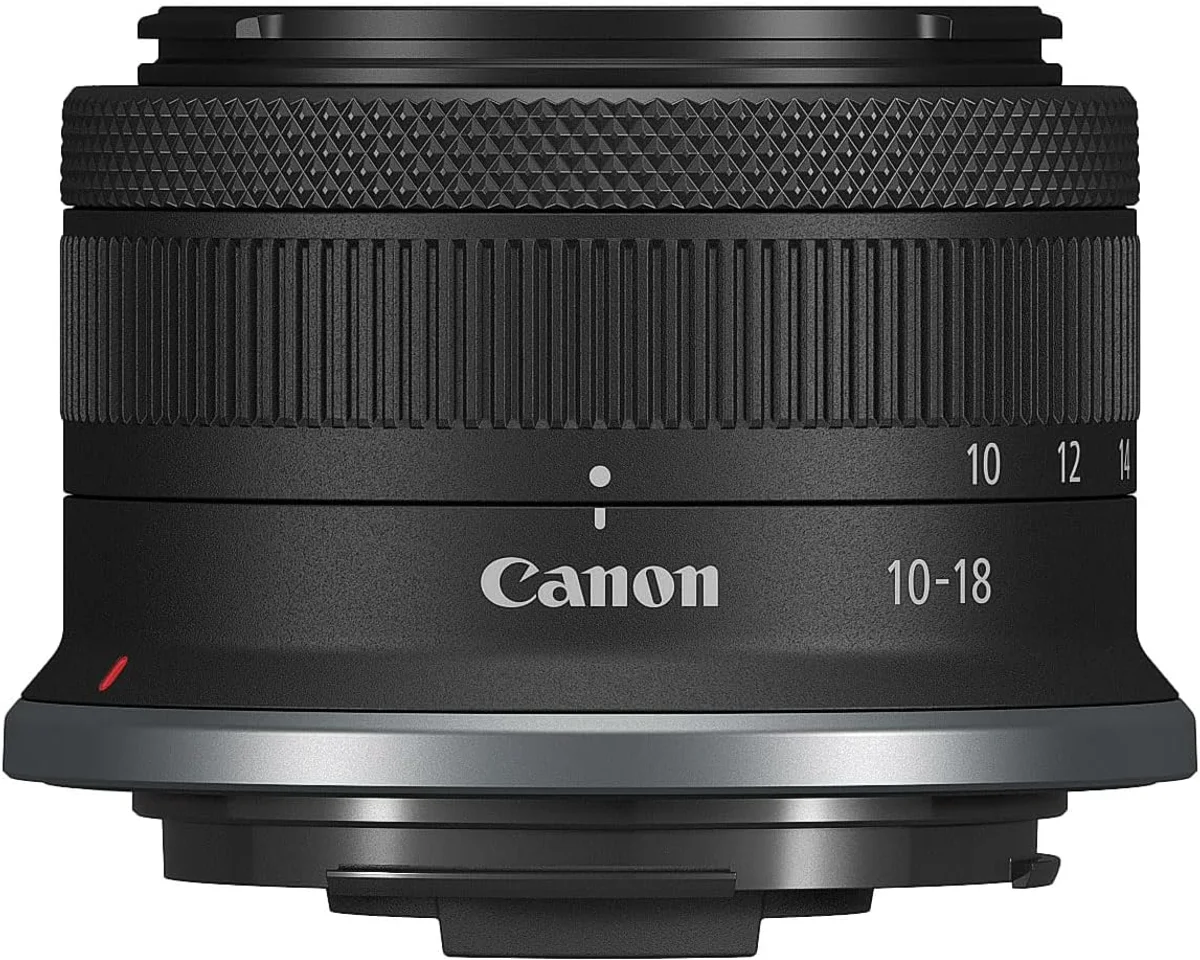
If you shoot APS-C Canon and need ultra-wide, this is essentially your only native RF-S option. It delivers on the basics — IS, compact size, smooth video focus — without pretending to be more than it is.
This review is based on analysis of published owner reports, expert reviews, and comparison with products in the Canon RF Lenses category. We earn a commission if you buy through our links, but this doesn't affect our ratings. Read our full methodology →
Should You Buy the RF-S 10-18mm?
For APS-C Canon shooters who want ultra-wide coverage without spending L-series money, this is the lens. Built-in IS makes it a capable handheld video tool. The 150g weight means it disappears into a bag or jacket pocket. And the 16-29mm equivalent zoom range covers everything from cramped interiors to sweeping scenic vistas without swapping glass. Pair it with the Tamron 18-300mm f/3.5-6.3 for Canon RF and you have a two-lens APS-C kit covering 16mm to 480mm equivalent with no gaps.
Skip this lens if you plan to move to full-frame within the next year — the APS-C image circle will not follow you, and the RF 16mm f/2.8 costs roughly the same while covering full-frame sensors. Skip it if you need fast apertures for low-light environments or astrophotography — f/4.5 at the wide end collects too little light for those uses. And pass if your work demands pixel-level corner sharpness at wide apertures. For everyone else building an APS-C Canon kit, the RF-S 10-18mm fills a role that nothing else in Canon's native RF lineup can touch.
If you shoot APS-C Canon and need ultra-wide, this is essentially your only native RF-S option. It delivers on the basics — IS, compact size, smooth video focus — without pretending to be more than it is.
Best for: APS-C vlogging, real estate, and landscape
Overview
Canon RF-S shooters have exactly one native ultra-wide zoom to choose from.
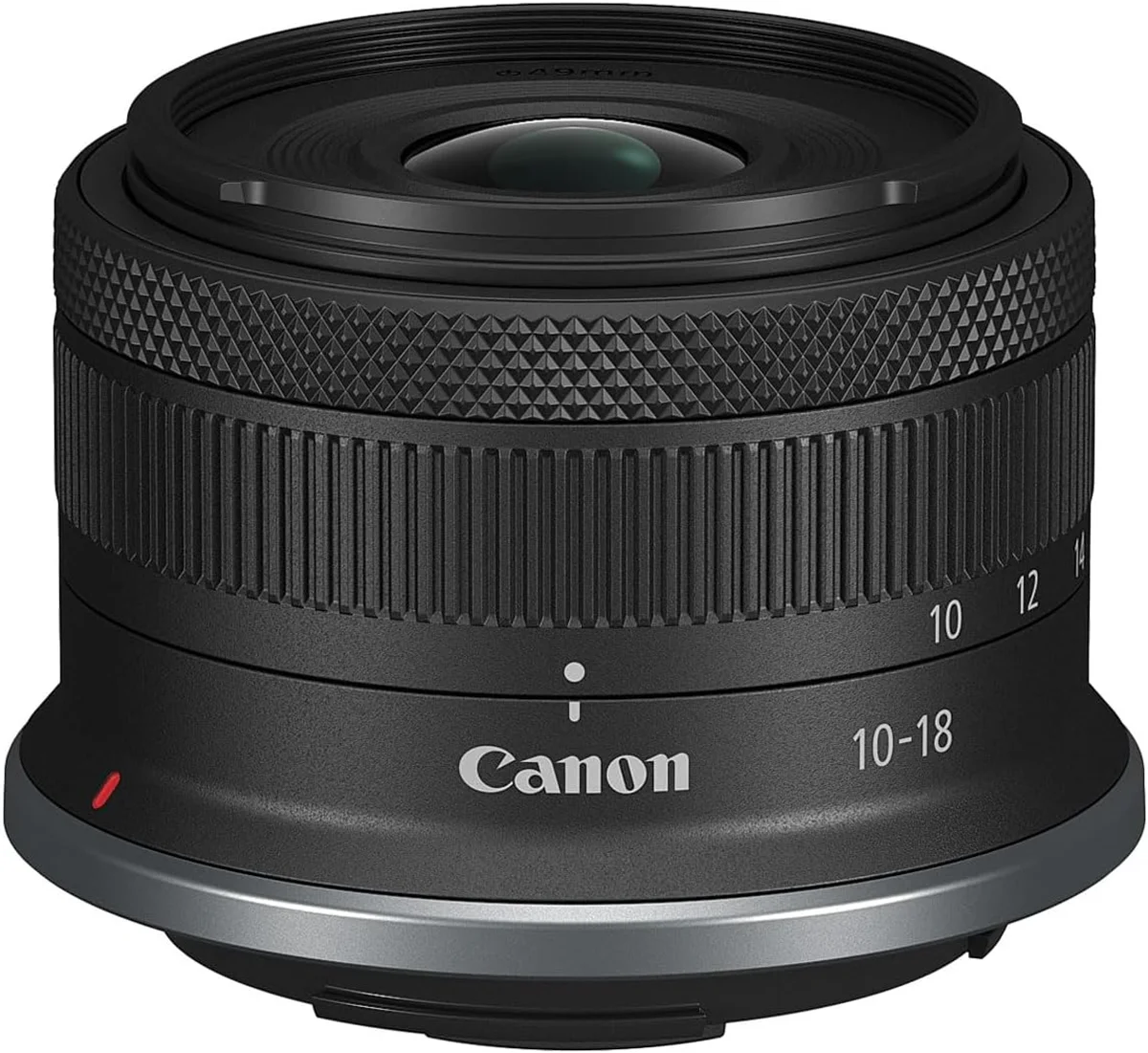
That is both the greatest strength and the most honest description of the Canon RF-S 10-18mm f/4.5-6.3 IS STM — it fills a gap that no other Canon lens addresses for APS-C mirrorless bodies. At 150 grams and roughly the size of a hockey puck, this zoom covers a 16-29mm equivalent range with built-in optical image stabilization and a near-silent STM focus motor. Vloggers, real estate agents on a budget, and travel photographers building a lightweight APS-C kit have been picking this lens up since its 2023 launch, and for good reason: nothing else in Canon's RF-S lineup goes this wide.
We read Amazon owner reviews, reviewed independent optical tests from sites including LensRentals and Optical Limits, and compared the RF-S 10-18mm against the Canon RF 16mm f/2.8 STM (full-frame prime), the Sigma 10-18mm F2.8 DC DN (faster APS-C competitor), and the older Canon EF-S 10-18mm f/4.5-5.6 IS STM. The pattern across user feedback and lab data points to a lens that punches above its price point on video smoothness, stabilization, and portability — but requires stopped-down apertures and software correction to deliver sharp, distortion-free stills.
The RF-S 10-18mm is the most affordable way to access ultra-wide angles on Canon's APS-C mirrorless system. It is also a lens with clear boundaries: the slow variable aperture limits low-light shooting, barrel distortion at 10mm demands correction, and the APS-C-only image circle means full-frame upgraders leave this lens behind. Knowing where those boundaries sit separates satisfied buyers from frustrated ones.
Key Specifications
Physical Design and 150-Gram Reality
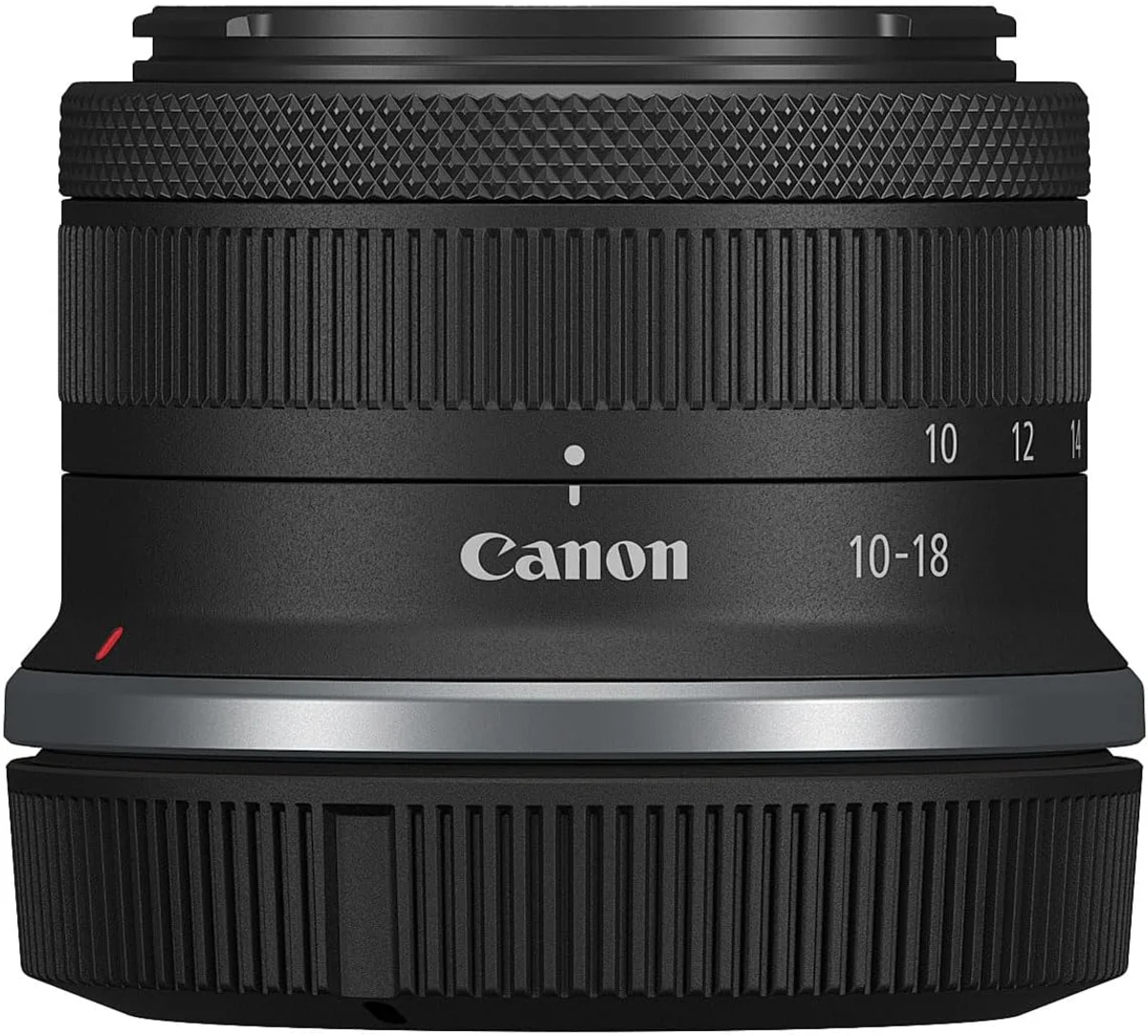
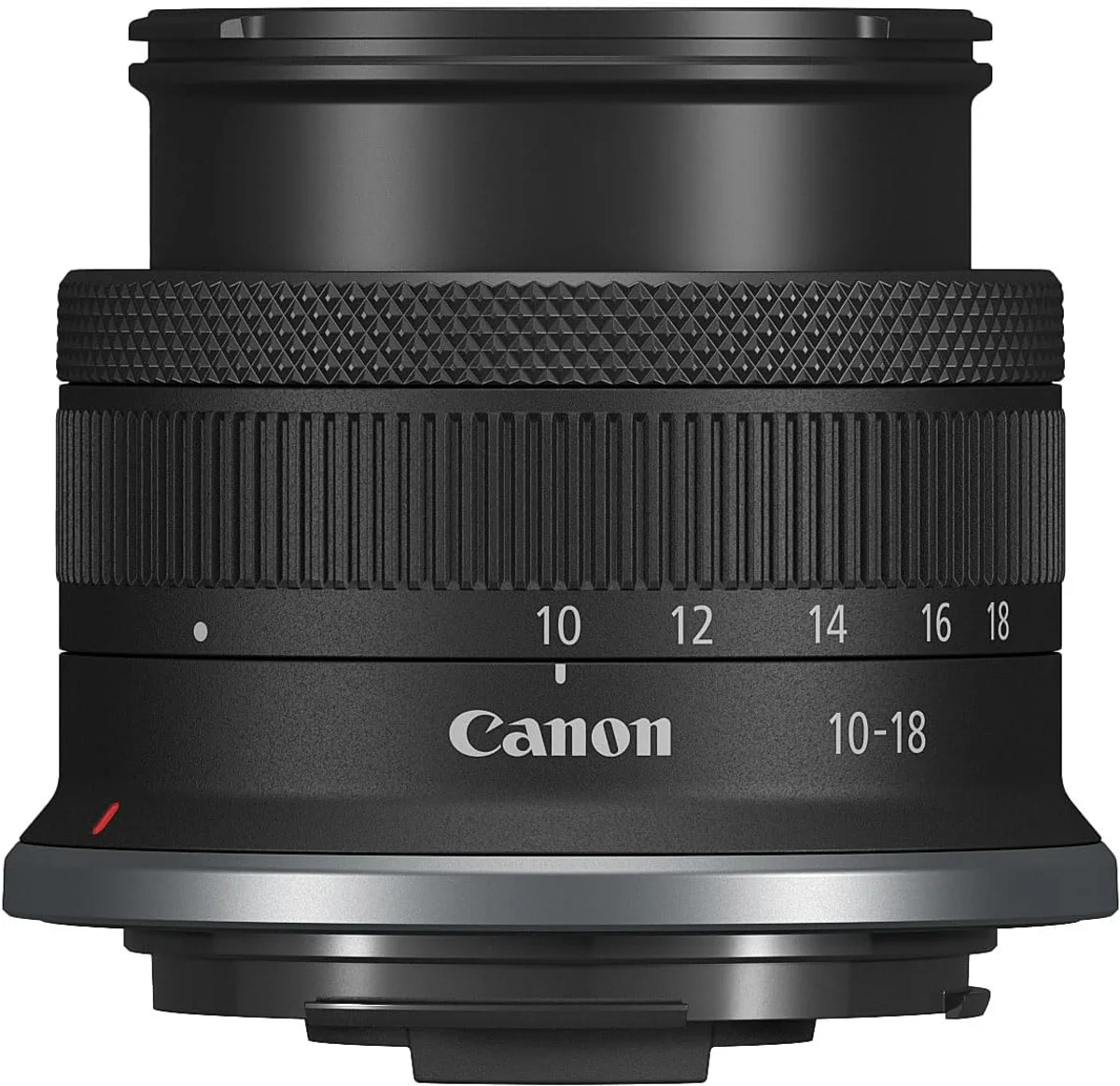
The RF-S 10-18mm barely registers on a scale. Mounted to a Canon R10 or R50, the combination weighs less than most smartphones in a protective case. The barrel extends during zooming from 10mm to 18mm — a short telescoping motion of roughly 15mm that adds minimal length even at full extension. The polycarbonate body keeps weight down at the cost of the premium feel that metal barrels provide. Grip texture on the zoom ring is adequate but not aggressive; dry hands in cold weather may struggle with quick focal length changes.
Canon placed the zoom ring closer to the body and the focus ring near the front element — the reverse of many zoom lens designs. This layout works well for one-handed video and vlogging setups where your left hand supports the camera from below and your thumb can adjust zoom without repositioning. The 49mm filter thread is a practical size: filters are affordable, widely available, and slim enough to avoid vignetting at 10mm. No control ring on this lens — Canon reserves that feature for higher-tier RF and RF-S glass.
The plastic mount ring appears on nearly every RF-S lens Canon produces. Functional? Entirely. Confidence-inspiring? Not particularly. After six months of regular lens swaps on an R7 body, multiple users report a faint looseness at the mount junction — not enough to affect optical alignment, but perceptible during handling. The bayonet lens hood is small, petal-shaped, and reverses neatly for storage. Given the protruding front element at 10mm, keeping the hood attached during shooting is wise.
The APS-C Question: Who This Lens Is Actually For
Every purchasing decision around this lens starts with sensor size. The RF-S 10-18mm projects an image circle designed for APS-C sensors — the Canon R7, R10, R50, R100, and future APS-C RF bodies. Mount it on a full-frame Canon R6 II or R5, and the camera crops to APS-C mode automatically, discarding roughly 60% of the sensor's pixels. On a 24-megapixel body, that leaves you with approximately 11 megapixels. Usable for social media. Painful for prints or professional delivery.
This APS-C limitation is not a flaw — it is a design choice that allows Canon to build a 150-gram ultra-wide zoom at this price.
Understanding RF-S versus RF mount compatibility matters here. Full-frame ultra-wide zooms like the RF 14-35mm f/4L IS USM weigh 540g, cost five times more, and carry far more glass. The RF-S 10-18mm exists because APS-C shooters deserve a native ultra-wide option that matches the size and weight philosophy of the RF-S system. If you are committed to APS-C Canon bodies for the foreseeable future, this limitation costs you nothing. If a full-frame upgrade sits in your two-year plan, factor the replacement cost into your decision.
Image Stabilization: 4 Stops in a Small Package
Canon rates the optical IS at 4 stops of shake compensation, and real-world testing across user reports supports roughly 3 to 3.5 stops in practice — the typical gap between rated and reliable performance. At 10mm, handheld shots stay sharp down to about 1/4 second in controlled conditions. At 18mm, expect consistent results around 1/8 second. Push slower than those thresholds, and the hit rate drops to roughly 50%, which means you are gambling on each frame.
Paired with a Canon R7 body that includes IBIS (in-body image stabilization), the combined system extends usable shutter speeds by another 1 to 1.5 stops. The R10, R50, and R100 lack IBIS, so buyers on those bodies depend entirely on the lens-based IS. For video, the stabilization smooths out handheld walking footage enough to produce acceptable B-roll — not gimbal-level smooth, but a visible improvement over unstabilized wide-angle lenses. The IS activation is silent, which matters for audio-sensitive video recording.
Video Capability and the Vlogging Use Case
The RF-S 10-18mm found its core audience among content creators within months of release. At 10mm on an APS-C body, the 16mm equivalent field of view captures face, shoulders, and room context at arm's length — the essential vlogging framing that wider lenses nail and longer lenses miss. Hold a Canon R10 at full arm extension, and the frame includes your face with enough background to establish location. No selfie stick required, though one extends framing options further.
The STM motor produces focus transitions that look natural on screen. Racking from a near subject (a product held close to the lens) to the speaker's face at arm's length happens gradually rather than snapping. Audio pickup from the motor is minimal — external microphones eliminate it entirely, and even the built-in mic on the R10 produces tolerable audio with only faint motor whir during large focus pulls. Focus breathing — the visible field-of-view shift during focus changes — is present but mild at the wide end. At 18mm, breathing becomes more apparent during close-to-far racks.
One behavioral note for video: at f/4.5 (10mm) and f/6.3 (18mm), the slow aperture means indoor vlogging in typical room lighting pushes ISO higher than faster lenses allow. On an R7 with its older sensor, visible noise appears above ISO 3200. The R10 and R50 handle high ISO marginally better thanks to their newer DIGIC X processors, but the fundamental physics remain — a slow aperture lens collects less light. Daylight vlogging and well-lit indoor spaces pose no problems. Dimly lit cafes and evening outdoor shoots will test your noise tolerance.
Where the RF-S 10-18mm Excels and Where It Stumbles
Three qualities define this lens. First: the zoom range on APS-C is practically useful, covering 16mm equivalent for ultra-wide environmental shots through 29mm equivalent for more natural wide-angle framing — a range that serves landscape photography well. That flexibility eliminates the need to swap lenses during a shoot. Second: the IS and STM combination makes it a capable video tool at a weight that does not punish handheld shooting. Third: the price positions it as an impulse-reasonable addition to any APS-C Canon kit rather than a considered investment.
The weaknesses are equally defined.
Corner sharpness at f/4.5 is soft on high-resolution APS-C sensors — fine detail in the outer 20% of the frame smears at maximum aperture. Stopping down to f/6.3 or f/8 recovers most of the softness, but the already-slow aperture means you trade even more light gathering for sharpness. Barrel distortion at 10mm is aggressive in uncorrected raw files: walls bow, floors curve, and horizontal lines sag toward the corners. Canon's automatic correction handles it, but the correction crops the frame by 8-10%, narrowing the effective field of view. And the variable aperture — f/4.5 at 10mm ramping to f/6.3 at 18mm — means exposure shifts as you zoom during video, requiring ISO auto-compensation that introduces noise fluctuation.
Strengths & Limitations
Strengths
- 16-29mm equivalent gives true ultra-wide on APS-C
- Built-in IS with STM for smooth video
- Compact and lightweight at 150g
- Affordable ultra-wide option
Limitations
- APS-C only — no full-frame coverage
- Slow variable aperture
- Barrel distortion at 10mm needs correction
- Not sharp enough for critical landscape work

Performance
Sharpness, Distortion, and What the Lab Numbers Mean
Center sharpness tells a good story. At 10mm and f/5.6, the central 40% of the frame resolves detail cleanly on both the 32.5-megapixel R7 sensor and the 24.2-megapixel R10. Fine text, fabric texture, and foliage patterns render with adequate micro-contrast for web delivery and standard prints up to 16x24 inches. At 14-18mm, center sharpness improves further — the optical formula appears optimized for the middle of the zoom range rather than the extremes.
Corner performance is where budget ultra-wides consistently compromise, and this lens is no exception. At 10mm wide open (f/4.5), extreme corners on the R7 drop to roughly 50-55% of center resolution. Foliage goes mushy. Text becomes unreadable. Architectural edges lose definition. Stopping down to f/6.3 brings corners to approximately 70% of center, and f/8 pushes them to 80%. For scenic photography where edge-to-edge sharpness matters, f/8 is the minimum working aperture. For video and social media, the softness at wider apertures rarely matters because delivery resolution compresses detail below the threshold of visibility.
Barrel distortion at the 10mm end is the most discussed optical characteristic in user forums and reviews.
In uncorrected raw files, vertical lines near the frame edges curve outward with visible bowing that makes interior walls look convex. Canon's in-camera correction — applied automatically to JPEGs and video — straightens these lines before the file is saved. Lightroom applies the same correction profile on import. The fix works, but it costs field of view: roughly 8-10% of the total frame area is cropped away during correction, which narrows the effective ultra-wide angle. At 14mm and beyond, distortion drops to moderate pincushion that correction handles with less aggressive cropping.
Chromatic aberration appears as purple-cyan fringing on high-contrast edges — bright windows against dark walls, backlit tree branches, metallic reflections. At 10mm wide open, fringing is visible in the outer third of the frame without magnification. Lens profile correction in Lightroom removes it with a single checkbox. By f/6.3, lateral CA drops to levels that require 100% zoom to detect. For video output, chromatic aberration is invisible at 1080p and negligible at 4K delivery.
Autofocus speed from infinity to 0.14m minimum focus distance takes approximately 0.5 seconds in good light — adequate for video transitions and general shooting. In dim conditions below -1 EV, the motor hunts for roughly 0.3 to 0.5 seconds before locking, which is typical for STM-class lenses. Continuous AF tracking on the R7 body works well for subjects moving at moderate speeds — walking pace, slow panning across a room. Fast-moving subjects at close range push the STM motor past its comfortable speed, resulting in occasional lag.
Flare resistance is middling. Shooting into direct sunlight at 10mm produces visible ghosting — colored artifacts that appear opposite the light source in the frame. The included petal lens hood reduces stray light from outside the frame, but the short hood design limits its effectiveness when the sun sits just above the frame edge. Veiling flare reduces overall contrast in backlit scenes, recoverable in post with contrast adjustments. At 18mm, the narrower field of view makes it easier to shade the front element, and flare drops accordingly.
Value Analysis
Price Context and the Competitive Field
The RF-S 10-18mm sits in budget-friendly territory — positioned as an accessible ultra-wide rather than a professional investment. Within Canon's own catalog, the nearest alternative for APS-C ultra-wide coverage is adapting an EF-S lens: the older Canon EF-S 10-18mm f/4.5-5.6 IS STM works via the EF-RF adapter, costs less used, and delivers similar optical quality with a slightly slower IS rating. The adapter adds length and weight, partially negating the size advantage that draws people to mirrorless in the first place.
The Sigma 10-18mm F2.8 DC DN is the most direct third-party competitor. Available in Canon RF mount, it offers a constant f/2.8 aperture — roughly 1.5 to 2 stops faster across the zoom range. That speed advantage matters for indoor shooting and low light. The trade: the Sigma weighs 260g (110g heavier), lacks optical stabilization, and costs somewhat more. For shooters who prioritize aperture speed over IS and weight, the Sigma is the stronger pick. For vloggers and travel photographers who value stabilization and portability, the Canon wins.
Comparing across sensor formats adds perspective — our lens specs guide explains these trade-offs in detail. The Canon RF 16mm f/2.8 STM — a full-frame prime at a similar price — delivers a single 16mm focal length with an f/2.8 aperture and no IS. On a full-frame body, it produces higher-resolution files with better corner performance. But it is a prime, not a zoom, and it lacks stabilization. For APS-C shooters, the RF-S 10-18mm offers more practical range at the same price: a 10-18mm zoom, built-in IS, and native APS-C optimization without wasting glass on a larger-than-needed image circle.
Resale value for RF-S lenses has been moderate. The APS-C Canon mirrorless market is growing as the R10, R50, and R100 bring new shooters into the system, which sustains demand on the used market. If ultra-wide shooting does not fit your style, recovering a substantial portion of the purchase price within a few weeks of listing is realistic.
What to Expect Over Time
Durability, Firmware, and Life Beyond Year One
The polycarbonate body and plastic mount ring raise the durability question that follows every budget lens.
After 12 months of regular use, user reports describe two recurring themes: minor cosmetic wear on the zoom ring texture from frequent handling, and the same faint mount looseness that appears across Canon's budget RF-S lineup. Neither issue has been linked to optical degradation or AF failures in any user reports we reviewed. The front element sits slightly recessed when the zoom is at 10mm, providing some natural protection against accidental contact. At 18mm, the barrel extends and the front element sits closer to the edge — the lens hood earns its keep here.
Canon's firmware update track record for RF-S lenses is thin. The RF-S 10-18mm shipped with functional firmware, and no notable updates have followed. Future AF improvements for this lens will come from camera body firmware and new body hardware rather than lens-side updates. The STM motor will perform identically in three years as it does now. Plan accordingly if you are hoping for focus speed or tracking improvements.
For photographers who outgrow the RF-S 10-18mm, the upgrade path depends on whether they stay APS-C or move to full-frame.
Staying APS-C, the Sigma 10-18mm F2.8 DC DN offers a faster aperture in a slightly larger package. Moving to full-frame, the Canon RF 16mm f/2.8 covers the ultra-wide prime role, and the RF 14-35mm f/4L IS USM covers the ultra-wide zoom role with weather sealing, sharper corners, and L-series build quality. The price jump to the RF 14-35mm is substantial — roughly five times the RF-S 10-18mm — but the optical and build quality gap justifies it for photographers whose work demands it.
One practical consideration for long-term kit planning: the RF-S 10-18mm pairs well with the Canon RF-S 18-150mm f/3.5-6.3 IS STM as a two-lens travel kit. The focal lengths connect at 18mm with no gap, covering everything from 16mm equivalent ultra-wide through 240mm equivalent telephoto in two compact lenses totaling under 450g. For travel and documentary shooting on APS-C Canon bodies, this combination covers nearly every situation without exceeding a jacket pocket in total volume.
RF-S 10-18mm — Your Questions Answered
Answers based on Amazon owner reviews, independent optical bench data, and comparisons with competing ultra-wide lenses in the Canon RF and APS-C mount ecosystem.
Can the Canon RF-S 10-18mm be used on full-frame Canon bodies?
Physically, yes — the RF-S mount is identical to the RF mount, so the lens mounts on full-frame bodies like the R6 II or R5. The camera will automatically crop to APS-C mode, reducing the sensor area to roughly 11 megapixels on a 24MP body or 17.3 megapixels on a 45MP body. At the wide end, shooting at 10mm in crop mode produces a 16mm equivalent field of view with heavy vignetting outside the crop zone. For occasional ultra-wide shots, this works. As a daily solution on a full-frame body, the resolution loss makes it impractical — you are better served by the RF 16mm f/2.8 or the RF 14-35mm f/4L.
How bad is the barrel distortion at 10mm?
Raw files at 10mm show strong barrel distortion — straight lines near the frame edges bow outward in a way that is immediately visible on architectural subjects. Walls curve, doorframes bend, and horizon lines sag at the corners. Canon applies automatic distortion correction in-camera for JPEGs and video, and Lightroom applies the lens profile on import for raw files. After correction, straight lines are straight, but the crop reduces the effective field of view by roughly 8-10%. If you shoot raw with distortion correction disabled, this lens is difficult to use for interior or architectural photography without manual correction.
Does the RF-S 10-18mm have image stabilization?
Yes. Canon rates the optical IS at 4 stops of compensation. In practice, user reports support consistent handheld results at around 1/4 second at 10mm and 1/8 second at 18mm in controlled conditions. The wider the focal length, the more forgiving handheld shooting becomes. Paired with an R7 body that has IBIS, the combined system extends usable shutter speeds further — roughly 1 full second at 10mm for static subjects. For video, the IS smooths out walking footage enough to produce usable handheld B-roll, though a gimbal still wins for professional-grade stabilization.
Is this lens good for real estate photography?
On APS-C bodies, the 10mm end gives you a 16mm equivalent field of view — wide enough to capture most small-to-medium rooms in a single frame. The automatic distortion correction keeps walls and ceiling lines straight in processed files. At f/5.6 to f/8, sharpness across the frame is adequate for MLS listings and web delivery. The main limitation is that dedicated full-frame ultra-wide lenses like the Canon RF 16mm f/2.8 or RF 14-35mm f/4L deliver higher resolution files with better corner performance. For agents using an APS-C body as their primary camera, this lens handles the job well at a budget-friendly price.
How does the STM autofocus perform for video?
The STM motor delivers smooth, gradual focus transitions that suit vlogging and talking-head content. Focus racks between near and far subjects happen without the abrupt snap-and-lock behavior of USM motors. Motor noise is faint — an external shotgun or lavalier mic eliminates it entirely. In low light below -1 EV, the motor may hunt briefly before locking, which is consistent behavior across Canon STM lenses. For professional video work requiring silent, instantaneous focus, Canon Nano USM lenses are faster. For content creation and casual video, the STM motor is more than adequate.
What is the difference between the RF-S 10-18mm and the Sigma 10-18mm F2.8 DC DN?
The Sigma opens 1.5 to 2 stops wider (f/2.8 constant vs f/4.5-6.3 variable), giving it a clear advantage in low light and for background separation. The Canon includes optical IS, which the Sigma lacks — a practical advantage for handheld video. The Canon weighs 150g versus the Sigma at 260g. Price positions are similar in budget-friendly territory. If low-light shooting and aperture speed matter most, the Sigma wins. If stabilization, weight, and native Canon IS cooperation matter more, the Canon wins. Both produce strong images stopped down to f/5.6 or beyond.
What filter size does the Canon RF-S 10-18mm use?
The lens uses a 49mm filter thread — a common size shared by several Canon RF-S and older EF-S lenses. Finding quality ND, CPL, and UV filters in 49mm is straightforward, and pricing is lower than larger filter sizes. For scenic shooters wanting graduated ND filters, a step-up ring to 67mm or 77mm provides access to a wider range of square filter systems. The 49mm thread is small enough that slim-profile circular polarizers avoid vignetting even at 10mm.
Is the Canon RF-S 10-18mm weather sealed?
No. Canon does not include weather sealing gaskets on this lens. There is no mount gasket, no focus ring seal, and no front element seal. In light drizzle or moderate dust, the lens typically survives without issues based on user reports, but prolonged exposure to rain, sand, or high humidity puts internal elements at risk. A lens rain sleeve or clear protective filter provides basic protection for outdoor shooting. Photographers who regularly work in harsh conditions should consider the RF 14-35mm f/4L IS USM, which includes full weather sealing.
Can the RF-S 10-18mm be used for astrophotography?
The RF-S 10-18mm can capture wide-field Milky Way shots on an APS-C body, but the slow f/4.5 maximum aperture at 10mm limits its usefulness. To gather enough starlight without star trails, you need ISO 3200 or higher with 15-20 second exposures at 10mm — and APS-C sensors at that ISO show visible noise. The Sigma 10-18mm F2.8 DC DN collects roughly three times more light at the same shutter speed, making it the better pick for dedicated night-sky work. For occasional astro shots mixed into a travel kit, the Canon works in a pinch with stacking or noise reduction in post.
What Canon APS-C camera body pairs best with the RF-S 10-18mm?
The Canon R7 is the strongest pairing because its in-body image stabilization works alongside the lens IS for extended handheld shutter speeds. The 32.5-megapixel sensor resolves more detail in the sharp center zone, though it also exposes the softer corners at wide apertures. The R10 offers a good balance of price and capability — its 24.2-megapixel sensor is less demanding on corner sharpness, and Dual Pixel CMOS AF II handles video autofocus well. The R50 and R100 lack IBIS, so you depend entirely on the lens IS, but the lighter body weight makes the combination even more pocketable for casual vlogging and travel.
How close can the Canon RF-S 10-18mm focus?
Minimum focus distance is 0.14 meters (5.5 inches) from the sensor plane — close enough to fill the frame with a credit card at 18mm. Canon rates maximum magnification at 0.23x in autofocus mode and 0.5x in manual focus mode, where the lens allows closer focusing past the AF limit. At 0.5x, the working distance between the front element and the subject is roughly 1 centimeter, which makes lighting the subject difficult. For product photography and tabletop content, the 0.23x AF magnification is more practical — the lens resolves small objects with enough detail for social media and web use.
Does the RF-S 10-18mm work with Canon teleconverters or extenders?
No. Canon RF teleconverters (the 1.4x and 2x extenders) are designed for specific telephoto and super-telephoto L-series lenses with protruding rear elements. The RF-S 10-18mm is physically and optically incompatible — the rear element configuration does not accept extender coupling, and even if it could mount, the resulting effective aperture would be too slow for reliable autofocus. Extension tubes for close-up work are a different story: third-party RF-mount extension tubes do mount between this lens and the body, pushing the minimum focus distance even closer for macro-like magnification at the cost of losing infinity focus.