Meike 50mm T2.2 Mini Cinema Review: Budget Glass, Real Results
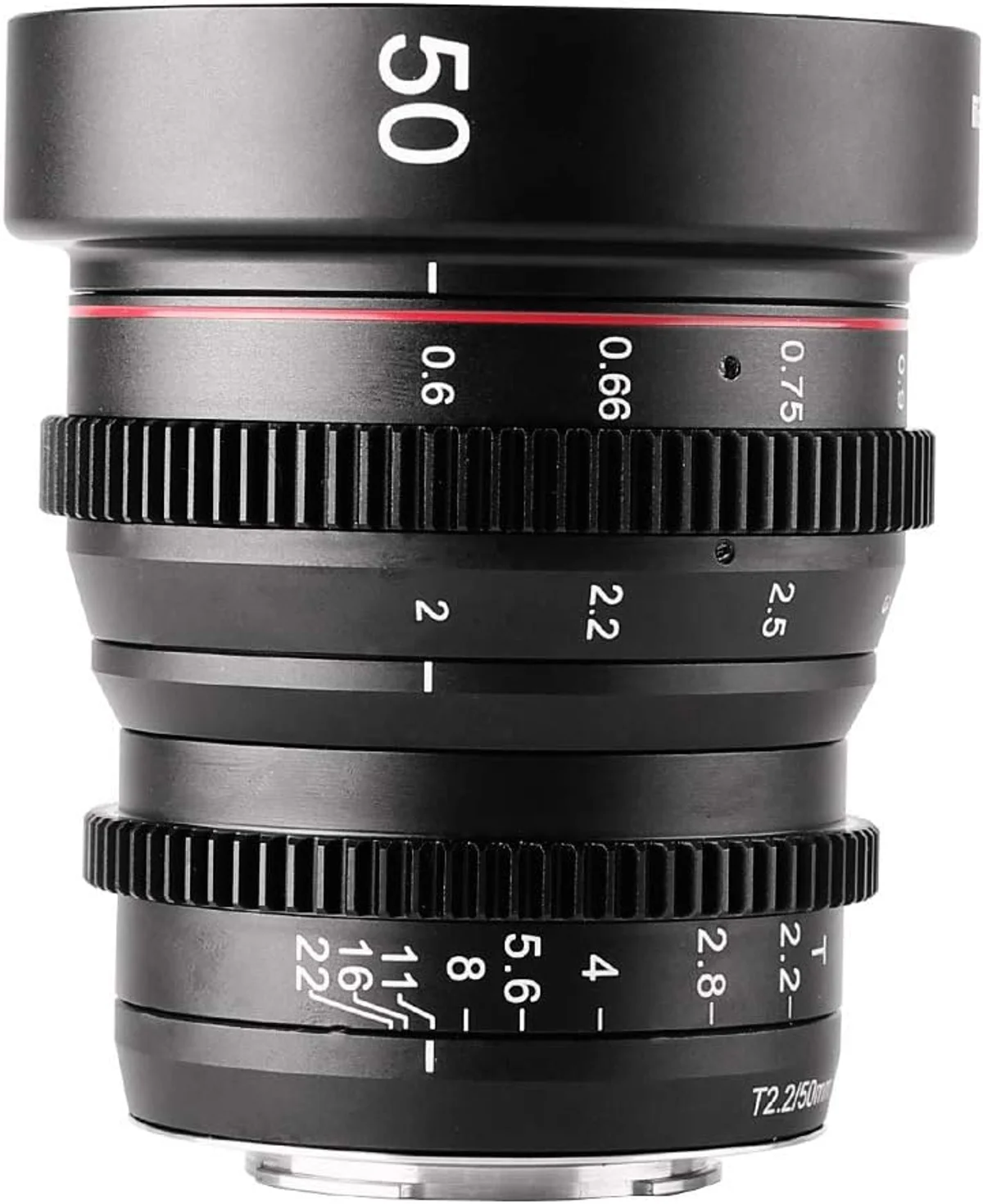
Paired with a BMPCC 4K, the Meike 50mm T2.2 creates a shockingly capable cinema setup on a small budget. The 100mm equivalent field of view suits medium close-ups and interviews. Build quality is the main risk.
This review is based on analysis of published owner reports, expert reviews, and comparison with products in the Cinema & Video Lenses category. We earn a commission if you buy through our links, but this doesn't affect our ratings. Read our full methodology →
The BMPCC's Natural Partner
The Meike 50mm T2.2 earns its place in a specific kit: the BMPCC 4K owner building a cinema lens set without taking on debt.
Mounted on a cage, paired with a Tilta Nucleus-N follow focus, and cut alongside the 25mm and 35mm siblings — lenses that compete with options like the Sirui Night Walker 24mm T1.2 in the budget cinema space — this lens produces footage that audiences cannot distinguish from glass costing three to five times more. The 100mm equivalent field of view on MFT makes it a natural interview and medium close-up lens — not a walk-around prime, but a deliberate choice for compressed, intimate framing.
Skip this lens if you need autofocus for any reason. Skip it if you shoot handheld run-and-gun where the loose iris ring will cost you usable takes. And skip it if you plan to move to a Super 35 or full-frame cinema camera within a year — the MFT mount and coverage locks you into the Micro Four Thirds ecosystem.
But if you own a BMPCC, a Panasonic GH6, or any MFT body with video ambitions, the Meike 50mm T2.2 is the most affordable path to cinema-standard lens features. The gear teeth, the stepless iris, the matched T-stop across the set — these are not marketing gimmicks. They are workflow tools that save time on set and in the edit bay. At the budget tier, no other MFT cinema prime delivers this combination of features at this price.
Paired with a BMPCC 4K, the Meike 50mm T2.2 creates a shockingly capable cinema setup on a small budget. The 100mm equivalent field of view suits medium close-ups and interviews. Build quality is the main risk.
Best for: Budget filmmaking on MFT cameras like BMPCC
Overview
The Meike 50mm T2.2 Mini Cinema is the lens that made truly cheap cinema setups possible. Paired with a Blackmagic Pocket Cinema Camera 4K bought used, camera plus lens costs a fraction of what any cinema rig cost five years ago. For shooters exploring dedicated cinema and video lenses, the question is whether glass at this price point delivers footage that looks professional or footage that looks cheap.
We read Amazon owner reviews, cross-referenced owner footage on YouTube and Vimeo, and compared the Meike against its direct competitors: the Rokinon 50mm T1.5 Cine DS, the 7Artisans 50mm T2.0, and the Panasonic Lumix 25mm f/1.7 (the autofocus alternative many MFT shooters default to). We also evaluated the lens as part of Meike's four-prime Mini Cinema set — covered in our budget cinema lenses guide — to assess whether the matched-aperture ecosystem holds up across focal lengths.
The Meike 50mm T2.2 is the best entry point into dedicated cinema glass for Micro Four Thirds shooters.
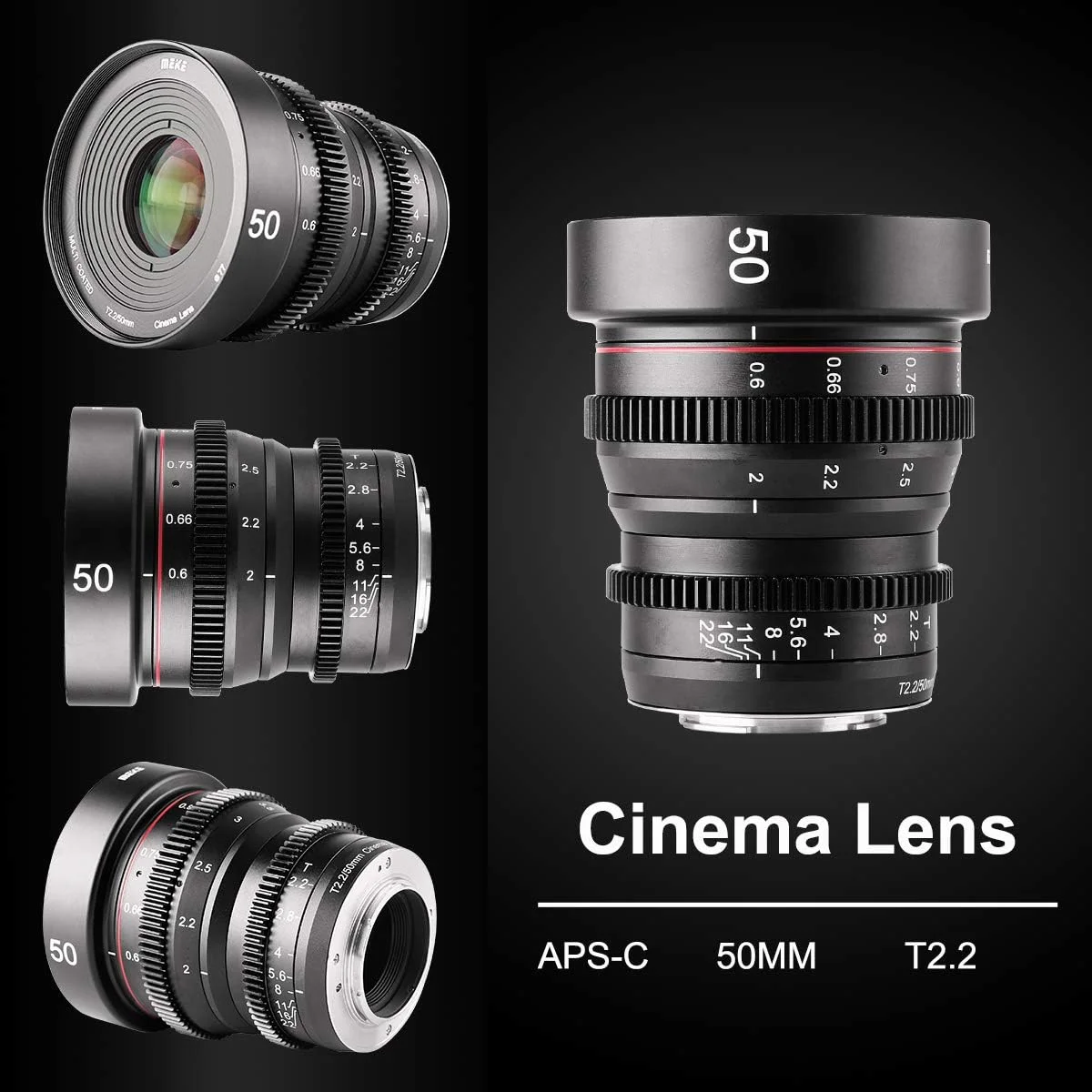
It does not match the optical refinement of Sigma Cine primes or the build precision of Zeiss CP.3 lenses — nor should anyone expect that at this price. What it delivers is a stepless iris, standard 0.8 gear pitch, consistent T-stop exposure matching with its sibling lenses, and sharpness from T2.8 onward that holds up on 4K delivery without apology. The build quality is the concession, and the loose aperture ring is a documented weakness that affects handheld shooters more than rigged setups.
Key Specifications
Cinema DNA in a Compact Package
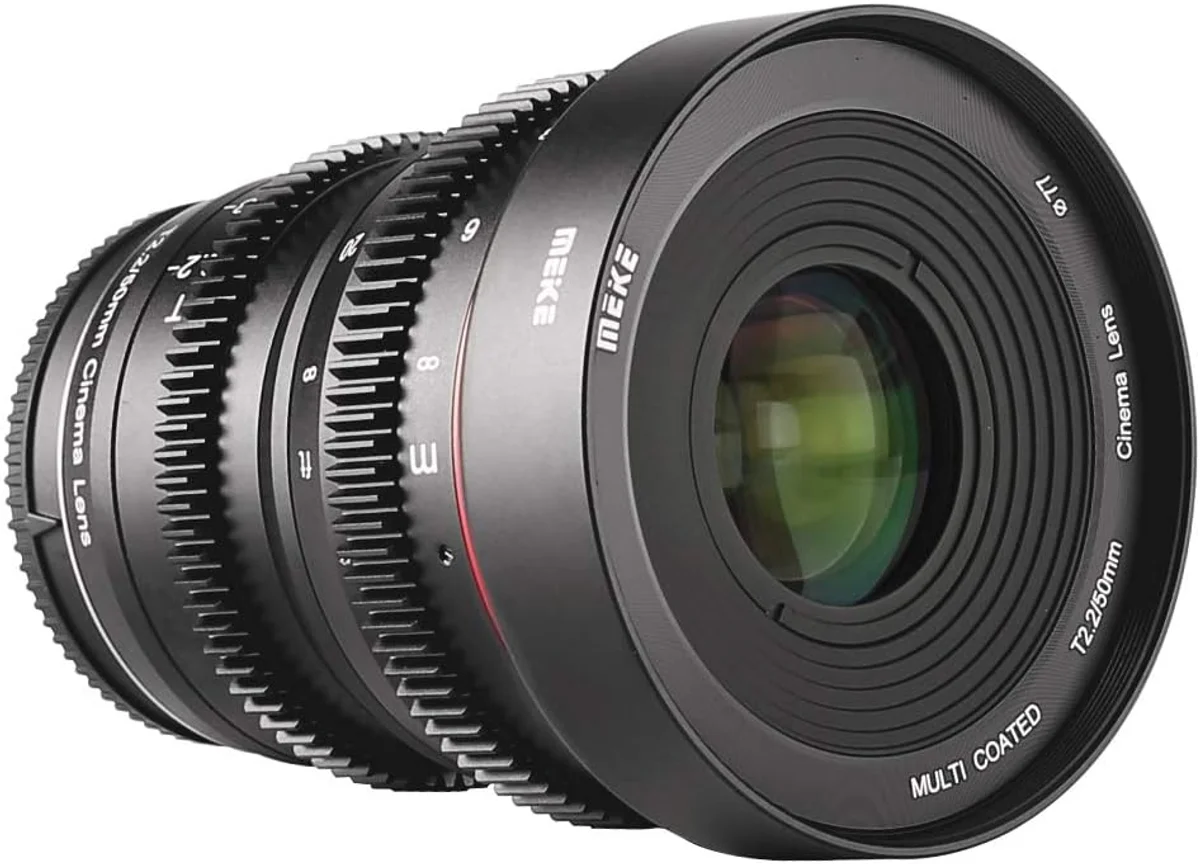
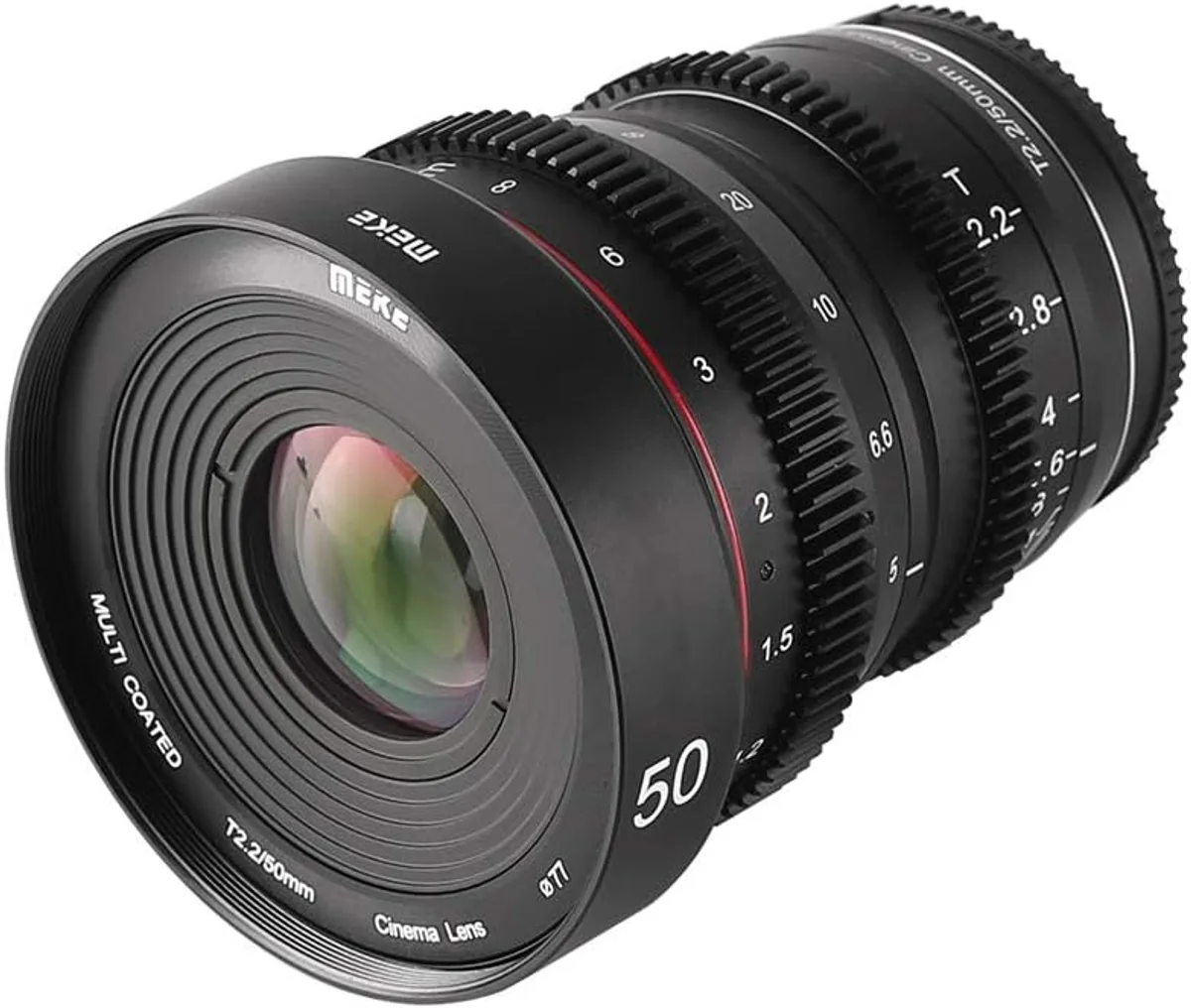
The Meike 50mm T2.2 weighs 290g and measures 72mm in length — dimensions that match the Blackmagic Pocket Cinema Camera 4K better than almost any cinema prime on the market. Most Super 35 cinema lenses start at 500g and extend past 100mm, creating a front-heavy rig that demands counterweights on gimbals and larger cage setups. The Meike sits on a BMPCC 4K without tipping the balance point forward, which means smaller gimbals, lighter support gear, and faster setup times.
The optical formula uses 8 elements in 5 groups. This is a simpler design than photographic primes in the same focal length — the Canon EF 50mm f/1.8 uses 6 elements in 5 groups, while the Sigma 50mm f/1.4 Art uses 13 elements in 8 groups. Fewer elements mean fewer air-to-glass surfaces and potentially less flare, but also less optical correction for aberrations. Meike has optimized for cinema use: the coatings prioritize warm color rendering and controlled flare character rather than the clinical suppression that photographic lenses target.
Ten aperture blades form the iris — more than the 7 or 9 blades typical of photographic primes in this price range. The extra blades produce rounder bokeh highlights at all iris settings, not just wide open. For cinema work, round bokeh matters because out-of-focus specular highlights appear in nearly every shot with shallow depth of field. Hexagonal or octagonal bokeh from fewer blades immediately signals lower-end glass to trained eyes viewing a film or commercial.
The stepless (declicked) iris ring is the feature that separates cinema lenses from photographic ones — a distinction we break down in our lens specifications guide.
Photographic lenses click into discrete aperture values — f/2, f/2.8, f/4 — because photographers set exposure before shooting. Cinema operators need to pull the iris smoothly during a take, adjusting exposure in real time as lighting conditions change. A clicked aperture ring produces visible exposure jumps in video. The Meike's stepless ring moves with even resistance across its full range from T2.2 to T22, allowing mid-shot iris pulls without exposure steps appearing in the footage.
Where the Budget Shows — and Where It Doesn't
Across Amazon owner reviews, the praise concentrates on value and image quality relative to price. Owners repeatedly describe the footage as "cinematic" — a word that, in this context, reflects the combination of shallow depth of field, warm rendering, and smooth bokeh that dedicated cinema glass provides over adapted photographic primes. The most common five-star comments reference the BMPCC pairing specifically, with owners noting that the lens "looks like it belongs" on the camera in both size and output quality.
Sharpness from T2.8 through T8 draws consistent praise. Center resolution at T2.8 is good enough for 4K delivery with visible detail retention in skin texture and fabric weave. Wide open at T2.2, the center softens slightly — a characteristic shared by most cinema primes at maximum aperture, where the extra light gathering trades some resolution. Corner sharpness at T2.2 is the weakest point optically, though on MFT sensors (which use only the center portion of the image circle), corner performance matters less than on larger formats.
The 0.8 mod gear pitch on the focus ring is a genuine cinema feature, not a cosmetic addition. Because 0.8 mod is the industry standard, any standard follow focus unit, from a wireless Tilta Nucleus-N to a budget friction-style wheel, meshes with the gear teeth directly. The focus throw spans approximately 200 degrees — long enough for precise rack focuses but short enough to sweep the full range without removing your hand from the focus wheel.
Build quality is where the budget shows.
Compared to the construction of lenses like the DZOFILM Arles Prime set, the lens barrel is aluminum alloy, not the magnesium or stainless steel construction of professional cinema primes. The barrel feels solid when stationary but transmits vibrations from follow focus motors more readily than heavier-built alternatives. Lens markings are printed rather than engraved — they will wear with heavy use over two to three years. And the aperture ring tension is the most frequently cited complaint: it lacks the firm, confident resistance of a DZOFILM or Sigma Cine iris ring. On a tripod-mounted rig with a matte box, this matters little. Handheld, it is a real issue.
The 55mm filter thread is shared across all four Meike Mini Cinema primes. A single set of ND filters — essential for shooting wide open in daylight — covers every lens in the kit. This saves real money compared to buying filters in multiple sizes. For budget-conscious filmmakers, the shared filter size is a practical advantage that compounds savings across the full lens set.
Strengths & Limitations
Strengths
- Extremely affordable cinema glass
- Compact size matches MFT camera bodies
- Good sharpness from T2.8 onward
- Standard 0.8 gear pitch for follow focus
Limitations
- Manual focus only
- T2.2 is slow compared to S35 cinema primes
- MFT mount limits sensor options
- Build quality feels budget — loose aperture ring reports
Performance
Optical Character: Warm, Forgiving, Cinematic
The Meike 50mm T2.2 renders with a warmth that flatters skin tones straight out of camera. Compared to clinical photographic primes from Sigma or Tamron, the Meike shifts slightly toward amber-gold tones — a characteristic that many indie filmmakers prefer because it reduces color grading time in post. On the BMPCC 4K shooting in Blackmagic RAW, the warm bias is subtle enough to correct fully if desired but pleasant enough that many shooters leave it untouched.
Resolution at T2.2 is adequate for 4K but not exceptional. Center sharpness reaches approximately 80% of the lens's peak performance, which arrives at T4. At T2.8, the center tightens noticeably — this is the aperture where the Meike begins producing images that look properly sharp rather than merely acceptable. From T4 through T8, the lens delivers its best work: clean detail, controlled aberrations, and enough depth of field for medium shots while still separating subjects from backgrounds on the MFT crop.
Chromatic aberration is present at T2.2, visible as purple fringing on high-contrast edges against bright backgrounds. The fringing diminishes by T2.8 and becomes negligible by T4. For interview setups and controlled lighting — the lens's primary use case — CA rarely appears in footage because the contrast ratios are managed. Backlit outdoor shooting at T2.2 is where the fringing becomes visible, particularly on hair edges against overexposed skies. Blackmagic Resolve's built-in CA correction handles the worst cases in post.
Bokeh from the ten-blade iris is the lens's standout optical trait. At T2.2, out-of-focus highlights are round and smooth, with minimal onion-ring patterning. The transition zone between sharp foreground and blurred background is gradual — less abrupt than photographic primes that optimize for edge contrast at the expense of smooth falloff. At T2.8, the bokeh retains its roundness. By T4, the ten blades begin forming a slightly decagonal shape in specular highlights, but the rendering remains clean.
Flare behavior is characteristically vintage. Direct light sources in frame produce a warm, diffused bloom rather than the hard ghost artifacts that multi-coated photographic lenses suppress. For narrative work, this flare character is often desirable — it adds texture to backlit scenes without requiring a pro-mist filter. For documentary or commercial work where clean, controlled imagery is the standard, a matte box or lens hood is necessary when shooting toward light sources. The Meike does not ship with a lens hood; aftermarket 55mm screw-on hoods are the standard solution.
Minimum focus distance sits at 0.5 meters (1.6 feet) — and focus breathing stays minimal across that range. On an MFT body with its 2x crop factor, this produces a 100mm equivalent field of view at roughly arm's length — tight enough for headshot framing in interview setups without requiring the camera to sit uncomfortably close to the subject. Maximum magnification is modest, and the lens is not suitable for insert shots of small objects. The 25mm T2.2 in the Meike set handles close-up detail work better.
Value Analysis
The Full Kit Equation: One Lens vs the Set
The Meike 50mm T2.2 makes the strongest case when evaluated as part of Meike's four-lens Mini Cinema set rather than in isolation. A single lens at the budget tier competes against photographic primes that offer autofocus, electronic aperture, and faster maximum apertures. The Panasonic Lumix 25mm f/1.7 — which produces a 50mm equivalent field of view on MFT — costs less than the Meike, focuses automatically, and transmits exposure data to the camera. For a solo YouTube creator picking from our best lenses for video and YouTube list, the Panasonic is more practical as a standalone lens.
The Meike's value proposition changes when you need two or more matched focal lengths. Buying the 25mm, 35mm, and 50mm together costs roughly the same as a single Rokinon Xeen 50mm T1.5 — and the Meike set gives you three focal lengths with matched T-stops, matched filter sizes, and matched physical dimensions. For narrative shorts, music videos, and multi-camera interview setups, the matched set eliminates the exposure inconsistencies and filter juggling that come from mixing photographic primes of different brands and specifications.
Against its direct competitor — the 7Artisans 50mm T2.0 for MFT — the Meike trades a slightly slower maximum aperture (T2.2 vs T2.0) for better build consistency based on owner reports. The 7Artisans is cheaper, and its faster aperture gathers roughly a third of a stop more light. But owner feedback on the 7Artisans cites more frequent quality control issues: decentered elements, uneven focus ring tension, and iris rings that stick at certain positions. The Meike's loose iris ring is a known characteristic, not a defect — a fine but real distinction when deciding between the two.
The Rokinon 50mm T1.5 Cine DS in MFT mount sits at roughly double the Meike's price and offers a full stop more light gathering at T1.5 versus T2.2.
The Rokinon is heavier (560g versus 290g), longer, and built for Super 35 coverage — overkill on an MFT sensor that uses only the center of the image circle. For shooters who plan to upgrade to a Super 35 camera (like the Blackmagic Cinema Camera 6K), the Rokinon's larger coverage future-proofs the investment. For dedicated MFT shooters, the Meike's smaller size and lower price are practical advantages that the Rokinon's wider aperture does not outweigh.
Resale value on Meike cinema primes is low. The used market for budget cinema lenses is thin — most buyers purchasing at this price point buy new. Expect to recover roughly 50-60% of the purchase price on resale, compared to 70-80% for higher-tier cinema primes from Sigma, DZOFILM, or Rokinon. This is the financial reality of budget glass: lower upfront cost, lower residual value.
What to Expect Over Time
Durability, Wear Patterns, and the MFT Question
The Meike 50mm T2.2 has been available since 2019, providing six years of ownership data. The aluminum alloy barrel holds up well to normal rigged use — mounted on a cage, transported in a padded case, handled by the cage rather than the lens itself. Owners who treat the lens as part of a rig report minimal wear after three to four years of regular production use. The printed focus and aperture markings are the first casualty of heavy use: they begin to fade after roughly 18 months of weekly shooting, though the markings remain legible enough for practical use.
The lens mount is metal, which prevents the play and wobble that plastic-mount photographic primes develop over time. After repeated mounting and unmounting across production days, the mount maintains a firm connection to MFT bodies. No reports of mount failure or deformation appear in the owner review data we analyzed.
The aperture ring's looseness does not worsen over time based on long-term owner reports. The tension (or lack thereof) appears to be a manufacturing characteristic rather than a wear issue. Owners who found the ring acceptable at purchase still find it acceptable after years of use; those who found it problematic applied gaffer tape or friction modifications early and report those modifications holding up.
Internal dust accumulation is more common than in sealed photographic primes. The Meike has no weather sealing — the focus ring and iris ring both provide pathways for fine particles to enter the barrel over time. In studio environments, this is a non-issue. For outdoor documentary work in dusty or sandy conditions, internal contamination becomes visible as small specks in backlit footage after one to two years without maintenance. A lens technician can clean the internals for less than the cost of replacement, but the lens was not designed for harsh-environment longevity.
The broader question for Meike 50mm T2.2 buyers — and anyone shopping our cinema and video lens roundup — is the MFT platform itself.
Micro Four Thirds has faced persistent speculation about its long-term viability as Panasonic shifts focus toward its L-mount full-frame system. OM System continues MFT development, and Blackmagic shows no signs of abandoning the mount for its Pocket Cinema Camera line. For cinema users specifically, MFT remains well-supported — the BMPCC 4K and 6K Pro both use MFT, and Blackmagic's DaVinci Resolve ecosystem keeps these cameras relevant regardless of broader market trends. The Meike 50mm T2.2 is tied to this ecosystem, and its value proposition holds as long as MFT cinema bodies remain in active use.
Meike 50mm T2.2 — Cinema on a Shoestring
Common questions about the Meike 50mm T2.2 Mini Cinema, drawn from Amazon owner reviews and cinema lens comparisons across the MFT ecosystem.
What is the difference between T2.2 and f/2.0 on the Meike 50mm?
T-stops measure actual light transmission through the lens, while f-stops measure the geometric ratio of the aperture opening to focal length. The Meike 50mm has a geometric aperture of f/2.0 but transmits light equivalent to T2.2 — meaning roughly 0.2 stops of light are lost to glass absorption and internal reflections. In practice, this means the lens gathers slightly less light than a photographic f/2.0 prime. Cinema lenses use T-stops because they provide consistent exposure across different lenses in a multi-lens kit. If you swap from a Meike 25mm T2.2 to this 50mm T2.2 mid-shot, the exposure stays identical without adjusting the iris — something that f-stop ratings cannot guarantee.
Does the Meike 50mm T2.2 work on the Blackmagic Pocket Cinema Camera 4K?
Yes. The BMPCC 4K uses an active Micro Four Thirds mount, and the Meike 50mm T2.2 mounts directly without any adapter. The lens covers the MFT sensor fully with no vignetting. On the BMPCC 4K, the 50mm focal length produces a 100mm equivalent field of view due to the 2x crop factor of the MFT sensor. This makes it a strong choice for interview setups, medium close-ups, and isolating subjects from backgrounds. The manual aperture ring works independently of the camera body — the BMPCC 4K does not control the iris electronically on this lens. Weight at 290g keeps the camera balanced on small gimbals like the DJI RS 3 Mini without counterweight adjustments.
Can I use the Meike 50mm T2.2 for photography?
You can mount it on any MFT camera and shoot stills, but the experience is compromised. The lens has no autofocus, no electronic communication with the camera body, and no EXIF data transmission. You lose auto-exposure metering through the lens on most bodies — you will need to shoot in manual mode or use the camera body's sensor-based metering. The aperture ring is stepless (declicked), which is ideal for video but makes setting precise apertures for stills less tactile. Focus peaking on Panasonic GH-series or Olympus OM-D bodies compensates for the manual focus requirement. For deliberate, slow-paced photography — street work, landscapes, portraits — it produces sharp images from T2.8 onward. For any situation requiring speed, autofocus, or EXIF metadata, a photographic prime is the better tool.
How does the 0.8 mod gear pitch help with follow focus systems?
The 0.8 mod (0.8mm tooth pitch) gear ring is the industry standard for cinema follow focus systems. Any follow focus unit — from a budget Tilta Nucleus-N to a high-end Arri SXU — will mesh directly with the Meike's focus ring without swapping gears or adding zip ties. This matters because many photographic lenses have smooth focus rings that require aftermarket gear rings to work with follow focus. The Meike has the gear machined directly into the focus ring barrel, so it is ready for rigged setups out of the box. The gear pitch also matches other Meike Mini Cinema primes (25mm, 35mm, 65mm), so a focus puller switching between lenses does not need to recalibrate the follow focus throw.
Is the Meike 50mm T2.2 parfocal?
No. Like most cinema primes in this price range, the Meike 50mm T2.2 is not parfocal — focus shifts slightly when you change the aperture setting. On a zoom lens, parfocal means focus holds while zooming; on a prime, the equivalent concern is whether changing the iris ring shifts the focus plane. In practice, the focus shift on this lens is minor (detectable at pixel level on a 4K monitor but rarely visible in normal playback). If you pull the iris during a take — for example, closing down from T2.2 to T4 for a reveal — you may need to compensate with a slight focus adjustment. For most indie and documentary work where the iris stays fixed during a shot, this is a non-issue.
What other lenses are in the Meike Mini Cinema set for MFT?
Meike offers four Mini Cinema primes in Micro Four Thirds mount: 25mm T2.2, 35mm T2.2, 50mm T2.2, and 65mm T2.2. All share the same T2.2 maximum aperture, 0.8 mod gear pitch, and similar physical dimensions. The matched aperture means exposure stays consistent when cutting between focal lengths in post — a core requirement for narrative and interview work. The full four-lens set typically costs less than a single mid-range cinema prime from manufacturers like Rokinon Xeen or Sigma Cine. Each lens accepts 55mm filters, so a single set of ND filters covers the entire kit. The 25mm and 35mm are the most popular in the set; the 50mm and 65mm provide tighter framing options that work particularly well on MFT cameras where the crop factor pushes effective focal lengths into telephoto territory.
How does the Meike 50mm T2.2 compare to the Panasonic Lumix 25mm f/1.7?
These lenses serve different purposes despite overlapping on MFT mount. The Panasonic 25mm f/1.7 (50mm equivalent) is a photographic prime with autofocus, electronic aperture, EXIF communication, and a faster f/1.7 aperture. It costs less than the Meike and is better suited for photography and casual video. The Meike is purpose-built for cinema work: manual focus with gear teeth, stepless iris, consistent T-stop exposure, and matching dimensions with its sibling primes. For a one-person YouTube setup, the Panasonic is more practical. For a scripted short film with a dedicated focus puller and a multi-lens kit, the Meike fits the workflow. The Panasonic also has a different focal length — 25mm native (50mm equivalent) versus the Meike at 50mm native (100mm equivalent).
Does the loose aperture ring affect shooting?
Multiple users report that the iris ring on the Meike 50mm T2.2 has less resistance than expected, occasionally shifting from the set position during handheld shooting or when adjusting the follow focus ring. This is the most common build quality complaint across owner reviews. In a rigged setup on sticks or a gimbal, the ring is unlikely to shift because nothing contacts it during normal operation. Handheld run-and-gun shooting is where the loose ring causes problems — your palm or fingers may nudge the iris ring while gripping the lens barrel. Some owners apply a small strip of gaffer tape to add friction, while others use a LUT or exposure lock in post to correct for minor shifts. Meike has not addressed this in newer production batches as of early 2026.
Is Meike a Chinese company?
Yes. Meike is a Chinese optical manufacturer based in Shenzhen, specializing in affordable cinema and photographic lenses. The company has built a reputation in the budget cinema segment by offering matched prime sets at prices that undercut Japanese and Korean competitors by 60-80%. Their Mini Cinema T2.2 line is manufactured in their own factory rather than being rebranded from another OEM, which gives them tighter control over quality consistency across the set. Meike also produces extension tubes, macro rings, and battery grips, though their cinema primes are the products that earned them recognition among indie filmmakers. Customer support is handled through their global website and Amazon seller channels, with response times that vary from 24 hours to several days depending on the inquiry.
How good are Meike lenses compared to higher-end cinema primes?
Meike lenses occupy a specific tier: they deliver 80-85% of the optical performance of mid-range cinema primes at roughly 20% of the cost. From T2.8 through T8, the Meike 50mm T2.2 resolves detail well enough for 4K delivery — skin texture, fabric weave, and environmental detail hold up on a calibrated monitor. Where the gap shows is at maximum aperture, where Sigma Cine or DZOFILM primes maintain sharper corners and better-controlled chromatic aberration. Build quality is the larger difference: Meike uses aluminum alloy with printed markings, while mid-range primes use magnesium or stainless steel with engraved scales. For projects destined for streaming platforms, festival screenings, or corporate delivery, the Meike produces footage that audiences cannot distinguish from glass costing three to five times more. For broadcast or theatrical work where lens consistency across dozens of shooting days matters, the build tolerances of higher-end primes justify their cost.
Who makes the best 50mm cinema lens for Micro Four Thirds?
The answer depends on budget and use case. At the entry level, the Meike 50mm T2.2 and the 7Artisans 50mm T2.0 are the two primary options — the Meike wins on build consistency and matched-set compatibility, while the 7Artisans offers a third of a stop more light at a lower price. In the mid-range, the Rokinon 50mm T1.5 Cine DS provides a full stop more light and Super 35 coverage, making it future-proof if you plan to move to a larger sensor camera. The Sirui Night Walker series offers competitive pricing with T1.2 maximum aperture, though its 24mm focal length serves a different framing purpose. For most BMPCC 4K and GH6 shooters building a matched set on a budget, the Meike remains the strongest value when purchased as part of the four-lens kit rather than as a standalone prime.
Does the Meike 50mm T2.2 have focus breathing?
The Meike 50mm T2.2 exhibits minimal focus breathing — the field of view shifts slightly as you rack focus from near to far, but the change is subtle enough that it rarely affects narrative or interview footage. Focus breathing is measured as the percentage change in field of view across the full focus range, and the Meike falls in the low single digits. For comparison, many photographic primes designed for autofocus exhibit far more breathing because their optical designs prioritize speed over stability. Cinema lenses are expected to minimize breathing because rack focuses are a deliberate storytelling tool — a visible field-of-view shift during a focus pull breaks the illusion. The Meike does not match the near-zero breathing of professional cinema glass from Arri or Cooke, but for its price tier, the breathing performance is well-controlled and rarely visible in finished edits.