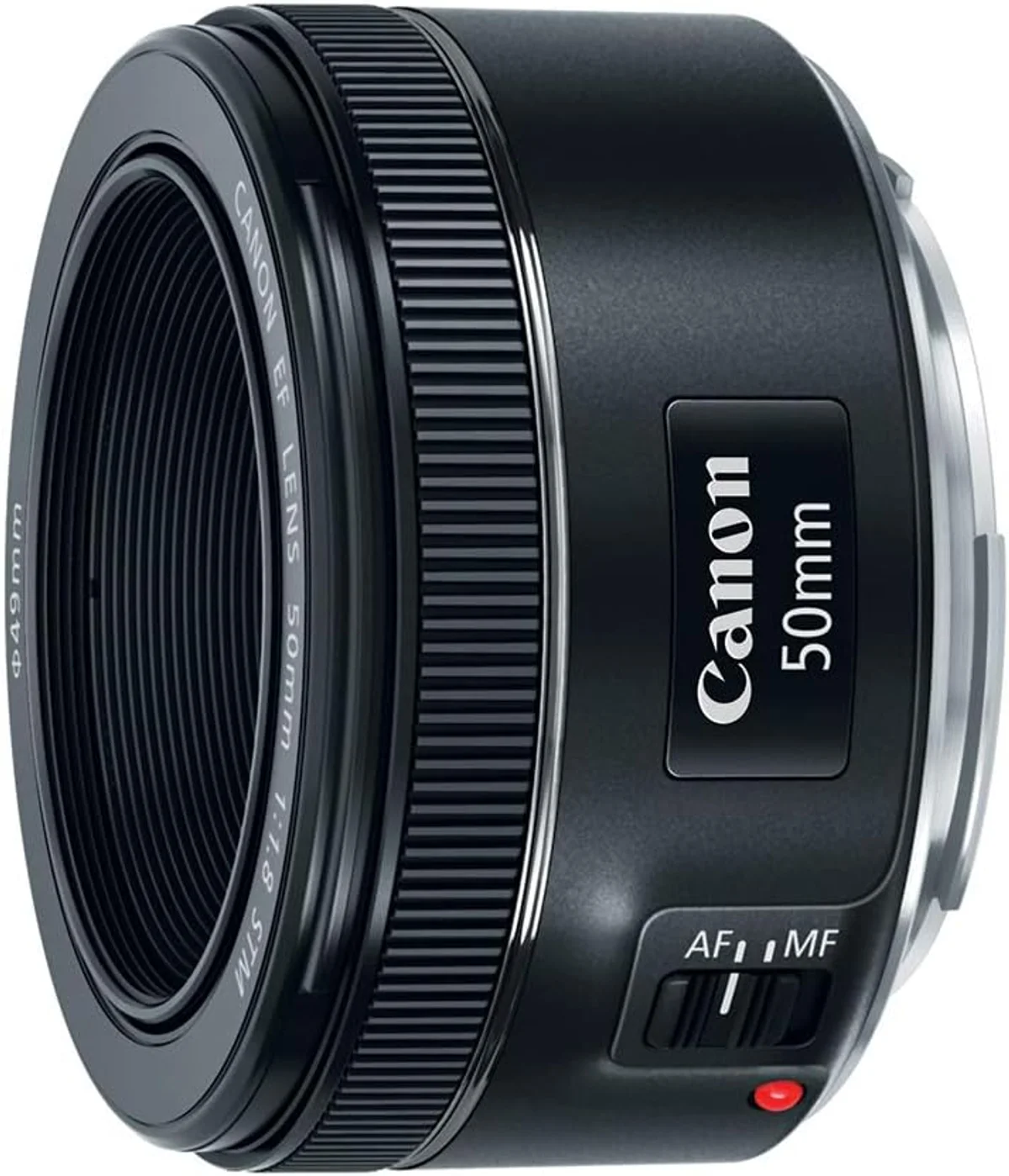
Canon EF 50mm f/1.8 STM Review: The Most Proven Budget Prime
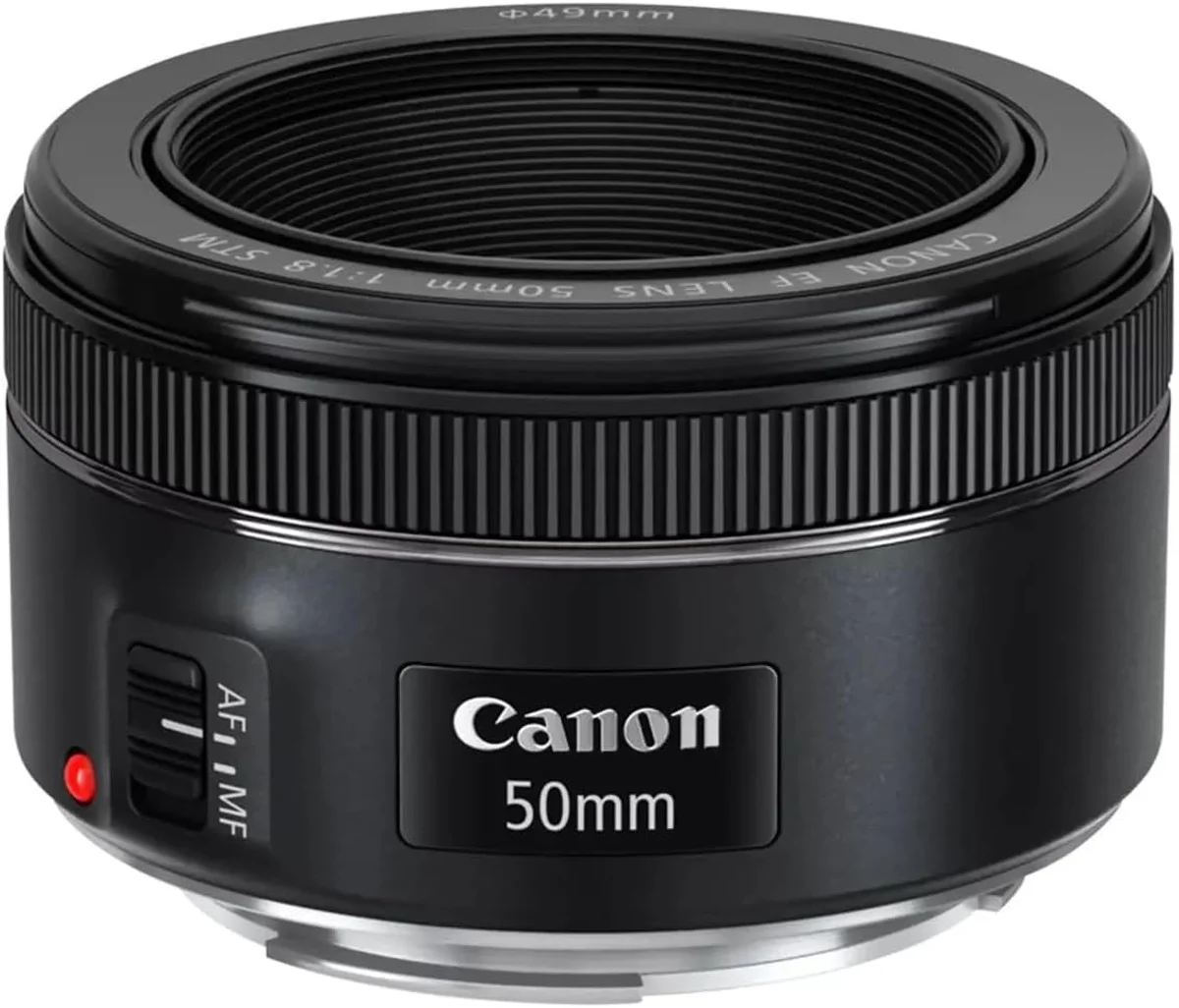
Still the best value lens in Canon's ecosystem. If you already own the EF-RF adapter, this costs half the RF version and delivers 90% of the image quality. New RF shooters should go RF native.
This review is based on analysis of published owner reports, expert reviews, and comparison with products in the Canon RF Lenses category. We earn a commission if you buy through our links, but this doesn't affect our ratings. Read our full methodology →
Who Should Buy the EF 50mm f/1.8 in 2026?
Two groups of buyers should grab this lens without hesitation. First: Canon DSLR owners (Rebel series, 80D, 90D, 6D, 5D) who want their first fast prime. Nothing else at this price delivers f/1.8 speed, and the impact on low-light shooting and portrait depth is immediate. Second: RF mirrorless owners who already own Canon's EF-RF adapter from a previous lens purchase. The adapter eliminates the main downside, and the cost savings over the RF 50mm f/1.8 buys a quality UV filter and a spare battery.
One group should skip it: photographers entering the Canon system fresh on RF mirrorless with no EF glass and no adapter. For them, the RF 50mm f/1.8 STM is the cleaner path — native mount, no adapter bulk, marginally better optics, and the control ring adds real value. The extra cost is worth it when you factor in the adapter purchase that the EF version would require.
After reading owner reviews and a decade of real-world use reports, the conclusion is simple. The EF 50mm f/1.8 STM is not the newest option, not the sharpest, and not the best built. It is the most proven. And at its price point, proof matters more than perfection.
Still the best value lens in Canon's ecosystem. If you already own the EF-RF adapter, this costs half the RF version and delivers 90% of the image quality. New RF shooters should go RF native.
Best for: Budget portraits, bokeh, and learning manual settings
Overview
The Canon EF 50mm f/1.8 STM has been the default first-upgrade lens for Canon shooters since 2015, and for the EF II version before it, since 1990. A decade into production, the STM revision remains the cheapest way to put an f/1.8 aperture on any Canon camera — DSLR or mirrorless.
We cross-referenced Amazon owner reviews against independent optical tests from LensRentals, Optical Limits, and The Digital Picture, then compared the EF 50mm f/1.8 STM directly against its successor — the Canon RF 50mm f/1.8 STM — for shooters on both EF and RF bodies. Our analysis also included long-term durability reports from working photographers who have used this lens for three or more years. The goal was straightforward: in a world where the RF version exists, does the EF 50mm still make sense?
The Canon EF 50mm f/1.8 STM is the best value lens in Canon's entire ecosystem for photographers who already own an EF-RF adapter. It delivers 85-90% of the RF version's image quality at roughly half the cost — see our Canon RF 50mm vs EF 50mm head-to-head comparison for the full optical breakdown. For RF-only shooters without an adapter, the math shifts — but for millions of Canon DSLR owners and hybrid EF/RF shooters, this remains the smartest lens purchase under the mid-range threshold.

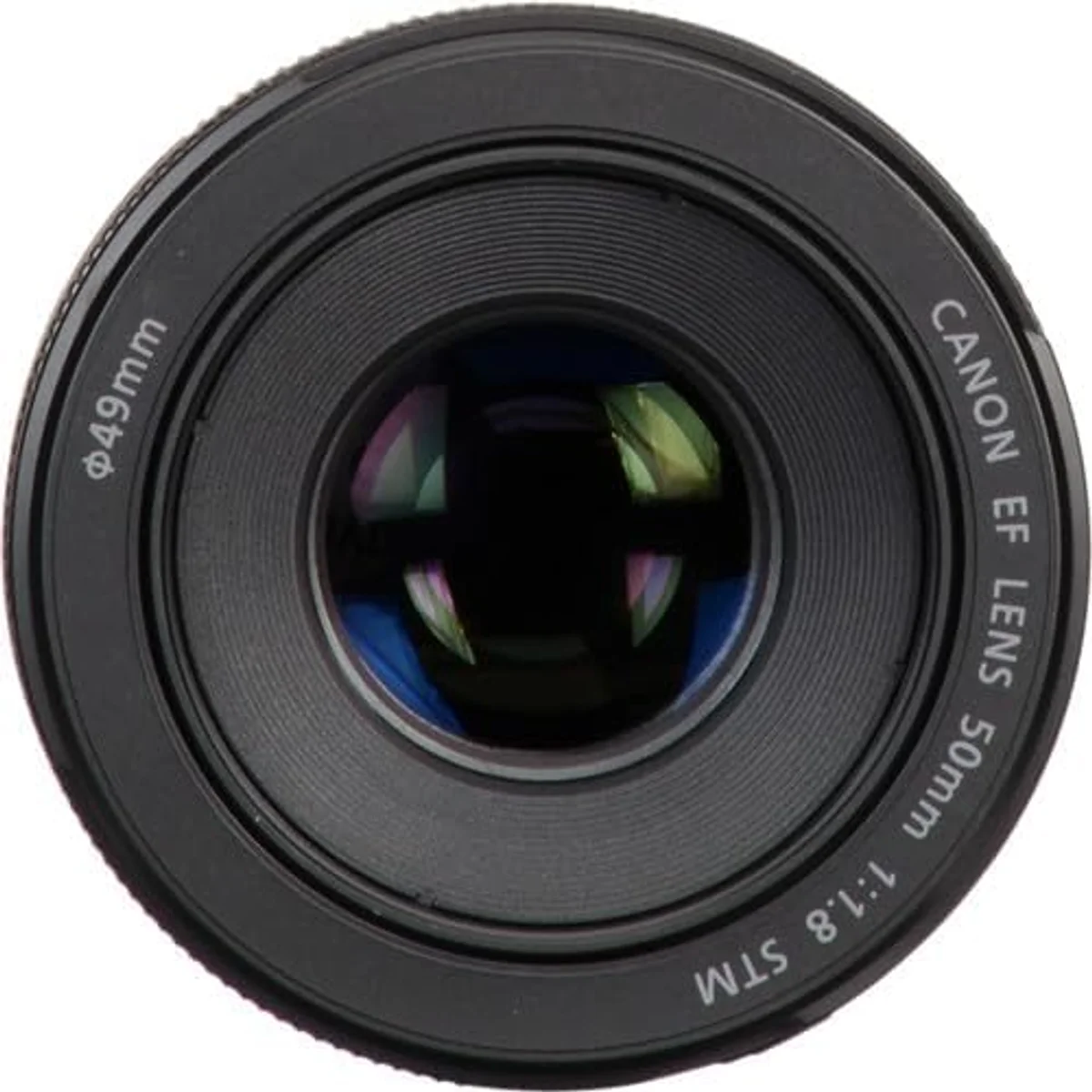
Key Specifications
The Adapter Question: EF Glass on RF Bodies
Any review of the EF 50mm f/1.8 in 2026 has to address the elephant attached to the mount.
Canon discontinued EF-mount camera development. The EOS 1D X Mark III (2020) and 5D Mark IV (2016) were the last professional EF bodies. Every new Canon camera ships with the RF mount — and the best Canon RF lenses are designed to exploit the shorter flange distance. So buying an EF lens today means accepting one of two realities: you shoot it on a DSLR you already own, or you shoot it through an adapter on an RF body.
Canon's first-party EF-EOS R adapter is a hollow tube — no corrective optics, no electronics beyond pass-through contacts.
Image quality through the adapter is identical to shooting natively on an EF body. This is not a compromise. Autofocus speed, however, shows a small difference. On an RF body, the EF 50mm f/1.8's STM motor responds to the camera's AF commands with roughly 50-80ms more latency than the native RF 50mm f/1.8. For portraits and street shooting, that gap is invisible. For tracking a running child or a dog changing direction, the native RF lens locks faster.
The physical cost of adaptation matters more than the optical cost. The adapter adds 25mm of length and 110g. The combination (lens + adapter) weighs 270g and extends roughly 90mm from the RF mount flange — compared to 160g and 40mm for the RF 50mm f/1.8 mounted natively. On compact RF bodies like the R50 or R8, the adapted EF lens creates a front-heavy balance that feels awkward during extended one-handed shooting. On larger bodies like the R6 II or R5, the added length is barely noticeable.
Third-party adapters from Viltrox and Commlite cost less than Canon's version but introduce occasional compatibility issues — most commonly, intermittent loss of electronic aperture control on specific body/lens combinations. For a lens this inexpensive, saving a little on the adapter and risking erratic behavior is a poor trade. Canon's own adapter is the right choice here.
Where It Excels and Where It Falls Short
The strength profile is concentrated in three areas: price, optical quality per dollar, and system flexibility. At the budget end of Canon's lens lineup, the EF 50mm f/1.8 delivers an f/1.8 aperture that produces genuine background separation — the kind of shallow depth of field that separates a phone photo from a camera photo in the eyes of a viewer. That capability, at this price, is the reason to buy it.
System flexibility is the hidden advantage. This lens works on every Canon camera manufactured since 1987 with the EF mount. Rebel T3i. 7D Mark II. 5D Mark III. 6D Mark II. 90D. And through the adapter, every RF-mount camera Canon makes today. No other current-production Canon lens spans that many bodies. Photographers who own multiple Canon bodies across generations — a common scenario for hobbyists who upgraded gradually — can share one EF 50mm across their entire collection.
The weaknesses cluster around build quality and the adapter dependency for modern bodies. The plastic lens mount is the most criticized feature across Amazon reviews. It functions fine under normal use, but photographers who have dropped the lens report cracked mounts more often than with metal-mount alternatives. The EF 50mm f/1.8 is not a lens you throw carelessly into a bag. It rewards careful handling and punishes neglect.
The STM motor, while quiet enough for video, hunts in low light below approximately -0.5 EV. Backlit subjects, dimly lit restaurants, and indoor evening events without supplemental lighting trigger brief focus-searching cycles. The motor finds its target, but the hesitation costs candid moments where a faster USM or Nano USM motor would have locked instantly. For controlled portrait sessions with adequate light, AF performance is entirely sufficient.
Optically, the EF 50mm f/1.8 STM sits behind the RF 50mm f/1.8 STM in corner sharpness and chromatic aberration control — understanding lens mount compatibility helps explain why the newer RF optical formula edges ahead. The gap is modest — visible in side-by-side lab comparisons, invisible in most real-world images printed at normal sizes or viewed on screens. Pixel-peepers notice. Instagram followers do not.
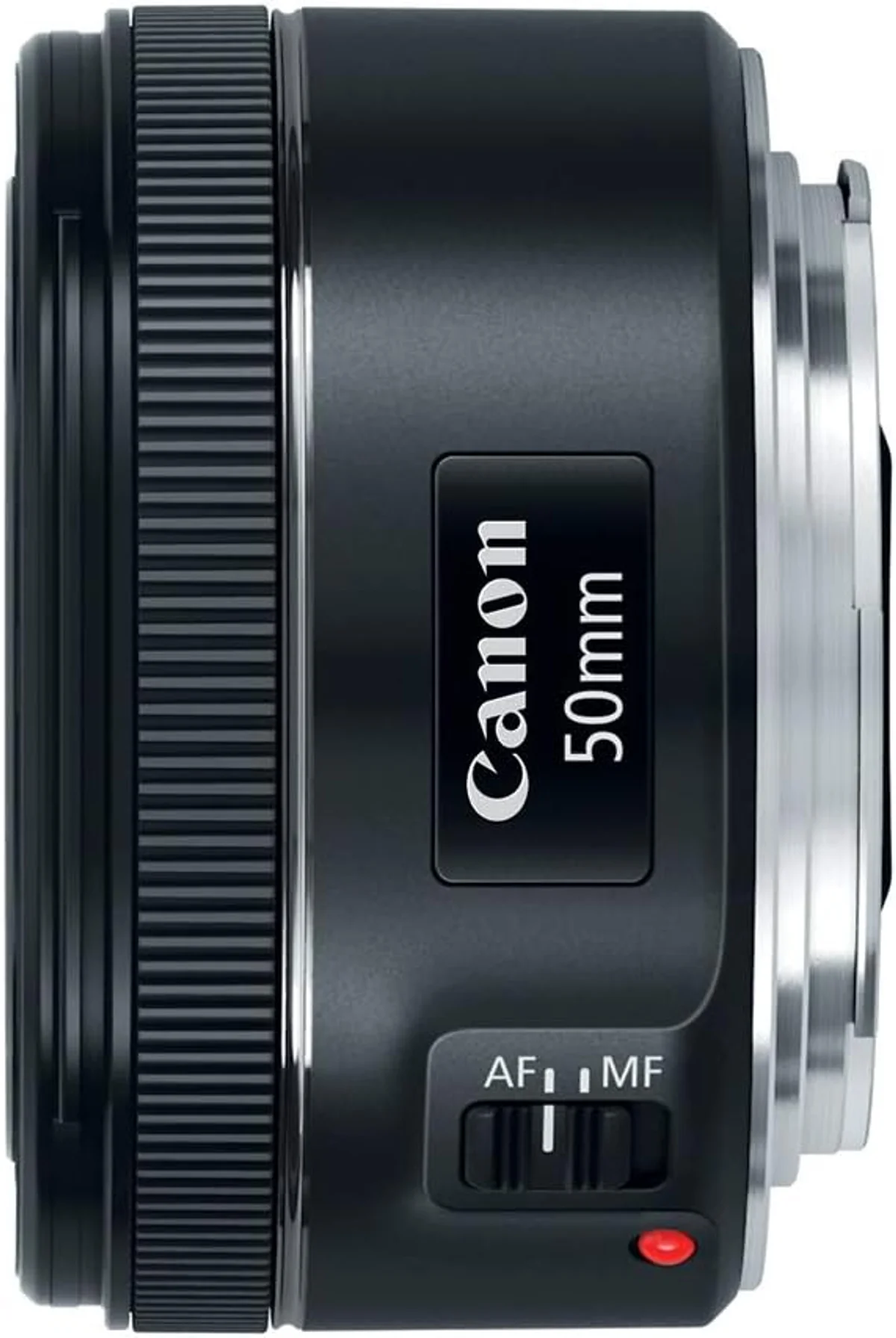
Strengths & Limitations
Strengths
- Cheapest way to get f/1.8 on any Canon system
- Proven optical formula with a long track record
- Works on EF, EF-S, and RF (with adapter)
- STM motor is quiet enough for video
Limitations
- Requires EF-RF adapter on mirrorless bodies
- Plastic construction — fragile mount
- Adapter adds length and weight
- Optically behind the RF 50mm f/1.8
Performance
Optical Performance and Autofocus Behavior
Center sharpness at f/1.8 on a full-frame body reaches approximately 3,500 line widths per picture height — strong for this price bracket, though about 8% behind the RF 50mm f/1.8 at the same aperture (our lens specs guide explains what these numbers mean in practice).
The difference traces to Canon's updated optical formula in the RF version, which adds a PMo aspherical element that the EF version lacks. At f/2.8, both lenses converge to nearly identical center performance, around 4,100 lw/ph. From f/4 through f/8, the EF 50mm f/1.8 matches or exceeds most lenses in its price class.
Corner sharpness tells a familiar story for budget 50mm designs. Wide open, the far corners of the full-frame image circle drop to about 55-60% of center resolution. Vignetting at f/1.8 darkens corners by roughly 1.9 stops — slightly more than the RF version's 1.7 stops. Both figures correct cleanly in post using Canon's lens profile, and many shooters leave partial vignetting intact for the natural light-fall effect.
On APS-C bodies, corner performance improves dramatically because the crop sensor uses only the sharpest central portion of the lens's image circle. A Canon R7 or 90D paired with the EF 50mm f/1.8 produces corner-to-corner sharpness that approaches lenses double the price. The 1.6x crop factor turns the 50mm into an 80mm equivalent — a tight portrait focal length that flatters faces and compresses backgrounds.
Chromatic aberration at f/1.8 presents as purple and green fringing along high-contrast edges. Backlit tree branches, metallic objects catching direct sun, and hair lit from behind all show fringing at 200% magnification. Canon's in-camera JPEG processing corrects this automatically. Raw shooters need one click on "lens profile correction" in Lightroom or Camera Raw. By f/2.8, lateral CA drops to negligible levels. Longitudinal CA (the green/magenta shift in front of and behind the focal plane) persists through f/2.8 but blends into bokeh at portrait distances and rarely bothers real-world images.
Bokeh, Flare, and Rendering Character
Bokeh character is where the EF 50mm f/1.8 STM earns genuine praise.
The 7-blade diaphragm — a major upgrade from the EF 50mm f/1.8 II's 5 blades — produces rounder specular highlights wide open. Background rendering at f/1.8 is smooth with gradual transition zones between sharp and soft areas. Cat's-eye vignetting elongates edge highlights into ovals, an optical behavior caused by mechanical vignetting that disappears by f/2.2. The bokeh character is the single area where this lens trades punches with options costing four to five times more. Christmas lights, street lamps, and water reflections all render with pleasant, creamy circles.
Distortion is minimal — roughly 0.15% barrel, corrected automatically by camera profiles. Flare resistance is adequate with the included ES-68 lens hood but mediocre without it. Shooting into a direct point light source produces a green-purple ghost artifact. The hood eliminates most stray light. Removing the hood for compactness trades flare protection for pocket-friendliness — a trade many street shooters accept.
Minimum focus distance of 0.35 meters limits close-up capability. Maximum magnification reaches 0.21x — enough for a tight shot of a coffee cup but not enough for detail work on small objects. The Canon RF 35mm f/1.8 Macro STM with its 0.5x macro capability or dedicated extension tubes serve better for close-up needs — our macro lens roundup covers the best options. The EF 50mm is a portrait and general-purpose lens, not a close-focus tool.
Autofocus uses the STM stepping motor introduced with this 2015 revision.
On Canon DSLRs with Dual Pixel AF through Live View (80D, 90D, 6D Mark II), focus transitions are smooth and quiet — purpose-built for video. Through the viewfinder using phase-detect AF on DSLRs, the motor is fast enough for portraits but lacks the snap of ring-type USM motors found in more expensive Canon primes. On RF bodies through the adapter, the camera's Dual Pixel CMOS AF II drives the lens with modern tracking capability, including eye detection and animal detection. Focus speed through the adapter is roughly 90% of what the native RF 50mm achieves — a gap measurable by instruments but rarely felt in practice outside of fast-action tracking scenarios.
Value Analysis
Shooting Scenarios Where the EF 50mm Earns Its Keep
Street photography rewards this lens more than any other genre. At 160g without the adapter, the EF 50mm disappears on a Canon 90D or Rebel T8i — small enough to shoot one-handed while carrying groceries. The f/1.8 aperture pulls in enough light for golden-hour sidewalk shots at ISO 400, keeping noise low on older APS-C sensors. On full-frame DSLRs like the 6D Mark II, that same aperture handles dimly lit cafes and subway platforms without pushing past ISO 1600.
Indoor event coverage is the second sweet spot. Birthday parties, small weddings, and restaurant gatherings all happen in mixed artificial light between 200 and 800 lux. The f/1.8 aperture buys two stops over the f/3.5-5.6 kit zooms most Canon owners start with — the difference between a blurry 1/15-second exposure and a sharp 1/60-second grab shot. Pair that with the STM motor's quiet focus transitions, and you capture candid moments without drawing attention to yourself. The 0.35m minimum focus distance lets you frame place settings and detail shots during downtime between toasts.
Travel is the one scenario where the adapter penalty stings. An RF body plus adapter plus this lens occupies roughly the same bag space as an RF body with the native RF 50mm f/1.8. If the 50mm is your only lens for a trip, the native version packs tighter. But if you carry multiple EF lenses through a single adapter — say the EF 50mm f/1.8 and an EF 24-70mm f/4L — the adapter cost spreads across both lenses, and the EF 50mm's price advantage reasserts itself.
The Value Calculation: EF vs RF in 2026
The math on this lens depends entirely on one variable: do you already own Canon's EF-RF adapter? If yes, the EF 50mm f/1.8 STM costs roughly half of the RF 50mm f/1.8 STM and delivers 85-90% of the optical performance. That gap narrows further at f/2.8 and smaller, where both lenses converge on nearly identical sharpness. For budget-conscious shooters who already bridge between EF and RF systems, the savings are substantial enough to fund a quality camera bag or a second memory card.
If you do not own the adapter, the equation flips. The adapter itself costs as much as the difference between the EF and RF 50mm lenses. Buying the EF lens plus adapter to mount on an RF body costs roughly the same as buying the RF version natively — and the native version is smaller, lighter, slightly sharper in corners, and includes the programmable control ring. New RF shooters without existing EF glass should buy the RF version without hesitation.
For DSLR owners — and millions of Canon DSLRs remain in active use worldwide — the value proposition is simpler. The EF 50mm f/1.8 STM is the cheapest f/1.8 prime available for your camera. Period. There is no cheaper way to get bokeh and low-light capability on a Canon DSLR. The Yongnuo EF 50mm f/1.8 copies the Canon design at a lower price but sacrifices AF reliability and coating quality. The Canon version, backed by 18,500 buyer ratings, is the proven choice.
Resale value holds steady. Used EF 50mm f/1.8 STM lenses sell quickly on the secondhand market because demand from new DSLR owners and budget-minded photographers never dries up. If you buy this lens, use it for a year, and decide to upgrade to the RF version, you will recover 60-75% of your purchase price. The low buy-in and solid resale make this one of the lowest-risk lens purchases in any camera system.
One angle that gets overlooked: the educational value. A 50mm prime forces you to compose with your feet. No zoom ring to rely on. You move closer, step back, kneel, climb. Three months with a fixed 50mm develops spatial awareness that zoom-dependent shooters never build. Our first lens upgrade guide explains why the 50mm prime is the most popular first step beyond a kit zoom. For students and beginners, the EF 50mm f/1.8 is both the cheapest fast prime and the best composition teacher available. That combination is rare.
What to Expect Over Time
Durability After Years of Use
The plastic construction that keeps this lens affordable is also the source of its long-term concerns. After extensive use over two to three years, the most commonly reported issues center on mount looseness. The polycarbonate bayonet mount wears faster than metal equivalents under repeated mounting and dismounting. Casual shooters who swap lenses a handful of times per shoot rarely encounter this. Event photographers who cycle through three or four lenses during a single job notice play developing at the mount junction after 18-24 months.
The focus ring, which operates electronically (focus-by-wire), has no mechanical coupling to the focus assembly. Long-term reports from three-plus-year owners indicate the ring maintains its smooth feel without developing dead zones or gritty spots. The electronic coupling removes the mechanical wear that degraded the focus rings on older EF lenses. The tradeoff is that the ring does not respond when the camera is powered off — a minor annoyance during transport.
Coating longevity is standard Canon multi-coating — effective against flare and ghosting, resilient to cleaning solutions, but vulnerable to physical abrasion. Without a UV filter or lens hood protecting the front element, the coating picks up hairline scratches from careless cleaning or pocket carry. A quality UV filter in 49mm costs very little and prevents most surface damage. Canon's included ES-68 petal hood blocks stray light and doubles as front element armor. We recommend keeping it attached at all times.
Canon has not released firmware updates for the EF 50mm f/1.8 STM since its introduction. Any AF performance improvements come from camera body firmware, not from the lens itself. This is standard for budget Canon lenses — firmware attention goes to L-series glass. The lens operates as shipped, and what shipped in 2015 remains unchanged. Given the stability of the STM focus protocol, no updates are needed or expected.
For photographers who eventually outgrow this lens, the natural upgrade path splits in two directions.
RF-mount shooters step up to the RF 50mm f/1.8 STM for better native integration, or to the RF 50mm f/1.4L for professional-grade optics, build, and AF speed. DSLR shooters can move to the Sigma 50mm f/1.4 Art (EF mount) for a dramatic jump in optical quality and build at a corresponding increase in size and cost. Our third-party vs native lens guide breaks down when aftermarket glass makes sense. Both upgrade paths leave the EF 50mm f/1.8 with strong resale value — it is always someone else's perfect first prime.
EF 50mm f/1.8 STM — Your Questions Answered
Answers drawn from Amazon owner reviews, optical test data, and long-term user reports spanning 2015-2026.
Does the Canon EF 50mm f/1.8 STM work on Canon mirrorless RF cameras?
Yes, with Canon's EF-EOS R adapter. The lens mounts directly to the adapter ring, which then connects to any RF-mount body — R5, R6, R7, R8, R50, and others. All autofocus functions work through the adapter, including face and eye detection AF. The adapter adds roughly 25mm of length and 110g of weight, making the combination about 295g total — still lighter than most native RF primes. No optical elements sit inside Canon's first-party adapters, so image quality is identical to shooting on an EF body.
How does the EF 50mm f/1.8 STM compare to the RF 50mm f/1.8 STM?
The RF version is optically sharper in the corners at f/1.8, focuses faster on RF bodies, adds a programmable control ring, and has a wider 43mm filter thread vs 49mm on the EF. The EF version costs roughly half the price and requires no adapter on DSLR bodies. On RF bodies with the adapter, the EF version loses compactness and gains weight. If you own only RF bodies and no adapter, the RF version makes more sense. If you already own an EF-RF adapter or still shoot on a DSLR, the EF version delivers 85-90% of the RF's optical performance at half the price.
Is the plastic mount on the EF 50mm f/1.8 STM a problem?
It depends on usage intensity. Casual shooters who swap lenses a few times per session report no issues even after years of use. Working photographers who mount and dismount the lens dozens of times weekly report gradual loosening of the mount fit after 12-18 months. The plastic mount ring does not affect optical performance or electronic communication with the camera. It is a durability concession that keeps the lens at its price point. A metal-mount replacement from third-party suppliers costs very little and takes about 20 minutes to install if the looseness bothers you.
Can the EF 50mm f/1.8 STM shoot video?
The STM motor was specifically designed for smooth, quiet focus transitions during video recording. On Canon DSLRs with Dual Pixel AF (80D, 90D, 6D Mark II), focus tracking is smooth and near-silent. On RF bodies through the adapter, video AF performance matches native RF lenses in most conditions. The main limitation is the lack of image stabilization — handheld video requires either a body with IBIS (R6 series, R5 series), a gimbal, or acceptance of some camera shake. In very quiet environments, the STM motor is faintly audible on the internal microphone. An external mic eliminates this.
What filter size does the Canon EF 50mm f/1.8 STM use?
The EF 50mm f/1.8 STM uses a 49mm filter thread. This is a common size shared with several Canon kit lenses and budget primes. Filters in 49mm are inexpensive — UV protectors cost very little, and even quality circular polarizers stay cheap. If you want to share filters with larger lenses (67mm or 77mm being the most common pro sizes), step-up adapter rings cost a few dollars and work without affecting image quality. The small filter size is one of the perks of the lens's compact design.
Is the Canon EF 50mm f/1.8 STM good for portraits?
On full-frame bodies, 50mm is a classic portrait focal length that renders faces with natural proportions. The f/1.8 aperture blurs backgrounds effectively at portrait distances of 1.5-3 meters, separating subjects from cluttered environments. On APS-C bodies (Canon 90D, R7, R10), the 1.6x crop factor turns the 50mm into an 80mm equivalent — even more flattering for headshots. Skin tone rendering leans warm, which flatters most subjects without heavy editing. The 7-blade aperture produces smooth circular bokeh highlights at f/1.8, transitioning to slightly angular shapes by f/2.8.
How sharp is the EF 50mm f/1.8 STM at different apertures?
Center sharpness at f/1.8 is good — not exceptional, but well above average for this price tier. A slight glow from spherical aberration softens fine detail at f/1.8, which many portrait photographers prefer as a natural skin-smoothing effect. At f/2.8, center sharpness reaches its peak and matches lenses costing three to five times more. Corners on full-frame bodies lag behind the center at f/1.8 by about 35-40%, which is typical for budget 50mm designs. By f/4, corner sharpness catches up to roughly 85% of center performance. The sweet spot for all-around sharpness sits at f/5.6, where the lens resolves evenly across the entire frame.
Does the EF 50mm f/1.8 STM have image stabilization?
No. The EF 50mm f/1.8 STM has no optical image stabilization. On Canon DSLRs, which also lack in-body stabilization, you rely entirely on shutter speed to avoid motion blur — the old rule of 1/focal-length (1/50 second minimum) applies. On RF bodies with IBIS like the R6 II or R5, the body stabilization compensates for camera shake and can extend handheld shooting to roughly 1/8 second at 50mm in good conditions. On RF bodies without IBIS (R50, R100, R10), the same DSLR shutter speed rules apply.
Is the Canon EF 50mm f/1.8 STM lens good for night photography?
The f/1.8 maximum aperture gathers four times more light than an f/3.5 kit zoom, making it a strong budget option for low-light work. For handheld night street scenes on a full-frame body, you can shoot at ISO 1600 and 1/50 second to freeze motion while keeping noise manageable. Astrophotography is possible at f/1.8 with a tripod — the lens resolves stars well in the center of the frame, though corner stars stretch into small comets due to coma. On APS-C bodies, the 80mm-equivalent field of view is too tight for Milky Way landscapes, but works for moon shots and constellation close-ups. For dedicated astro use, wider primes outperform it, but for casual night shooting and city scenes, the EF 50mm punches well above its price.
What is a 50mm lens not good for?
Three main scenarios push the 50mm out of its comfort zone. First, interior real estate and architecture — the 46-degree diagonal field of view cannot capture a full room from a doorway. You need 24mm or wider for that. Second, large group photos in tight spaces. At a 3-meter shooting distance, the 50mm frames roughly 4-5 people standing shoulder to shoulder on full frame. Back up to fit more, and you run out of room indoors. Third, sports and wildlife. The 50mm focal length is too short for action beyond 10-15 meters, and the f/1.8 aperture does not compensate for the lack of reach. A 70-200mm or 100-400mm telephoto covers those scenarios. The 50mm excels at portraits, street, food, product flats, and general walk-around photography — subjects within arm's reach to about 8 meters.
Which lens is better, USM or STM?
USM (Ultrasonic Motor) and STM (Stepping Motor) serve different priorities. USM lenses focus faster for still photography — the ring-type USM in Canon L primes locks focus in roughly 0.1-0.2 seconds, versus 0.2-0.4 seconds for STM. USM also supports full-time manual focus override, meaning you can grab the focus ring mid-autofocus without switching modes. STM lenses focus more smoothly and quietly, making them superior for video recording. The EF 50mm f/1.8 STM's stepping motor produces near-silent focus transitions during video, whereas older USM lenses produce audible servo noise that internal microphones pick up. For hybrid shooters who split time between stills and video, STM is the better choice at this price point. For action-only photographers who never shoot video, a USM lens tracks faster.
Is a 50mm too long for street photography?
Depends on how you shoot. A 50mm on full frame gives a natural field of view close to what the eye sees, which produces images that feel immediate and unmanipulated. Legendary street photographers — Henri Cartier-Bresson shot with a 50mm for decades. The tradeoff versus a 35mm is tighter framing: you isolate one or two subjects rather than capturing wide environmental context. In narrow alleyways and crowded markets, 50mm forces you to step back or accept tighter compositions. In open plazas and sidewalks, it frames single-subject stories with clean backgrounds. On APS-C bodies, the 80mm equivalent is genuinely tight for street — most APS-C street shooters prefer a 24mm or 35mm equivalent. For full-frame Canon bodies, 50mm is a valid and proven street focal length.