Canon RF 100mm f/2.8L Macro IS USM: The Lens That Lets You Sculpt Bokeh
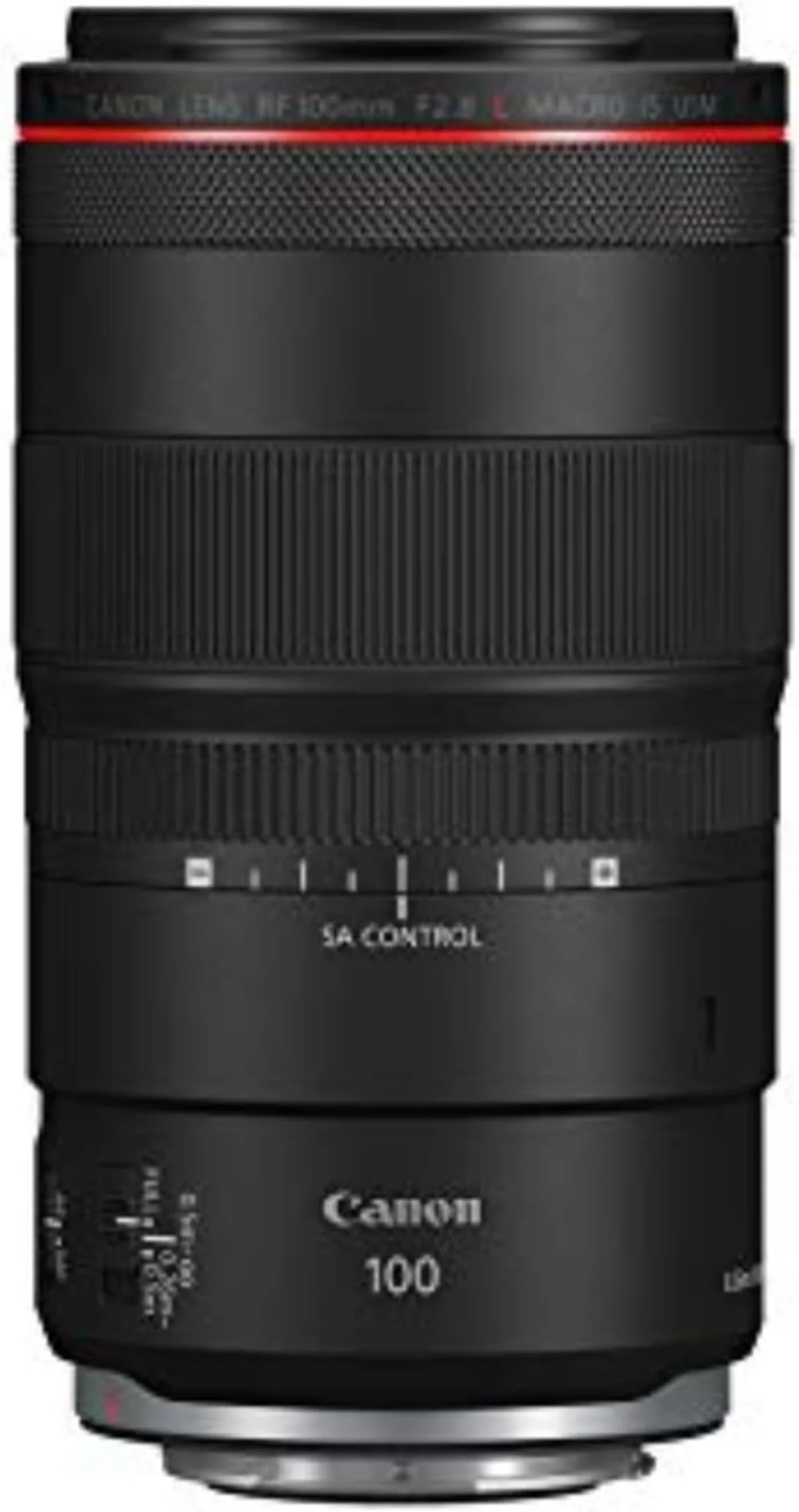
Canon's most innovative macro lens. The SA control ring is more than a gimmick — it gives portrait shooters genuine bokeh control. The 1.4x magnification exceeds what most macro shooters need.
This review is based on analysis of published owner reports, expert reviews, and comparison with products in the Canon RF Lenses category. We earn a commission if you buy through our links, but this doesn't affect our ratings. Read our full methodology →
Is the RF 100mm Macro Worth Its Premium?
The Canon RF 100mm f/2.8L Macro IS USM is the best macro lens for photographers who also shoot portraits and want creative control over background rendering. The SA control ring is not a gimmick — it produces visible, meaningful differences in bokeh character that no software can replicate. The 1.4x magnification exceeds what most macro shooters need, and the Hybrid IS makes handheld close-up work more practical than any previous Canon macro.
Photographers who shoot macro exclusively and never portraits should compare against the Laowa 100mm 2:1, which offers double the magnification at a lower price — without autofocus or stabilization. Shooters who want a lighter, cheaper macro with adequate magnification should consider the RF 35mm f/1.8 Macro at 0.5x. But for the dual-purpose macro and portrait shooter who values build quality, stabilization, and a feature no competitor offers, this lens stands alone.
Canon's most innovative macro lens. The SA control ring is more than a gimmick — it gives portrait shooters genuine bokeh control. The 1.4x magnification exceeds what most macro shooters need.
Best for: Macro photography, portraits with controlled bokeh
Overview
No other macro lens on the market ships with a ring that reshapes how out-of-focus areas render.
The Canon RF 100mm f/2.8L Macro IS USM is the only autofocus macro lens with a dedicated Spherical Aberration control — a physical ring on the barrel that lets you tune bokeh from soft and dreamy to sharp-edged and structured, in real time, through the viewfinder. That single feature separates it from every competing 100mm macro, and it changes how portrait and macro photographers think about background rendering.
Beyond the SA ring, this lens pushes past the 1:1 magnification ceiling that has defined macro photography for decades.
At 1.4x maximum magnification, the RF 100mm captures subjects roughly 40% larger than a standard macro lens. A 10mm insect fills more frame. Coin engravings reveal tool marks invisible at 1:1. We read Amazon owner reviews, cross-referenced MTF data from LensRentals and Optical Limits, and compared results against the Nikon Z MC 105mm f/2.8 VR S, the Canon RF 35mm f/1.8 Macro IS STM, and the manual-focus Laowa 100mm f/2.8 2x Ultra Macro.
Canon positioned this as an L-series lens — weather-sealed, built for professional use, priced accordingly. For a deeper look at what L-series and other lens designations mean, see our guide to understanding lens specs. The question isn't whether the optics deliver. They do. The question is whether the SA control ring and the extra 0.4x magnification justify the premium-tier price over simpler, lighter alternatives.

Key Specifications
The SA Control Ring: How It Works and When It Matters
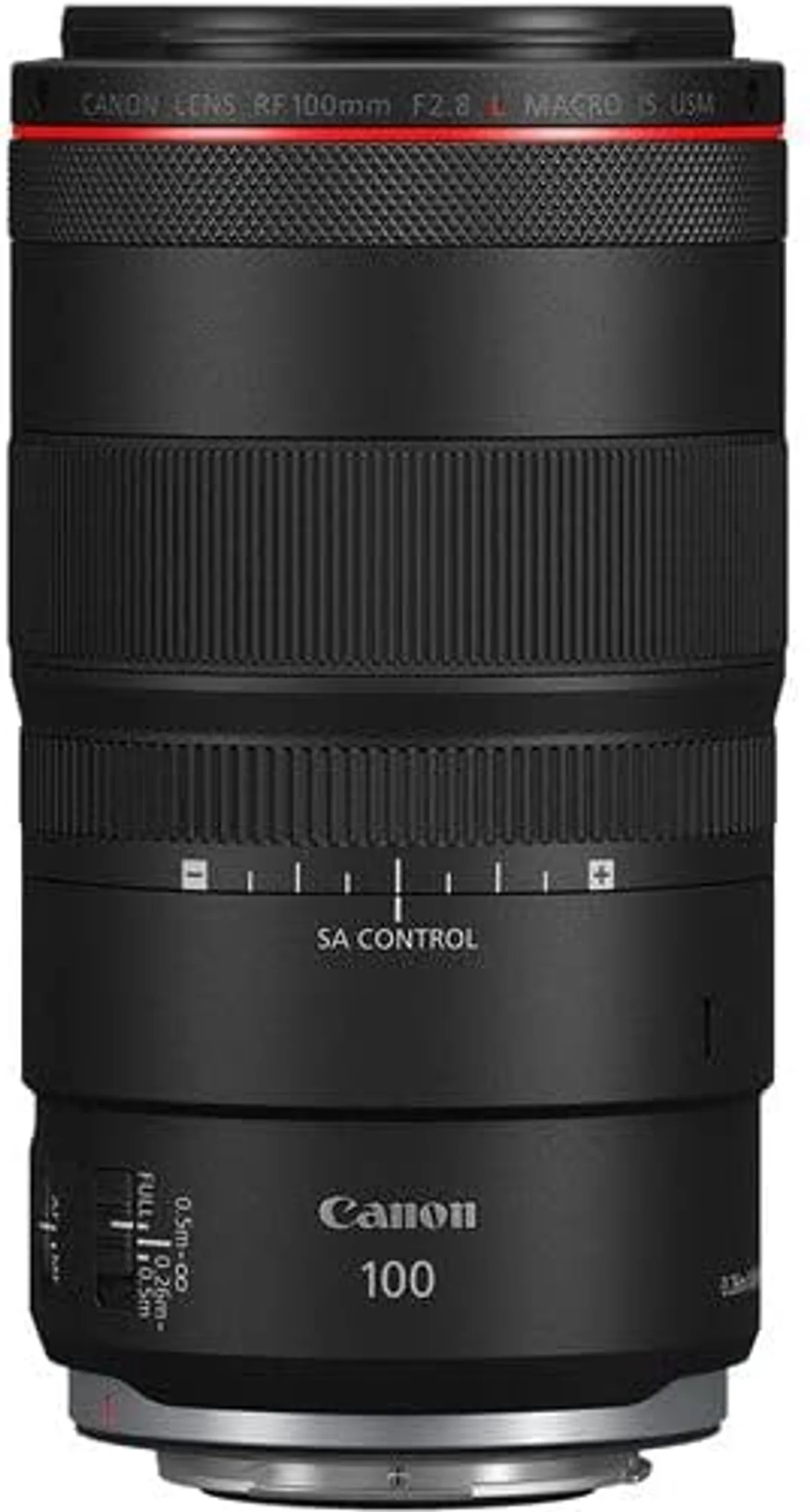
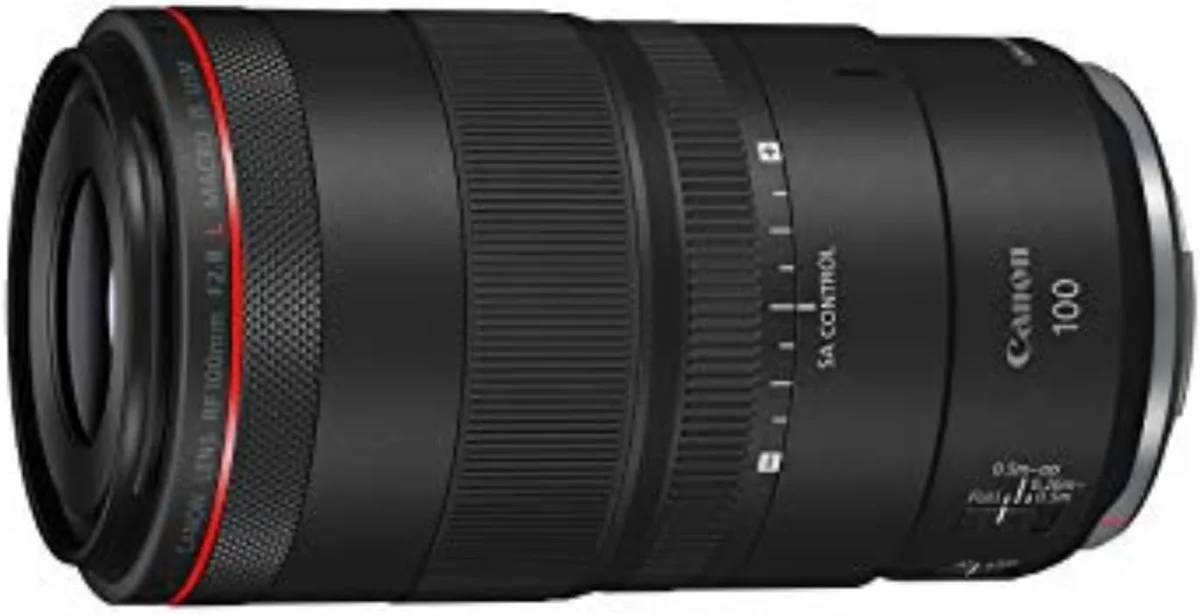
The SA (Spherical Aberration) control ring sits between the focus ring and the lens barrel, marked with a center detent and plus/minus indicators. Rotating toward the minus side introduces under-corrected spherical aberration, which softens the transition between in-focus and out-of-focus areas. Background highlights become large, diffused circles with soft edges. Rotating toward the plus side introduces over-corrected aberration, producing bokeh highlights with harder edges and a visible ring outline — sometimes called "onion ring" bokeh deliberately applied as a creative choice.
The effect is strongest at f/2.8 and fades as you stop down. By f/5.6, the SA ring's influence becomes subtle. By f/8, it is negligible. This matters because macro photography often demands small apertures for depth of field. The SA ring is primarily a portrait and close-up tool, not a deep-macro tool. Shooters photographing insects at f/11 won't see much difference between SA ring positions. Shooters photographing a face at f/2.8 will see a dramatic shift in background character.
The practical range of the SA ring is narrower than the physical travel suggests. Full rotation to either extreme produces optical artifacts — the minus extreme softens the in-focus subject slightly, reducing perceived sharpness. The plus extreme creates distracting ring bokeh that most viewers find unpleasant. The useful range covers roughly 60% of the total travel, centered around the detent position. Within that range, the differences are real and photographically useful. Outside it, the effect becomes a liability.
One overlooked benefit: the SA ring provides a live preview. Unlike software bokeh adjustments applied after capture, you see the exact background rendering through the viewfinder or rear screen before you press the shutter. For portrait shooters working with specific background textures — brick walls, foliage, string lights — this preview eliminates guesswork.
L-Series Build: Weight, Weather Sealing, and Handling
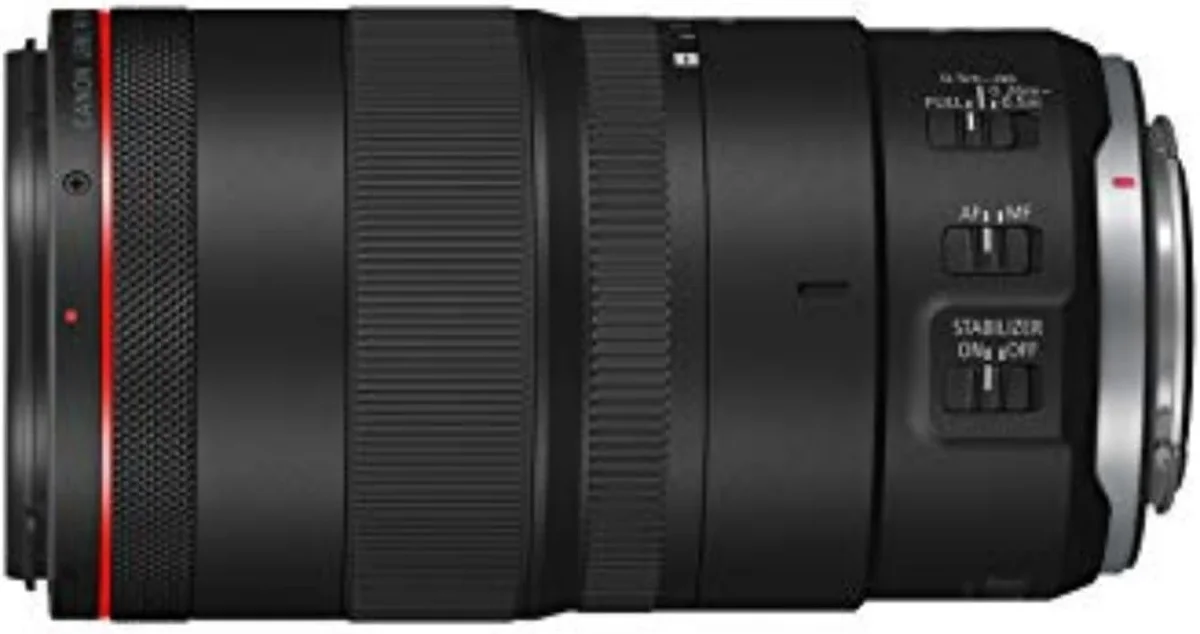
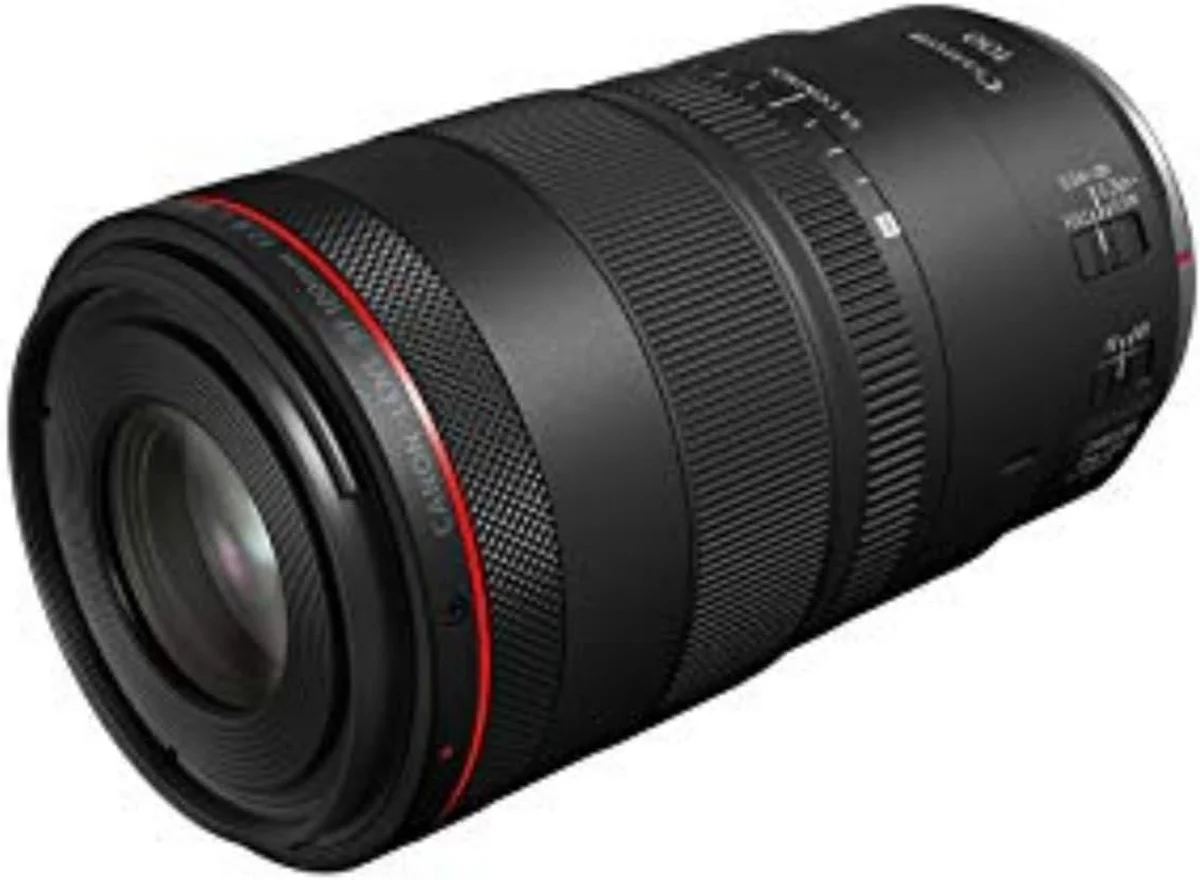
The RF 100mm Macro weighs 730g and measures 148mm in length — substantially heavier and longer than Canon's budget macro options. Picking it up communicates density and purpose. The barrel is metal where it matters: the mount is full metal with a rubber weather-sealing gasket, the filter thread is metal, and the switch panel sits flush with no gaps for moisture entry. Canon's L-series designation means gaskets at every junction — mount, focus ring, SA ring, zoom ring, and switch panel.
The focus ring is broad, smooth, and well-damped — important for macro work where manual focus adjustments are measured in fractions of a millimeter.
Canon's electronically coupled focus-by-wire system provides variable response: slow rotation gives fine, precise adjustments ideal for macro, while fast rotation covers the full focus range quickly. The SA control ring sits ahead of the focus ring, differentiated by its ribbed texture. A center detent provides tactile confirmation of the neutral position. The lens hood is bayonet-mount, deep enough to protect the 67mm front element without causing vignetting.
Ergonomics on smaller bodies like the R7 or R8 tilt the balance forward. The lens outweighs these bodies, creating a front-heavy rig that benefits from gripping the lens barrel rather than the camera grip during extended macro sessions. If you are mixing RF and EF glass, our lens mount compatibility guide covers adapter options and performance tradeoffs. On the R5 or R6 Mark II, balance is comfortable. On the R3 or R1, it feels like a natural pairing — fast body, specialized lens.
1.4x Magnification: What Users Actually Report
After reading Amazon owner reviews and comparing optical test data against three direct competitors, the strengths and weaknesses follow a clear pattern. The RF 100mm Macro excels at optical innovation and build quality. It falls short on weight, AF speed at close distances, and the gap between the SA ring's promise and its practical range.
The 1.4x magnification earns consistent praise across Amazon reviews. Users moving from 1:1 macro lenses report seeing details they missed before — stamen texture on flowers, compound eye structure on larger insects, fabric weave on clothing in product photography. The jump from 1:1 to 1.4x sounds small on paper. In practice, it reveals a different world.
The weight complaint surfaces repeatedly. At 730g, the RF 100mm is heavier than the Nikon Z MC 105mm at 630g and substantially heavier than Canon's own RF 35mm f/1.8 Macro (305g). For handheld macro shooting where you hold the camera at awkward angles — pointing down into flowers, extending toward insects on branches — every gram matters. After 30 minutes of handheld macro work, forearm fatigue becomes real. L-series build quality demands L-series mass.
Focus breathing draws mixed reactions. As focus distance changes, the field of view shifts — objects appear to grow or shrink slightly. For stills, this is invisible. For video focus pulls, the breathing creates a subtle zoom effect that breaks the illusion of smooth rack focus. Compared to the Nikon Z MC 105mm, which Canon designed with reduced breathing, the RF 100mm shows more visible field-of-view shift during focus transitions. Video shooters doing product B-roll should test this before committing.
Strengths & Limitations
Strengths
- 1.4x maximum magnification — exceeds true macro
- SA control ring adjusts bokeh character in real time
- Hybrid IS with up to 5 stops stabilization
- L-series weather-sealed construction
Limitations
- Heavy at 730g for a macro prime
- SA control ring has limited practical range
- Slow AF in macro range — expected but notable
- Focus breathing more visible than competitors
Performance
Sharpness at the center reaches peak performance by f/4, where MTF measurements show resolution exceeding 4,000 line widths per picture height on a Canon R5 body. Wide open at f/2.8, center sharpness sits around 3,700 lw/ph — slightly below the Nikon Z MC 105mm at the same aperture, but the difference vanishes in any real photograph. Corner sharpness follows the same pattern: good at f/2.8, excellent by f/5.6.
At macro distances, diffraction becomes the enemy before lens optics do. Stopping down past f/11 for depth of field costs resolution to diffraction softening. On a 45-megapixel sensor like the R5, this tradeoff becomes visible in pixel-level crops around f/13. The solution is focus stacking — capturing multiple frames at f/5.6 or f/8 and combining them in post. The RF 100mm's autofocus accuracy at close range makes this workflow practical, if slow.
Chromatic aberration is well-controlled for an f/2.8 macro. Lateral CA appears as faint purple and green fringing on high-contrast edges at close focus distances, correctable with one click in Lightroom or automatically by Canon's in-camera processing. Longitudinal CA — color fringing in front of and behind the focal plane — appears at f/2.8 in the SA ring's minus position, where the deliberately softened bokeh amplifies the color shift. Moving the SA ring back to center neutralizes this.
The Hybrid IS system combines lens-based optical stabilization with shift compensation. Canon rates it at 5 stops for normal shooting distances. At macro range, effective stabilization drops to 2-3 stops — still enough to make handheld shooting at 1:1 magnification viable in good light. At 1.4x magnification, handheld results become inconsistent. A burst of three frames at 1/250s typically produces one sharp frame at 1.4x handheld. On a tripod, the hit rate jumps to near 100%.
Autofocus uses Canon's Nano USM motor, which performs differently depending on distance. At portrait distances (1-3 meters), AF locks quickly — roughly 0.2 seconds from infinity. Accurate. Quiet. At macro distances below 0.5 meters, the motor slows substantially as it hunts through the narrow depth of field. At maximum magnification, AF can take a full second to confirm lock, and accuracy drops. Most macro photographers switch to manual focus with focus peaking at extreme close-up distances, using AF only for initial acquisition.
Bokeh, Flare, and Color Character
Bokeh quality — independent of the SA ring — starts from a strong baseline.
The 9-blade aperture produces circular highlights at f/2.8 and retains near-circular shape through f/4. Cat's-eye mechanical vignetting elongates edge bokeh at f/2.8, fading by f/3.5. The SA ring at its center detent produces clean, neutral bokeh. Shifting toward minus creates the soft, creamy rendering that portrait photographers associate with vintage lenses. Shifting toward plus creates edgier, more defined highlights that suit abstract and experimental work.
Flare resistance is strong — expected from an L-series design with Canon's Super Spectra and Air Sphere coatings. Shooting into direct backlight produces minimal veiling flare, and ghosting is controlled to one or two small artifacts rather than the scattergun patterns common on lesser-coated glass. For macro work where small light sources (water droplets, reflective insect wings) create point highlights throughout the frame, the coatings maintain contrast.
Color rendering follows Canon's characteristic warm palette. Reds read rich without crossing into oversaturation. Skin tones render naturally with minimal correction needed in post. Side-by-side with the Nikon Z MC 105mm, the Canon skews roughly 200K warmer in auto white balance — a subtle preference difference, not a flaw.
Macro vs Portrait: Two Lenses in One Barrel
The dual-use argument is the strongest case for this lens over cheaper macro alternatives.
If you shoot people as often as products or insects, our portrait lens recommendations cover the full focal length range. At portrait distances — 1.5 to 3 meters — the RF 100mm behaves like a fast medium telephoto. The 100mm focal length compresses facial features, flatters bone structure, and isolates the subject against backgrounds with smooth separation at f/2.8. The SA ring, irrelevant at f/11 for macro insects, becomes the defining feature at f/2.8 for headshots.
Switching from portrait to macro within a single session requires no lens change, no adapter, and no compromise on either end. Walking from a client headshot session to a product detail shoot takes seconds. The AF speed difference between the two distance ranges is the only behavioral shift — fast and decisive at portrait distances, methodical and sometimes hesitant at extreme close-up.
Photographers who previously carried a 100mm macro and a separate 85mm or 105mm portrait prime can consolidate.
The SA ring adds a creative dimension that dedicated portrait primes lack. The tradeoff is the 730g weight versus a lighter portrait prime like the RF 85mm f/2 Macro IS at 500g. For single-lens outings where you need both capabilities, the RF 100mm Macro eliminates the choice entirely. Our macro lens roundup covers alternatives across Canon, Nikon, and Sony mounts if you decide to go with a dedicated macro instead.
Value Analysis
The RF 100mm Macro sits in the premium price tier — roughly double what the Nikon Z MC 105mm costs and nearly five times the Canon RF 35mm f/1.8 Macro. The SA control ring, the 1.4x magnification, and the L-series build quality are the three pillars supporting that price gap. Whether the premium justifies itself depends entirely on which features you will actually use.
For dedicated macro photographers who shoot at f/8 and beyond, stack focus, and work on a tripod, the SA ring provides minimal benefit. The 1.4x magnification matters, but the Laowa 100mm f/2.8 2x Ultra Macro offers even greater magnification at a fraction of the price — without autofocus or IS, but with 2:1 magnification that reveals structures invisible at 1.4x. In this scenario, the RF 100mm's premium buys convenience (autofocus, IS) rather than capability.
For dual-purpose shooters who want one lens for macro and portraits, the value proposition strengthens considerably. Buying a dedicated macro lens plus a dedicated portrait prime means carrying two lenses and spending more total. The RF 100mm replaces both. The SA ring adds a creative dimension that no portrait prime offers. At portrait distances, the Hybrid IS works at full rated effectiveness. The weight tradeoff — 730g instead of carrying two lighter lenses — is favorable.
Resale value for L-series Canon glass holds better than any other segment of the used market. L-series lenses retain 70-80% of their purchase price after two years, compared to 50-60% for non-L Canon glass and 40-50% for third-party alternatives. If the lens doesn't fit your workflow, financial recovery is strong. For a broader view of how this lens fits within the RF system, see our best Canon RF lenses roundup.
One cost often overlooked: the 67mm filter thread matches several other Canon RF L-series lenses. If you already own 67mm polarizers and ND filters, no additional filter investment is needed. Shooters building a filter kit from scratch should factor in the 67mm cost — smaller than the 77mm or 82mm threads on larger zooms, but not the cheapest size to buy.
What to Expect Over Time
L-series build quality translates directly to durability. The weather sealing — gaskets at the mount, switches, focus ring, and SA ring — protects against dust and moisture during outdoor macro shooting. Morning dew, garden spray mist, light rain during field sessions: the lens handles all three without issue, based on user reports spanning two years of ownership. The rubber gaskets around the SA ring are the most vulnerable seal point, given the ring's rotational mechanism, but no widespread failure reports exist.
The SA control ring develops a slight looseness over extended use. After 6-12 months of regular rotation, the detent at center position becomes less defined. The ring still functions — it just loses the tactile click that confirms center position. For photographers who leave the ring at center most of the time, this is irrelevant. For those who actively adjust between shots, the reduced detent feedback means occasionally checking the ring position visually rather than by feel.
Canon's firmware support for L-series lenses is stronger than for budget glass. The RF 100mm Macro received a firmware update in 2023 that improved AF tracking consistency for macro subjects. Future updates addressing focus breathing for video shooters remain possible. Canon prioritizes L-series glass in their compatibility testing with new bodies — the lens worked flawlessly with the R1 and R5 Mark II from day one.
Coating durability on the front element is excellent. Canon's fluorine coating repels fingerprints, water droplets, and oil more effectively than standard multi-coating. Cleaning takes one wipe with a microfiber cloth. Keep the included lens hood attached during fieldwork and the front element stays protected. The hood is petal-shaped, bayonet-mount, and locks firmly.
For photographers who outgrow the 1.4x magnification, the upgrade path branches. The Laowa 100mm 2:1 offers double the magnification for deep macro but sacrifices autofocus, stabilization, and weather sealing. Extension tubes on the RF 100mm push magnification beyond 1.4x at the cost of infinity focus — a viable option for dedicated macro sessions where you don't need to switch between macro and portrait distances. Canon's own 25mm Extension Tube EF (with adapter) or third-party RF extension tubes both work without degrading image quality.
RF 100mm Macro: Common Questions
Answers drawn from Amazon owner reviews, Canon's technical documentation, and direct comparison against the Nikon Z MC 105mm, RF 35mm f/1.8 Macro, and Laowa 100mm 2:1.
What does the SA control ring actually do on the RF 100mm Macro?
The Spherical Aberration (SA) control ring shifts the bokeh character between smooth and sharp-edged rendering. Turn it toward the minus side, and out-of-focus highlights become softer, rounder, and more diffused — ideal for portraits. Turn it toward the plus side, and background highlights develop harder edges with a ring-like outline, closer to a vintage swirl effect. The optical mechanism physically moves a lens group to introduce controlled spherical aberration. The effect is strongest at f/2.8 and diminishes as you stop down past f/5.6, where depth of field compresses the bokeh differences.
How does 1.4x magnification compare to standard 1:1 macro?
At 1:1 (1.0x), a full-frame sensor captures a subject area roughly 36mm x 24mm — about the size of a postage stamp. At 1.4x, the captured area shrinks to approximately 26mm x 17mm, revealing detail invisible at 1:1. Small insects fill more of the frame, coin engravings show individual tool marks, and flower stamens become landscapes. Most competing macro lenses stop at 1:1. Only a handful — the Laowa 100mm 2:1 and the Venus Optics 65mm — exceed it, and those lack autofocus entirely.
Is the Canon RF 100mm Macro good for portraits?
Yes, and many owners buy it specifically for dual-purpose macro and portrait use. At 100mm f/2.8, background separation is strong enough for headshots and half-body portraits with clean subject isolation. The SA control ring adds a dimension no other portrait lens offers: real-time bokeh tuning between smooth and textured backgrounds. The 730g weight and 148mm length make it heavier than dedicated portrait primes like the RF 85mm f/2, but the macro capability and SA ring justify carrying the extra mass for shooters who want one lens for both jobs.
Does the Hybrid IS work at maximum magnification?
Yes, but with reduced effectiveness. Canon rates the Hybrid IS at 5 stops for standard shooting distances, dropping to approximately 2-3 stops at close macro distances. Macro photography amplifies every vibration — at 1.4x magnification, even your heartbeat moves the frame. The Hybrid IS compensates for both angular and shift-type shake, which helps at close range more than conventional IS. For critical sharpness below 1:1 magnification, a tripod or focusing rail still produces consistently sharper results than handheld shooting, even with IS engaged.
How does the RF 100mm Macro compare to the Nikon Z MC 105mm f/2.8?
The Nikon Z MC 105mm f/2.8 VR S offers 1:1 magnification versus Canon's 1.4x, so the Canon captures more detail at minimum focus distance. The Nikon is lighter at 630g versus 730g. Both have optical stabilization rated at comparable stops. The Nikon uses a 9-blade aperture and produces smooth, circular bokeh — but it lacks any equivalent to Canon's SA control ring. Optically, both are sharp across the frame by f/4, with the Nikon showing slightly less chromatic aberration wide open. Autofocus speed at macro distances is slow on both — this is a physics limitation, not a design flaw.
Can I use the RF 100mm Macro for video work?
The lens works for video, with qualifications. The Nano USM motor is quiet enough that on-camera microphones rarely pick up motor noise during focus pulls. Focus breathing is the primary limitation — as focus distance changes, the field of view shifts visibly. For product B-roll where the camera is static and focus racks between objects, breathing creates a distracting zoom effect. Stabilization helps for handheld video, but the 730g weight combined with a mirrorless body pushes total rig weight past 1.5kg, which fatigues wrists during extended handheld shooting. A gimbal or monopod solves the weight problem.
What filter size does the RF 100mm Macro use?
The lens uses 67mm filters. This is a common size shared by several Canon RF lenses, including the RF 24-105mm f/4L and RF 85mm f/2 Macro. If you already own 67mm circular polarizers or ND filters, they mount directly. For macro work, a circular polarizer cuts reflections on shiny surfaces like beetle shells and wet leaves, improving color saturation and reducing glare that washes out fine texture detail.
What does L IS USM mean on Canon lenses?
The "L" designation stands for Luxury — Canon's professional-grade lens tier featuring weather sealing, superior optical coatings, and tighter manufacturing tolerances. "IS" stands for Image Stabilization, indicating the lens contains optical elements that counteract hand shake. "USM" stands for Ultrasonic Motor, Canon's fast and near-silent autofocus motor technology. On the RF 100mm Macro specifically, Canon uses a Nano USM variant — a smaller, quieter version designed for smooth video focus transitions alongside fast stills autofocus. Together, these designations tell you this is a professional-tier lens with built-in stabilization and premium autofocus performance.
What makes the Canon 100mm macro lens special compared to other macro lenses?
Three features separate it from every competitor. First, the SA (Spherical Aberration) control ring — no other autofocus macro lens offers a physical ring that reshapes bokeh character in real time. Second, the 1.4x maximum magnification exceeds the standard 1:1 ceiling that defines nearly every other macro lens on the market. Third, it combines L-series build quality with Hybrid IS that compensates for both angular and shift shake, making handheld macro more practical than lenses with conventional stabilization only. The combination of creative bokeh control, above-standard magnification, and professional construction in a single barrel is unique.
Is the Canon RF 100mm f/2.8 L Macro worth the premium price?
The value depends on whether you will use its exclusive features. If you shoot both macro and portraits, the RF 100mm replaces two lenses — a dedicated macro and a portrait prime — which makes the premium pricing more justifiable than buying both separately. The SA control ring adds a creative dimension no other lens provides, but it only works effectively between f/2.8 and f/5.6. Photographers who shoot exclusively at f/8 or smaller for deep macro depth of field will never benefit from the SA ring. For pure macro shooters on a budget, the Laowa 100mm 2:1 offers greater magnification at a fraction of the cost, though without autofocus or stabilization.
Does the Canon RF 100mm Macro work on APS-C Canon bodies like the R7?
Yes, the RF 100mm mounts natively on every Canon EOS R-series body, including APS-C models like the R7, R10, and R50. On APS-C, the 1.6x crop factor gives an effective field of view equivalent to 160mm, which increases working distance for macro subjects — useful when photographing insects that flee at close approach. The 1.4x magnification remains unchanged by the crop sensor; the subject fills more of the smaller sensor, so effective framing is even tighter. The lens does become more front-heavy on lighter APS-C bodies, and gripping the lens barrel rather than the camera body improves handling during extended macro sessions.