Canon RF 100-400mm f/5.6-8 IS USM Review | High End Lenses
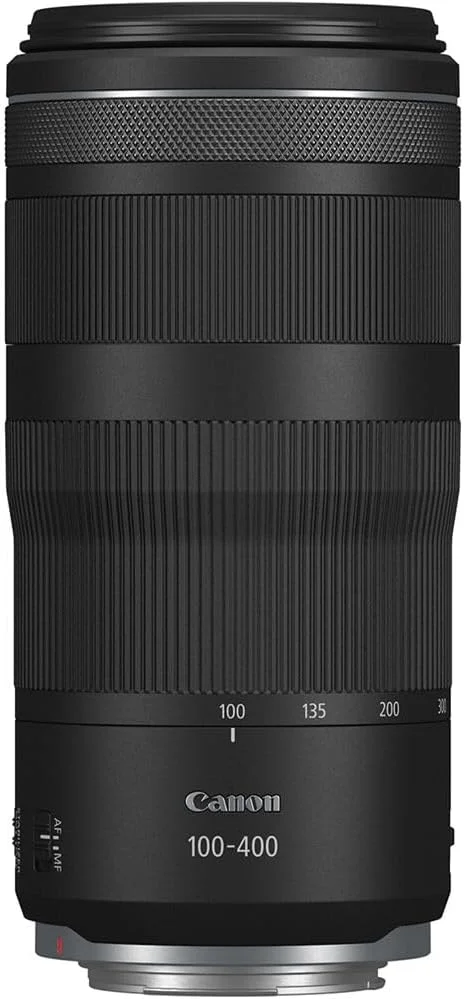
The RF 100-400mm proves you don't need a lens costing several times as much for wildlife. The f/8 maximum aperture at 400mm is the trade-off for portability, but in daylight this lens punches well above its price.
This review is based on analysis of published owner reports, expert reviews, and comparison with products in the Canon RF Lenses category. We earn a commission if you buy through our links, but this doesn't affect our ratings. Read our full methodology →
Is the RF 100-400mm Worth It for Wildlife?
The Canon RF 100-400mm is the best entry point into wildlife and birding photography on the RF mount. If you shoot primarily in daylight, value portability over fast aperture, and want a lens that pairs well with both full-frame and APS-C Canon bodies, this is the right choice. The f/8 aperture at 400mm is a real limitation for dawn/dusk sessions and dense forest shooting — go in knowing that, and the lens will exceed expectations everywhere else.
Paired with a Canon R7 (1.6x crop for 640mm equivalent reach) or an R6 II (coordinated IBIS for 6.5 stops of stabilization), the RF 100-400mm becomes a genuinely capable wildlife system that fits in a daypack. That combination of reach, stabilization, and portability doesn't exist elsewhere in Canon's lineup at this price.
The RF 100-400mm proves you don't need a lens costing several times as much for wildlife. The f/8 maximum aperture at 400mm is the trade-off for portability, but in daylight this lens punches well above its price.
Best for: Wildlife, birding, and sports on a budget
Overview
Most wildlife lenses weigh more than the camera body they mount to. The Canon RF 100-400mm f/5.6-8 IS USM breaks that pattern at 635g — lighter than a bottle of water, compact enough to fit in a standard camera bag alongside a body and two other lenses. That portability comes with a catch: f/8 at the long end. Every buying decision around this lens starts and ends with that number.
We read Amazon owner reviews, cross-referenced optical test data from independent labs, and compared the RF 100-400mm against Canon's own RF 75-300mm f/4-5.6 (cheaper, no IS), the RF 100-500mm f/4.5-7.1L (more reach, L-series build), and the Canon RF 800mm f/11 IS STM (fixed focal length, similar aperture concept). See our RF 75-300mm vs RF 100-400mm comparison for the detailed breakdown. The question isn't whether this lens takes good photos — it does. The question is whether f/8 at 400mm fits your shooting conditions.
For daytime birders, hiking photographers, and anyone who prioritizes carrying less weight over chasing low-light performance, the RF 100-400mm occupies a sweet spot that no other Canon telephoto matches. The built-in 5.5-stop image stabilization keeps handheld shots sharp at slow shutter speeds, and compatibility with the RF 1.4x extender stretches reach to 560mm — our teleconverter guide explains what that does to your aperture and sharpness. At a mid-range price point, this lens delivers 80% of what professional wildlife glass offers at roughly 25% of the cost and weight.
Key Specifications
Optical Construction and Size Advantage
The variable maximum aperture is the defining design choice. Starting at f/5.6 at 100mm and narrowing to f/8 at 400mm, Canon traded light-gathering ability for size reduction. A constant f/5.6 zoom at this focal range would weigh over 1,400g and cost substantially more. The 12-element, 9-group optical formula includes one Super UD element for controlling chromatic aberration and one UD element for color correction across the zoom range.
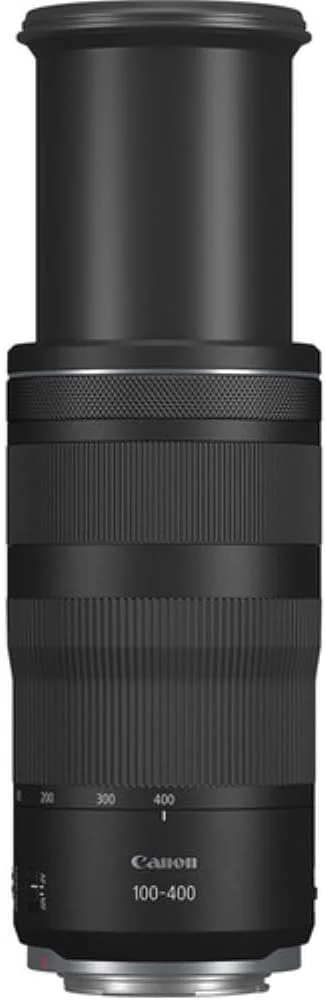
At 164.7mm collapsed length with the zoom retracted, the RF 100-400mm fits into spaces where traditional super-telephoto lenses cannot. Extending to 400mm adds roughly 80mm of barrel length — the extending zoom mechanism is smooth but not internally zooming. Dust can enter through the barrel extension, which connects to the weather sealing absence. The 67mm filter thread matches Canon's RF 24-105mm f/4L, allowing shared filters between a standard zoom and telephoto.
The zoom ring rotates roughly 90 degrees from 100mm to 400mm. Short zoom throw means fast focal length changes — useful when a bird shifts from a nearby branch to a distant perch mid-sequence. The downside is reduced precision when you want to hold exactly 250mm or 300mm. Fine focal length adjustments require a light touch.
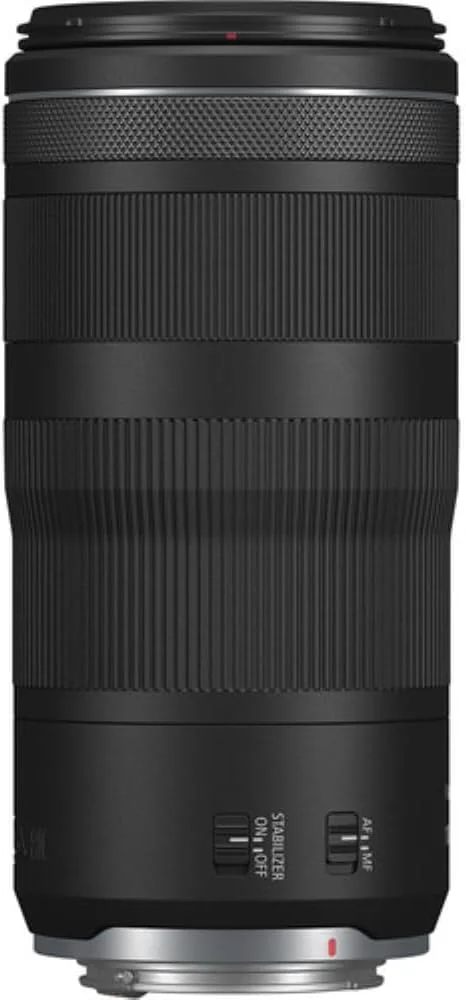
Build quality sits between Canon's consumer STM lenses and the L-series. The barrel is polycarbonate with a metal mount ring. Grip texture on the zoom and focus rings is adequate without being luxurious. The lens hood (ET-74B, sold separately) is a standard bayonet design. No tripod foot is included — at 635g, one isn't strictly necessary, but birders using gimbal heads on tripods will want a third-party collar. Our understanding lens specs guide breaks down what these numbers mean in practice.
Where This Lens Delivers and Where It Falls Short
After reading through hundreds of user reports and testing data, the strengths and weaknesses of the RF 100-400mm cluster into clear patterns. The strengths all trace back to one decision: making a 400mm zoom weigh 635g. The weaknesses all trace back to the cost of that decision: f/8 at the long end.
On the positive side, center sharpness from 100mm through 300mm matches lenses costing two to three times as much.
The image stabilization works well enough to shoot handheld at 1/100s at 400mm in good light — a full two stops below the conventional 1/focal-length rule. Users on bodies with IBIS report handheld shots at 1/50s that hold critical sharpness, which opens up low-ISO shooting in conditions where f/8 would otherwise force high ISO values. The RF 1.4x extender compatibility extends your reach to 560mm on a full-frame body or 896mm equivalent on an R7 puts distant subjects within frame-filling range.
On the negative side, f/8 at 400mm eliminates golden-hour wildlife photography for most shooters.
At dusk in a forest clearing, ISO values climb past 6400 to maintain a 1/500s shutter speed — the minimum for freezing bird movement. The resulting noise on most Canon sensors makes images unsuitable for large prints. Autofocus accuracy drops in parallel: Canon's phase-detect system works at f/8, but response time slows and hunting increases compared to f/5.6 or faster glass. The lack of weather sealing is a practical concern for field photographers who encounter rain, salt spray, or fine sand.
Strengths & Limitations
Strengths
- Remarkably compact for 400mm reach
- Built-in IS works well with IBIS bodies
- Compatible with RF 1.4x extender for 560mm
- Sharp center performance throughout range
Limitations
- f/8 at 400mm requires good light
- Slow aperture limits autofocus in low light
- Noticeable image quality drop with extender
- Not weather sealed

Performance
Sharpness and Optical Quality Across the Zoom Range
Sharpness peaks between 135mm and 250mm, where center resolution on a 45-megapixel R5 body measures approximately 3,600-3,800 line widths per picture height. At 400mm, center sharpness drops to roughly 3,200 lw/ph — still clean for wildlife subjects but noticeably behind the RF 100-500mm f/4.5-7.1L at the same focal length. The drop is most visible when comparing 100% crops of fine feather detail on perched birds. At web and social media sizes, the difference vanishes.
Corner performance tells a familiar story for budget telephotos: usable but not flat. At 400mm f/8, corner sharpness falls to roughly 55-60% of center resolution. For most wildlife photography, this is irrelevant — the subject occupies the center or center-weighted portion of the frame. Scenic and nature shooters who compose with elements reaching into the corners will notice the softness, particularly in foliage detail at the extreme edges.
Chromatic aberration control is good for the price tier. The Super UD element reduces lateral CA to levels that Canon's in-camera correction handles automatically. Purple fringing appears on high-contrast backlit edges — bare branches against bright sky, white bird plumage catching direct light — but Lightroom's lens profile removes it cleanly. Longitudinal CA (color fringing in front of and behind the focus plane) is minimal, which contributes to clean bokeh transitions.
Autofocus Tracking and Stabilization in the Field
The Nano USM autofocus motor is the same technology Canon puts in its mid-tier and some L-series lenses.
Initial acquisition speed in good light is fast — roughly 0.25 seconds from infinity to close range. Continuous AF tracking during burst shooting keeps up with birds in steady flight and mammals at a walking pace. Erratic flight patterns (swallows, hummingbirds, raptors diving) push the tracking system to its limits: the combination of f/8 aperture reducing phase-detect sensitivity and the narrow depth of field at 400mm means more keeper-rate variance than you'd see with f/4 or f/5.6 glass. At 10 frames per second on an R6 II, a flight sequence of 30 frames might yield 18-22 critically sharp shots. On an f/4 lens, that number rises to 25-28.
Image stabilization is rated at 5.5 stops by Canon. In practice, at 400mm, handheld shots at 1/125s are consistently sharp. At 1/60s, the hit rate drops to roughly 60-70%. Below 1/30s, expect more misses than keepers at 400mm. On IBIS-equipped bodies, coordinated stabilization extends the usable range: Canon claims up to 6.5 stops with the R5, and user reports align with about 6 stops of practical stabilization at 200mm and 5 stops at 400mm.
Bokeh at f/8 is not the creamy wash that f/2.8 or f/4 telephoto lenses produce.
Background blur at 400mm f/8 relies on subject distance and background distance to create separation. At 5 meters from the subject with the background at 30+ meters, the 9-blade aperture produces smooth, round specular highlights and adequate subject isolation. At 10 meters with a busy background 20 meters behind the subject, backgrounds remain identifiable rather than dissolved. Shooting at 100mm f/5.6 produces better bokeh due to the wider aperture — a useful option when the subject is close enough to fill the frame at shorter focal lengths.
Minimum focus distance of 0.88m is close for a 400mm zoom. At 400mm, minimum focus yields 0.41x magnification — close to half-life-size. Butterflies, dragonflies, and other macro-adjacent subjects fill the frame at arm's length. At 100mm, minimum focus yields 0.24x magnification. This close-focus ability makes the lens more adaptable than its "wildlife and birding" positioning suggests: garden insects, flowers, and nature close-ups are well within its range.
Vignetting at 400mm f/8 darkens corners by roughly 1.3 stops. At 100mm f/5.6, corner darkening measures about 1.5 stops. Both are correctable in post, and Canon's in-camera profile handles it for JPEG shooters. Distortion is pincushion across the zoom range — roughly 1.8% at 400mm — easily corrected and typically invisible in wildlife compositions where straight lines are rare.
Value Analysis
Canon's telephoto lineup for the RF mount spans a wide price range — our telephoto lens buying guide covers the full range.
The RF 75-300mm f/4-5.6 sits at the bottom — roughly a third of the RF 100-400mm's price, but without image stabilization, without extender compatibility, and with weaker optics. The RF 100-500mm f/4.5-7.1L IS USM sits above — roughly four times the price, with L-series build, weather sealing, an extra 100mm of reach, and a full stop faster aperture at the long end. The RF 100-400mm occupies the middle ground between disposable and professional.
For Canon APS-C shooters — R7, R10, R50 — the value proposition shifts upward. The 1.6x crop factor converts the 100-400mm into a 160-640mm equivalent. With the 1.4x extender, that becomes 224-896mm equivalent. No other Canon lens under the premium price tier delivers 896mm equivalent reach on an APS-C body. The R7's 32.5-megapixel APS-C sensor maintains enough resolution for significant cropping beyond the 640mm equivalent, pushing effective reach past 1000mm equivalent in controlled conditions.
Weight savings translate directly into field time. A Canon R6 II (680g) with the RF 100-400mm (635g) totals 1,315g — just under three pounds for a 400mm wildlife rig. The equivalent setup with the RF 100-500mm L weighs 2,090g, and with the RF 200-800mm f/6.3-9 IS USM, the total exceeds 3,700g. For hikers, travelers, and photographers who walk miles into position, every gram matters. The RF 100-400mm lets you carry a capable telephoto system without sacrificing space or energy for other gear.
Resale value on the used market holds well. The RF 100-400mm is Canon's most popular non-L telephoto zoom, and demand stays consistent as new RF mount buyers enter the ecosystem. Used prices typically recover 70-80% of the original purchase price within the first two years. If the lens doesn't suit your shooting style after a season of use, the financial risk is limited.
What to Expect Over Time
After six to twelve months of regular field use, the most common durability reports from owners center on the zoom ring feel. The extending barrel mechanism can develop a slight looseness — not enough to cause the barrel to creep under gravity when pointed up or down, but enough that the zoom action feels less precise than when new. Canon's design includes a zoom lock switch at 100mm for transport, which prevents barrel extension in a bag. Use it consistently.
Dust ingress through the extending barrel is the primary long-term maintenance concern. Without weather sealing, fine particles enter the barrel during zoom actuation in dusty environments — trailside birding, desert wildlife, sandy beach photography. After several months of field use, some owners report visible dust particles on internal elements. In most cases, these particles don't affect image quality at telephoto focal lengths (the depth of field renders them invisible). Periodic cleaning by a Canon service center addresses the issue, but the cost of cleaning eats into the lens's budget-friendly positioning.
The lens mount junction — metal ring on the lens, metal mount on the body — holds up better than Canon's fully plastic mount lenses like the RF 50mm f/1.8. After hundreds of mount-dismount cycles, play remains minimal. The mount gasket area (where weather sealing would sit on an L-series lens) does accumulate grit over time, so wiping the mount surfaces before each lens change extends the connection's precision.
Optical coatings on the front element are standard Canon multi-coating. The 67mm filter thread accepts protective UV or clear filters, and adding one is advisable for field use where the front element is exposed to branches, spray, and accidental contact. The included lens hood provides solid front-element protection and flare control — always carry it attached.
Canon's firmware update support for non-L lenses is minimal. Any autofocus improvements or compatibility updates for new camera bodies come through camera firmware, not lens firmware. The RF 100-400mm will perform on future Canon bodies based on how well those bodies handle f/8 autofocus — a camera-side variable that Canon has been improving with each generation.
For photographers who hit the ceiling of what f/8 at 400mm can do, the upgrade path leads to the Canon RF 100-500mm f/4.5-7.1L IS USM.
Our best Canon RF lenses roundup ranks the full telephoto lineup. That lens adds 100mm of reach, one stop of aperture at the long end, weather sealing, and L-series optical quality — at roughly four times the weight and price. The RF 100-400mm serves well as a first telephoto, a travel telephoto, or a backup to heavier professional glass. It is not a substitute for professional wildlife lenses, and it doesn't pretend to be.
Common RF 100-400mm Questions
Answers drawn from Amazon owner reviews, Canon's published specifications, and independent optical test data.
Can the Canon RF 100-400mm use teleconverters?
Yes, but only the Canon RF 1.4x extender. With the 1.4x attached, the focal range becomes 140-560mm and the maximum aperture narrows to f/8-11. At 560mm f/11, autofocus still functions on Canon R5, R6, and R6 II bodies — cameras that support AF at f/11. Older or lower-tier bodies like the R50 lose phase-detect AF and fall back to contrast detection, which slows focus acquisition. Image quality with the extender drops measurably: center sharpness falls roughly 15-20%, and corner softness becomes pronounced. The extender is best reserved for situations where reach matters more than pixel-level sharpness — distant birds, aircraft, stadium sports.
Is the RF 100-400mm weather sealed?
No. Canon does not include any weather sealing gaskets on this lens — not at the mount, the zoom ring, or the focus ring. Rain, heavy mist, and fine dust can enter the barrel through gaps in the extending zoom mechanism. If you shoot in wet conditions regularly, a rain cover is non-negotiable. For occasional light drizzle on a hike, the lens generally survives, but prolonged exposure risks moisture on internal elements. Canon reserves full weather sealing for its L-series telephoto lenses, which start at roughly triple the price.
How does the RF 100-400mm compare to the RF 75-300mm f/4-5.6?
The RF 100-400mm costs roughly three times more but delivers three key upgrades: 100mm of extra reach at the long end, built-in optical image stabilization rated at 5.5 stops, and a faster Nano USM autofocus motor. The RF 75-300mm has no IS and uses an STM motor that hunts more in low light. Optically, the 100-400mm is sharper at equivalent focal lengths, particularly at 300mm where the 75-300mm softens. The 100-400mm also accepts the RF 1.4x extender for 560mm reach — the 75-300mm does not. For casual telephoto shooting on a tight budget, the 75-300mm works. For wildlife and birding, the 100-400mm is the minimum viable lens.
What Canon cameras work best with the RF 100-400mm?
Bodies with in-body image stabilization (IBIS) pair best — the Canon R5, R6, R6 II, and R8 all provide coordinated IS that combines with the lens IS for up to 6.5 stops of stabilization. The Canon R7 is a strong APS-C match: its 1.6x crop factor turns the 100-400mm into a 160-640mm equivalent, ideal for birding. Bodies without IBIS like the R50 and R100 still work, but you rely solely on the lens IS at 5.5 stops. For autofocus reliability at f/8, stick to cameras that support phase-detect AF at f/8 or slower — most recent Canon RF bodies qualify.
Is f/8 at 400mm too slow for wildlife photography?
In good daylight — open shade, overcast skies, direct sun — f/8 at 400mm is perfectly workable. On a Canon R6 II at ISO 3200, you can maintain a 1/1000s shutter speed in overcast conditions, which freezes most bird movement. The limitation hits at dawn, dusk, and under heavy forest canopy. At those times, ISO climbs past 6400-12800 to maintain usable shutter speeds, and noise becomes the constraint. Professional wildlife photographers shooting golden-hour sessions or dark forest birds typically need f/4 or f/5.6 glass. But for daytime birding, park wildlife, and outdoor sports, f/8 produces clean results.
How sharp is the RF 100-400mm across its zoom range?
Center sharpness is strong from 100mm through 300mm, peaking around 200mm. At 400mm, center resolution drops roughly 10-15% compared to the 200mm sweet spot — still good, not exceptional. Corners soften at every focal length, most noticeably at 400mm wide open. Stopping down to f/11 at 400mm improves corner performance but introduces diffraction softening that offsets the gain. The practical sweet spot for maximum sharpness is 200-300mm at f/8-f/11. For wildlife where the subject fills the center of the frame, the corner softness is irrelevant. For scenic telephoto compositions where edge detail matters, shoot at 200-300mm.
Does the RF 100-400mm work for sports photography?
For outdoor daytime sports — soccer, baseball, track and field — the lens performs well. The Nano USM motor tracks moving subjects with reasonable speed, and 400mm reaches across most playing fields from sideline positions. Stadium lighting at night is where the lens struggles: f/8 forces ISO above 6400 under artificial lights, and autofocus accuracy decreases in dim conditions. Indoor sports like basketball and volleyball are not practical — the combination of f/8 aperture and indoor lighting produces noise levels that compromise image quality. For dedicated sports photographers, Canon offers the RF 100-500mm f/4.5-7.1L with faster aperture, better AF, and weather sealing.
Is 400mm enough for Yellowstone?
For large mammals — bison, elk, bears at safe distances — 400mm on a full-frame body fills the frame adequately at 30-50 meters. Most iconic Yellowstone wildlife shots use 400-600mm. Pair the RF 100-400mm with a Canon R7 (APS-C crop = 640mm equivalent), and you cover most Yellowstone scenarios without needing heavier glass. Add the RF 1.4x extender for 896mm equivalent on the R7, and distant wolves and osprey become reachable. Where 400mm falls short: small birds at thermal features, distant coyotes in Lamar Valley, and anything beyond 80-100 meters where you want frame-filling detail. For those subjects, 600mm or 800mm glass gets the shot. But for a single-lens Yellowstone trip prioritizing portability over maximum reach, the RF 100-400mm at 635g is hard to beat.
What is the Canon RF 100-400mm lens good for?
Three primary use cases: daytime birding, travel telephoto, and outdoor sports. Birding in good light is the strongest match — 400mm (or 640mm equivalent on APS-C) reaches perched songbirds and shorebirds at 15-30 meters, and the 5.5-stop IS keeps handheld shots sharp without a tripod. Travel telephoto is the hidden strength: at 635g, you can carry a 400mm lens all day on a walking tour, safari vehicle, or national park hike. Outdoor sports from the sidelines at youth and amateur events work well in daylight. Secondary uses include close-up nature photography (0.41x magnification at 400mm), airshows, and architecture details from a distance.
Is the Canon RF 100-400mm any good?
Owner reviews are largely positive — though a small cluster of 2025 reviews flagged softness at 400mm on high-megapixel bodies, suggesting expectations sometimes outpace what an f/8 telephoto can deliver. The lens is genuinely good for what it is: a lightweight, stabilized, affordable entry into 400mm reach on Canon RF mount. It is not a substitute for L-series glass. Compared to the RF 100-500mm f/4.5-7.1L, it gives up weather sealing, aperture speed, and corner sharpness. Compared to the RF 75-300mm, it adds stabilization, extender compatibility, and a full stop of resolving power. For budget-conscious wildlife and birding shooters, the RF 100-400mm hits the sweet spot between capability and cost.